-
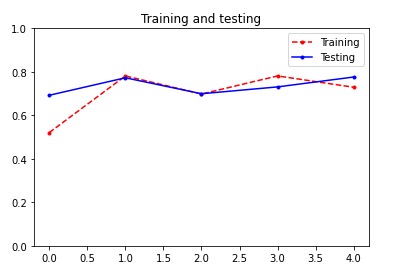
Training and testing plot.
Inspiration
As the greenhouse effect rises, the deadliest skin cancer, Melanoma, occupies a progressive percentage of cases, from people in vulnerable age to healthy individuals. Early diagnosis of this disease could help medical professionals better understand the patient's condition, while computer-aided systems have the flexibility to facilitate more experiments.
What it does
Diagnosis of skin Melanoma using the classification model ResNet50.
How we built it
This application was made with Keras and Tensorflow frameworks, written in Python Jupyter notebook. We performed transfer learning based on ResNet50 whereby we kept the original weights and retrained the classification layer with melanoma images.
Result
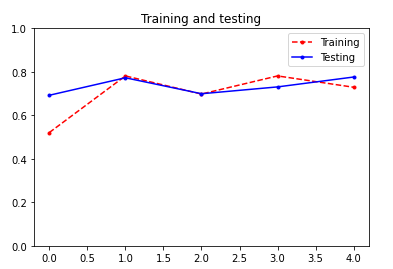
We were able to complete the program and it produced results. We limited it to 5 epochs due to time and space constraints. Essentially, our results are promising. The Training and Testing errors are improving with each epoch and reaching 73% accuracy.
Challenges we ran into
Finding a proper dataset and computational resources.
Accomplishments that we're proud of
We are proud that in such a short time, we were able to create a working model with testing average accuracy of 73%.
What we learned
How dangerous skin Melanoma is . How slowly Google Drive updates the capacity status. The challenges of data preprocessing plus the power of using CNN with Transfer Learning in regards to creating very complex and accurate Medical Imaging algorithms.
What's next for Melanoma Diagnosis with ResNet50 Transfer Learning
Further academic investigation of other novel techniques, like Time-Lapse analysis, Unsupervised Learning Algorithms, implementation on datasets with more metadata, types of Melanoma tumors in different body positions, increased training and processing size, use of different ImageNet models, and use longitudinal data.
Built With
- jupyter
- keras
- python
- resnet50
- tensorflow


Log in or sign up for Devpost to join the conversation.