
Read alone. Not alone.
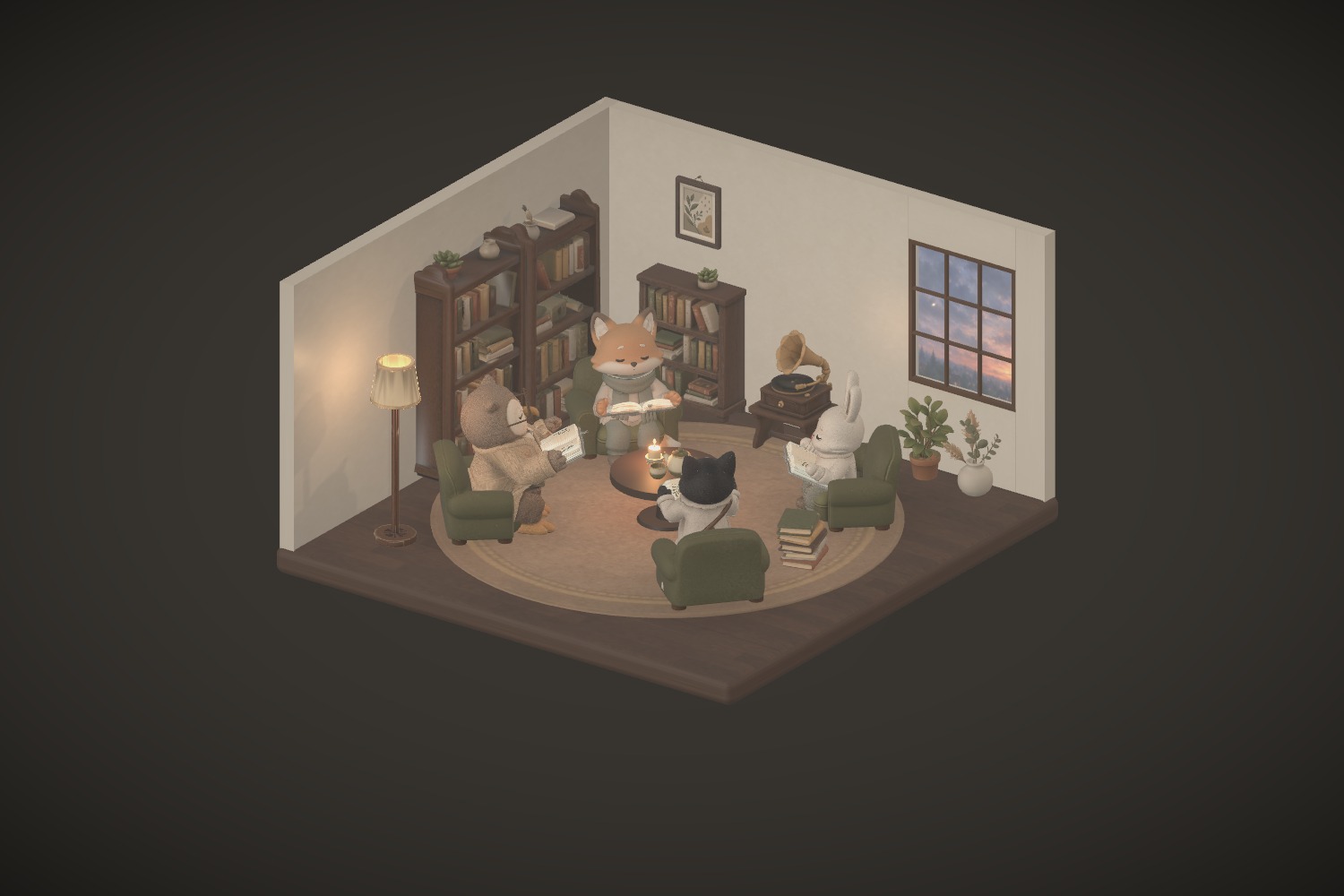
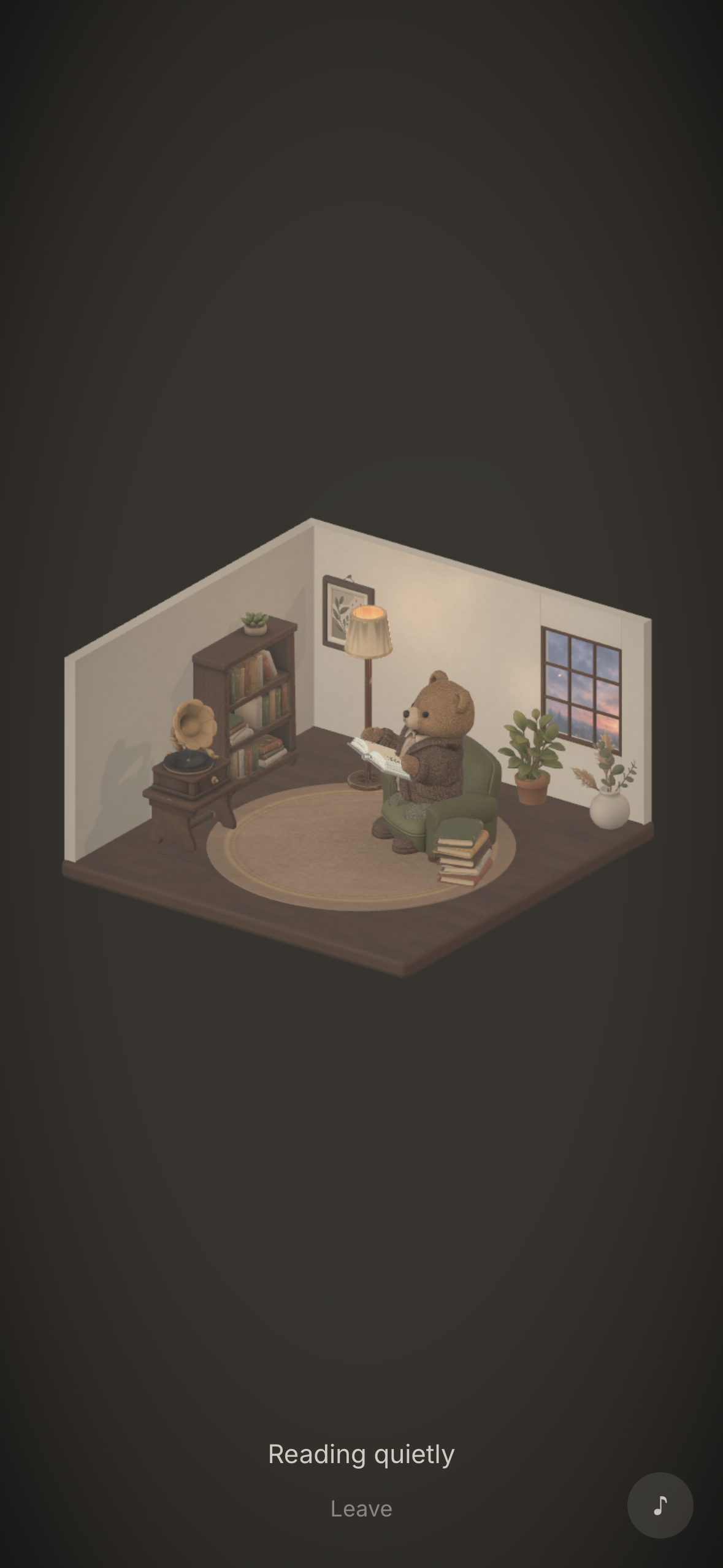
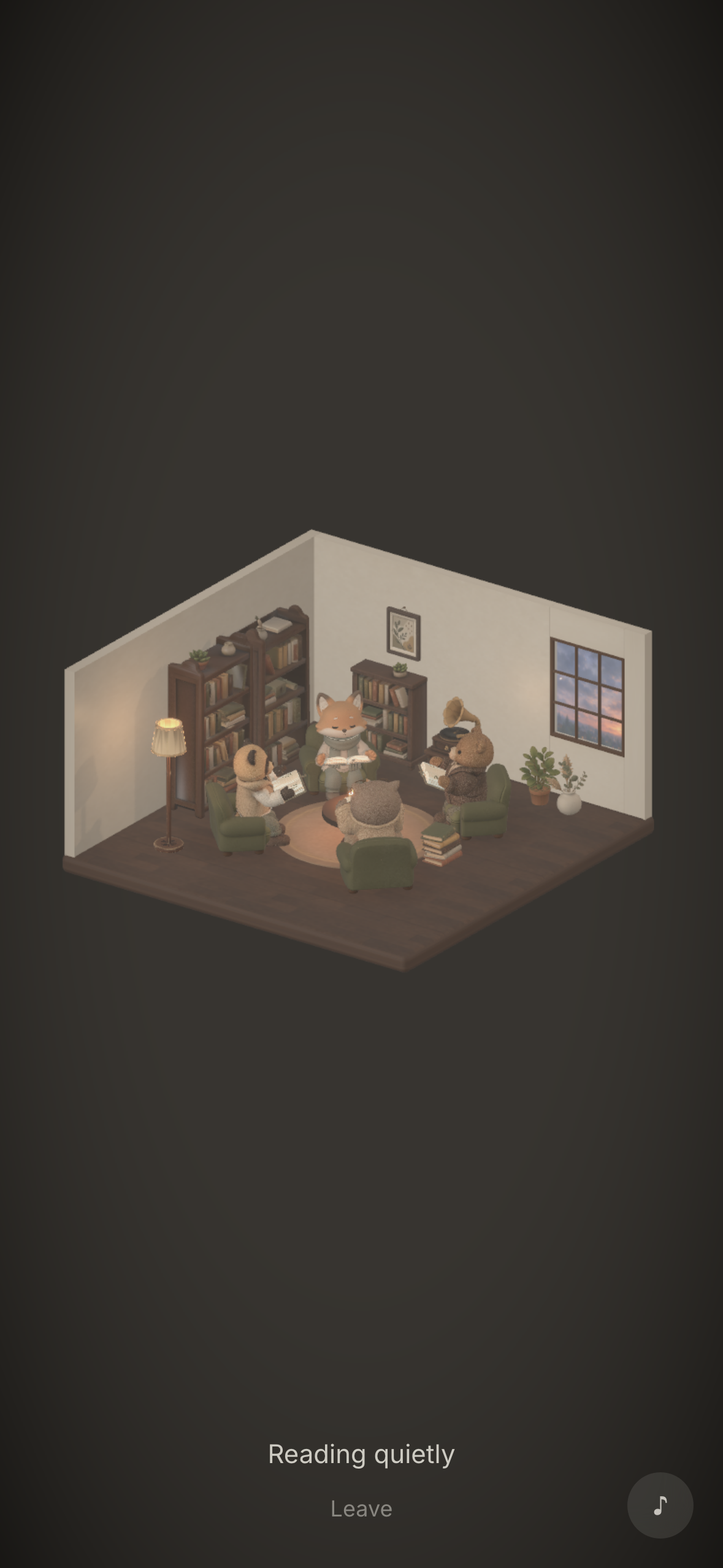
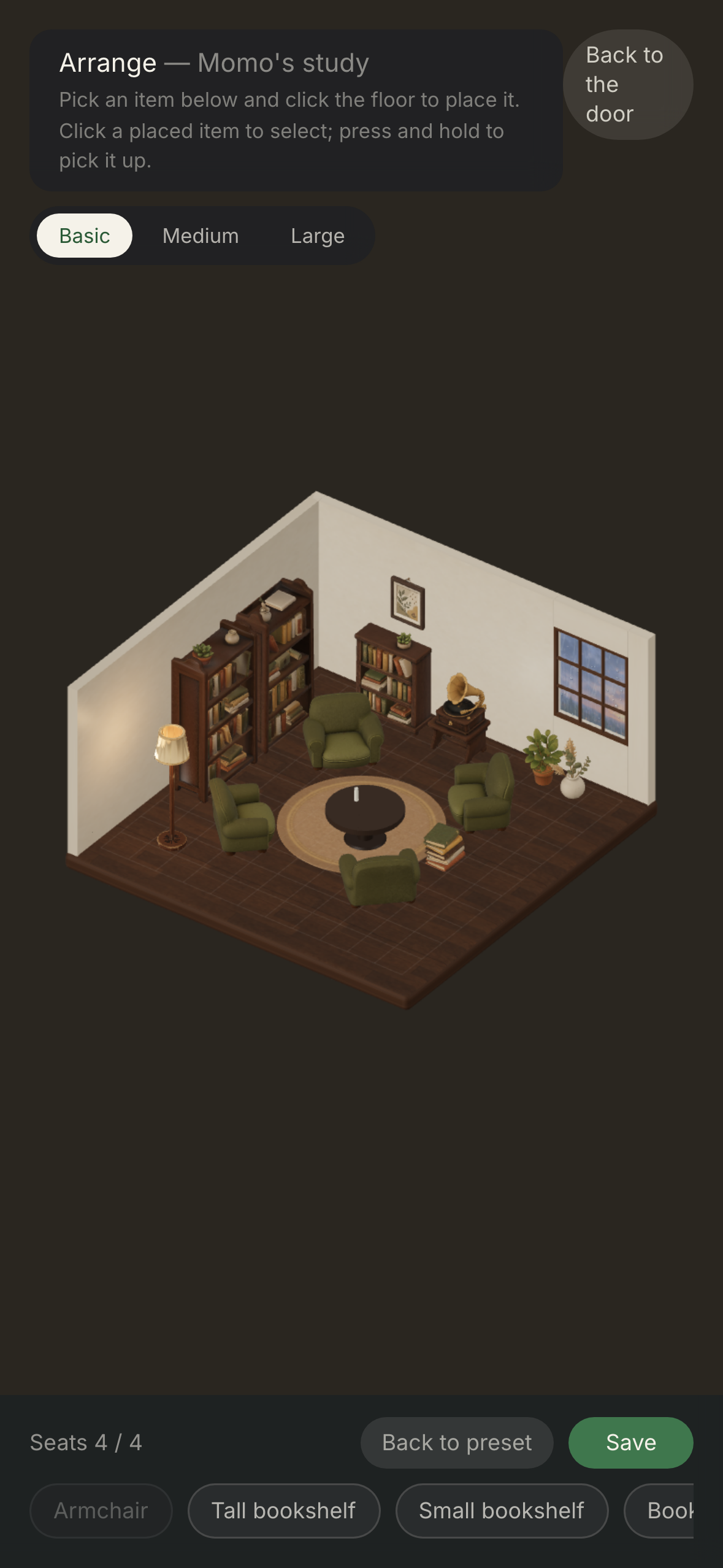
No need to talk. You just want someone to read with — like the quiet hours you once spent in a library. mekuru is that room, in your pocket: a small 3D study where you sit down as a plush animal, open your own paper book on your lap, and read. Other readers are in the room with you — you see them turn a page, step away, come back. That is the whole feature.
I loved libraries. Dozens of people in one room, and not one of them speaks to you. Everyone is reading a different book — and still, you are not alone. I don't think I could concentrate there because it was quiet. I think it was because the person next to me was doing the same thing.
There is no chat, no microphone, no likes, no follower count, no feed. And by policy, mekuru will never send you a push notification. The room you are not in owes you silence.
One post, September 23
On 2026-09-23 a bookbinder posted two of mekuru's reader cards on X and wrote that what they liked was what the room leaves out: no reviews to write, no messages. That evening I opened an official X account for mekuru; its first post said the same thing in the app's own words and passed 1,000,000 views, and mekuru trended on X in Japan. That day about 7,200 readers — 3,277 of them for a minute or more — read 1,338 hours in mekuru, against 199 the day before. By the next morning mekuru was #1 in Japan's free Books chart on the App Store, and #18 among all free apps (games are ranked separately); it was still #1 in the early hours of Sep 25, Japan time. And on Sep 24, the readers who had joined before that day — nearly all of them the day before — read more minutes than that day's newcomers. Every day through Sep 28 saw more reading than the day of the post, and on Sep 29 the App Store in Japan showed 4.7 stars from 205 ratings.
Why a room, and not a tracker
The reading apps I tried counted pages and sent streak reminders — the attention economy wearing a cardigan. Reading is quiet company, not a score.
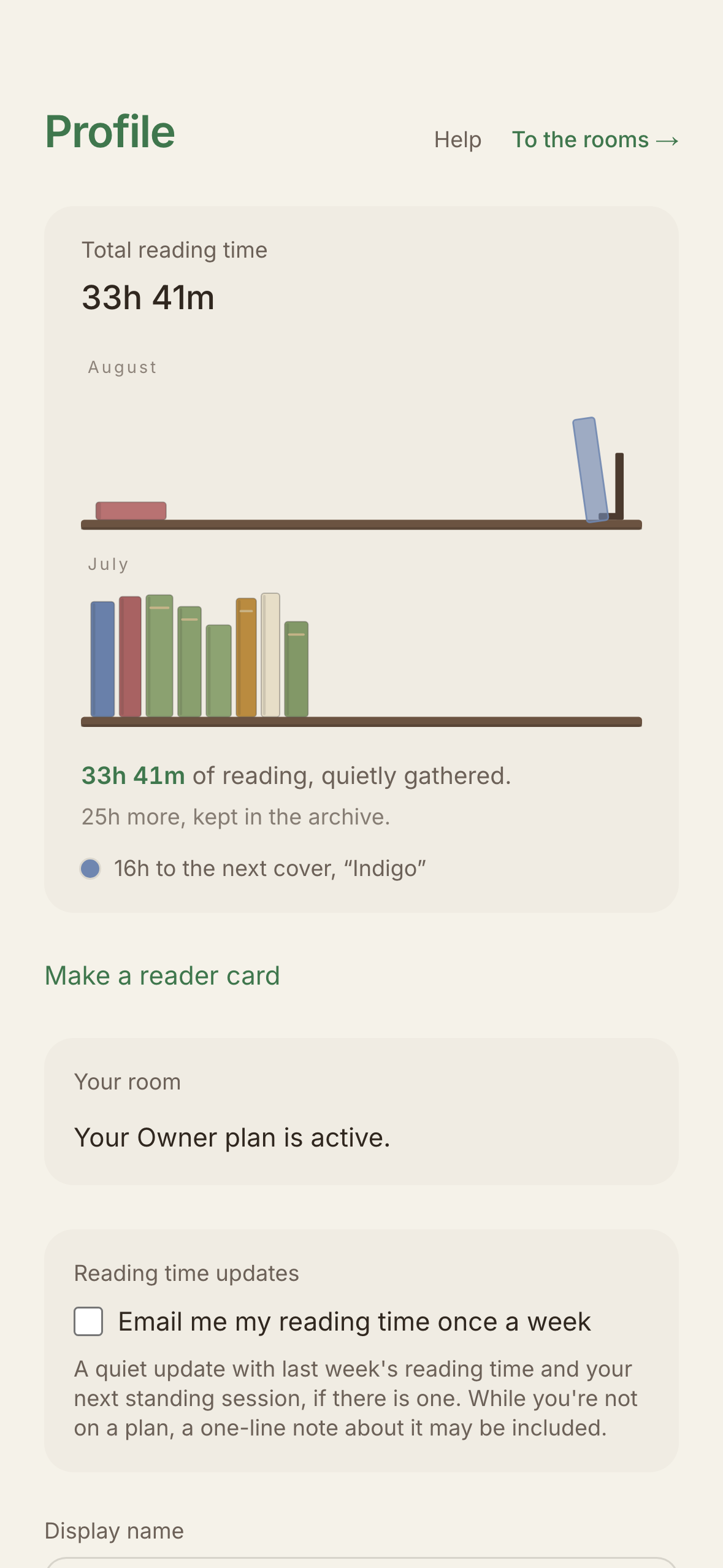
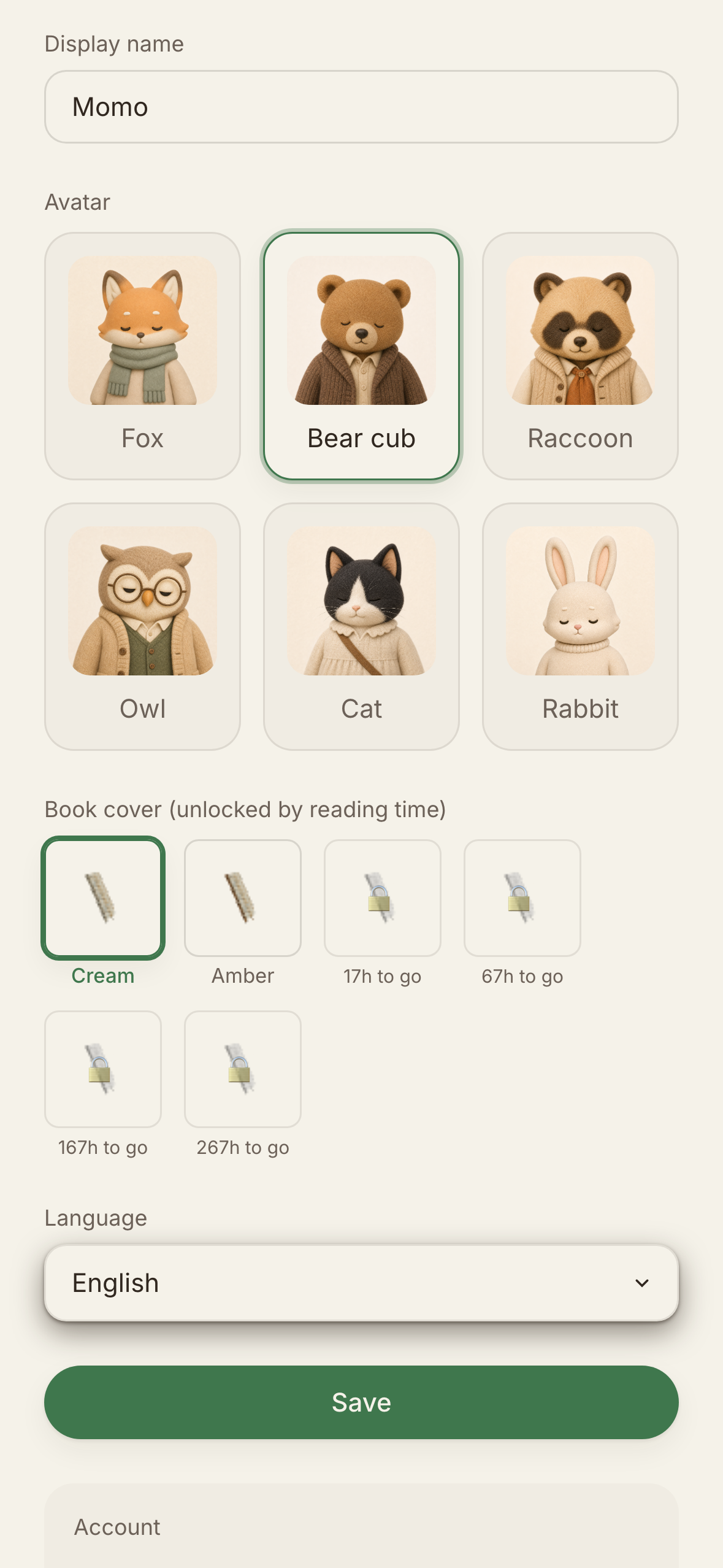
So mekuru counts only one thing: time. Not pages, not books per month. Your reading time stacks up on a Time Shelf as spines, month by month, and a new cover colour unlocks after enough hours. Nothing is ranked.
What is in the room
- Plush readers — six animal avatars (fox, bear cub, raccoon, owl, cat, rabbit) on one shared 41-bone skeleton: concept art, a Tripo mesh, then cleaned, weighted and animated in Blender. Page turns drift on an ambient rhythm (a fresh random gap per seat — 20–45 s in the current App Store build), so the room never moves in lock-step.
- Names that greet and leave — when someone sits down, their name fades in above their head (250 ms), stays four seconds, and fades out (800 ms). Presence without chrome ("Always show names" keeps them up, if you prefer).
- Breaks you can see — pull down Control Centre or open the share sheet — or a call comes in — and your reader puts its book away and rests; the others see it. Leave the app and your seat opens at once for whoever wants it; the room stays open for the others, and you can come back to it.
- Open rooms and invited rooms — walk into a public room, or send one link / QR code to a friend. Invite landings deep-link straight into the app.
- A sound you chose, or none — a room plays the page turns and nothing else until you pick one ambient sound (White noise, Rain, or — only while the window shows the night sky — Crickets; a room with a wood stove has its fire). Pick Rain and it rains on the window too, and a "Rustling pages" switch silences the page turns alone. Nothing else arrives unasked.
- A room you arrange — Owners furnish their room by hand and set its light anywhere between "Dimmer" and "Brighter"; everyone reading with them sees the same light, and Preview shows the room as it looks when you walk in and lets you seat animals on the chairs. Since 4.2.0 a new look for furniture the app already knows — another plant type, say — can arrive from a catalogue the app fetches, without waiting for an App Store release.
- Time Shelf and reader cards — hours, kept as book spines by month, and a reader card (room / book / today's time, or your line) to share when you leave, if you want to. The post that started Sep 23 carried two of these cards.
- One line, if you feel like it — a single line of up to 50 characters, on leaving the room or while you read. It is kept by date (and by book, if you register your books), with no counts and no badges, and goes out only if you put it on a reader card yourself.
- iPad and landscape, a Low-power mode that lists who is here instead of drawing the room, a Lock Screen / Dynamic Island Live Activity, a Home Screen widget, and a Siri Shortcut ("Start Reading").
How it makes money (and why so little of it is paywalled)
Everything social is free: the basic four-seat room, sitting with others, presence, your reading time on the Time Shelf, invite links. The single paid plan is Owner (¥580/month, ≈ $3.99): Arrange (furnish your room by hand, and set its light), six- and ten-seat rooms, making your rooms public, and registering the books you read. Company is the soul of the product; paywalling it would kill the room.
One RevenueCat entitlement (room_owner) covers App Store purchases and restores and the web room, where RevenueCat's web SDK opens a Stripe checkout. Registered accounts get a 14-day free trial: no card, nothing to cancel, it simply ends. More than 1,500 people have started one, and on Sep 29 RevenueCat counted 102 active Owner subscriptions — two of them our own — and $369 in MRR, up from $7 on Sep 11.
Built during Shipaton
- 2026-08-12 — 1.0.0 on the App Store (a browser prototype of the room existed before August; the app is the product).
- 1.1.0 (Aug 12) — Live Activity and Dynamic Island, a Home Screen widget, a "Start Reading" Shortcut, QR invite codes, and a name that drifts above its reader, then fades.
- 1.2.0 (Aug 16) — you are yourself from the moment the app opens; rooms, books and reading time readable with no signal; books stand on the shelf with spines and a bookmark.
- 1.3.0 (Aug 17) — three reader-card styles: the room, the book, today's time. Stepping away frees your seat and leaves the room open.
- 1.3.1 (Aug 19) — switching reader-card styles no longer sticks on "Preparing…".
- 1.4.0 (Aug 26) — Arrange: furniture follows your finger, no grid, pieces snap to each other and stop instead of overlapping.
- 1.5.0 (Aug 29) — floors and walls chosen per room, and a quiet offer to become reading companions with someone you sat beside for five minutes.
- 2.0.0 (Sep 2) — "Still reading?" after two hours without a touch, so a forgotten phone stops adding to your record; the reader card; and a reason when an invite link cannot let you in.
- 2.1.0 (Sep 6) — iPad, and landscape on both; the page-turn sound is now a recording of real paper in place of the synthesized one.
- 3.0.0 (Sep 10) — one line on leaving the room, kept by date and by book; the profile laid out as Reading life and Bookshelf; a companions list.
- 3.1.0 (Sep 10) — the line can be written while you are still reading, and a book you have just finished can go out as a card.
- 4.0.0 (Sep 18) — a Light setting the whole room shares; an ambient sound you choose (white noise, or rain that also falls on the window); a wood stove and its crackling fire, three chair styles, rugs by shape, size and material; rooms drawn at their true brightness; a book you register becomes what you are "Reading now".
- 4.1.0 (Sep 19) — Undo and Redo in Arrange, and one row of controls under the room for both the furniture and the room itself.
- 4.2.0 (Sep 21) — a long walnut table beside the round one, plants with types, 90° rotation in Arrange, and a room holding furniture this app doesn't know still lets you in.
- 4.3.0 (Sep 25) — a "?" on every screen that explains that spot; Preview in Arrange — the room as you will see it when you walk in, animals you can seat on the chairs, and an "Arranged my room" card; a "Rustling pages" switch that stops only the page sounds; "Leave without saving".
- 4.4.0 (Sep 27) — "Crickets", offered only while the window shows the night sky; the solo room can be arranged too; Low-power mode, which stops drawing the 3D room and lists who is here; "Always show names"; a bookmark card and an Owner card.
Stack: Expo / React Native, three.js via react-three-fiber on expo-gl, a shared TypeScript runtime with the web app (Next.js), Supabase (Realtime Presence, Postgres, Auth), RevenueCat; Tripo (the meshes, and the auto-rig behind the one skeleton all six share) and Blender for the avatars; SwiftUI only for the widget and Live Activity extensions.
Where it is going
The room is only worth anything with people in it. From Aug 23 to Sep 20 I opened a public room at night and sat in it myself — on 24 of those 29 nights, and on 17 of them someone else came and stayed. Sep 23 brought four times as many readers in one day as all the weeks before it. So the next thing to build is a timetable, not a feature: a room is only worth coming back to if someone is in it at an hour you can name.
Built With
- activitykit
- blender
- expo-gl
- expo.io
- next.js
- postgresql
- react-native
- react-three-fiber
- revenuecat
- stripe
- supabase
- swift
- swiftui
- three.js
- tripo
- typescript
- vercel
- widgetkit


Log in or sign up for Devpost to join the conversation.