Inspiration
Observing the city-wide waste backlog in crucial local zones like the Mattuthavani Market, Periyar Bus Stand, and the Vaigai Riverbanks highlighted a critical gap in municipal sanitation. Our ongoing biotechnology coursework drove us to look beyond basic tracking and address the root biological hazards. We wanted to engineer a platform that not only monitors organic degradation but actively protects public health by tracking disease vectors like Dengue and Malaria across 12 monitoring districts.
What it does
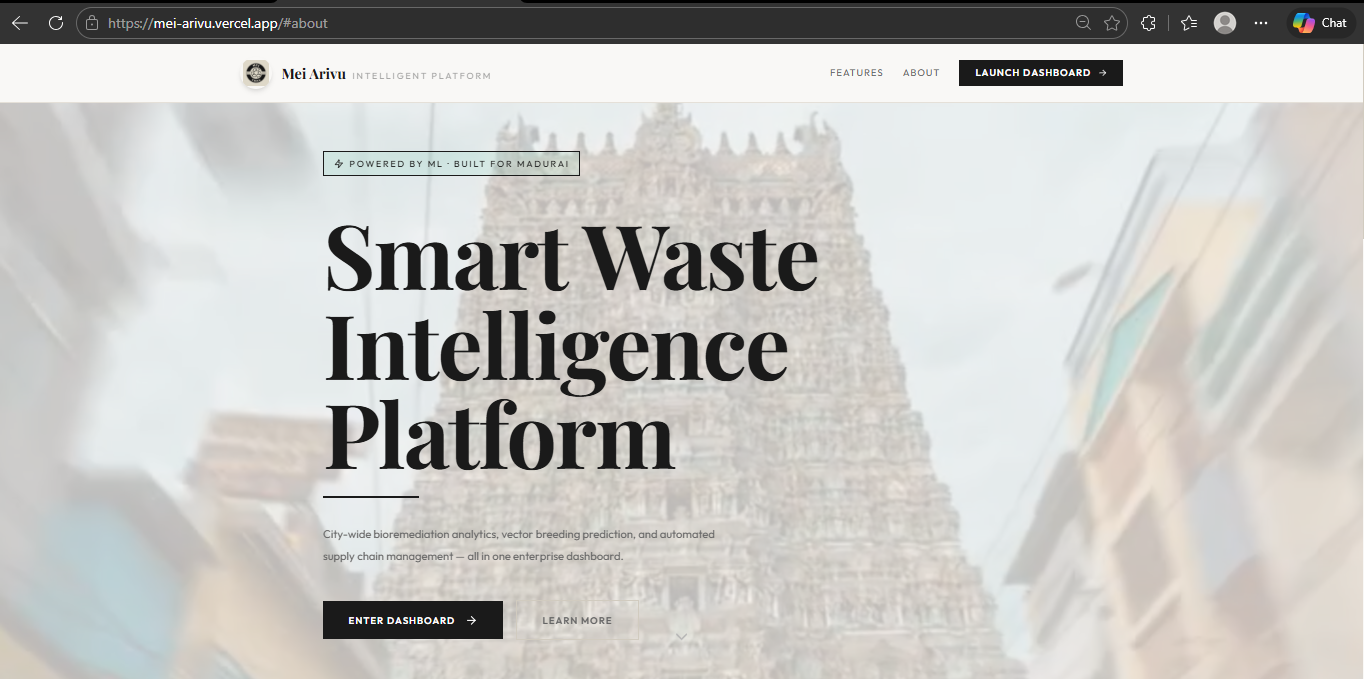
Mei Arivu is an intelligent platform for municipal waste management that provides predictive diagnostics and pathogen surveillance.
- Telemetry & Diagnostics: It uses a "User-as-a-Sensor" model where manual field inputs capture critical data like temperature, pH, moisture, and C:N ratios.
- ML Forecasting Engine: A Python-based machine learning engine analyzes this data to generate real-time decomposition forecasts.
- Command Center & Pathogen Radar: A geospatial dashboard provides real-time hotspot detection for high-risk zones and geofenced alerts when pathogen thresholds exceed safety benchmarks.
- Bio-Supply Inventory: It tracks inventory levels for essential materials like Bacillus Subtilis culture and Lime Powder, automatically initiating procurement workflows when stocks drop.
How we built it
We built Mei Arivu using a modern, production-grade technology stack.
- Frontend: We developed a component-based architecture using React, Vite, and TailwindCSS for responsive, utility-first styling.
- Backend & API: The backend is powered by FastAPI and Scikit-learn for the machine learning models. The React frontend communicates with the Python backend via a REST API using HTTP POST integration.
- Visualizations & UI: We implemented Recharts, a D3-based charting engine, to render radial gauges for telemetry. We also used Lucide-React for interactive iconography and React Hot Toast for a non-blocking notification system.
Challenges we ran into
One of our primary challenges was architecting the frontend to seamlessly handle state management and side effects using functional components and React Hooks. Additionally, to demonstrate the platform's capabilities without a live backend connection, we had to engineer robust offline simulations. This included writing setTimeout() functions to accurately emulate low-stock triggers and auto-reorder workflows for the bio-supply chain registry.
Accomplishments that we're proud of
We successfully mapped active bioremediation sites across the Madurai district, creating a functional Command Center that visualizes data for locations like the Thirupparankundram Plant and Tallakulam Zone. We are particularly proud of integrating the Pathogen Surveillance module, which acts as a static risk-tracking database for 12 monitoring districts.
What we learned
Building this platform significantly advanced our abilities in full-stack development and geospatial analytics. We learned how to optimize a frontend architecture for real-time data visualization and how to design non-blocking alert systems for system status updates. It also solidified our understanding of bridging environmental biotechnology with Python-based predictive modeling.
What's next for Mei Arivu: Biotech Waste & Geospatial Analytics
The immediate next step is transitioning our simulated offline results and auto-reorder functions into fully live, automated systems. We plan to expand the Bio-Supply Chain Registry with more dynamic supplier integrations and scale the Geospatial Command Center to monitor additional municipal zones beyond the current Madurai implementation.
Built With
- fastapi
- machine-learning
- python
- react
- recharts
- restapi
- scikit-learn
- tailwindcss
- vite


Log in or sign up for Devpost to join the conversation.