-
-
MEGHA
Inspiration Meghalaya, with nearly 80% of its population residing in rural areas, faces a persistent challenge: although numerous government schemes and welfare programmes exist, a significant number of citizens remain unaware of them, are unsure about their eligibility, or struggle to access benefits. The complexity of navigating these schemes, combined with language barriers, fragmented information, and low digital literacy, exacerbates this gap. We were inspired to create MEGHA – Meghalaya E-Governance Human-Centred Assistance to bridge this critical divide. Our vision is to ensure that every citizen, irrespective of education level or digital access, can easily understand, apply for, and benefit from government initiatives through a simple, trusted, and voice-driven interface.
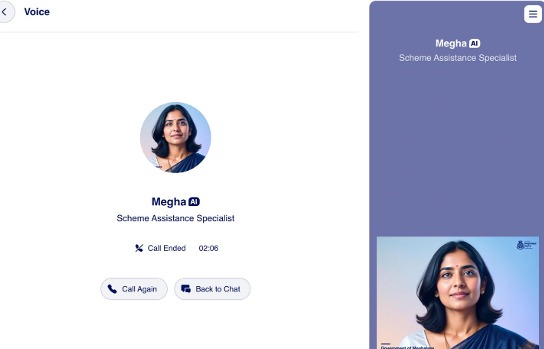
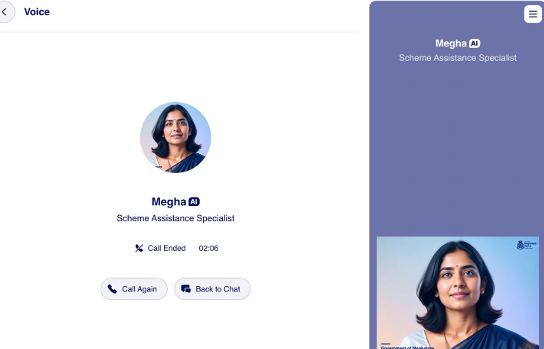
What MEGHA Does MEGHA is a voice-first AI agent built specifically to assist Meghalaya’s rural population. It explains scheme eligibility, required documents, application processes, and available benefits in simple, conversational language. All responses are grounded strictly on verified, uploaded official documents, thereby reducing the risk of hallucinations and ensuring trust. MEGHA supports local accents and phrasing styles to enhance accessibility. It is designed to ask for additional citizen details such as age, gender, occupation, and income only when required to determine eligibility, and always with explicit consent. The agent also offers escalation paths when it cannot find an answer, ensuring that citizens are never left without assistance. Moreover, MEGHA has the capability to send summary emails both to the concerned government office and to the citizen, if the citizen consents. By operating in a natural, patient, and supportive manner, MEGHA helps demystify governance processes for those who need it most.
How We Built MEGHA MEGHA’s development followed a two-stage approach: data preparation and system design. In the first stage, official government orders, application forms, and notifications for approximately 140 schemes were collected from government websites and verified public domain sources. The data was meticulously cleaned to filter out unwanted or irrelevant content, remove non-English text for consistency, and retain only the latest applicable government orders. Order numbers, issue dates, and scheme references were cross-verified to ensure correctness. This curated dataset was consolidated into a single structured knowledge base, optimised for fast and accurate retrieval.
The second stage involved system design along two parallel tracks. A voice-enabled AI model was developed using ChatGPT customised with PingPong to enable natural, empathetic voice-based citizen interactions. In parallel, a virtual avatar interface was developed using Jotform AI Agent Builder to create a more citizen-friendly and approachable user experience. The system architecture was based on retrieval-augmented generation (RAG) principles, ensuring that all responses were anchored in official, verified documents. Interaction prompts and system instructions were continuously fine-tuned to provide short, accurate, and grounded responses suited to Meghalaya’s rural population. MEGHA was further optimised for lightweight deployment, enabling it to function effectively even in low-bandwidth environments.
Challenges We Faced Developing MEGHA posed several important challenges. The first was related to data collection and validation. Scheme information was scattered across multiple government departments, often inconsistent, outdated, or incomplete. Ensuring relevance, correctness, and accuracy demanded extensive manual cleaning, filtering, and cross-verification. Another significant challenge was technical compatibility during system development and deployment. Integrating multiple platforms like PingPong and Jotform required resolving API issues, deploying models across different environments, and ensuring smooth interoperability.
An equally critical challenge was maintaining strict alignment of AI responses. Disciplined prompt engineering was essential to prevent hallucinations, ensure retrieval from only verified documents, and maintain factual consistency. Continuous refinements were necessary to align the system’s communication style to government terminology while keeping it simple for rural citizens. In addition, adapting MEGHA to understand rural accents and local phrasing required intensive testing and adjustments. Finally, ensuring citizen trust and privacy was central to the design process. It was essential to seek explicit permission before asking for personal information and to immediately erase all citizen data after each interaction.
Accomplishments That We Are Proud Of We are proud to have created Meghalaya’s first truly voice-first rural governance assistant grounded in human-centred design. MEGHA successfully brings verified scheme information closer to rural citizens who previously had limited access to such resources. By implementing a grounded, hallucination-resistant system optimised for low-connectivity environments, we have laid the foundation for scalable and replicable digital governance models. Our solution demonstrates how empathetic and carefully aligned technology can empower citizens, ensuring that even individuals without literacy skills or smartphones can understand and claim their entitlements. Most importantly, MEGHA sets a new standard for citizen-centric digital public services that can inspire similar initiatives across India.
What We Learned Throughout the development of MEGHA, several critical lessons emerged. Human-centred design is not optional but essential; simplicity, clarity, and respect must guide every decision when building technology for governance in rural areas. We realised that the quality of data directly determines the quality of citizen interaction — high-quality, structured, and accurate data preparation is foundational. Additionally, we discovered that grounded, factual AI is far more valuable in governance applications than complex conversational features. Rural citizens deeply appreciate straightforward, accurate information rather than sophistication. We also learned that voice-based systems, when delivered in a compassionate and patient manner, build trust and confidence much more effectively than text-based interfaces. Finally, maintaining strict alignment to verified information requires continuous prompt refinement and discipline throughout model lifecycle management.
What's Next for MEGHA – Meghalaya E-Governance Human-Centred Assistance Looking ahead, we plan to expand MEGHA’s multilingual capabilities by incorporating Khasi, Garo, and Pnar languages fully, enabling better understanding and more relatable voice responses. We also aim to integrate a grievance redressal module, allowing citizens to report complaints directly through MEGHA and track their status transparently. To keep up with evolving government programmes, we will develop a dynamic knowledge update mechanism that automatically refreshes MEGHA’s database as new schemes are launched or modified. Recognising the challenges of limited connectivity in rural areas, we intend to explore offline access through USSD-based or IVR-based models. Additionally, we are forging partnerships with Gram Panchayats and Common Service Centres to extend MEGHA’s reach to the last mile. Over time, we envision MEGHA evolving into a comprehensive Citizen Assistant platform, capable not only of scheme explanation but also of supporting critical services such as voter registration, disaster alerts, school admissions, and health updates, thereby becoming an indispensable tool for governance transformation in Meghalaya.
Built With
- customgpt
- openai
- rag
- scheme
- slm
- voiceagent


Log in or sign up for Devpost to join the conversation.