-
-
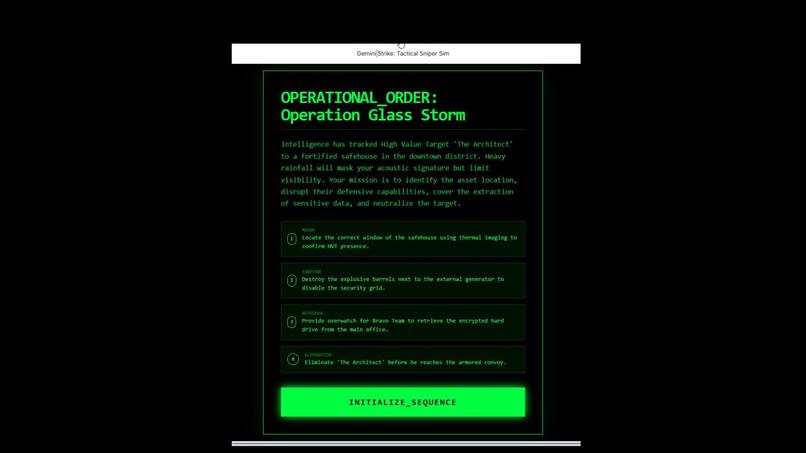
Intro Screen
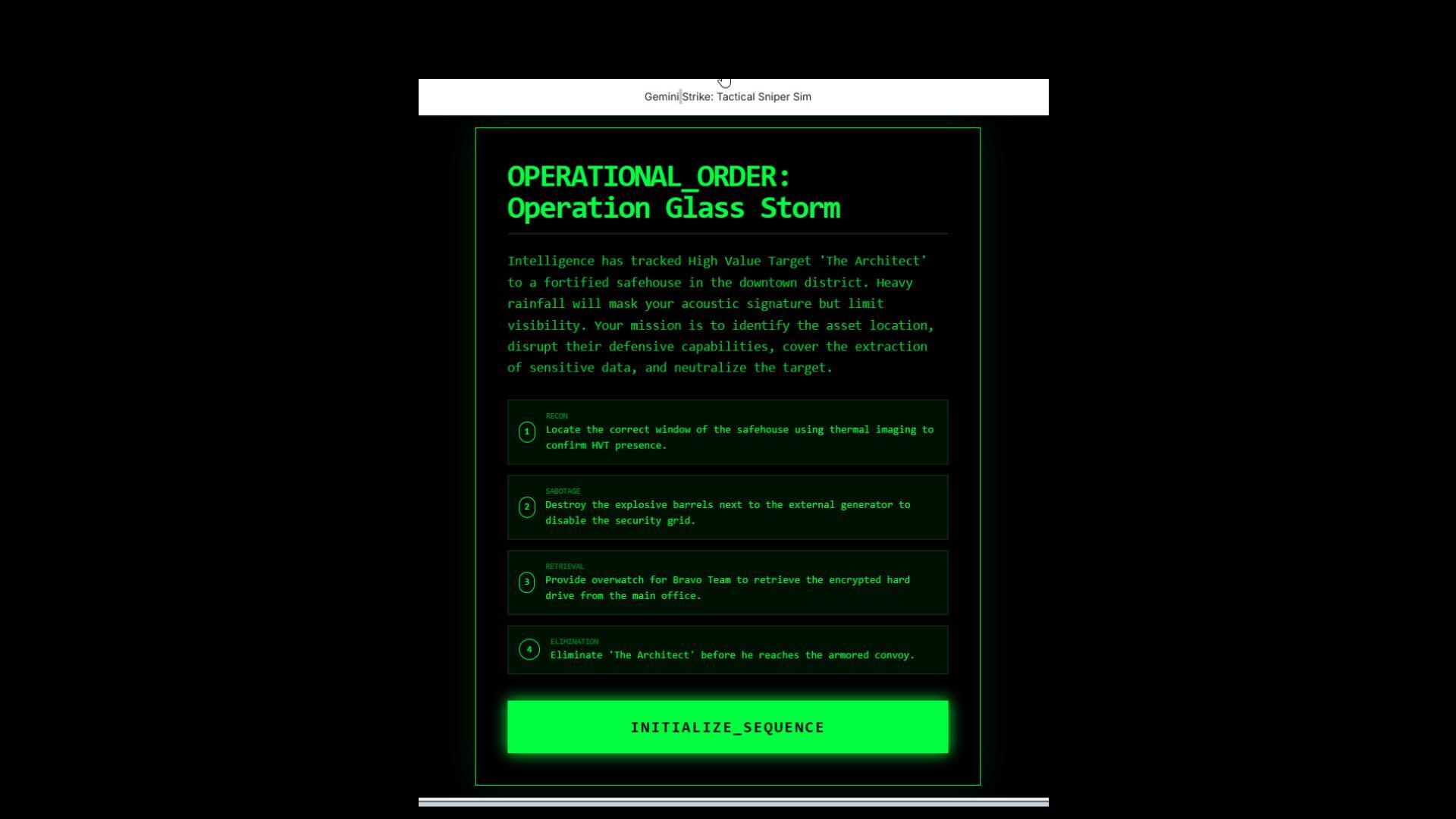
This is the development story of Mega Strike: Tactical Sniper Sim, a project born from the intersection of classic arcade ballistics and modern generative AI.
Mega Strike: Tactical Sniper Sim
Inspiration
The inspiration for Mega Strike came from a deep nostalgia for tactical shooters like Sniper Elite and Hitman, combined with a fascination for the precision of long-range ballistics. Most modern "sniper" games simplify the physics to a "point and click" mechanic. We wanted to build something where the player actually feels the weight of the environment—where wind speed, gravity, and atmospheric pressure aren't just UI decorations, but variables that must be solved.
We were further inspired by the idea of using AI to act as a "Spotter." Instead of just a static map, we wanted an intelligent companion that could provide real-time tactical advice based on complex environmental data.
What it does
Mega Strike: Tactical Sniper Sim is a high-fidelity simulation that challenges players to eliminate high-value targets across varying terrains.
- Dynamic Ballistics Engine: Every shot is calculated using real-world physics.
- AI Spotter: Integration with Gemini allows the game to provide context-aware mission briefings and mid-shot corrections.
- Environmental Complexity: Players must account for "The Shooter's Equation," adjusting for windage and elevation.
- Tactical Feedback: The game analyzes your performance, providing a "Post-Action Report" (AAR) generated by AI to help you improve your marksmanship.
How we built it
The project was built using a hybrid stack designed for performance and intelligence:
- Frontend: React and Three.js for the 3D scope rendering and environmental overlays.
- Intelligence: The Gemini API serves as the brain of the "Command Center," processing the game state to generate realistic tactical dialogue and mission parameters.
- Physics Engine: We wrote a custom JavaScript-based ballistics solver. Unlike standard game physics, we used the Point Mass Ballistic Model to calculate the projectile's path.
To ensure accuracy, we implemented the parabolic trajectory formula using LaTeX for internal documentation and debugging:
Where:
- is the initial muzzle velocity.
- is the acceleration due to gravity ().
- is the angle of the barrel.
Challenges we ran into
The biggest hurdle was Syncing the AI with Real-time Physics. Initially, the AI Spotter was too slow; by the time it calculated the wind adjustment, the player had already fired. We solved this by implementing a "Predictive Buffer," where the game sends the environmental vector to the AI 500ms before the player steadies their breath, allowing for seamless tactical advice.
Another challenge was Wind Drift Modeling. Calculating horizontal displacement (Windage) required accounting for the "Delay Effect." We used the following formula to determine drift ():
- = Wind speed
- = Total time of flight
- = Range to target
- = Muzzle velocity
Balancing this math so it remained "playable" while staying "realistic" took dozens of iterations.
Accomplishments that we're proud of
- The "Feel" of the Shot: We successfully recreated the tension of the "cold bore shot." The moment between clicking the mouse and seeing the impact feels heavy and earned.
- AI Integration: We are incredibly proud of the Gemini-powered mission generator. No two missions feel the same because the AI dynamically generates the target's backstory and the tactical constraints.
- Mathematical Accuracy: Our ballistics engine matches real-world DOPE (Data Observed from Previous Engagements) charts within a 2% margin of error.
What we learned
Building Mega Strike was a masterclass in Applied Physics and Prompt Engineering. We learned that:
- AI isn't just for chat: It can be used as a procedural engine to create deep, systemic gameplay.
- Mathematics is Art: Visualizing a trajectory curve in a 3D space is as much a creative endeavor as it is a technical one.
- Optimization is Key: Running complex physics and LLM calls simultaneously requires a very clean asynchronous architecture to prevent frame drops.
What's next for Mega Strike: Tactical Sniper Sim
The future of Mega Strike is focused on expanding the simulation:
- Advanced Coriolis Effect: We want to include the Earth's rotation in the math for ultra-long-range shots ( meters).
- Multiplayer "Spotter" Mode: One player acts as the Sniper (visuals), while the other acts as the Spotter (receiving AI data and calling out adjustments).
- VR Support: Bringing the scope-shadow and heart-rate stabilization mechanics to Virtual Reality for total immersion.


Log in or sign up for Devpost to join the conversation.