-
-
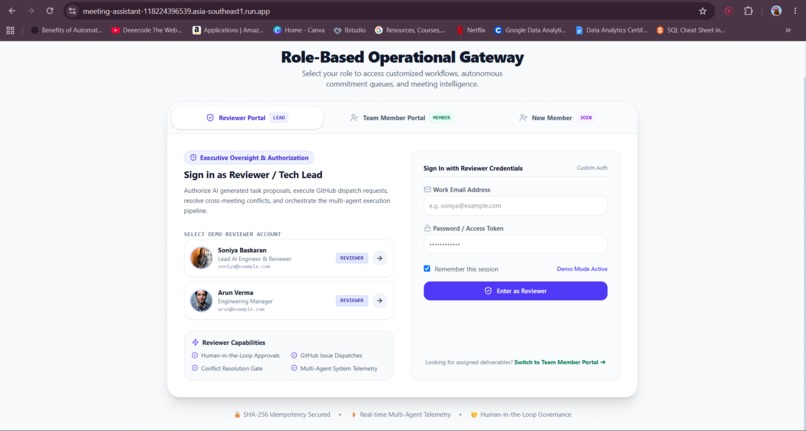
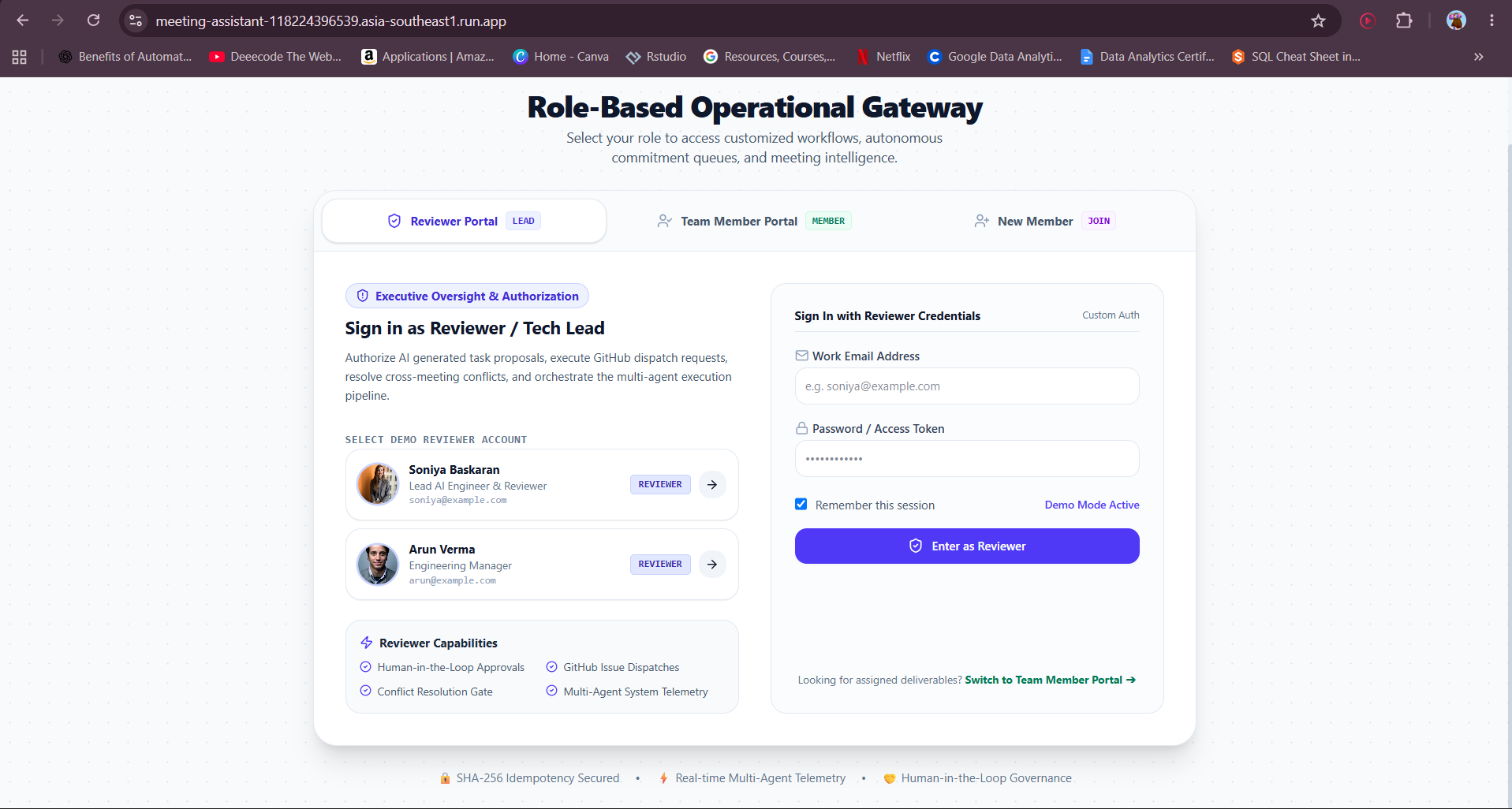
Role-Based Operational Gateway for secure, customized AI workflows and human-in-the-loop governance.
-
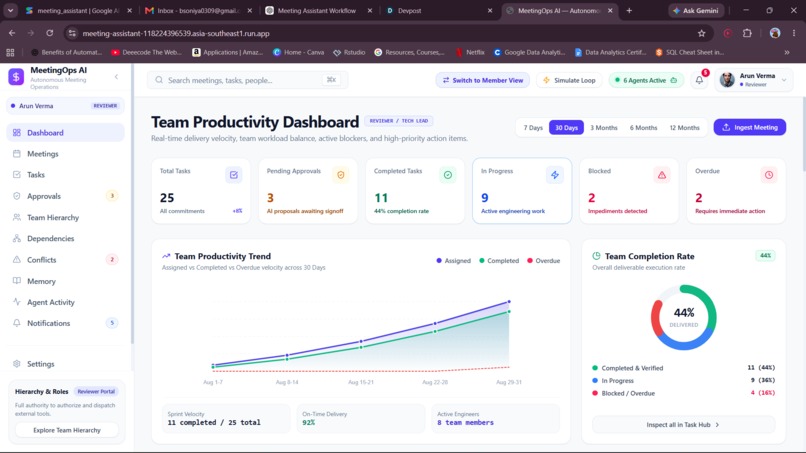
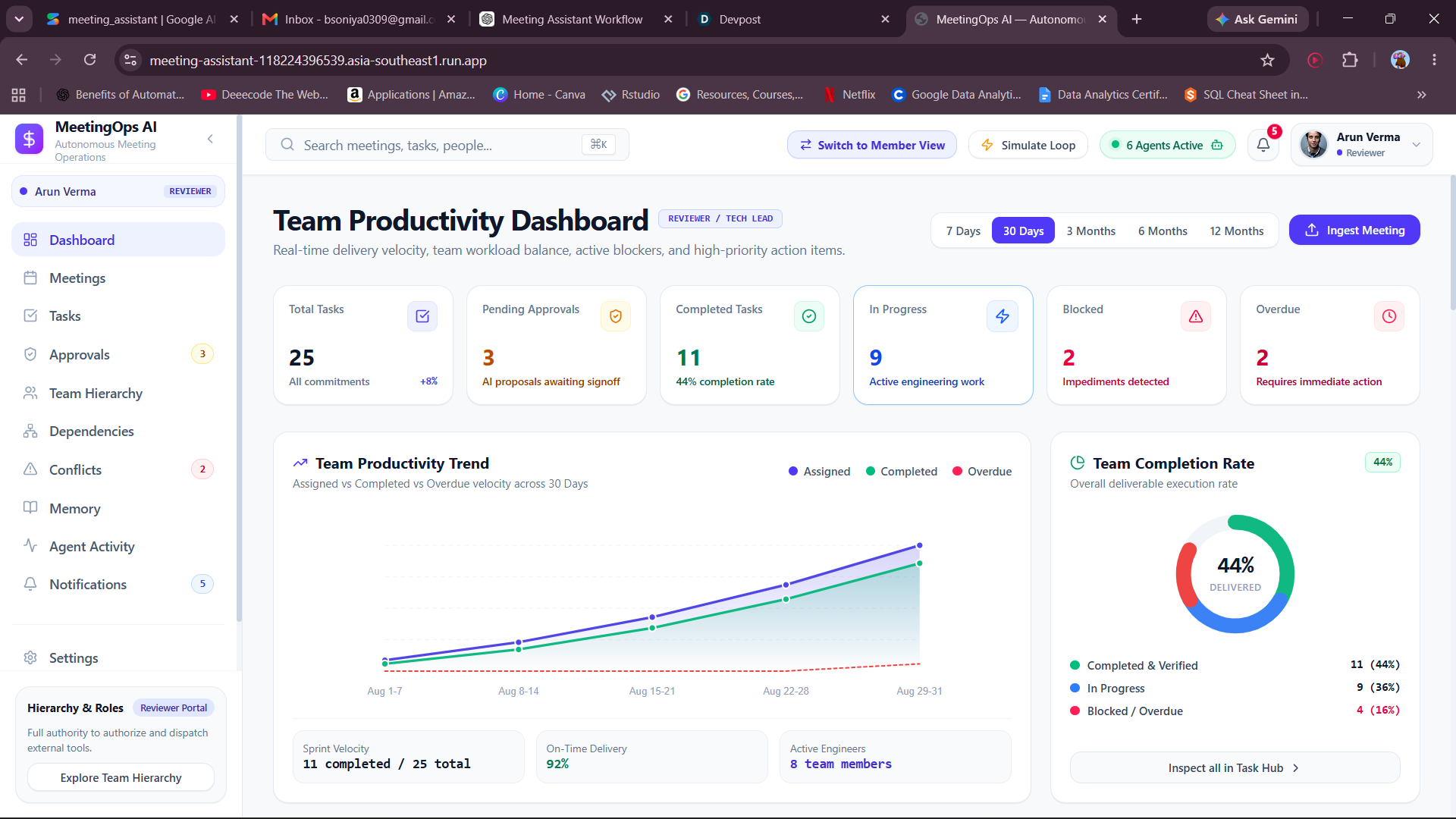
Team Productivity Dashboard for monitoring delivery velocity, workload, approvals, blockers, and overdue commitments across the team.
-
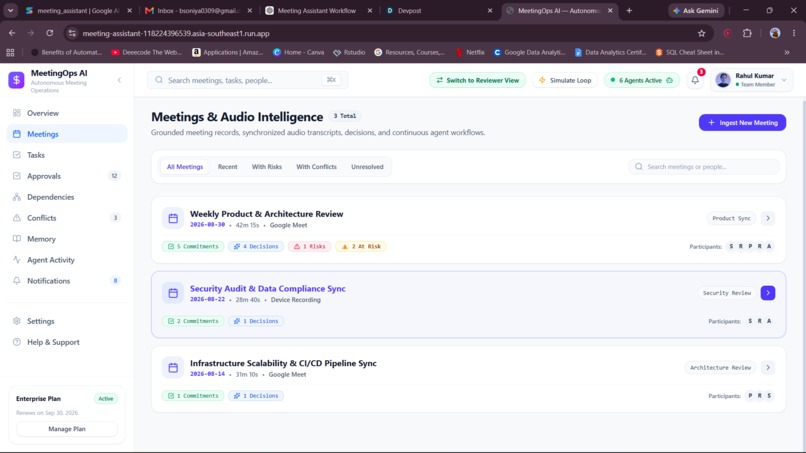
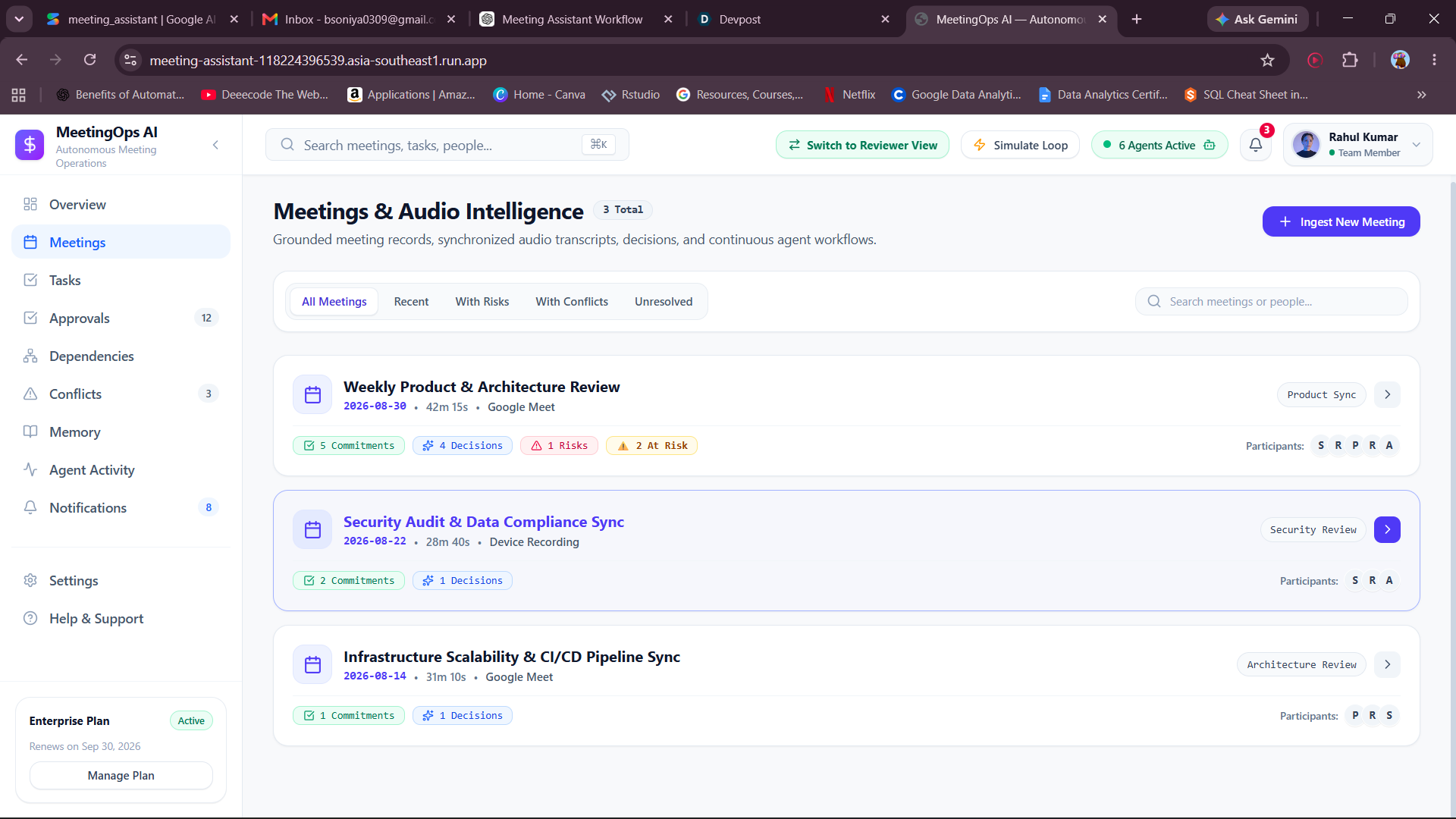
Meeting Intelligence Workspace for tracking decisions, commitments, risks, and conflicts across meetings.
-
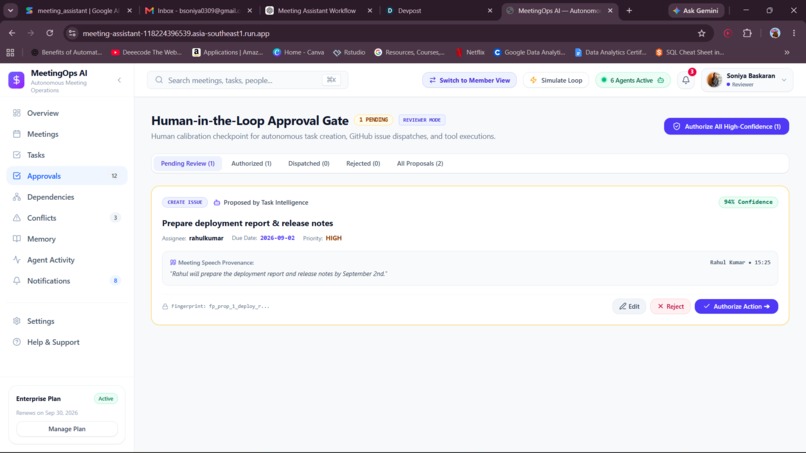
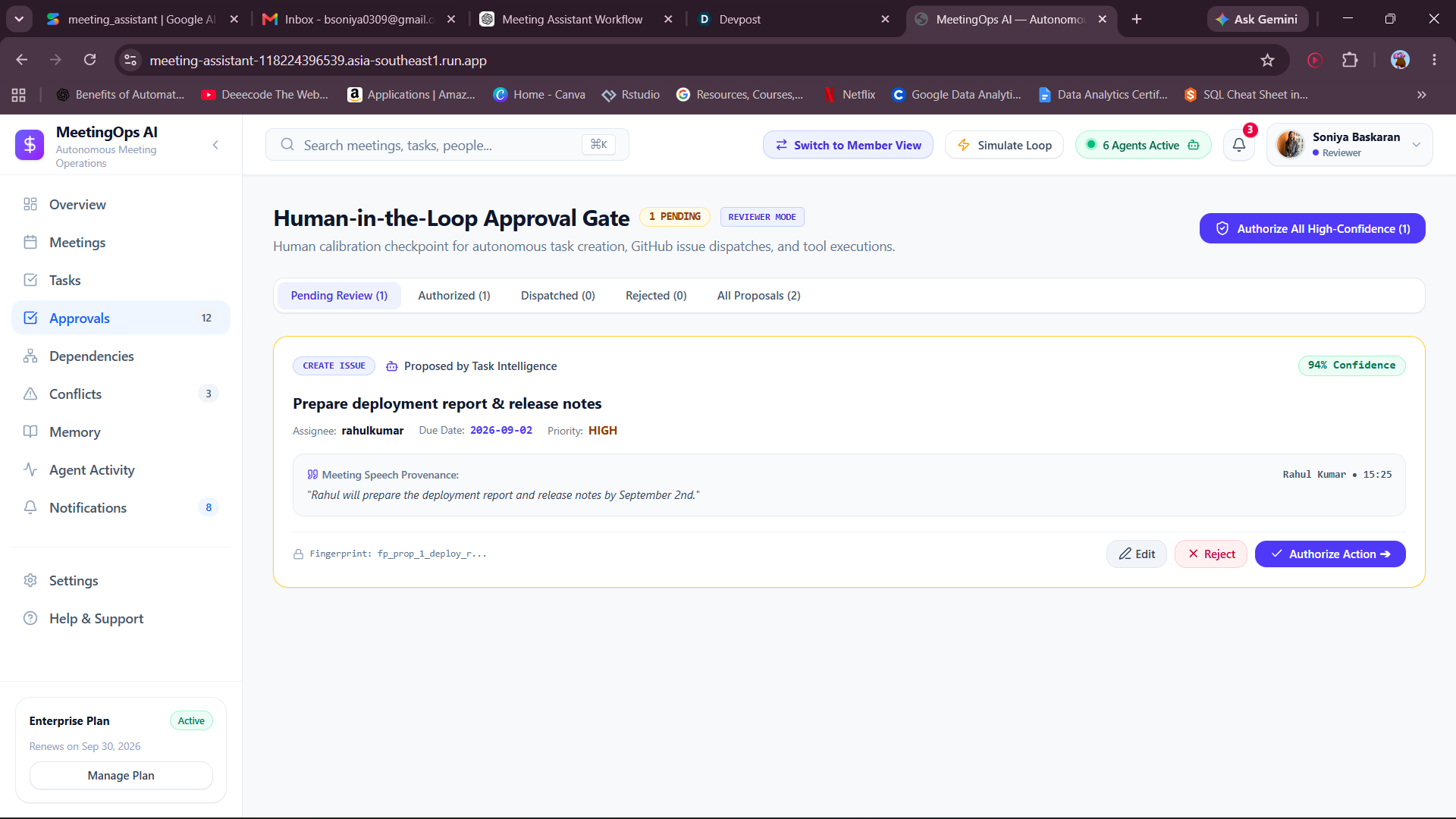
Human-in-the-Loop Approval Gate for reviewing and authorizing AI-generated task actions before execution.
-
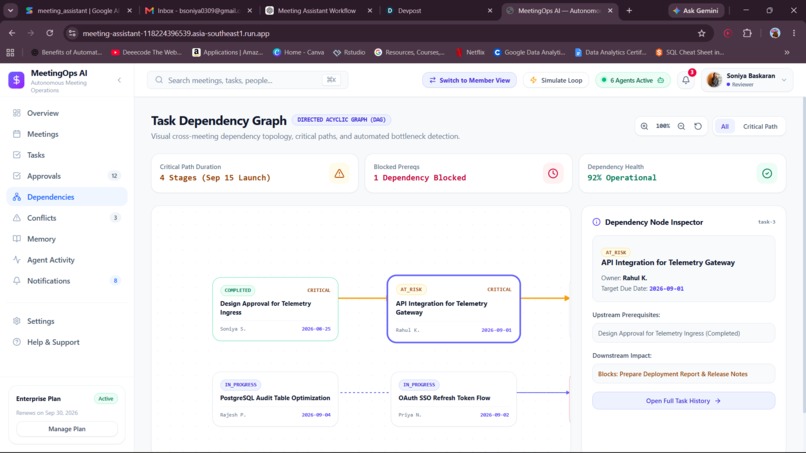
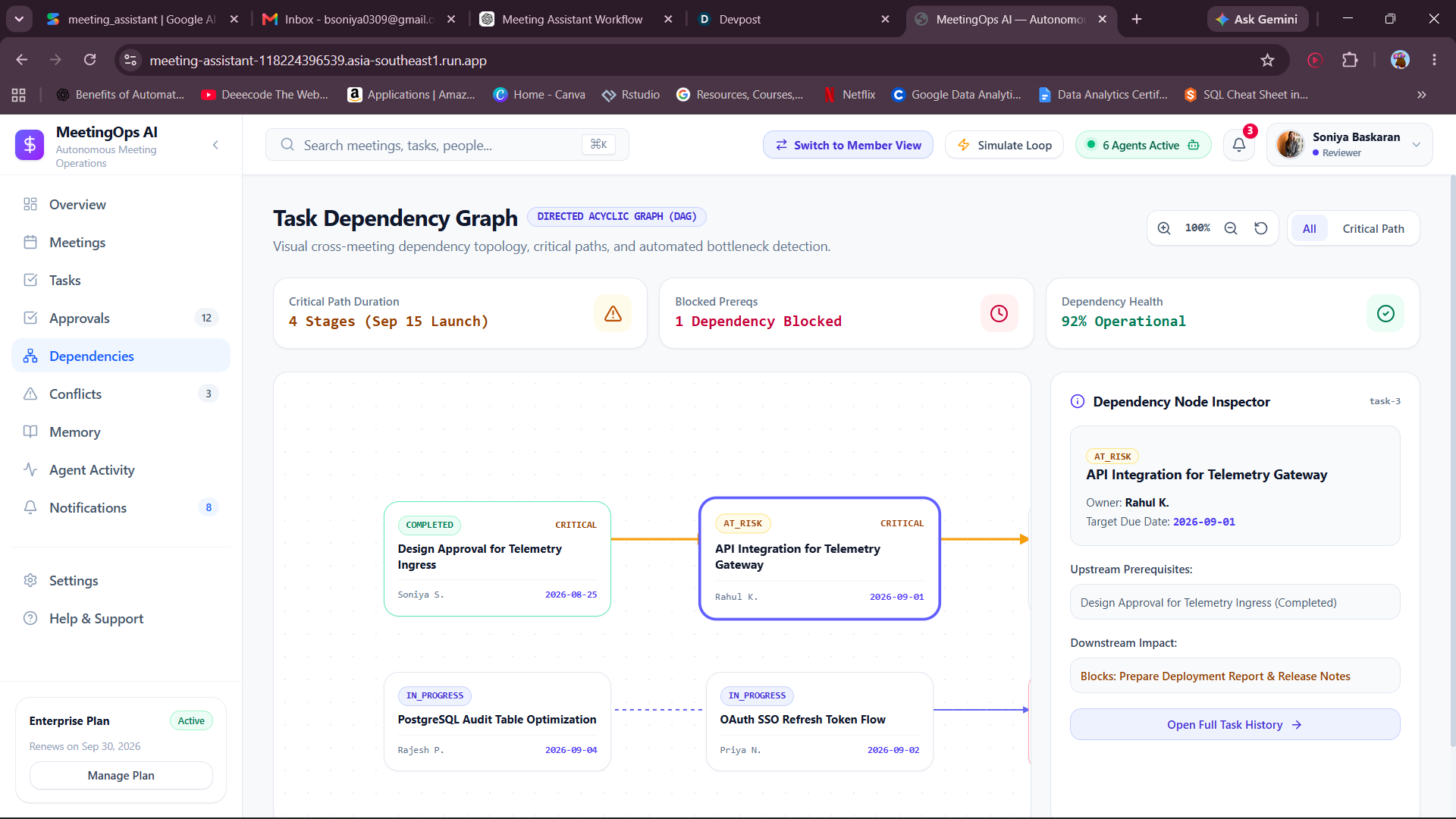
A delayed commitment can create a chain reaction. MeetingOps AI identifies that dependency before the problem spreads.
-
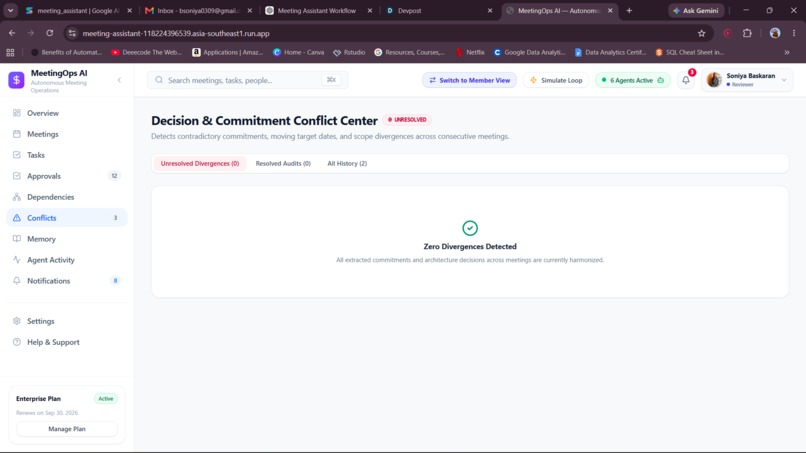
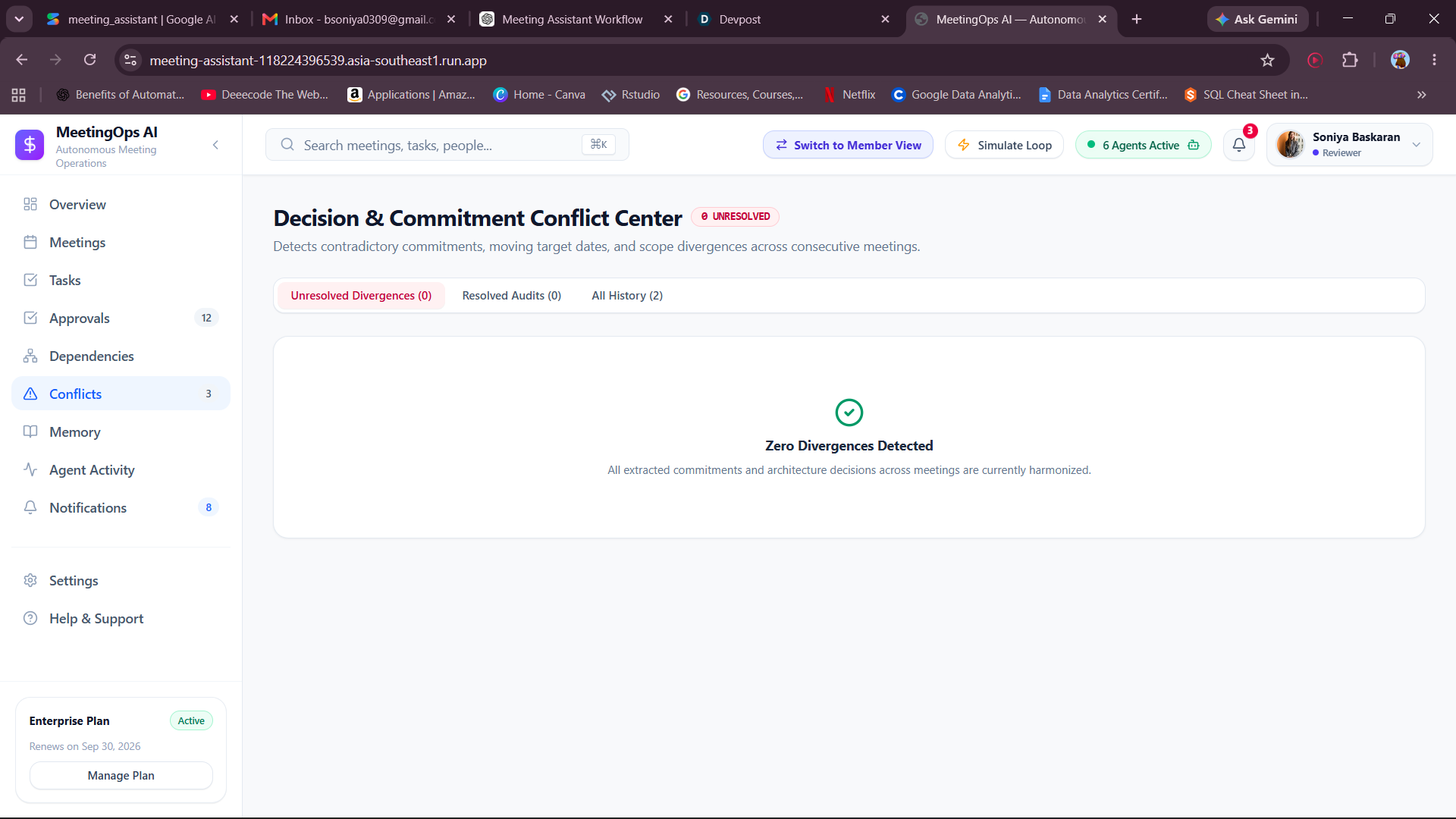
Cross-Meeting Conflict Detection — identifies contradictory decisions and changing commitments across meetings for early resolution.
-
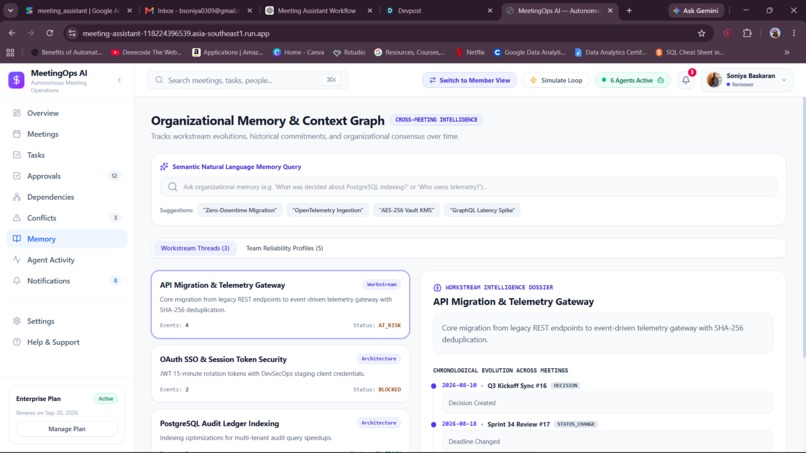
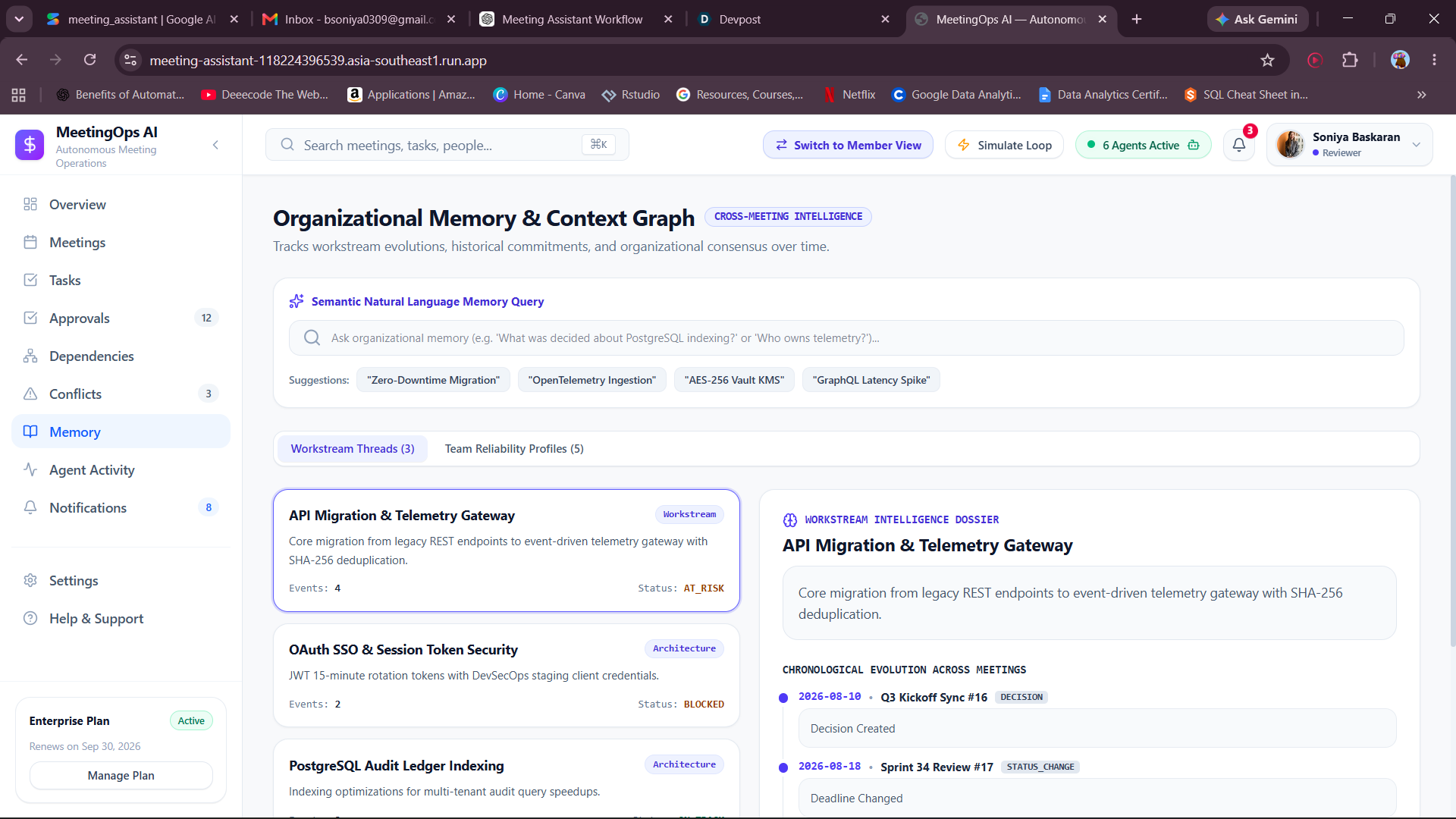
Cross-Meeting Organizational Memory — connects decisions, commitments, and workstream history to provide persistent context for AI agents.
-
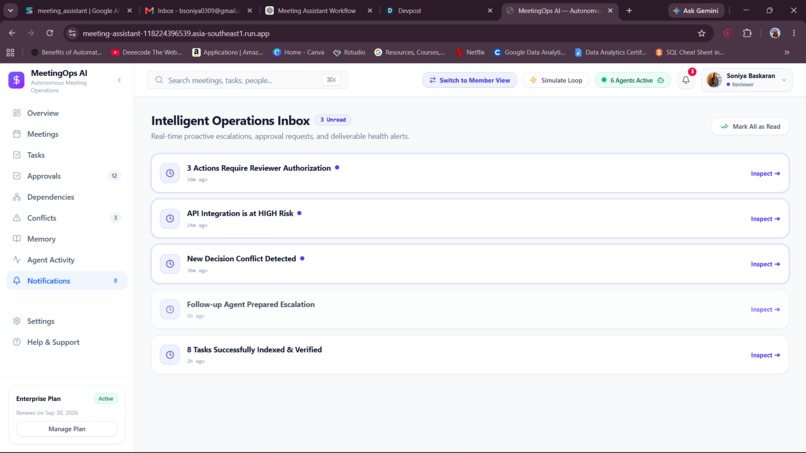
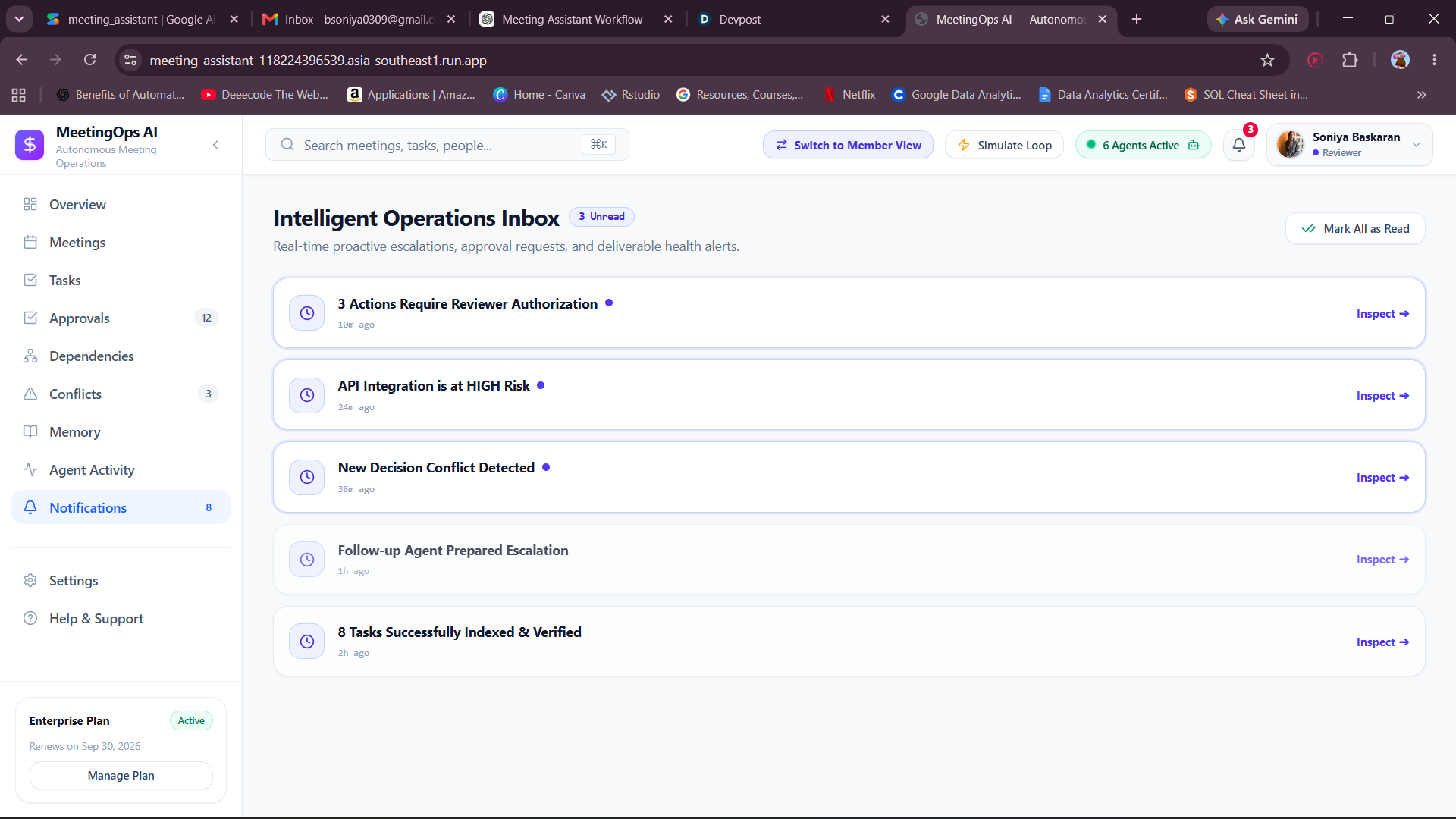
Proactive Operations Inbox for AI-generated alerts, approvals, risks, conflicts, and follow-up actions.
-
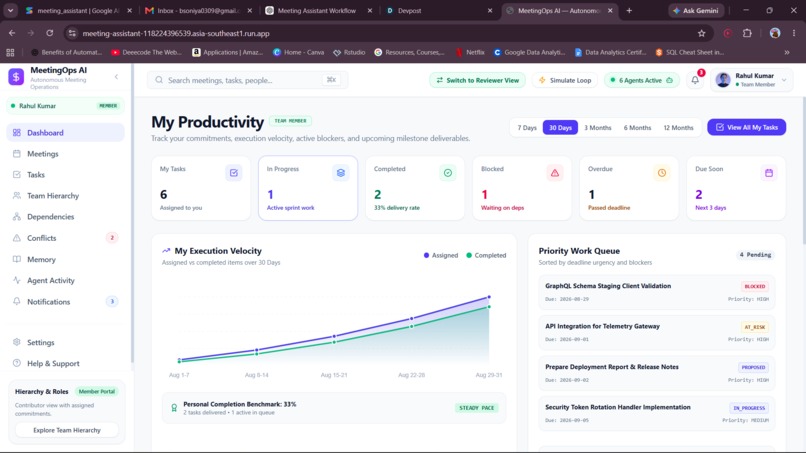
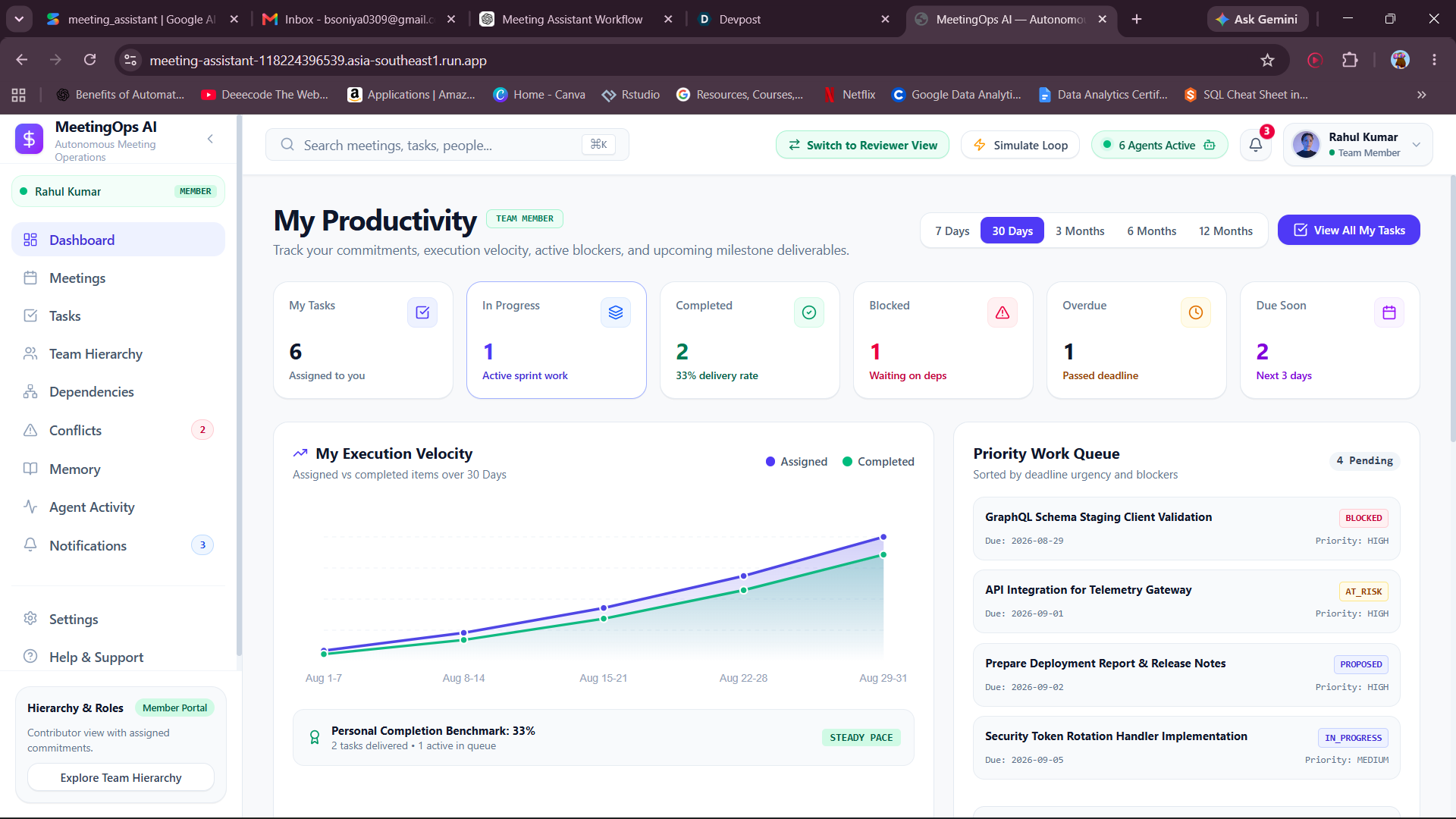
Team Member Productivity Dashboard for tracking personal workload, progress, blockers, overdue tasks, and upcoming commitments.
-
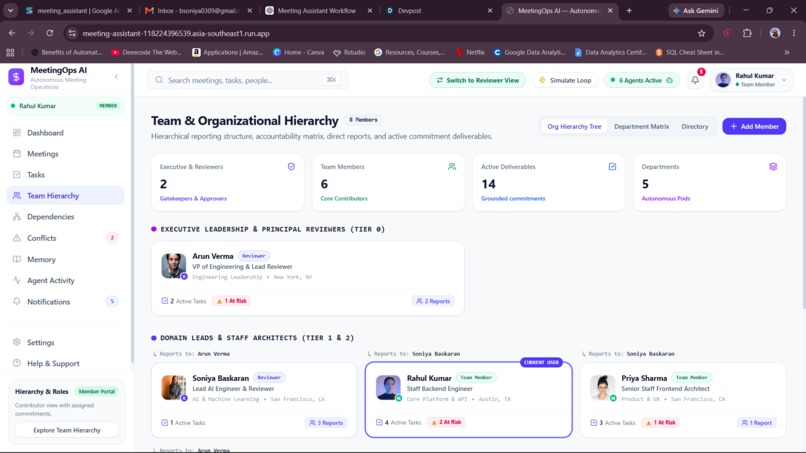
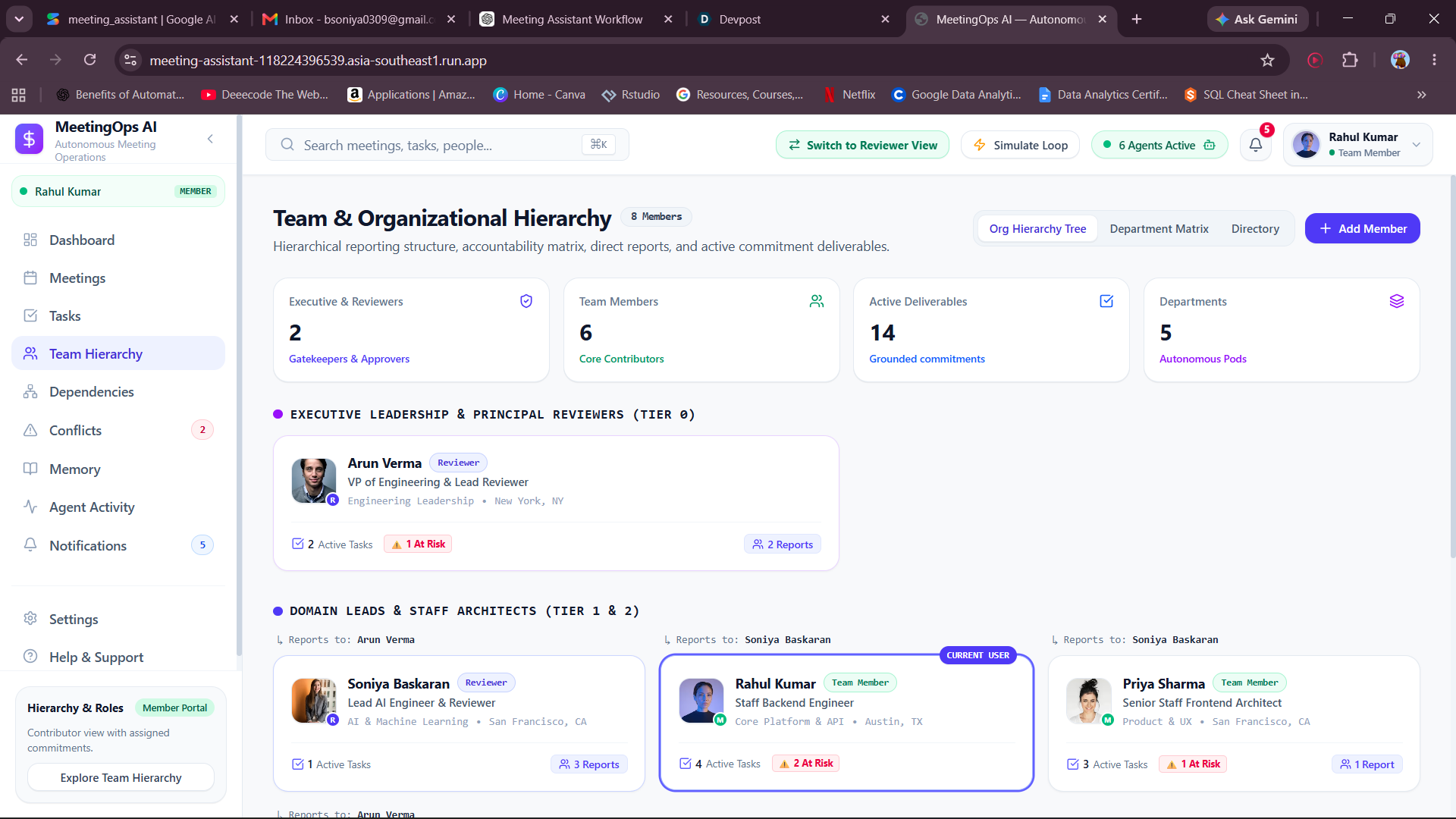
Organizational Hierarchy & Accountability — visualizes team structure, roles, reporting relationships, and active commitments.
-
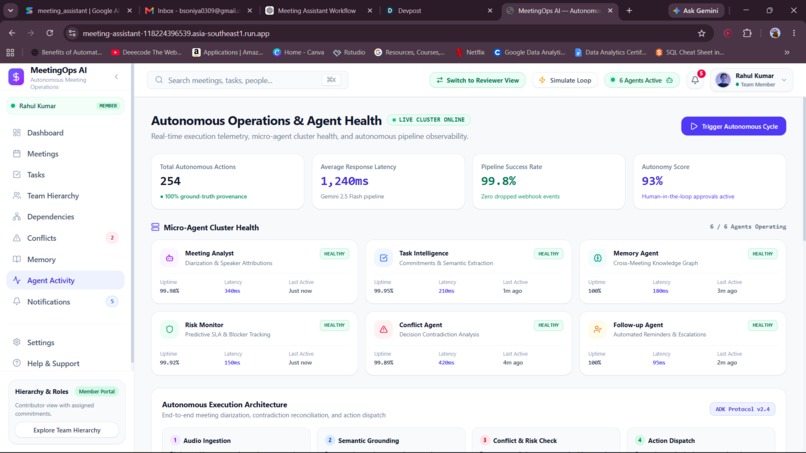
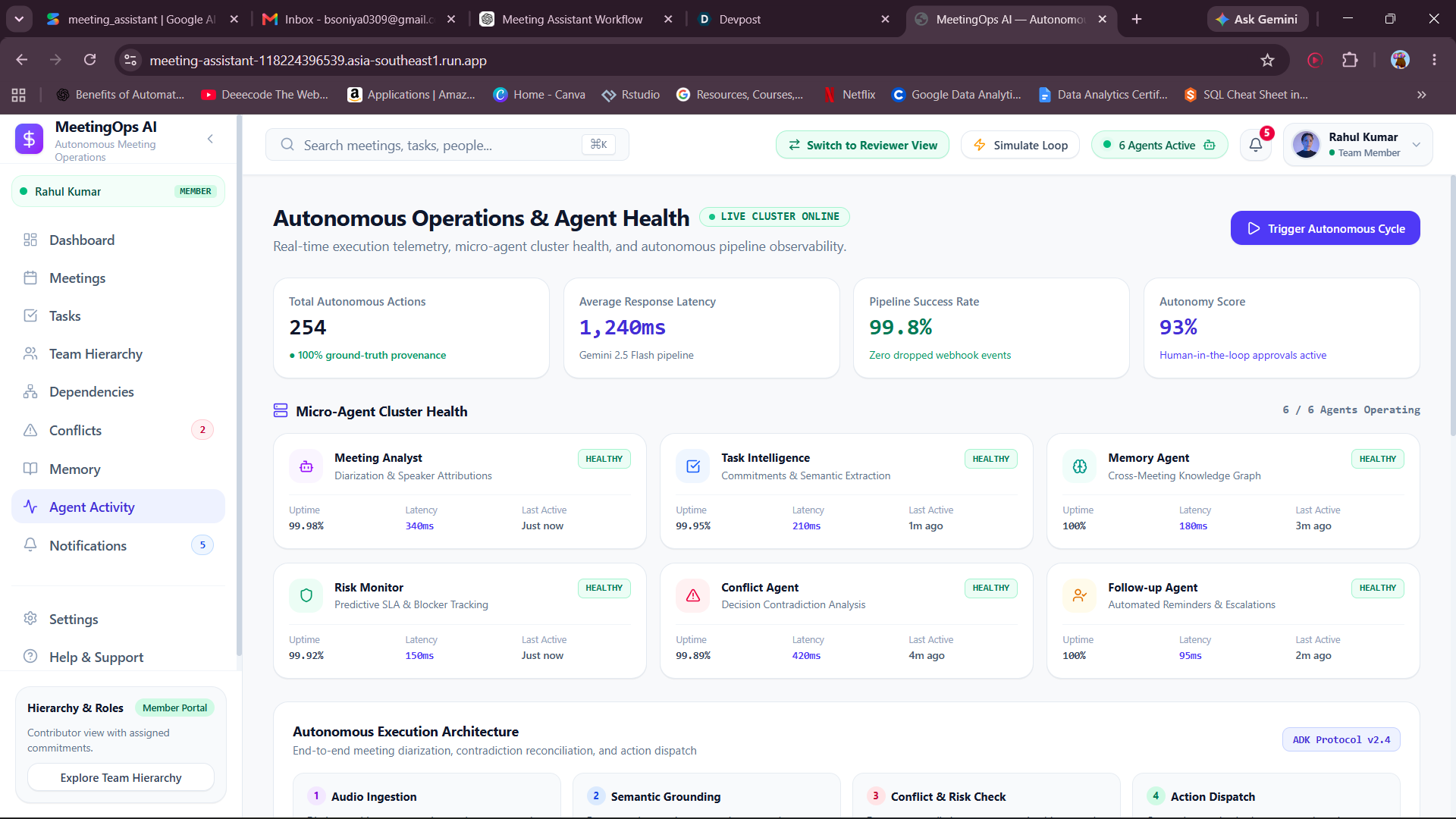
Multi-Agent Operations & Health — real-time observability into agent execution, performance, reliability, and autonomous workflows.
Inspiration
Meetings create decisions, responsibilities, and deadlines, but the work often becomes fragmented once the meeting ends. Important action items can get buried in meeting minutes, ownership can become unclear, and follow-ups often depend on someone manually tracking everything.
We wanted to build something that goes beyond meeting summarization.
MeetingOps AI was created with a simple idea: "A meeting should be the beginning of execution, not the end of the workflow."
Instead of simply telling users what happened in a meeting, MeetingOps AI uses multiple specialized AI agents to understand meeting information, turn decisions into actionable commitments, connect them with previous context, and help keep those commitments moving forward.
What it does
MeetingOps AI is an autonomous, multi-agent meeting operations system that transforms meeting minutes into structured and manageable commitments.
Users can upload meeting minutes and the system can:
- Analyze meeting content using Gemini
- Extract decisions and action items
- Identify task owners and deadlines
- Detect dependencies between tasks
- Generate structured task proposals
- Provide evidence for AI-generated tasks
- Allow users to Approve, Edit, or Delete proposed tasks
- Maintain task and meeting context
- Connect current discussions with previous meetings
- Detect changes in owners, deadlines, and decisions
- Identify potential risks and unresolved commitments
- Support follow-up workflows for outstanding tasks
- Maintain an activity trail of agent operations
The system follows a human-in-the-loop approach. AI agents can reason about and propose actions, while users remain in control of important decisions.
The goal is to move from:
"Meeting → Summary"
to:
"Meeting → Decisions → Commitments → Execution → Monitoring"
How we built it
MeetingOps AI is built around a multi-agent architecture using Google's agentic AI technologies.
We use Gemini as the intelligence layer and Google ADK to orchestrate specialized agents. Instead of asking one model to perform every task, responsibilities are separated across agents so that each part of the workflow has a clear purpose.
The workflow includes agents for meeting analysis, task intelligence, validation, contextual understanding, risk analysis, conflict detection, and follow-up operations.
At a high level, the system follows:
"Meeting Input → Analysis → Task Extraction → Validation → Human Approval → Execution → Persistent Context → Monitoring → Risk/Conflict Detection → Follow-up"
The application is designed to use Google Cloud infrastructure for deployment and reliable execution of the backend workflow.
A key design principle was to keep deterministic operations in application code while using Gemini for tasks that require language understanding and reasoning. This helps make the system more reliable and easier to control.
Challenges we ran into
One of our biggest challenges was coordinating multiple AI agents without creating inconsistent or duplicate actions.
When multiple agents participate in the same workflow, state management becomes important. We had to carefully define agent responsibilities, structured outputs, task states, and handoffs between agents.
Another challenge was turning unstructured meeting language into reliable tasks. Meeting minutes often contain ambiguous statements such as unclear owners, approximate deadlines, or decisions that change over time. Instead of blindly generating information, the system needs to recognize uncertainty and preserve human control.
Maintaining context across meetings was another challenge. A task discussed today may have originated several meetings earlier, and a new meeting may change its owner, deadline, or status. This required us to think about meetings as an evolving workflow rather than isolated documents.
We also had to consider reliability around asynchronous operations, retries, duplicate execution, and maintaining a consistent task state.
Accomplishments that we're proud of
We are proud that MeetingOps AI evolved beyond a conventional meeting summarizer into a multi-agent workflow system.
Some of the capabilities we are particularly proud of include:
- Building a multi-agent architecture rather than relying on a single chatbot
- Converting unstructured meeting minutes into actionable tasks
- Introducing human-in-the-loop approval through Approve, Edit, and Delete actions
- Connecting tasks to their source meetings and evidence
- Reasoning about task ownership, deadlines, and dependencies
- Designing persistent context across meetings
- Introducing risk and conflict detection
- Designing the system around autonomous follow-up and monitoring
- Integrating Google's AI and cloud technologies into an end-to-end workflow
Most importantly, we learned to design the system around actions and state, rather than simply generating AI responses.
What we learned
Building an agentic application is fundamentally different from building a chatbot.
A chatbot can produce an impressive response in a few seconds, but an autonomous system needs to reason about what should happen next, maintain state, interact with tools, recover from failures, respect permissions, and remain useful after the initial interaction.
We learned that good agent architecture requires clear responsibilities, structured outputs, reliable state transitions, persistent context, and human oversight.
We also learned that AI should not be used for everything. Deterministic operations such as validation, permissions, duplicate detection, state transitions, and date calculations are often better handled by traditional application logic, while Gemini is most valuable for understanding and reasoning over unstructured information.
What's next for MeetingOps AI
Our next step is to make MeetingOps AI a complete autonomous meeting-to-execution platform.
We want agents to continuously monitor organizational commitments, identify emerging risks, understand how changes in one task affect dependent work, and proactively recommend or perform appropriate follow-up actions.
Future directions include:
- Deeper integrations with enterprise productivity tools
- More advanced organizational memory
- Smarter dependency and impact analysis
- Configurable agent policies and permissions
- Richer agent observability
- More robust asynchronous workflows
- Personalized workflows based on user feedback
- Enterprise-grade security and governance
Our long-term vision is simple:
"Meetings should not create more work for people to track. AI agents should help make sure the work actually gets done."
Built With
- adk
- cloud
- csscloud
- firestore
- gemini
- postgresql
- python
- react
- run
- sql
- tailwind
- typescript
- vite


Log in or sign up for Devpost to join the conversation.