Prototype link (Please submit a link to a playable prototype, not a link to your design file) Link
Describe your project (max 150 words)
Part of being human is growing older—falling in love, traveling the world, landing dream jobs, and hitting major milestones. But it also means filing taxes, doing laundry, and figuring out how to make friends. Where do we even begin?
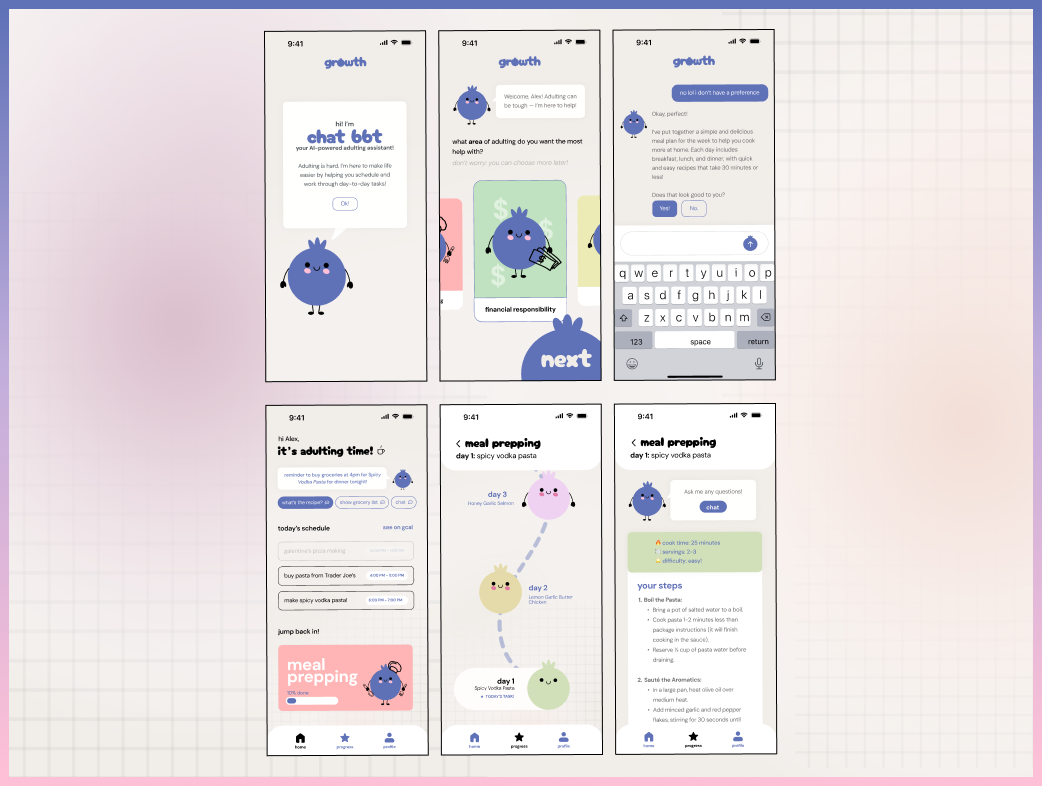
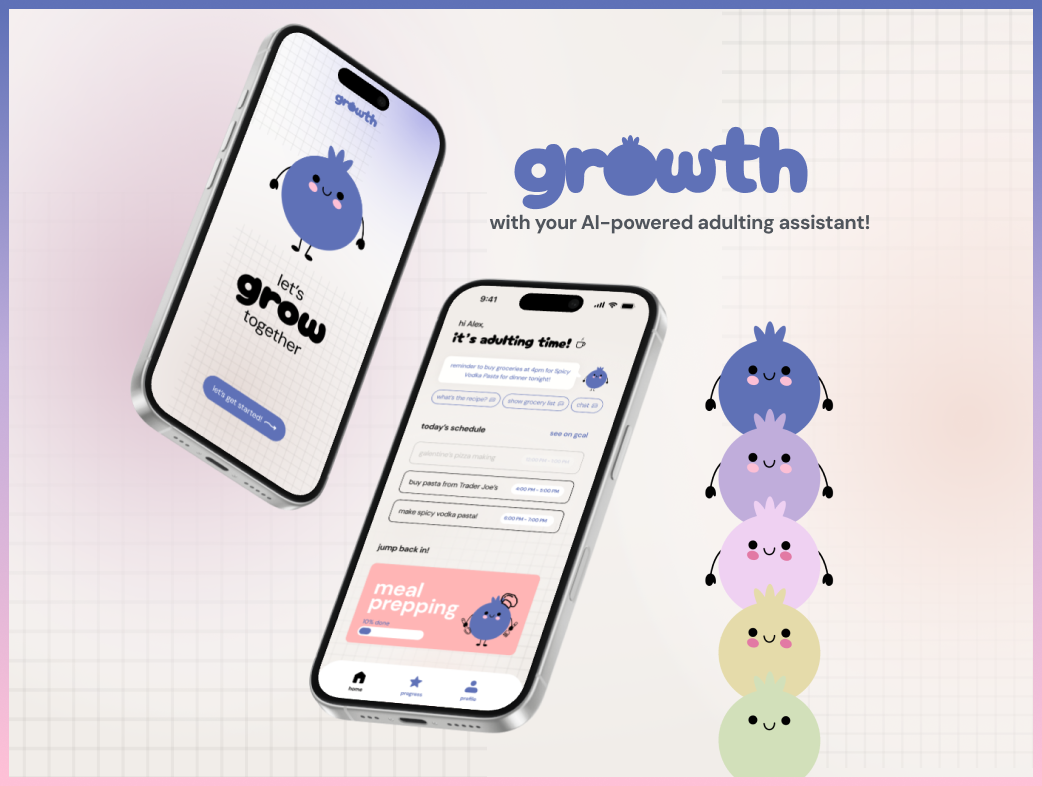
Growing up is a privilege, but, admittedly, most people don’t know how to best do so. Thus, Growth, (as adulting will always entail self-growth) is a mobile application where, with the help of an AI friend (Chat-BBT), users start to get situated with three major adulting categories — finances, cooking, and work/career. The judgment-free Chat-BBT then helps set personalized goals for each category and automatically syncs with Google Calendar to schedule tasks, reminders, and dedicated time in their existing schedules. A roadmap unique to you is generated to keep you on track with the goal you made. Adulting doesn’t have to be overwhelming— but when it is, Growth makes it berry-able.
- Describe your research process and findings. If you conducted any surveys or interviews, please include the survey form and/or interview questions here. If you conducted secondary research by pulling from online sources, please include a link to your sources. (Max 500 words)
Survey: https://forms.gle/JeWtLZXJVp9joG9m6
User research was conducted with a mix of ~30 survey responses and 1-1 interviews, and explicitly we made it a priority to conduct it throughout the design process.
We first wanted to make sure that this was a real problem that we could address—we sent out a survey with 26 participants with ~5 select 1-1 interviews about their experiences and thoughts about adulting: • The majority (61%) of participants either felt below average or average about adulting → Most people do not feel confident in their ability to be an "adult.” • An overwhelming majority of participants look on Google or browse (95.7%) or ask a friend or family member (87%) with adulting-related questions → Most people rely on external sources for adulting advice rather than their internal knowledge. • The current tasks that participants use to organize their tasks are Google Calendar (41% ) and Notion (20%)
The biggest pain points were the fear of judgment, embarrassment about not knowing (40%) • overwhelming complexity or simply lack of resources – 30% • inability to stay motivated or consistent — 20%
And, when we asked the users what the #1 most important feature they would appreciate, they answered: • AI-powered chat assistant – 30% (fun fact: we didn’t even ask them about AI… they mentioned this themselves!) • personalized to-do lists and scheduling – 25% • google calendar integration – 20% • organized categories for life tasks (separating topics like finances, cooking, bills) – 20%
The 1-1 interviews were also crucial in helping us identify the problem (“What emotions do you associate with adult responsibilities?”), assessing the need (“What’s a recent adulting challenge you faced? How did you overcome it?”), and defining the product (“If an AI tool guided you through tasks, how much control would you want to have?”). This information helped us 1) confirm that this was a real problem that was addressable with AI and 2) find the pain points that we can cover in our product, which we will address further in #4.
We also did iterative research with competitive analysis. As the preliminary research rolled in, we decided to look at what these alternative platforms (Google Calendar, Notion, and word of mouth) are doing right (or wrong).
Aside from iterative research, we did iterative testing — asking questions on par to: “Say that you’re a user and you’re trying to talk to the AI. How would you do that?,” and “Walk me through how you would go about the onboarding process.” Even as we were designing, we conducted additional testing with multiple people (~10), asking them to walk through our low-fidelity wireframes (~3 users) and provide feedback on the structure/flow/usability of our final prototypes (~4 users). We observed how users navigated and reacted to the interface without our prompts, interacted with our buttons and features, and interpreted instructions: with these pieces of feedback, we were able to change our copywriting to make the onboarding clearer, refine our layout, and feature placement.
- Describe your most important design decisions. What research findings and/or user testing results led you to make these decisions? (Max 500 words)
Our design decisions were guided by user research at every stage, ensuring that our final product directly addressed real user pain points! Through user surveys, interviews, and testing, we identified key challenges people face when learning how to “adult”—from feeling overwhelmed to struggling with fragmented information. These insights informed four major design decisions:
(1) Task Organization & Scheduling Integration:
As we mentioned before, users reported relying on Google Calendar (41% ) and Notion (20%)... but they still felt overwhelmed when faced with handling new ‘adult responsibilities’. Enter Chat-BBT, Growth’s very own personal AI chat assistant that goes beyond answering questions (e.g., “teach me how to meal prep” or “help me file my taxes”). Instead, it translates learning into action by breaking down goals into structured, manageable tasks—such as generating a grocery list or setting scheduling reminders. Seamless integration with existing tools people already use (specifically, we asked them to connect their Google Calendars) allows users to dedicate time to learning new ‘adulting’ skills without disrupting their workflow and helps them build habits instead of just gathering information.
(2) Simplified, Step-by-Step Guidance:
Users shared feelings of being overwhelmed by learning/completing ‘adulting tasks—particularly financial responsibilities (75%), career management (55%), and meal prepping (45%)! Some also didn’t know where to start or found traditional resources too complex (30%). In response, we designed with the intention of making these tasks more manageable by structuring a system that directs clear, step-by-step guidance—simplifying adulting tasks. Interactive roadmaps and chat-based learning provide bite-sized instructions, making tasks more approachable, and early user testing confirmed that breaking tasks into actionable steps significantly reduced users’ hesitation and increased their confidence in tackling new responsibilities!
(3) Judgment-Free, Reliable Support:
A surprisingly overwhelming number of users (41%) expressed concerns about feeling embarrassed for not knowing how to perform typical ‘adulting tasks’ as expected or judged when seeking help. This insight informed our decision to design Growth to be an approachable app and Chat-BBT to be a non-judgmental, supportive assistant—one that validates users’ experiences while offering reliable, practical solutions! By framing our blueberry-assistant as a friendly, understanding guide, we aim to help users feel more comfortable seeking help.
(4) Progress Roadmaps: Customization & Adaptive Learning:
Users want a system that caters to their specific needs and evolves with their growing skill sets, rather than providing one-size-fits-all advice. Instead of offering the same beginner-level tips repeatedly, Growth will adapt based on user interactions over time. Additionally, the customizable “modules” (unique to each user based on their needs and goals) within the Progress Roadmaps will allow users to personalize their learning journey, giving them ownership over how they approach adulting tasks.
Each decision was carefully informed by user research and later validated feedback and testing, shaping a final MVP that is not only functional but also a supportive, stress-free way for users to navigate adulting. By focusing on integration, guidance, non-judgmental support, and hands-on learning, we believe in helping users navigate adulting and supporting their growth!
Built With
- figma


Log in or sign up for Devpost to join the conversation.