MedWatch
MedWatch is an IT management and security monitoring platform for Medical Internet of Things (MIoT) devices. It helps hospital IT and security teams discover clinical devices, understand the protocols they speak, and flag risky or unauthorized behavior without actively probing fragile medical equipment.
Inspiration
Hospitals depend on connected devices like imaging scanners, lab analyzers, PACS servers, EHR systems, and clinical workstations. These systems often run on segmented networks, use specialized protocols like DICOM and HL7, and cannot always be scanned aggressively like normal enterprise laptops.
That creates a hard problem for hospital security teams: they need visibility into what is on the network, but the safest way to get that visibility is passive. MedWatch was built around that idea. Instead of touching the devices directly, it listens to network traffic, identifies clinical protocols, builds an asset inventory, and surfaces policy violations that a human operator can review.
What It Does
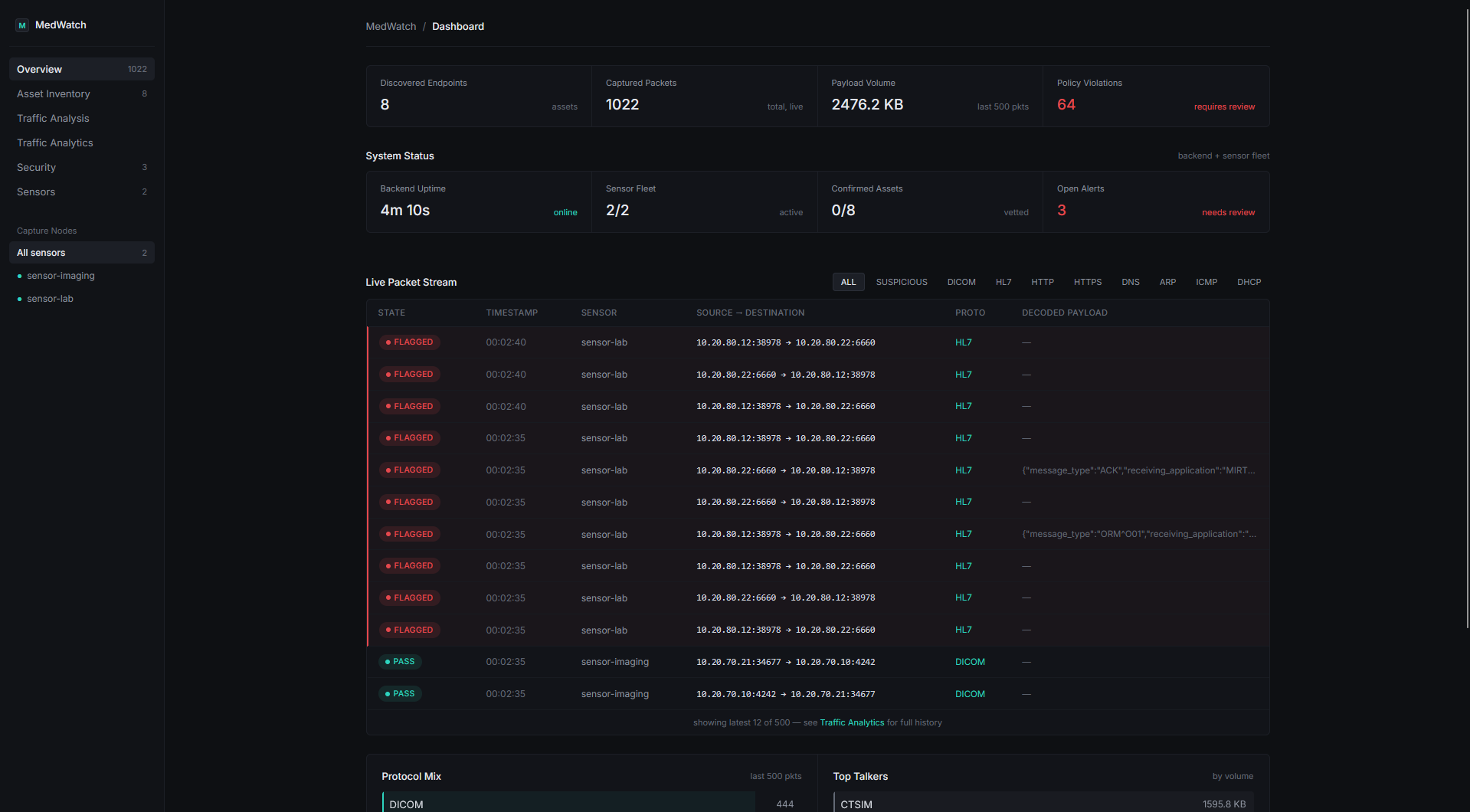
MedWatch passively monitors simulated hospital device networks and turns raw traffic into a live security dashboard.
Key features include:
- Passive asset discovery for MIoT and clinical infrastructure devices
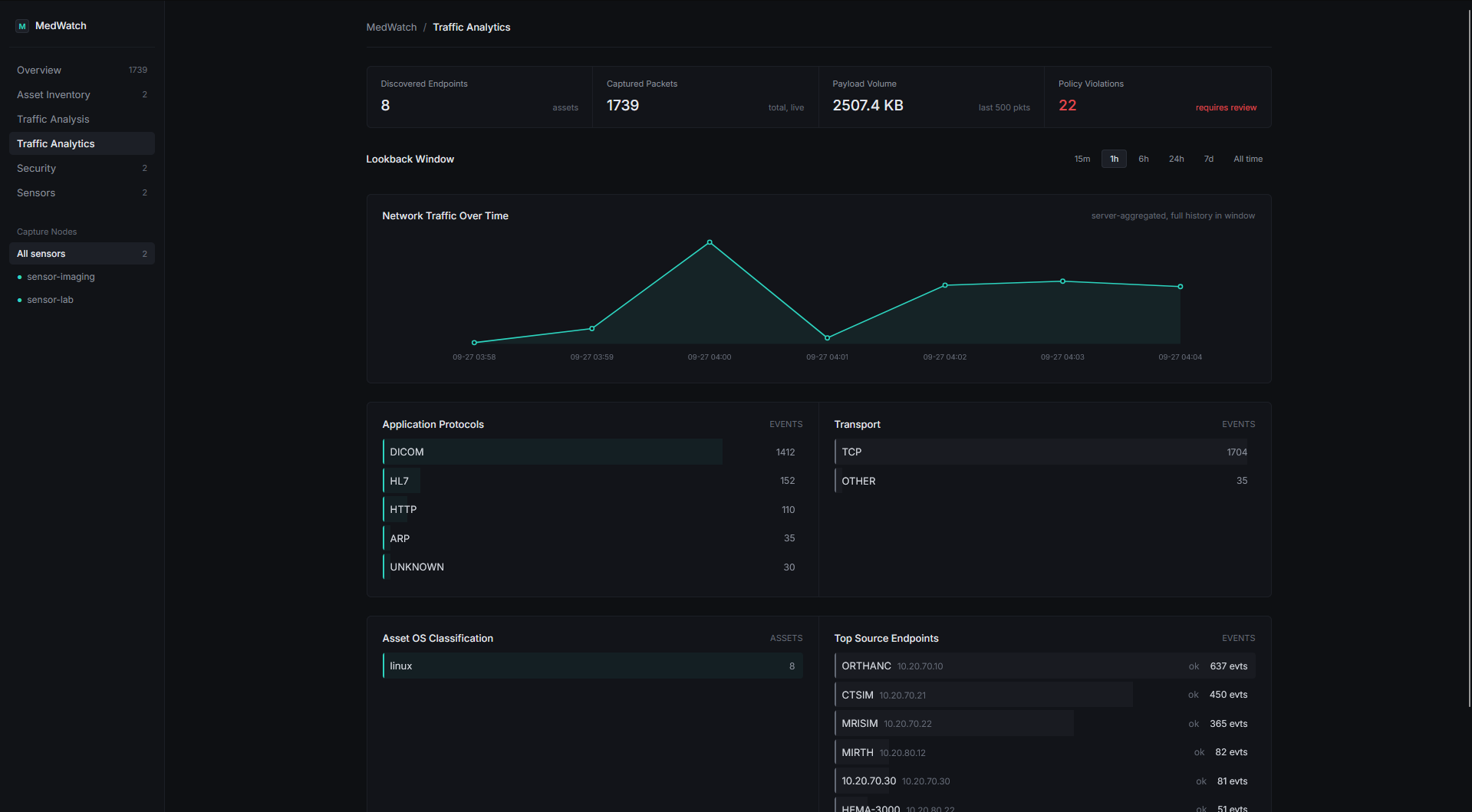
- DICOM and HL7 protocol detection and metadata extraction
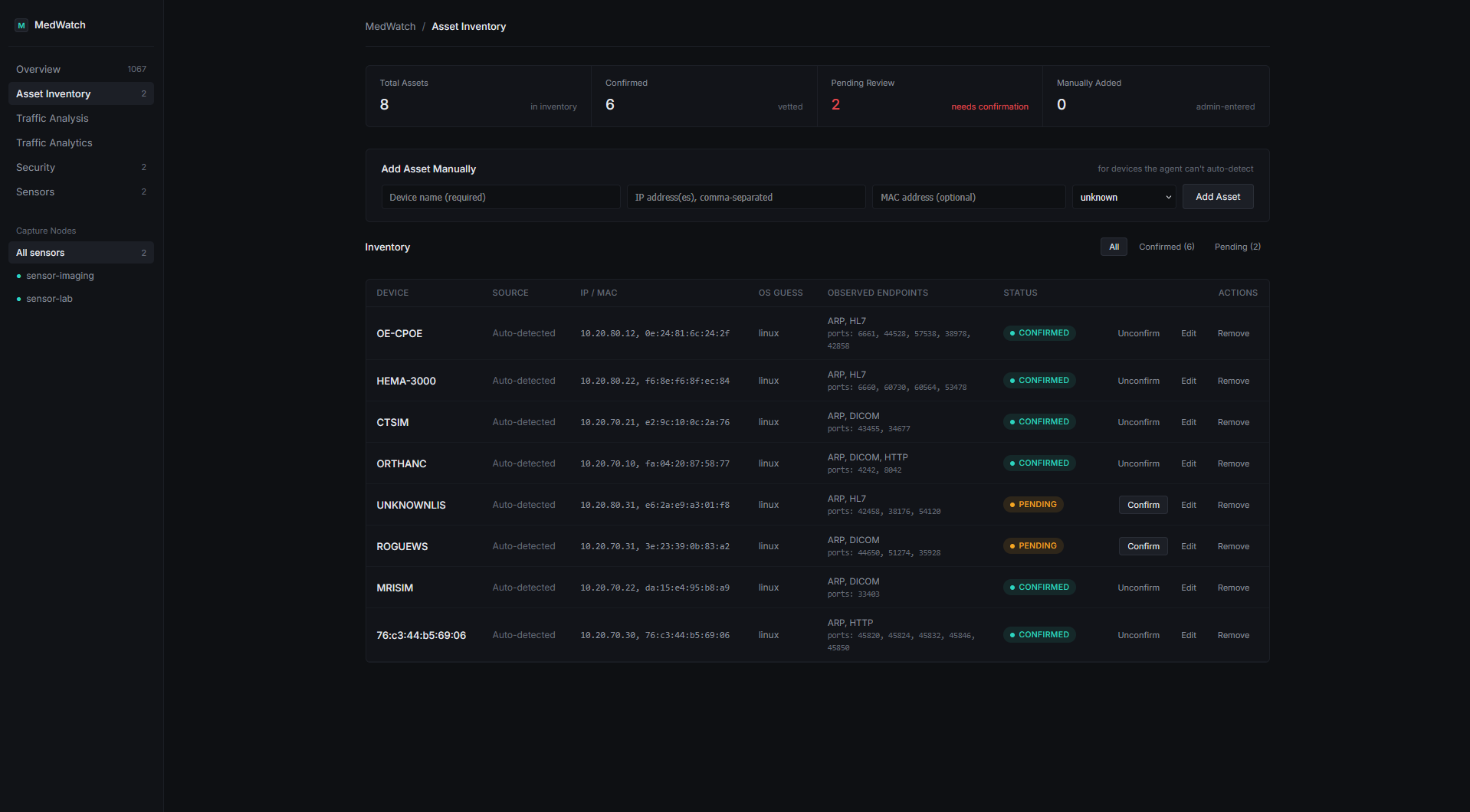
- A live asset inventory with confirmed and pending devices
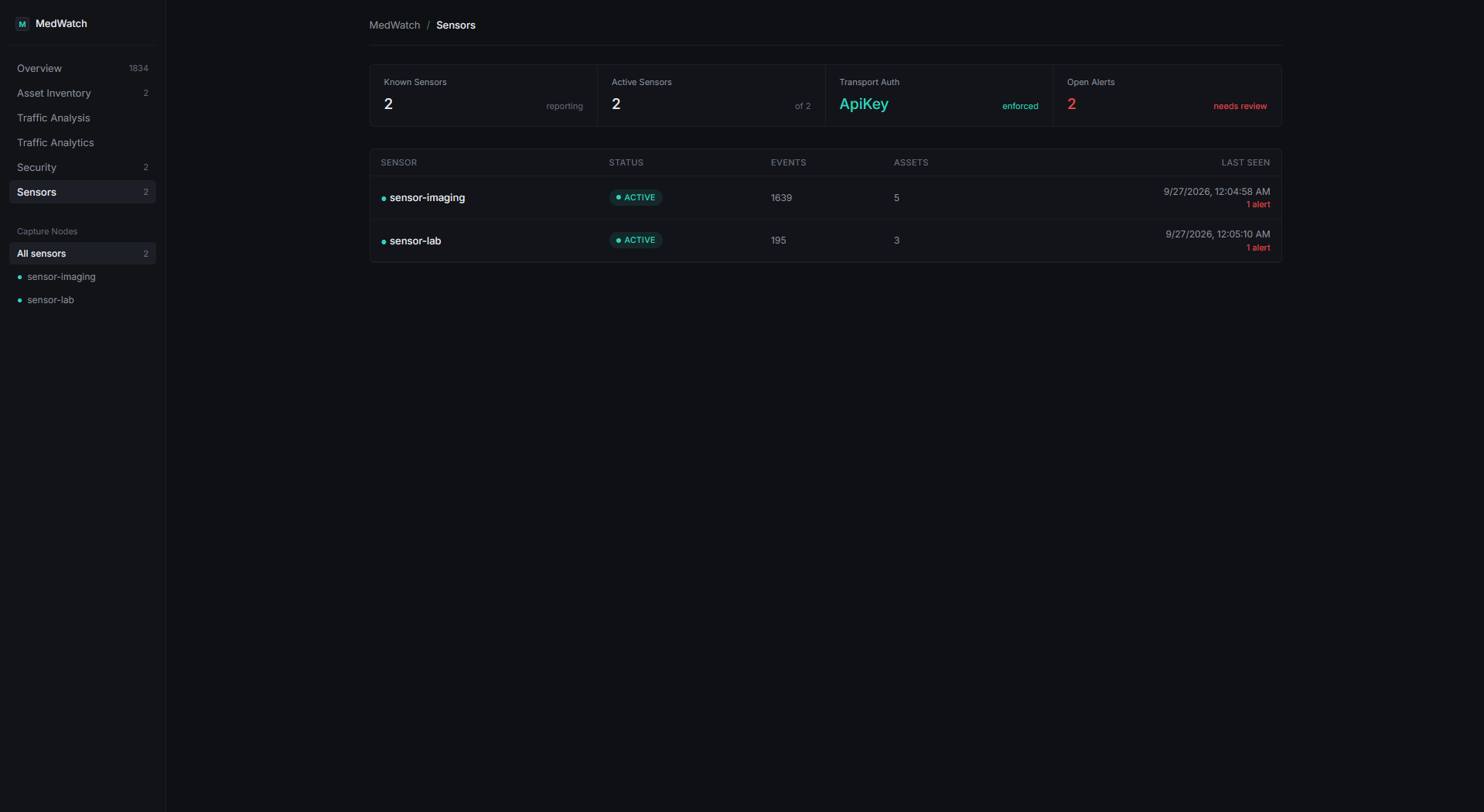
- Multi-sensor support across separate clinical subnets
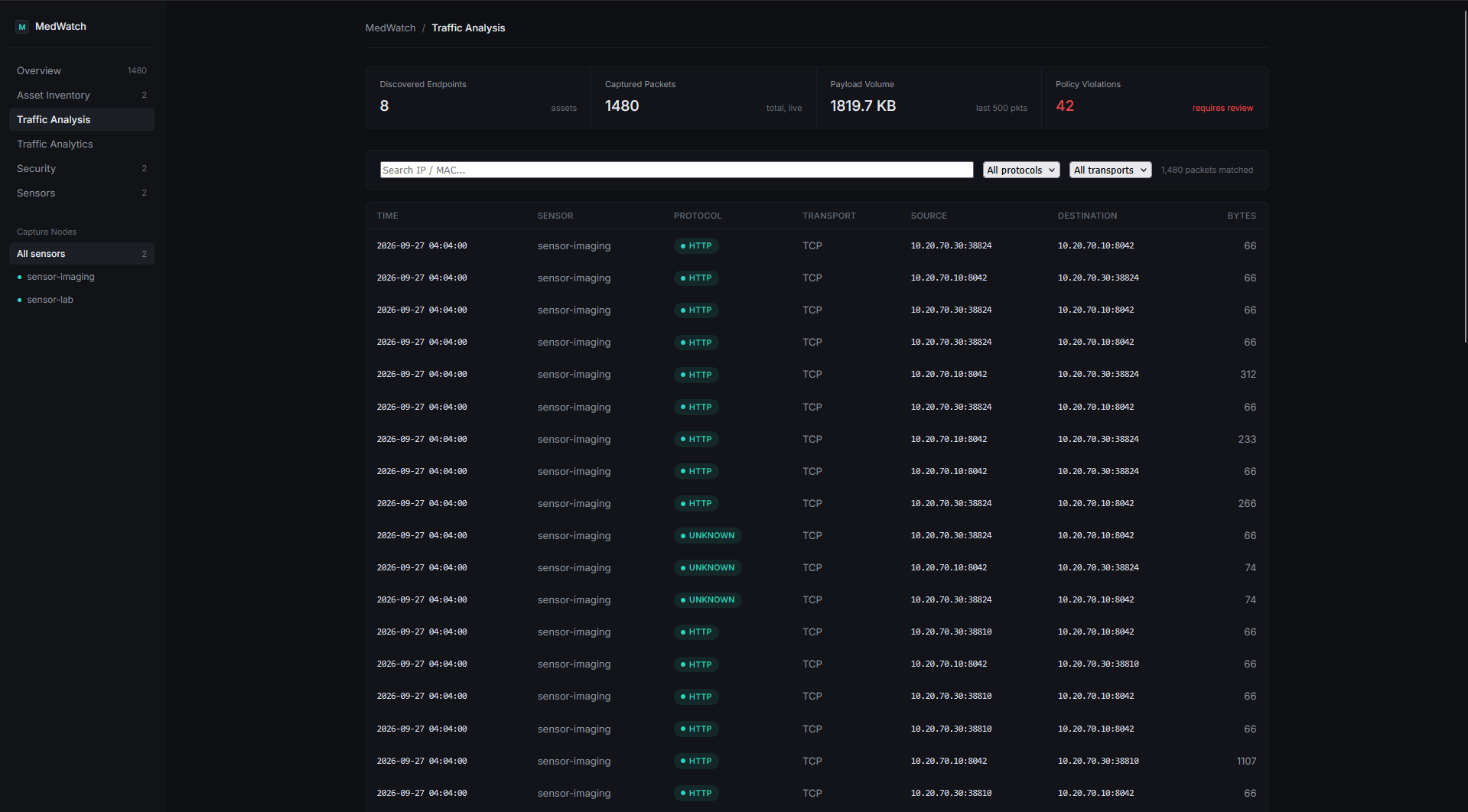
- Traffic analytics for protocol mix, packet flow, and suspicious activity
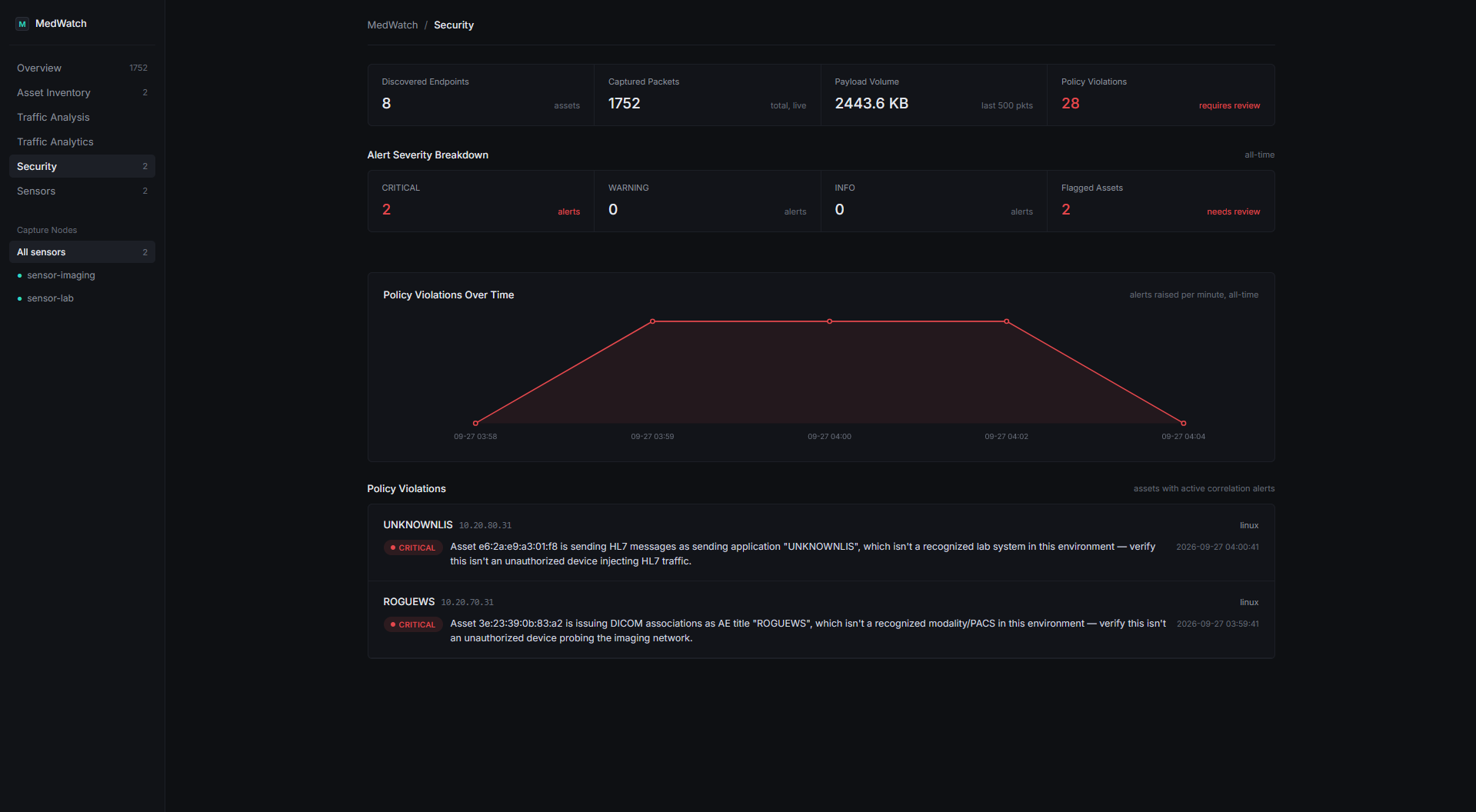
- Correlation rules that flag risky behavior, such as unauthorized DICOM initiators, unknown HL7 senders, or embedded devices exposing remote admin ports
- A realistic demo range with CT/MRI modality simulators, hematology analyzers, Orthanc PACS, Mirth Connect, OpenEMR, and a red-team traffic generator
In the demo, MedWatch watches two clinical networks:
- An imaging subnet where CT and MRI simulators send DICOM studies to Orthanc
- A lab subnet where hematology analyzers exchange HL7 messages through Mirth
A separate red-team container sends deliberately suspicious DICOM and HL7 traffic so MedWatch can detect unauthorized clinical-protocol activity in real time.
How We Built It
MedWatch is built as a full-stack security platform plus a Docker-based hospital cyber range.
The sensor agent is written in Rust and captures packets passively from network taps. It classifies traffic, tracks flows, extracts lightweight protocol metadata, fingerprints assets, and ships events to the backend API.
The backend is a Node.js service that stores events and discovered assets, exposes read APIs for the dashboard, and runs correlation rules that generate security alerts. The frontend is a Vite/React dashboard for operators to inspect assets, sensors, live traffic, analytics, and policy violations.
For the demo environment, we used Docker Compose to model a small hospital network:
- OpenEMR for the EHR
- Mirth Connect for HL7 integration
- Orthanc as the PACS
- CT and MRI DICOM modality simulators
- HL7 hematology analyzer simulators
- A radiology workstation that creates normal background traffic
- Two MedWatch monitoring agents, one per clinical subnet
- A red-team box that generates unauthorized DICOM and HL7 traffic
One important implementation detail is that Docker bridge networks behave like switched networks, not hubs. A monitoring container attached normally to a bridge cannot see other containers' unicast traffic. To make the demo realistic, each MedWatch sensor resolves the host bridge device for its target Docker network and captures there, similar to how a real deployment would use a SPAN port or network tap.
Challenges We Ran Into
The biggest challenge was making the demo environment behave like a real hospital network instead of a toy simulation. Clinical protocols are noisy and specialized, and passive monitoring only works if the sensor is placed correctly.
We had to solve several problems:
- Capturing real inter-container traffic from Docker bridge networks
- Distinguishing DICOM and HL7 traffic from generic TCP payloads
- Preserving protocol identity across multi-packet flows
- Avoiding invasive scanning or active probing assumptions
- Keeping simulated clinical traffic realistic enough to demonstrate useful detection
- Separating normal device behavior from intentionally suspicious red-team traffic
We also had to balance hackathon scope with correctness. The correlation rules are intentionally simple, but the pipeline is structured like a real product: sensors collect, backend correlates, dashboard explains, and operators confirm what is known-good.
Accomplishments
We are proud that MedWatch is more than a mock dashboard. It includes a working cyber range, passive packet capture, clinical protocol parsing, backend ingestion, security correlation, and a live operator interface.
The demo can show a full workflow:
- Clinical devices begin talking on the network.
- MedWatch sensors observe DICOM and HL7 traffic passively.
- Assets appear in the inventory with identity hints and observed protocols.
- A red-team host sends unauthorized clinical-protocol traffic.
- MedWatch raises alerts for unrecognized DICOM and HL7 identities.
- The operator reviews, confirms, edits, or removes assets from the dashboard.
That end-to-end loop is the core of what we wanted to prove.
What We Learned
We learned that visibility in medical networks has to be designed around safety. Traditional enterprise scanning assumptions do not always fit environments with embedded clinical equipment, legacy software, and uptime-sensitive workflows.
We also learned how much network placement matters. Passive monitoring sounds simple, but in both real switched networks and Docker bridge networks, a sensor only sees useful traffic if it is connected to the right observation point.
On the implementation side, we learned how to parse just enough DICOM and HL7 metadata to identify devices and detect suspicious behavior without collecting sensitive patient data.
What's Next
The next steps for MedWatch are:
- Replace demo hardcoded allowlists with configurable hospital asset policies
- Add richer device fingerprinting and confidence scores
- Support more medical and operational protocols
- Add alert triage workflows and integrations with ticketing or SIEM tools
- Build deployment profiles for real network taps, SPAN ports, and Kubernetes environments
- Improve historical analytics and incident timelines
- Add role-based access control for hospital IT and security teams
Long term, MedWatch could become a safety-first security layer for clinical networks: passive by default, protocol-aware, and built for the realities of hospital operations.
Built With
- Rust
- Node.js
- React
- Vite
- SQLite
- Docker Compose
- DICOM
- HL7v2 / MLLP
- Orthanc
- Mirth Connect
- OpenEMR
Short Description
MedWatch is a passive IT management and security platform for Medical IoT devices. It discovers clinical assets, analyzes DICOM and HL7 traffic, and flags unauthorized behavior across simulated hospital networks.
Tagline
Passive security visibility for Medical IoT networks.


Log in or sign up for Devpost to join the conversation.