Inspiration

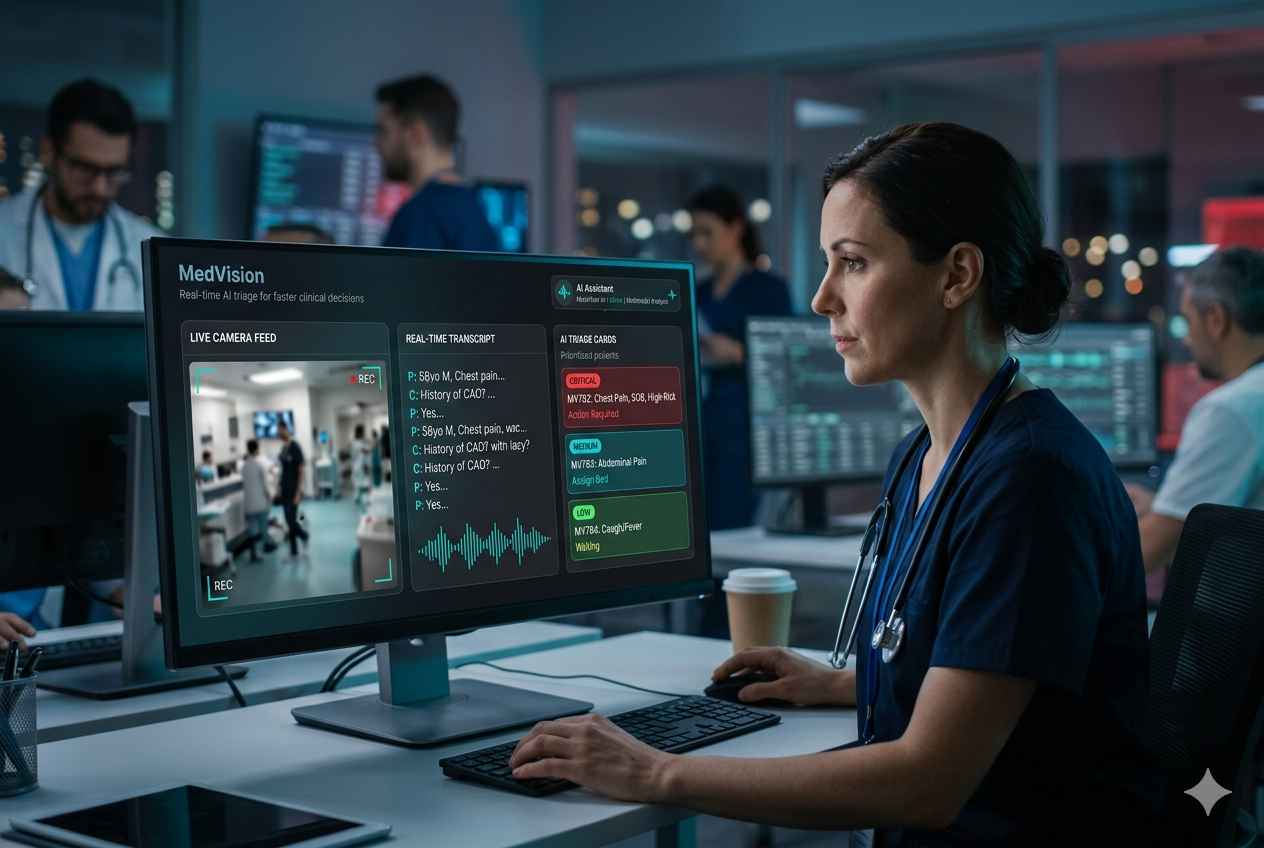
MedVision came from one core problem: in urgent care moments, clinicians have to process too much information too quickly. We wanted to build an AI teammate that can listen, observe, and surface critical triage signals in real time, so medical teams can focus on patients instead of juggling fragmented inputs

What it does

MedVision is a real-time triage assistant. It takes live audio and video input, streams it to an AI backend, and returns:

live transcript updates, spoken/interactive agent responses, triage cards with urgency-focused insights, a session log and downloadable report for review. In short, it acts like a multimodal “clinical co-pilot” during fast-moving assessments.

How we built it

We built MedVision as a full-stack, realtime system:

Frontend: React + TypeScript dashboard for camera feed, transcript, triage panel, and controls. Backend: FastAPI-based service that manages live sessions and AI orchestration. Realtime flow: microphone audio + periodic video frames sent to the model, then rendered as transcript and triage output. Reliability features: audio gating, interrupt support, state-aware session controls, and structured logging/report export. The focus was on low-friction UX under pressure, not just model output quality.

Challenges we ran into

Managing real-time audio without echo or feedback loops. Keeping latency low while still getting useful, stable triage output. Synchronizing multiple live states (camera, mic, speaking status, connection state, logs). Handling local/cloud environment differences during setup and deployment. Designing an interface that stays clear when many events happen at once.

Accomplishments that we're proud of

Built an end-to-end multimodal prototype that actually works live. Created a clean command-center UI that surfaces the right information quickly. Implemented practical safety/UX controls like mute, interrupt, and connection-aware settings. Added structured session logs and downloadable reports for transparency and review. Demonstrated a strong foundation for AI-assisted clinical triage workflows.

What we learned

Real-time AI UX is mostly about trust, clarity, and timing. Small engineering decisions (buffer windows, gating, retries) have huge UX impact. In healthcare contexts, explainability and traceability matter as much as speed. Building with clinicians in mind means reducing cognitive load, not adding more screens.

What's next for MedVision

Improve triage precision with richer medical prompting and better guardrails. Add multilingual voice quality improvements and locale-aware triage phrasing. Introduce clinician-in-the-loop review tools for safer recommendations. Expand integrations (EHR-ready export formats, hospital workflow hooks). Run pilot testing with real users to measure impact on triage speed and confidence.

Built With

Share this project:

Updates

posted an update —

MedVision – Project Update

I would like to share the latest progress on MedVision, an AI-powered real-time medical assistance system built using Gemini Live technology.

Overview

MedVision is designed to assist with real-time symptom recognition and emergency triage using live video and voice interaction. The system analyzes visual cues and spoken symptoms to help identify possible medical conditions and guide appropriate next steps.

Recent Improvements

Live Video AI Analysis The system now integrates Gemini Live to analyze camera input and recognize important visual cues such as: • Hand on chest indicating potential chest pain or cardiac symptoms • Labored breathing posture suggesting respiratory distress • Holding the head indicating possible headache or neurological concern • Slumped posture which may indicate shock, fatigue, or weakness

User Interface Enhancements • Camera framing guides to help users position themselves correctly during analysis • Symptom reference buttons for quick identification of chest, breathing, head, and posture issues • Visual indicators that show when the AI system is actively analyzing video input

System Stability Improvements • Fixed frontend loading issues • Improved real-time frame capture performance • Enhanced prompt handling to improve AI response accuracy

Upcoming Development

Future updates will include: • Emergency detection alerts • A medical recommendation engine • Mobile-friendly interface improvements • Integration with healthcare service providers

Vision

MedVision aims to become an intelligent AI triage assistant that helps identify critical symptoms quickly and supports patients in seeking appropriate medical care.

Technology Stack • Gemini Live API • Python backend • Modern web frontend • Real-time video processing

Log in or sign up for Devpost to join the conversation.

posted an update —

We are excited to share the latest progress on MedVision, our AI-powered real-time medical assistance system built using Gemini Live Agent technology.

What is MedVision?

MedVision is designed to assist in real-time symptom recognition and emergency triage using live video and voice interaction. The system analyzes visual cues and spoken symptoms to help identify possible medical conditions and guide the next steps.

Recent Improvements

Live Video AI Analysis The system now uses Gemini Live to analyze live camera input and detect visual cues such as: • Hand on chest → possible chest pain / cardiac symptoms • Labored breathing → respiratory distress • Head holding → possible headache or neurological issue • Slumped posture → possible shock or fatigue

Improved UI / UX • Camera framing guides to help users position themselves correctly • Symptom quick-reference buttons (Chest, Breathing, Head, Posture) • Real-time visual feedback indicators showing when AI analysis is active

Stability Improvements • Fixed frontend loading issues • Optimized real-time frame capture • Improved Gemini prompt handling for better accuracy

Upcoming Updates • Emergency detection alerts • Medical recommendation engine • Mobile-friendly interface • Integration with healthcare providers

Vision

MedVision aims to become a smart AI triage assistant that can help identify critical symptoms quickly and guide patients toward appropriate medical care.

Built With • Gemini Live API • Python backend • Modern web frontend • Real-time video processing

Log in or sign up for Devpost to join the conversation.

Submission history