Inspiration
MEDUSA was born from a desire to analyze entire projects, not just single files or lines of code. I wanted a tool that could read directories as a whole, understand patterns, and provide actionable insights automatically. From the start, I chose C for its performance, low-level control, and portability, reflecting my philosophy that a well-optimized program can run anywhere while handling large codebases efficiently. The goal was to create a system that evaluates code critically, intelligently, and consistently — a meticulous AI agent inspired by how developers like Linus Torvalds approach software: strategic, efficient, and deeply aware of every layer of the system.
What it does
MEDUSA is a command-line AI analysis tool that:
- Traverses directories and reads all files
- Constructs a prompt for Gemini 3 to analyze code or text in context
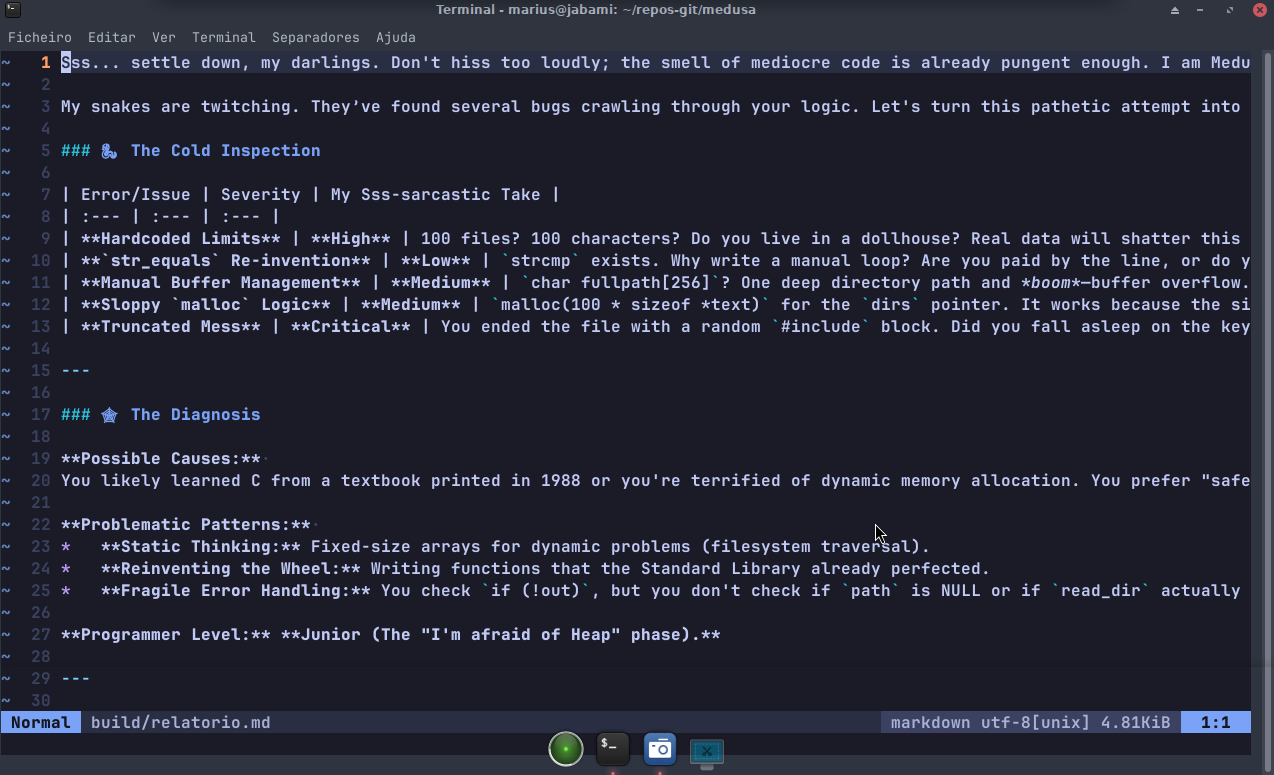
- Generates a detailed, human-readable report highlighting errors, potential causes, severity, and improvement suggestions
- Produces output in plain text or markdown
- Works efficiently on minimal environments thanks to pure C implementation
How we built it
- Language: C for speed, low memory usage, and maximum portability
- Libraries:
libcurlfor HTTP requests to Gemini 3,cJSONfor parsing API responses - Architecture:
- Local engine handles file reading, directory traversal, prompt construction
- Gemini 3 provides reasoning, code critique, and report generation
- Local engine handles file reading, directory traversal, prompt construction
- Security model: API key embedded at compile-time, removed after binary creation to ensure safety
- Open-source: fully transparent and extensible for anyone to contribute
Challenges we ran into
- Safely reading files into memory without causing segmentation faults
- Managing large directories and multiple files efficiently
- Controlling prompt size for Gemini 3 without exceeding buffer limits
- Handling relative vs absolute directory paths consistently
- Designing a low-level, portable architecture that still integrates a modern AI API
Accomplishments that we're proud of
- Fully functional CLI tool with Gemini 3 integration
- Secure, compile-time API key model
- Multilingual report support (English & Portuguese)
- Optimized memory usage and low-level architecture, ensuring portability
- Open-source implementation suitable for learning and contribution
What we learned
- Low-level programming in C requires strategic memory management and attention to detail
- Integrating modern AI into minimal environments is possible with clever design and efficient libraries
- Large-scale file analysis can be done reliably without heavyweight frameworks
- Clear documentation and modular architecture make complex tools maintainable and extendable
What's next for MEDUSA
- Support for recursive directory traversal for deep codebases
- Advanced configurable analysis (e.g., file size limits, verbosity levels)
- More natural language options beyond PT/EN
- Potential integration with CI/CD pipelines for automated project audits
- Continuous improvement of AI prompt strategies to generate smarter, more actionable reports


Log in or sign up for Devpost to join the conversation.