-
The MEDule logo.
-
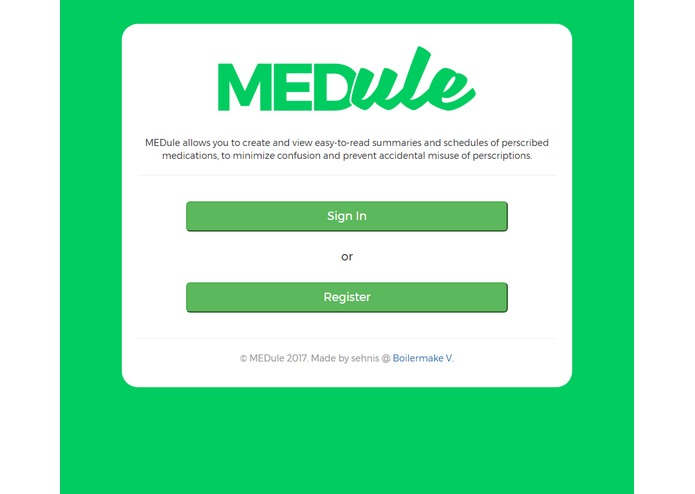
Example of a landing page.
-
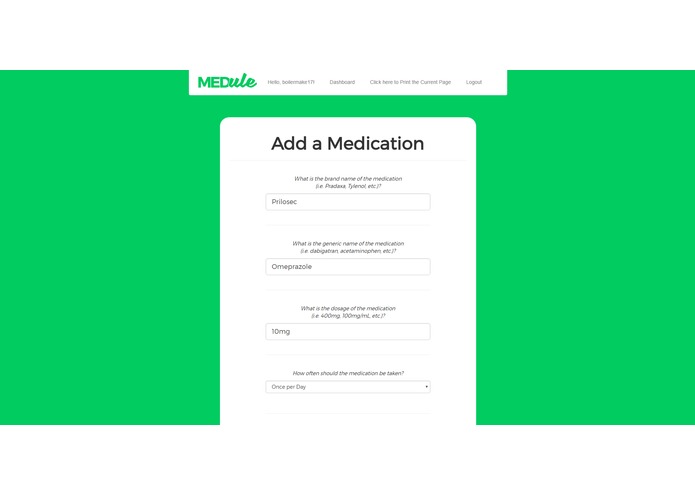
Filling out a form. Riveting, I know.


Note: the official site is medule.org, but bit.ly/MEDule links to the Heroku demo.
Inspiration
Boilermake V's retro theme this year seemed to bring up a specific question for me; what older technologies in our everyday lives could be brought up to speed in just 36 hours of work? Rather than designing something for someone in the eighties, though, I opted to focus on something to benefit people in _ their _ eighties. Medicine labels are tiny, full of jargon, and inconvenient for people of all ages let an older population with more challenges in reading and properly scheduling use for them. Partially in line with Liberty Mutual's safety-themed challenge, I set out to make an alternative to confusing labels that simultaneously worked for both tech-oriented and tech-averse crowds.
What it does
Simply put, this web app takes in user input about what medications they take, and organizes them be be easily read both online and when printed. Individuals (or more likely, their loved ones or doctors/nurses) can create an account, and store digital alternatives to medical labels for use both alongside and/or instead of the labels on small pill bottles. The implication is that these can be used to make better plans and schedules; hence the union of one's med icine and sche dule , forming MEDule.
How I built it
In the early stages, I used a relatively vanilla flask/python setup to produce the various pages with sqlite as the database under the hood. As the pages started developing, I began to stylize them more and more with bootstrap, as well as adding special fonts and graphic design elements. I eventually fleshed out the structure with more CSS and JQuery, before migrating my database to mySQL in order to host the site on Heroku for presentations.
Challenges I ran into
Come to find out, SQL is pretty weird. I didn't expect developing something like this on my own to be a cakewalk, but I quickly found myself worrying about two simultaneous extremes; that I was stretching myself too thin with all that I was trying to learn and do for the first time, and that sticking to what I knew would make for an unimpressive app. In the end, The difficulty involved in facing these issues for the first time proved a little too much for me to accomplish all that I wanted to; some features such as API integrations had to get thrown to the wayside entirely, just so that I could be sure that everything worked well on a basic level.
Accomplishments that I'm proud of
I went into Boilermake having very nervous and having never done a hackathon before, and came out with both a renewed interest in coding projects as well as a newfound desire to do them in such a fun setting. Being able to point to a real, functioning web app (however insignificant it may be in the grand scheme of things) was a rewarding experience, too.
What I learned
A lot. I got to talk with a number of other students as well as professionals from tech-based companies, all of whom were very understanding with me and my lack of knowledge on certain concepts. My struggles with figuring out SQL led me to learn a lot about SQL as well as its alternatives such as MongoDB; although 36 hours wasn't enough to fully explore and implement this and more, it left me with a lot of interesting leads for me to pursue further, as well as better methods of using my current expertise through trial and error.
What's next for MEDule
If I were to continue this project, there's a number of different directions I'd go with it. The most important one would be to up the overall security and encryption involved in the system, given its medical nature and potential for synergy with actual medical records. On top of this, though, I'd be interested in incorporating more outside data and APIs to make it easier for users to produce and use the lists produced by the site.


Log in or sign up for Devpost to join the conversation.