-
-
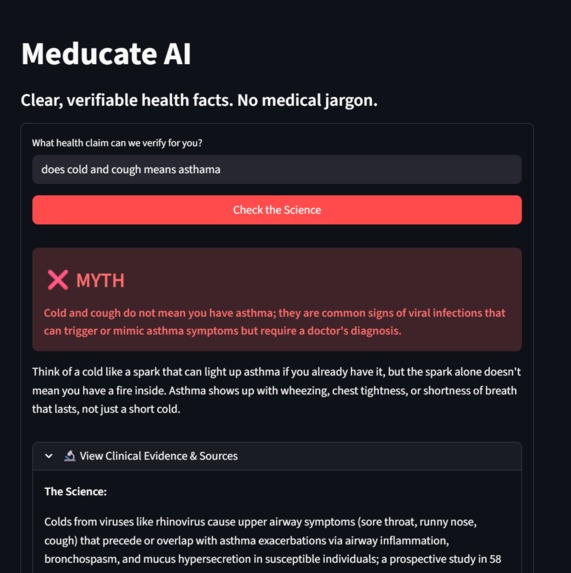
app demo
Inspiration
Medical misinformation on social media spreads faster than clinical facts. I noticed a massive "Health Literacy Gap": peer-reviewed journals are locked behind dense jargon, while accessible health content online is often unverified or trying to sell a supplement. I wanted to build a bridge, a tool that takes the highest standard of human knowledge (clinical trials) and makes it instantly understandable to an 8th-grader.
What it does
Meducate AI is a real-time clinical fact-checker. Users input a health claim or medical term. The app searches medical journals published within the last 12 months and uses Progressive Disclosure to present the answer:
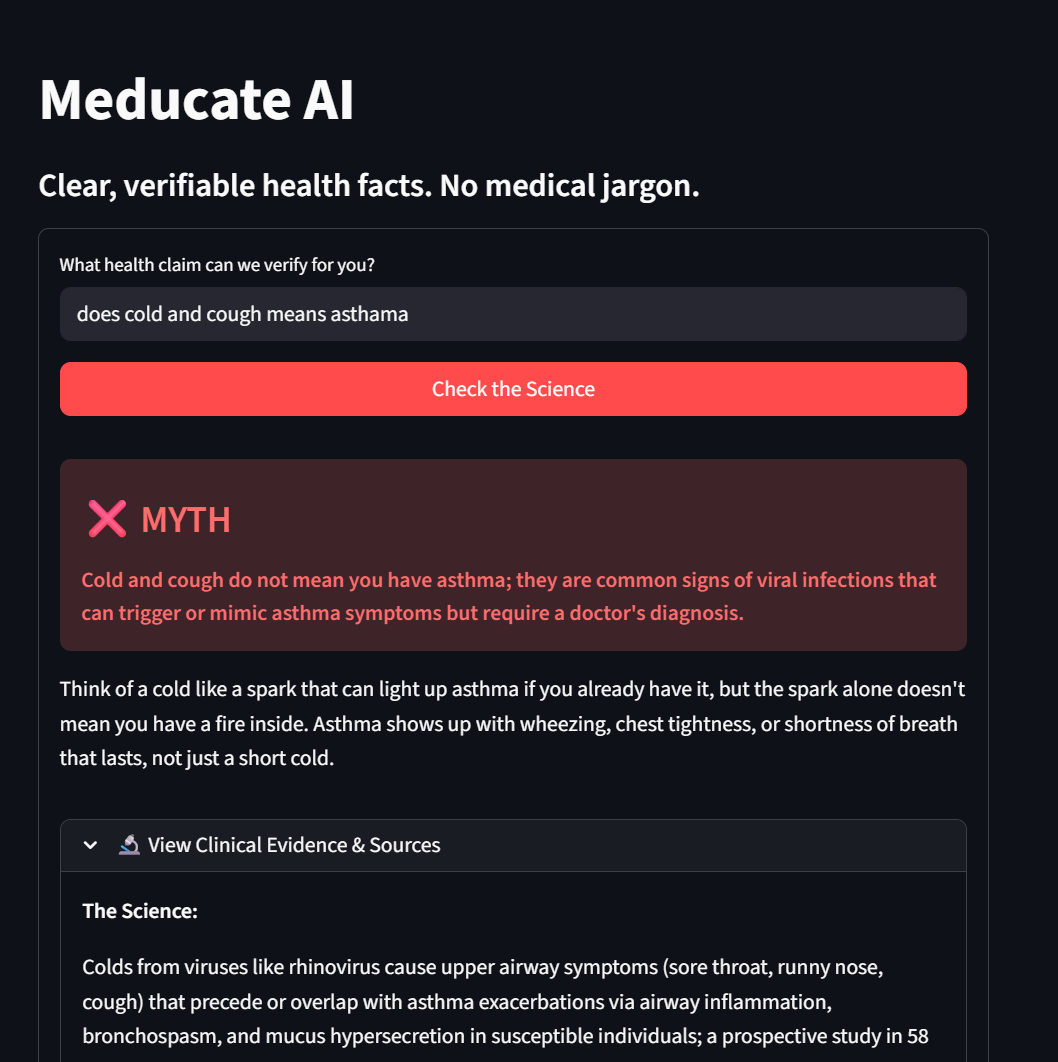
- The Verdict: A color-coded Fact, Myth, or Mixed Evidence badge.
- The Bottom Line: A simple, plain-English summary and analogy.
- The Science: A collapsible section containing the biological mechanism of action and directly cited source links for medical professionals or skeptics.
How we built it
I built the frontend and routing entirely in Python using Streamlit, optimizing for a clean, mobile-friendly SaaS aesthetic. For the backend intelligence, I integrated the Perplexity API (Sonar-Pro model). Instead of using it as a standard chatbot, I engineered a strict system prompt that forces the LLM to act as a structured data extractor. It fetches live web data, analyzes it, and outputs a strict JSON payload, which our Streamlit app then parses and maps directly to the UI components.
Challenges we ran into
The biggest challenge was LLM formatting instability. Even when instructed to return pure JSON, AI models frequently wrap their responses in Markdown code blocks (e.g., ```json), which crashes standard Python json.loads() functions. I overcame this by writing a custom RegEx extraction function (extract_json) that dynamically hunts for the JSON object within the payload, ensuring the app never breaks during a live query.
Accomplishments that we're proud of
I successfully built a hallucination-resistant medical AI. By leveraging Perplexity's search-first architecture and enforcing a 12-month data constraint, the app refuses to guess. I am also proud of the UI design; implementing "Progressive Disclosure" allows the app to serve both a concerned parent and a medical student perfectly without cluttering the screen.
What we learned
I learned the critical difference between Generative AI (writing text) and Analytical AI (synthesizing structured data). I also learned how to manipulate system prompts to control exact output formats, bridging the gap between an LLM and a rigid frontend framework.
What's next for Meducate AI
- Multilingual Support: Translating complex health data into local languages.
- PDF Report Export: Allowing patients to generate a 1-page PDF of their query to take directly to their doctor's appointment.
- Enterprise API: Packaging the engine so telehealth apps can embed our "Fact-Check" button directly into their patient portals.

Log in or sign up for Devpost to join the conversation.