-
-
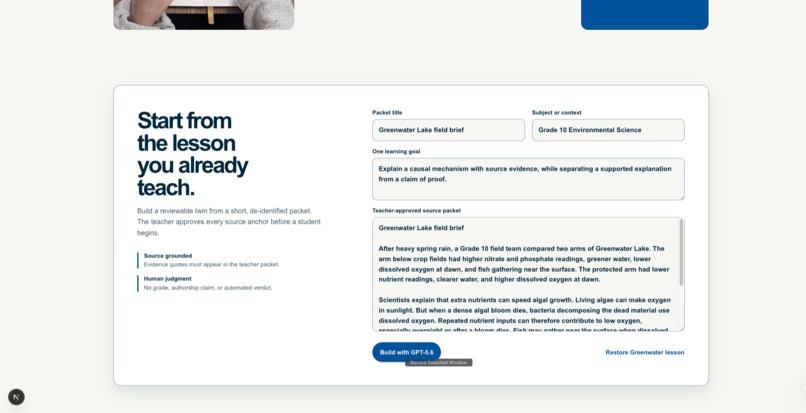
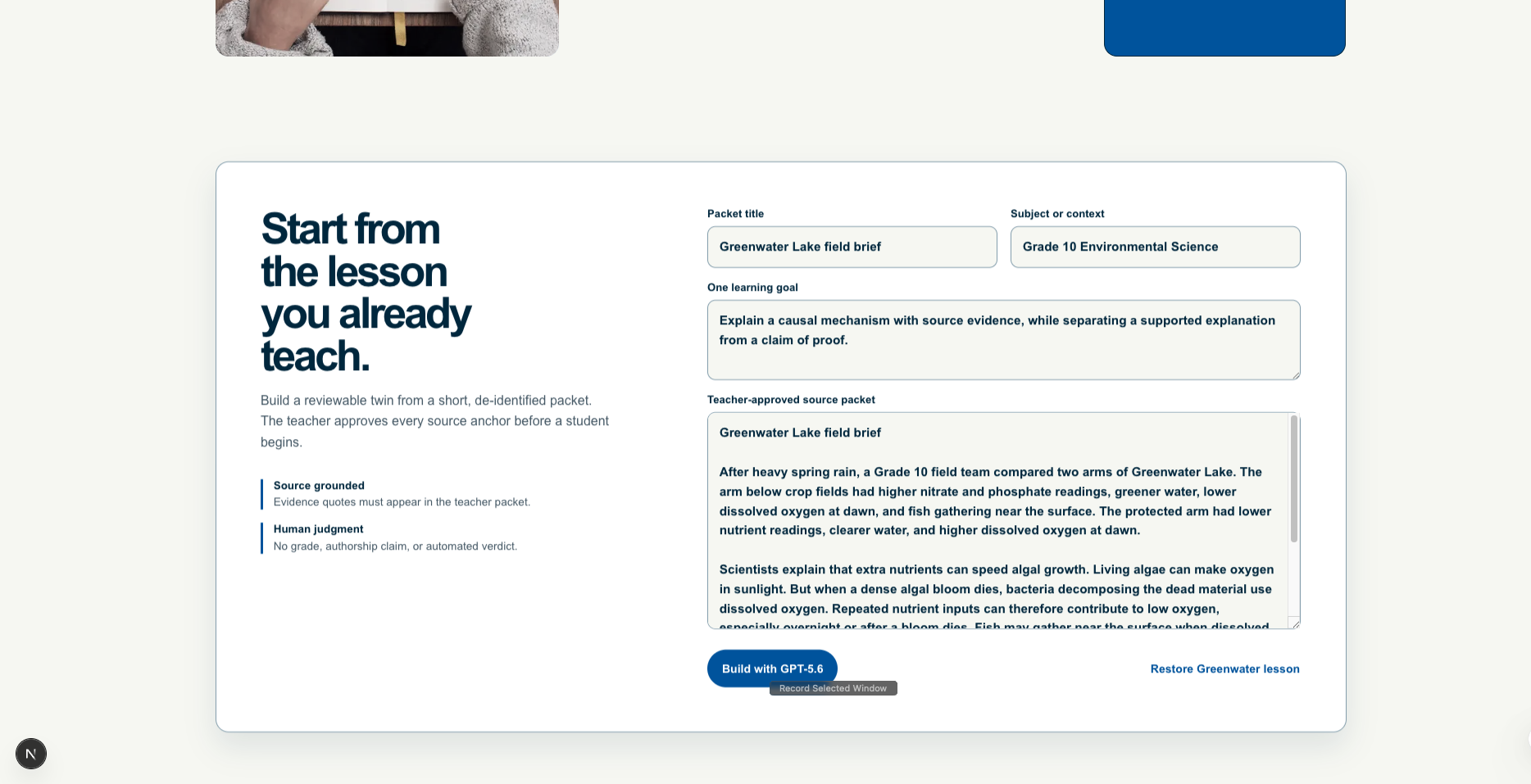
Start from the lesson you already teach.
-
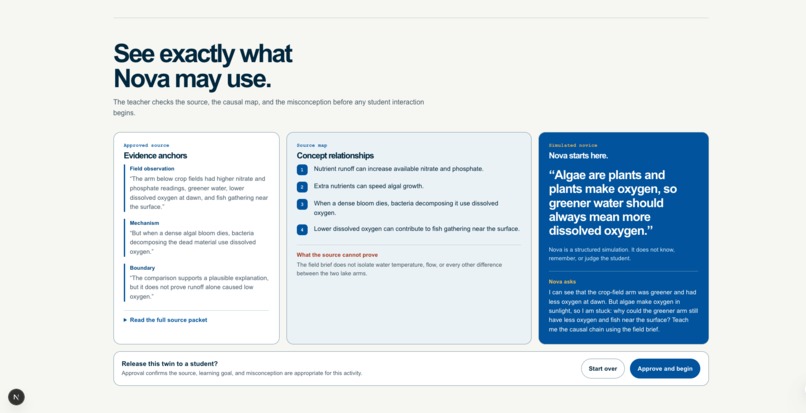
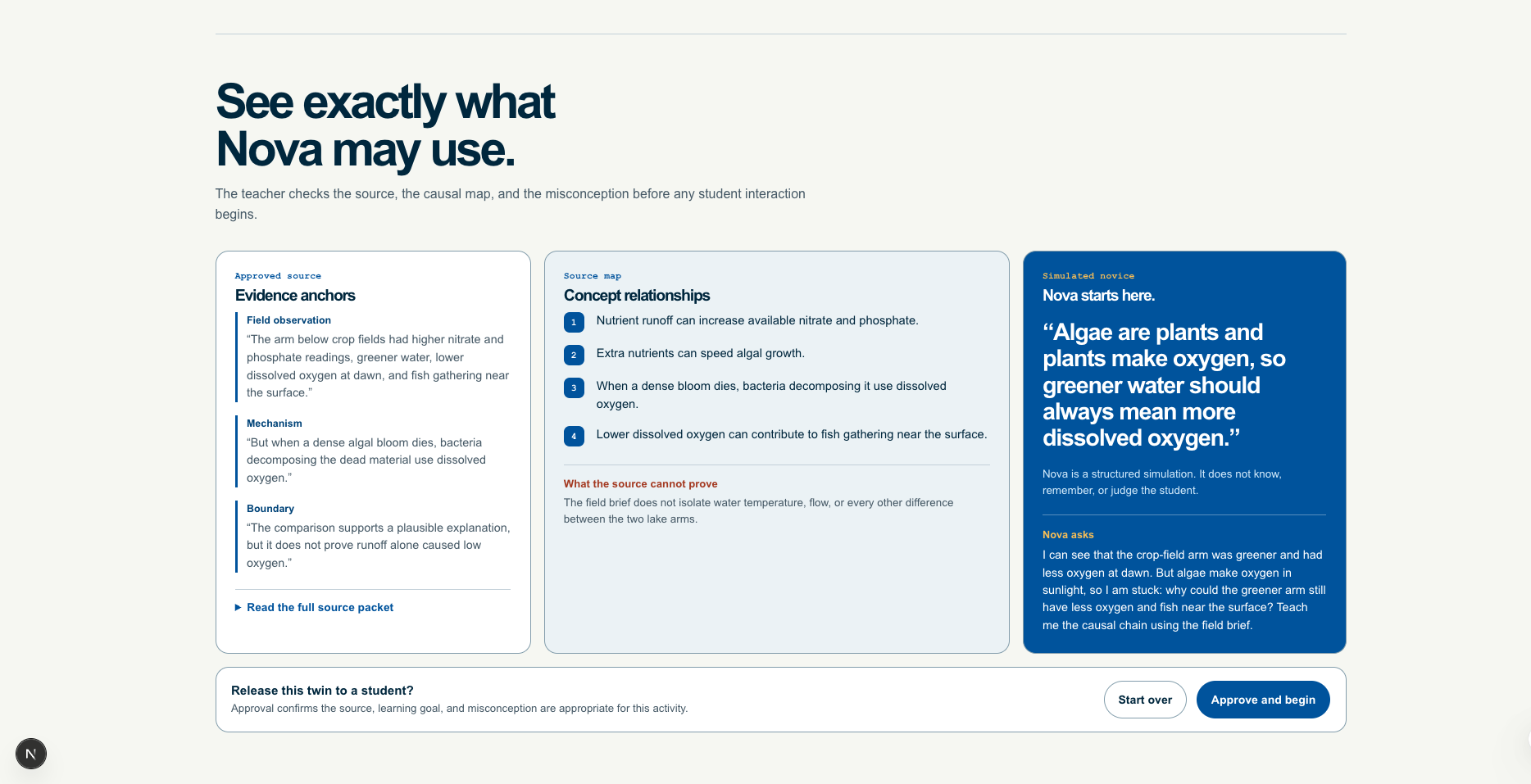
See exactly what Nova may use.
-
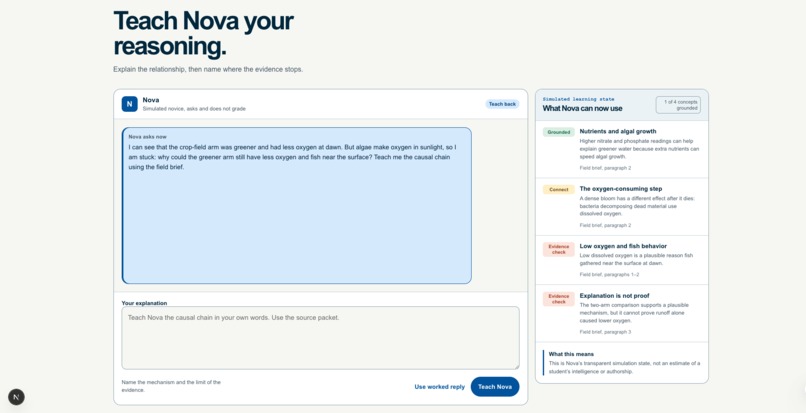
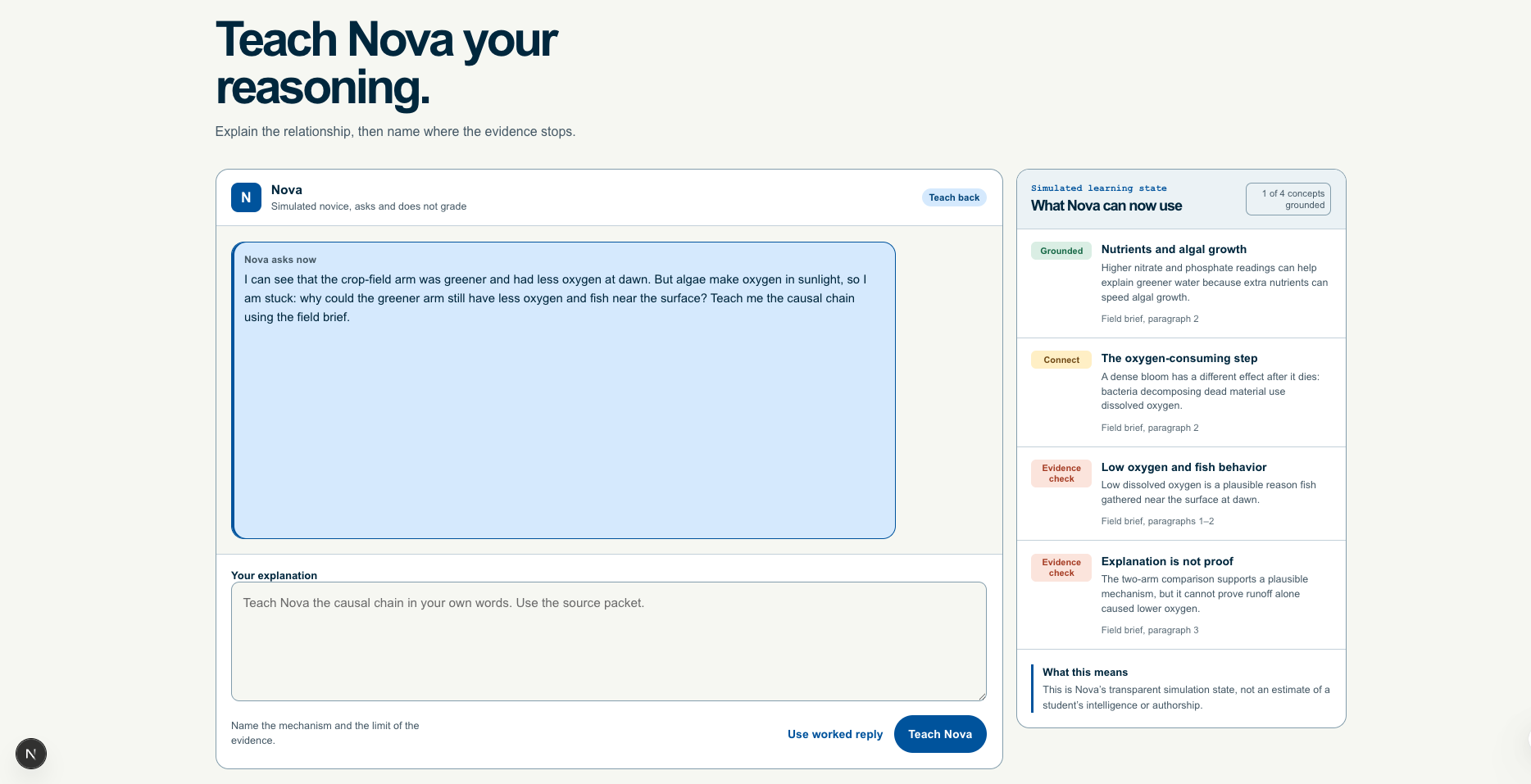
Teach Nova your reasoning.
-
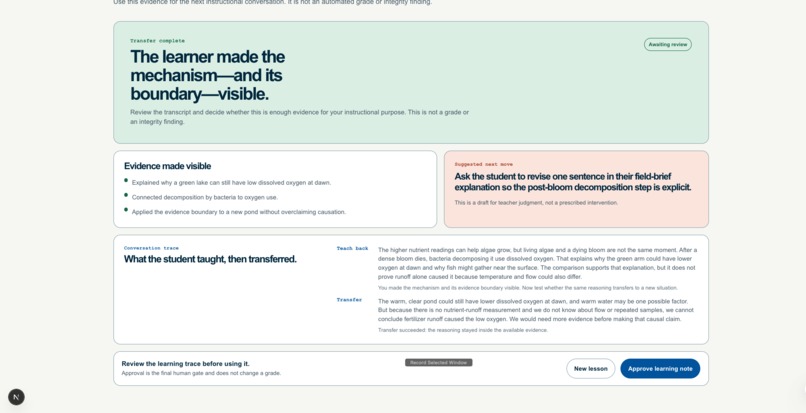
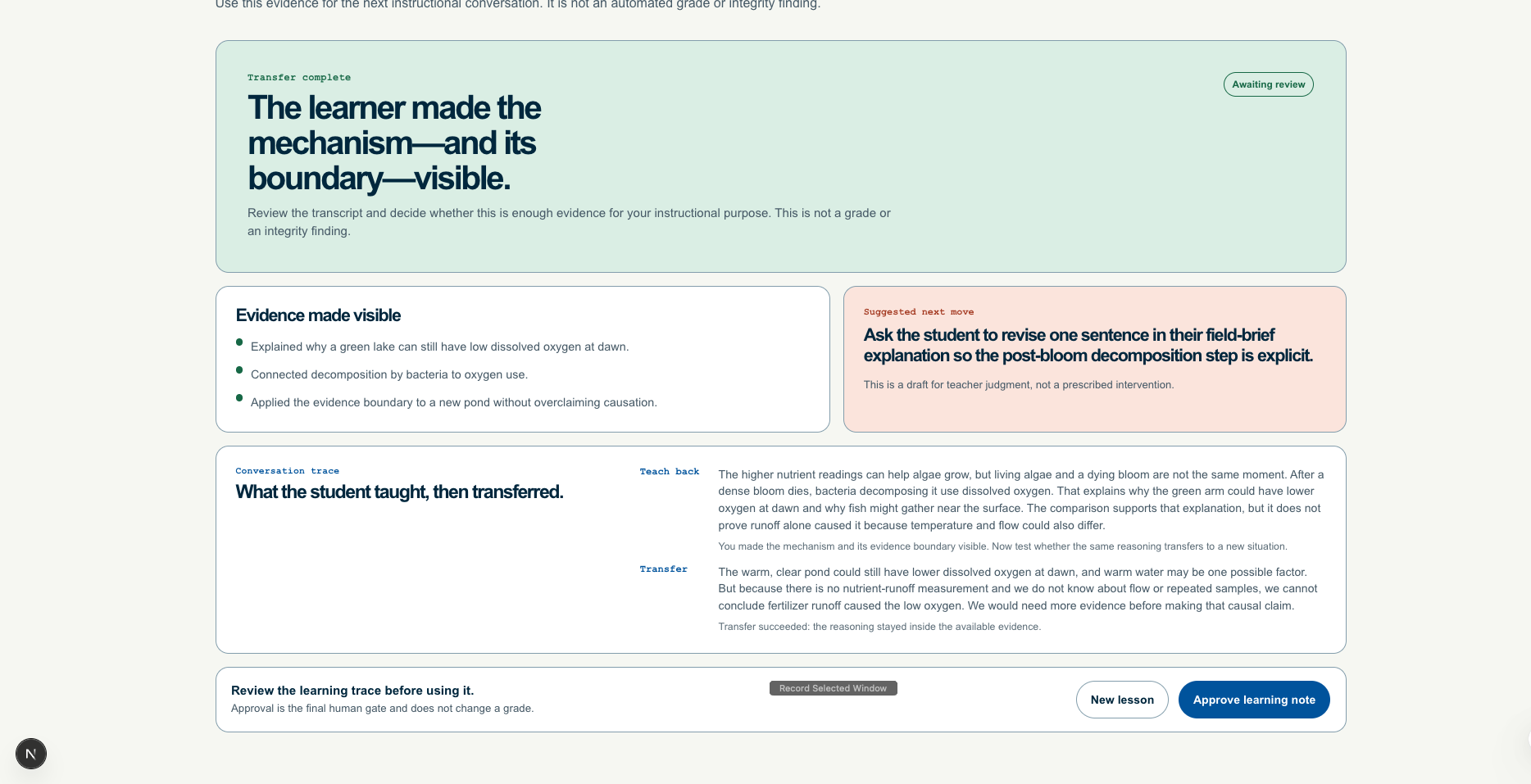
A learning trace, not a verdict.
Inspiration
As large language models make polished prose ubiquitous, evaluating a student’s understanding based solely on a final written product has grown increasingly unreliable. Rather than leaning into algorithmic surveillance or an escalating AI-detection arms race, we approached this problem from a cognitive-learning perspective: the peer-tutoring effect.
TeachBack requires students to explain concepts to a simulated peer, a "Misconception Twin" named Nova, who holds a plausible, domain-specific misunderstanding. By making the explanation and transfer process visible, the system generates a concrete learning trace for instructor review. It explicitly avoids automated grading, cheating accusations, or epistemic claims about what a student internally "knows."
What it does
The workflow begins when an instructor submits a concise, de-identified source document and a target learning objective. TeachBack parses this material to construct a reviewable concept map, literal evidence anchors, and a single, well-bounded misconception for the simulated student, Nova. Once the instructor approves this baseline setup, the interaction opens to the user.
The student must explain the underlying causal mechanics to Nova and subsequently apply that reasoning to a novel scenario. Nova’s internal "learning state" is strictly bounded; it only updates when the student explicitly addresses the required causal links and supports their claims with source evidence. Once the dialogue concludes, the entire trace is submitted to the instructor for formative evaluation.
Our demonstration includes the Greenwater Lake fixture, a scenario where students must articulate why a decaying algal bloom depletes dissolved oxygen, and critically distinguish between a plausible biological hypothesis and what the observational data actually prove.
How we built it
We built the application using Next.js and TypeScript, integrating the OpenAI Responses API with GPT-5.6 to handle the natural language reasoning. The architecture relies on two highly structured generation phases:
- Setup Phase: Constructs a 3-to-5-node concept map, extracts exact textual quotes for evidence anchoring, formulates one target misconception, and drafts the initial student prompts.
- Turn-Update Phase: Generates Nova’s conversational replies, validates evidence grounding, and modifies the approved concept-map state as the student fills in conceptual gaps.
To prevent model drift and hallucination, we implemented strict server-side safeguards. Every citation displayed by the UI must literally match text from the instructor's original packet. State transitions can reference only pre-approved node IDs; student turns remain locked until instructor validation is complete; and the session terminates automatically once submitted for review.
For evaluation and offline demonstration, we engineered a deterministic, fully labeled Greenwater fixture that executes without an active API key. The codebase is backed by automated test suites covering workflow gates, citation validity, malformed inputs, and state-update boundaries.
Challenges we ran into
- Avoiding Hidden Assessment: Our primary architectural challenge was keeping the system a formative scaffolding tool without letting it creep into hidden assessment. We took deliberate steps to ensure Nova never claims to evaluate students' abilities; the interface displays only a simulated cognitive state indicating which concepts the novice can currently use.
- Grounding Generative Output: Grounding generative output in source texts presented another significant hurdle. Because conversational models easily generate convincing yet unverified claims, we constrained the engine using strict JSON schemas and enforced server-side validation for all literal quote strings and node identifiers.
- Resisting Scope Creep: Finally, we had to actively resist scope creep. While adding automated rubrics, AI-detection scoring, student accounts, or LMS integrations would have been straightforward, doing so would have diluted our primary focus. We chose to strip away those features to refine a single, coherent pedagogical loop: source → misconception → explanation → transfer → instructor review.
Accomplishments that we're proud of
- Reframing the AI Dilemma: Reframing the classroom AI dilemma from a policing problem into a constructive, formative practice exercise.
- Human-in-the-Loop Design: Designing a workflow that maintains instructor authority through mandatory pre-approval and post-activity review.
- Legible AI Mechanics: Making the AI's mechanics legible through visible source maps, evidence anchors, real-time state changes, and explicit declarations of uncertainty.
- Deterministic Offline Demo: Building a fully deterministic offline architecture so evaluators can reliably inspect the core loop without external API dependencies.
- Robust Backend Safeguards: Implementing robust backend validation that actively rejects hallucinated citations, unauthorized node modifications, and out-of-order student turns.
What we learned
Building TeachBack reinforced that generative AI in education requires rigid operational boundaries to be pedagogical and trustworthy. The model proved far more valuable as an interactive foil, generating a focused misconception and surfacing missing logical links, than as a direct answer generator.
We also observed the critical importance of testing for transfer. A student can easily parrot definitions from a text, but requiring them to guide Nova through an unfamiliar test case immediately exposes superficial understanding. This simple shift made the interaction feel like genuine cognitive work rather than a scripted chatbot exchange.
What's next for TeachBack
Our immediate priority is conducting qualitative studies with instructors and students using live, de-identified course materials. This will allow us to evaluate whether our prompt structures, misconception designs, and review traces genuinely improve classroom discussion and revision cycles.
Following empirical validation, we plan to explore instructor-configurable rubrics and domain-specific source templates, ensuring the teacher's judgment remains the primary arbiter of quality. Long-term, we intend to investigate privacy-preserving LMS integrations, though we will only pursue scale after verifying that the foundational teach-back loop delivers measurable pedagogical value.
Built With
- codex
- education
- nextjs
- openai
- react
- typescript


Log in or sign up for Devpost to join the conversation.