Inspiration
It started with a question a patient might never think to ask: "Does the heat change anything about the medications I'm taking?" For most people the answer never surfaces. Climate conditions — heat, humidity, dehydration, sunlight, wildfire smoke, flooding, power outages — affect both how medications should be taken and how they hold up physically, yet medication information isn't connected to the climate around the patient. We wanted to close that gap: to make climate alerts double as medication alerts.
What it does
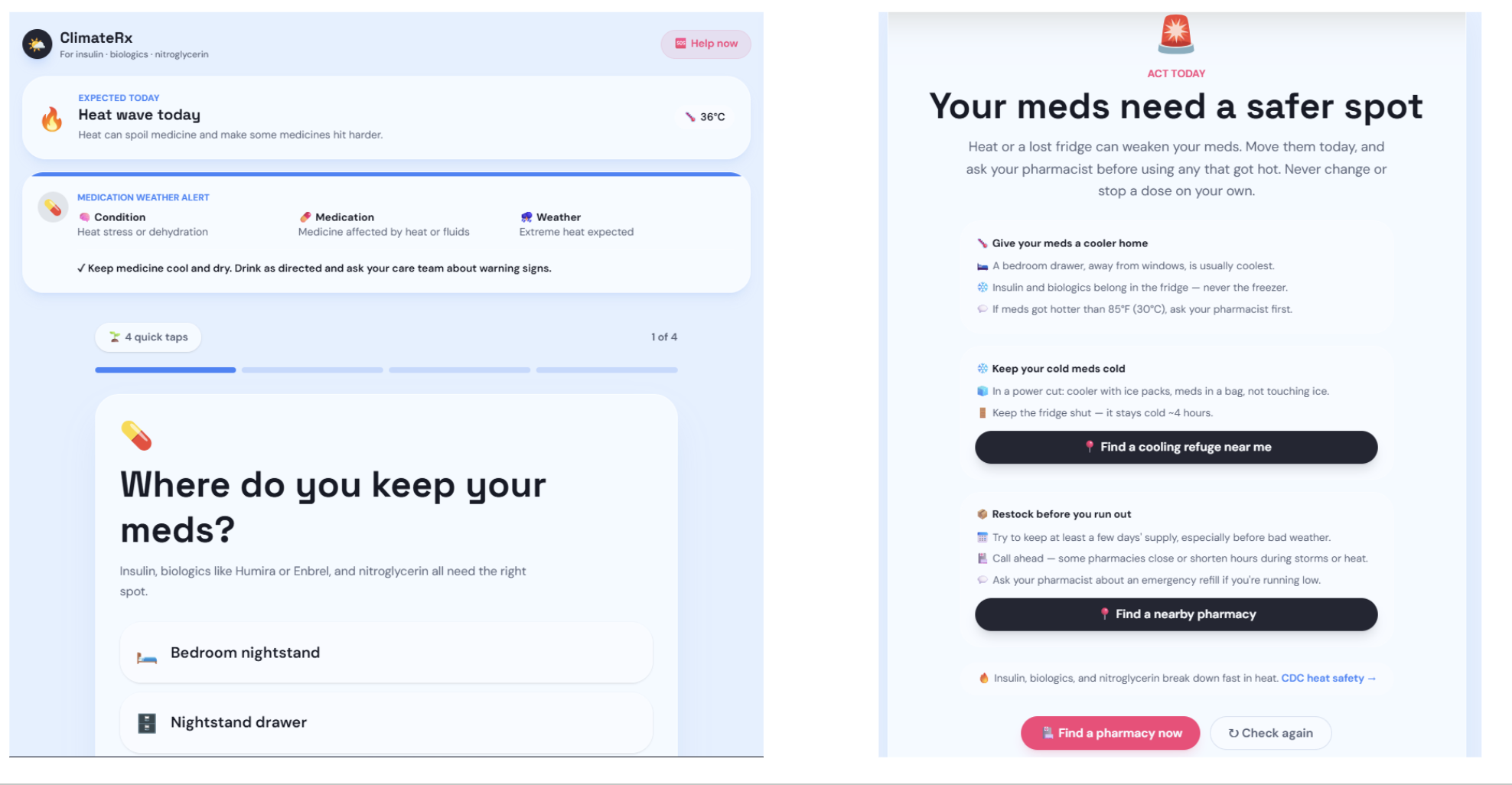
ClimateRX is a personalized, climate-aware medication safety and efficacy layer that connects the local forecast to the individual patient. It runs a simple pipeline — environmental signal → clinical context → human action — so a raw weather forecast becomes a concrete, patient-specific step. For patients, it surfaces climate-driven risks to their specific medications, tells them what to ask their clinician, and helps protect medication quality (like temperature-sensitive storage). Our initial focus is adults living with chronic mental-health conditions who take psychotropic medications — a group whose medications and physiology can be especially sensitive to heat and dehydration.
How we built it
ClimateRX has two halves: a backend that fuses environmental/forecast signals with a clinical-context layer to generate patient-specific guidance, and a patient-facing frontend that delivers those alerts. The core design principle is the signal → context → action pipeline that keeps every alert tied to a concrete recommendation rather than raw data.
Challenges we ran into
Translating heterogeneous climate signals into medication-specific guidance without over-alerting, encoding clinical context safely and responsibly, and scoping an enormous problem space down to a tractable, high-need first population.
Accomplishments that we're proud of
Reframing climate alerts as medication alerts — a genuinely new connection between two systems that don't talk to each other today. We built a clear, defensible signal → context → action pipeline and grounded it in a specific, underserved population instead of staying abstract.
What we learned
Climate resilience shouldn't depend on knowing which questions to ask. There's a missing infrastructure layer between climate data and medication management, and putting the right knowledge in front of patients before a crisis is where the leverage is.
What's next for ClimateRX
More data, real-world pilots, and expansion to other patient demographics. Longer term, there's a clear value story for health systems, pharmacy networks, employers/insurers, and public-health agencies — all of whom benefit from moving intervention upstream and building climate resilience into medication-management workflows.
Built With
- fastapi
- python

Log in or sign up for Devpost to join the conversation.