-
-
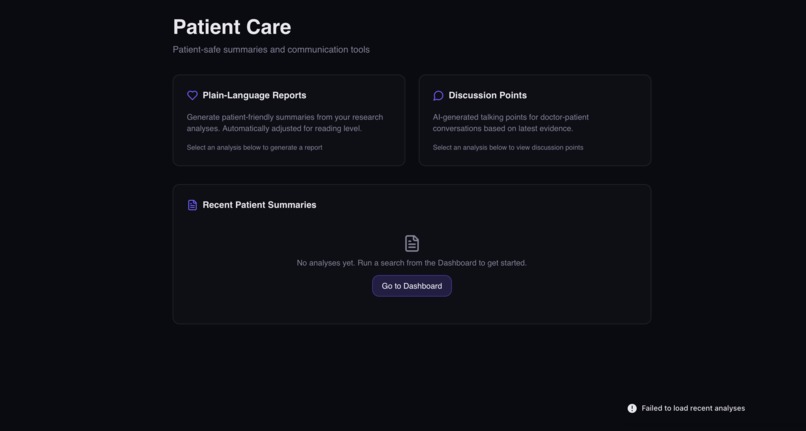
Paitent care page
-
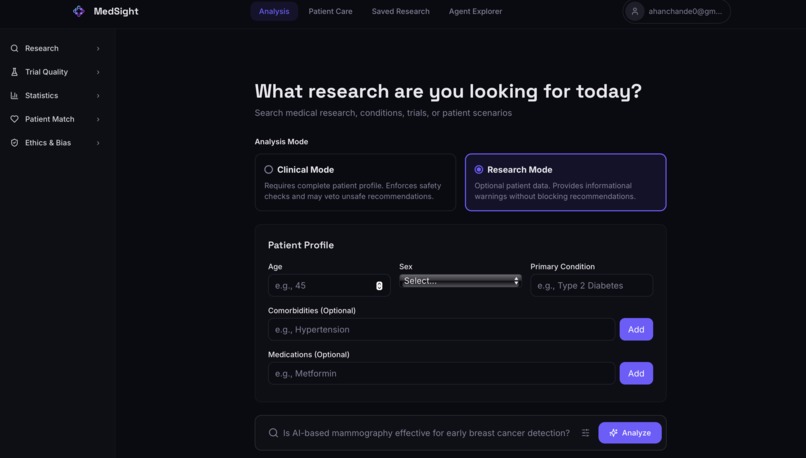
Main landing page after sign in
Inspiration
Medical research is growing faster than clinicians and researchers can realistically keep up with. Critical decisions are often made using fragmented, conflicting, or biased evidence, and single-model medical AI tools can oversimplify complex data. MedSight was inspired by the need for AI that reasons critically, surfaces uncertainty, and supports---not replaces---clinical judgment.
What it does
MedSight is a multi-agent AI platform for medical research and clinical reasoning. It searches and ingests medical literature from sources like PubMed and OpenAlex, evaluates trial quality, analyzes statistics, matches evidence to patient context, and synthesizes findings into clear, cited conclusions. The platform also provides interactive visualizations, ethical and bias analysis, and plain-language summaries for patient communication.
How we built it
MedSight was built as a full-stack TypeScript application. The frontend uses React, Vite, Tailwind CSS, and shadcn/ui to deliver a modern interface with dashboards, agent explorers, and results views. The backend is a Node.js and Express server that orchestrates a multi-agent analysis pipeline, where specialized AI agents handle literature ranking, trial quality assessment, statistical reasoning, patient matching, and synthesis---while keeping all API keys securely on the server.
Challenges we ran into
One of our biggest challenges was handling conflicting or low-quality medical evidence while maintaining trustworthy outputs. Designing agents that could disagree, cross-check each other, and still produce a coherent synthesis required careful orchestration. We also had to balance depth of analysis with performance and design an interface that communicates complex reasoning clearly---especially within a 24-hour hackathon.
Accomplishments that we're proud of
We’re proud of building a fully functional multi-agent medical reasoning system in such a short time. MedSight goes beyond summarization by explicitly evaluating trial quality, surfacing bias and uncertainty, and grounding outputs with citations. We’re also proud of the transparent agent architecture and the strong emphasis on ethical, patient-centered AI design.
What we learned
This project taught us how powerful multi-agent systems can be when each agent has a clearly defined role and limitations. We gained a deeper understanding of medical research workflows, evidence evaluation, and the importance of explainability in high-stakes AI. We also learned how crucial thoughtful UX is when presenting complex insights to clinicians.
What's next for MedSight
Next, we plan to expand patient-specific reasoning with deeper demographic and comorbidity modeling, integrate additional data sources like clinical guidelines and real-world evidence, and add clinician feedback loops. Our long-term vision is to make MedSight a trusted clinical intelligence layer that improves decision-making while preserving human oversight.
Built With
- amazon-web-services
- css
- geminiapi
- node.js
- openalex
- pubmed
- react
- supabase
- tailwind
- tanstack
- typescript
- vite

Log in or sign up for Devpost to join the conversation.