-
-

MedReport Logo
-
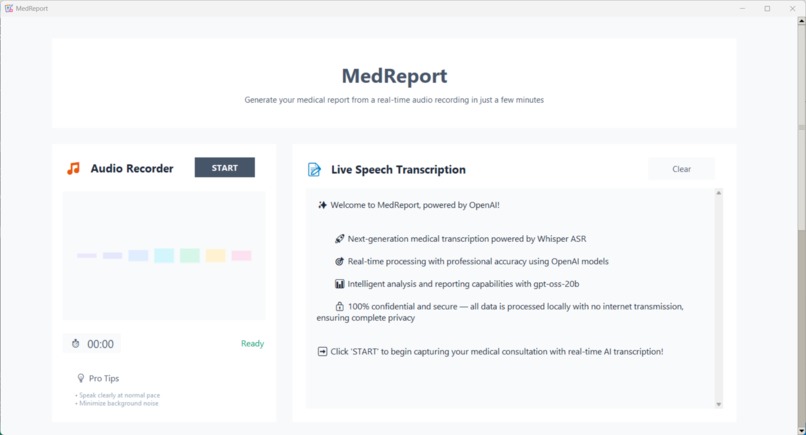
MedReport Screenshot 1
-
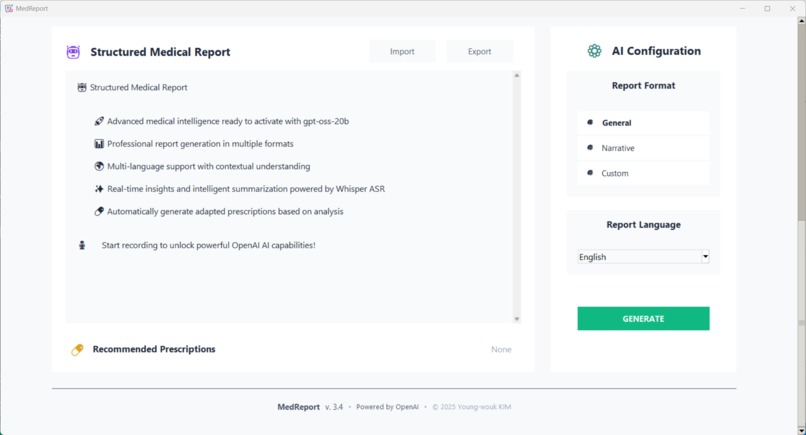
MedReport Screenshot 2

MedReport: Transforming Doctor-Patient Conversations into Professional Medical Reports
OpenAI Open Model Hackathon Submission
Where Natural Conversation Becomes Professional Documentation
Video Link
Inspiration
Hi there! I'm Young-wouk, and I wear two hats: by day I'm a practicing physician with over 10 years of clinical experience, and by night I'm a developer with 25+ years of programming under my belt (fueled, of course, by a serious coffee habit).
Living at the intersection of medicine and technology, I’ve experienced firsthand the soul-crushing reality of spending more time staring at computer screens documenting patient encounters than actually looking patients in the eye. Every consultation ended the same way: “Great, now let me spend 15 minutes typing everything we just discussed...” It was driving me — and my colleagues — absolutely insane.
When OpenAI released gpt-oss-120b and gpt-oss-20b with their revolutionary open-weight reasoning capabilities, something clicked. Here was a model that could understand complex medical reasoning, run completely offline (goodbye privacy nightmares!), and had the power to actually solve healthcare's biggest workflow problem. Paired with OpenAI's Whisper for medical-grade speech recognition, I got super motivated — the kind of motivated that makes you forget what sunlight looks like.
After many days of coding, many more nights than I care to admit, and way too many tutorials on how to use video editors — because presenting your work is just as important as building it — MedReport was born.
The vision was simple: What if every natural conversation between doctor and patient could automatically become professional documentation? What if we could give physicians back those precious hours to do what they love most — actually care for people?
Turns out, with a lot of determination, OpenAI's incredible gpt-oss architecture, and the perfect synergy between Whisper and gpt-oss-20b, we could make it happen. And yes, it works beautifully — completely offline.
The Problem: Healthcare's Documentation Crisis
Healthcare faces a critical workflow challenge that directly impacts both patient care quality and physician wellbeing:
Current State:
- 10-15 minutes per consultation lost to post-documentation tasks
- 2+ hours daily spent by physicians on paperwork instead of patient care
- 60% of physician burnout directly attributed to administrative burden
- 25% of global population faces language barriers in healthcare access
- Privacy concerns prevent adoption of cloud-based medical AI solutions
Why Current Solutions Fail:
- Medical Secretaries: Limited availability, expensive, still require dictation time
- Dictation Software: Requires formal post-consultation dictation, breaks consultation flow
- Electronic Health Record Systems: Focus on manual data entry rather than natural conversation capture
- Cloud AI Services: Privacy concerns make them unusable in confidential medical settings
Technical Gap: No existing system can process natural doctor-patient conversations in real-time while maintaining complete privacy and generating professional medical documentation — until now.
What MedReport does
MedReport transforms unstructured doctor-patient conversations into professional medical documentation in real-time using OpenAI's gpt-oss-20b for medical reasoning and OpenAI Whisper for medical-grade speech recognition — all completely offline.
Core Functionality:
- Natural Consultation Flow: Doctor and patient converse normally during visits
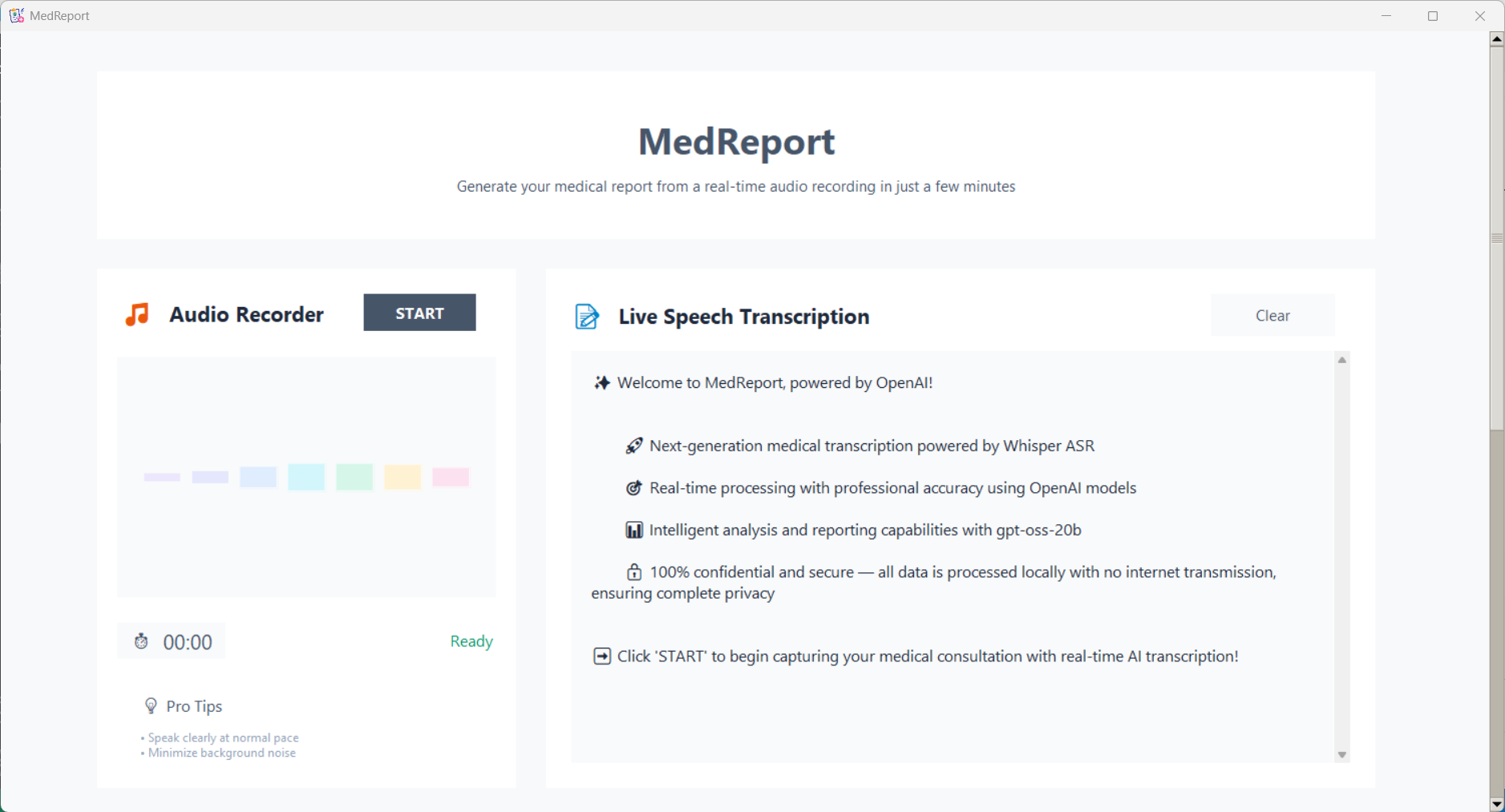
- Real-Time Transcription: OpenAI Whisper processes audio locally with superior medical terminology accuracy
- Intelligent Medical Analysis: gpt-oss-20b understands clinical context and applies medical reasoning patterns
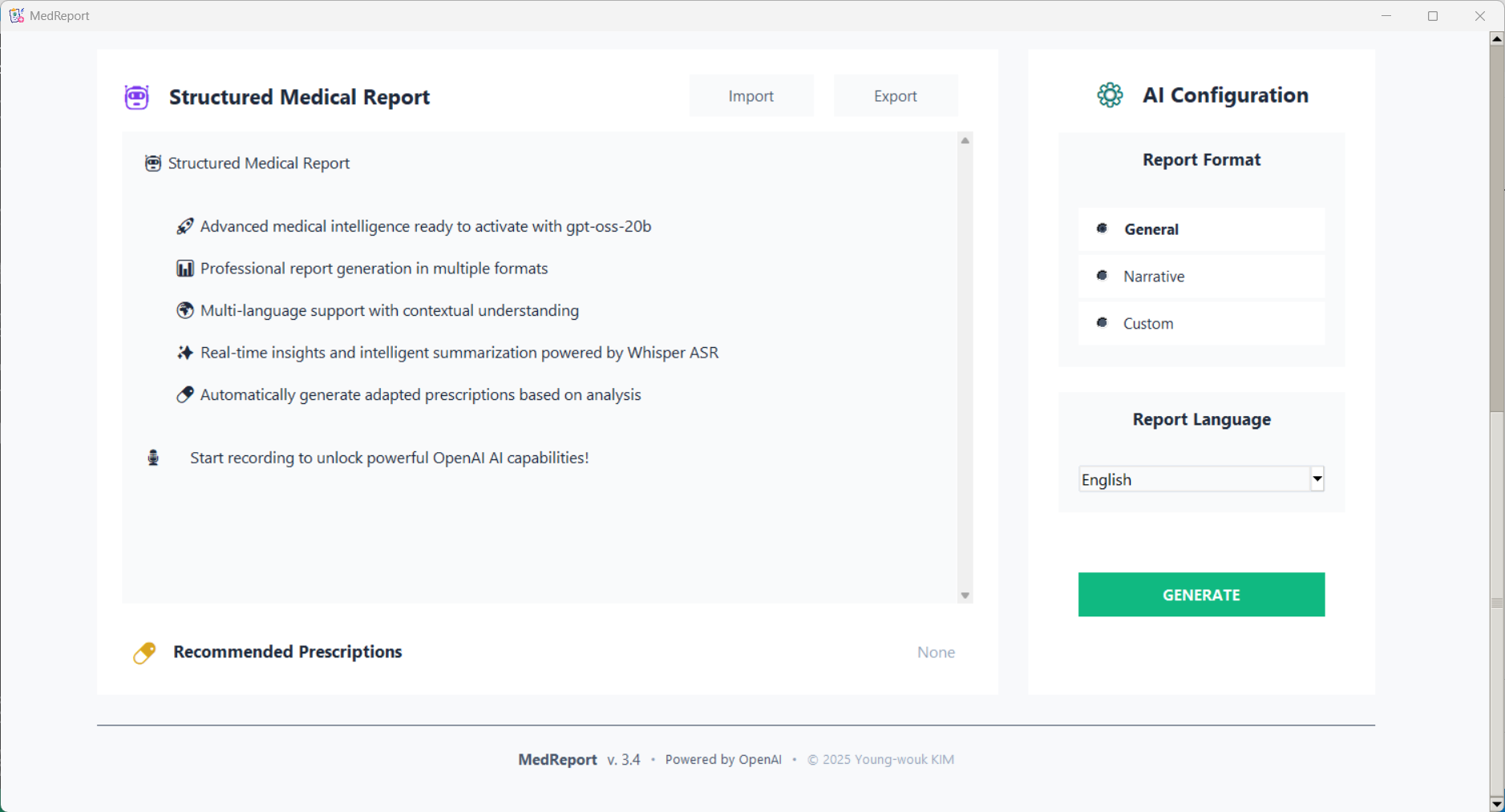
- Professional Documentation: Generates structured medical reports in a few minutes
- Document Integration: Seamlessly incorporates external medical documents when relevant
- Smart Prescription Detection: Advanced reasoning automatically identifies and formats prescriptions as PDFs
- Multilingual Support: Documentation in 10+ languages
- 100% Privacy: Complete offline functionality with zero data transmission
Impact Metrics:
- 75% reduction in documentation time (10-15 minutes saved per consultation)
- 2+ hours daily returned to physicians for patient care
- >20× faster report generation compared to manual creation
- 95%+ accuracy in medical terminology recognition
How we built MedReport
Architecture Overview: A Local-First Medical AI System
MedReport operates as a complete offline solution, built around OpenAI's gpt-oss-20b and Whisper models to ensure absolute privacy while delivering professional-grade medical documentation. Our architecture eliminates all external dependencies, making it deployable anywhere healthcare is practiced.
Model Selection & Deployment Strategy
Why OpenAI's gpt-oss Models Over Alternatives: Healthcare demands absolute privacy and data sovereignty while requiring excellent performance, making OpenAI's open-weight models the only viable choice that delivers both:
- Exceptional Performance: Remarkable reasoning capabilities and medical knowledge produce professional-grade results with high accuracy
- Complete Offline Operation: Patient conversations never leave the device — critical for HIPAA compliance
- Open-Weight Architecture: Full transparency and control for medical applications
- Zero Privacy Risk: No API calls, no cloud dependencies, no data transmission
- Universal Accessibility: Works in remote clinics, disaster zones, and areas with poor connectivity
Strategic Decision: Base Models Over Fine-Tuning: The base gpt-oss-20b model demonstrated exceptional performance for medical documentation tasks right out of the box. To validate this, we prepared 200+ audio transcription pairs and 1000+ medical report training examples using Unsloth for potential fine-tuning, but found only minor improvements that didn't justify the additional computational overhead. Key reasons for skipping fine-tuning include:
- Excellent prompt-guided results: With well-crafted prompts, base model delivers excellent and consistent professional outputs
- Extensive medical knowledge: Pre-training already embedded comprehensive clinical knowledge
- Strong clinical reasoning: Natural understanding of medical contexts across specialties
- Broad flexibility: Maintained versatility across medical contexts without domain-specific constraints
- Faster deployment: No training overhead or specialized fine-tuning infrastructure required
Core Technology Stack Implementation
Audio Processing Pipeline with OpenAI Whisper:
Audio Input → 16kHz Mono Conversion → 10s Chunks (8s Overlap) → Whisper-Small → Real-time Transcription
- Model Selection: Whisper-small optimized for medical terminology while running efficiently on standard laptops
- Real-time Processing: Audio chunks sent incrementally for immediate transcription feedback, enhancing user experience with live text display
- Chunking Strategy: 10-second segments with 8-second overlaps preserve conversational continuity without losing clinical context
- Context Preservation: Complete transcription sent to gpt-oss-20b at the end of recording (not fragmented chunks) maintaining clinical narrative flow
- Noise Handling: Optimized for typical medical office environments with background conversations and equipment sounds
Medical Reasoning Engine with OpenAI's gpt-oss-20b:
Full Transcription ± External Documents → Clinical Context Analysis → Structured Medical Report
- Deployment: F16.gguf quantization providing optimal accuracy-performance balance on consumer hardware
- Prompt Engineering: Sophisticated prompts that leverage the model's reasoning capabilities to:
- Distinguish symptoms from diagnoses from treatment plans
- Apply clinical decision-making logic
- Maintain professional medical documentation standards
- Handle complex multi-symptom presentations
- Generate structured reports using specific examples provided based on selected format
Document Integration Workflow:
PDF Upload via Import Button → PyMuPDF Text Extraction → Relevance Analysis → Context Integration → Report Generation
- User-Controlled Import: Users can optionally load external PDFs (lab results, referral letters, imaging reports) via dedicated Import button
- Text Extraction: PyMuPDF extracts content which is passed to model in prompt for contextual analysis
- Smart Processing: gpt-oss-20b determines which external document content is consultation-relevant based on transcribed conversation
- Selective Integration: Only includes information actually discussed or pertinent to the current visit
Advanced Feature Implementation
Prescription Detection & PDF Generation: Our most innovative feature uses gpt-oss-20b's reasoning to automatically identify prescriptions and generate professional documents through single-inference processing — the model simultaneously generates the structured medical report and appends any detected prescriptions in custom XML format:
- Detection Phase: Model analyzes transcription for medication mentions during clinical reasoning
- Integrated Output: Prescription data automatically formatted in custom XML and appended to the medical report through specific prompt instructions specifying XML structure with title, patient, content, and context fields
- Function Calling: The presence of prescription XML in the report automatically triggers the creation of action buttons in the UI — when clicked, these buttons generate print-ready prescription PDFs with complete medical report integration
- Clean Display: XML removed from user-visible report while maintaining structured data for processing
Multi-Format Report Generation:
- General Format: Structured documentation with bullet points and clear sections for quick reference, guided by a specific report example provided in the prompt
- Narrative Format: Comprehensive prose-style reports with detailed clinical descriptions for thorough documentation, using a narrative report example in the prompt
- Custom Templates: Configurable via
custom_report_format.txt— content is loaded and passed as a report example in the prompt for specialty-specific needs
User Interface & Experience Design
Modular GUI Architecture: Built with separated, maintainable components, with particular attention paid to design: simple and functional, yet easy and pleasant to use. The software was designed and developed by a physician (with extensive programming experience) for physicians:
- UI Manager: Non-blocking interface ensuring responsiveness during AI processing
- Audio Handler: Real-time capture with visual feedback and buffer management
- Animation System: Real-time audio wave visualization providing engagement feedback
- PDF Generator: Professional document creation with medical formatting standards
Performance Optimization:
- Thread-Safe Operations: Audio processing, AI inference, and UI updates run independently
- Memory Management: Smart buffer handling prevents memory leaks during extended consultations
- Resource Efficiency: Optimized to run smoothly on laptops without dedicated GPUs
- Error Handling: Graceful degradation with user-friendly error messages
Privacy & Security Implementation
Complete Offline Architecture: Every component designed for zero network dependency:
- Local Model Storage: Both Whisper and gpt-oss-20b models stored locally
- Offline Processing: All transcription, analysis, and document generation happens on-device
- No Telemetry: Zero data collection or transmission of any kind
- HIPAA Compliance: Meets all healthcare privacy requirements by design
Data Handling:
- Session-Based: Audio and transcriptions exist only during active consultation
- Secure Cleanup: Automatic cleanup of temporary files and memory buffers
- Local Storage: Generated reports saved locally under user control
This architecture demonstrates how OpenAI's open-weight models can power sophisticated healthcare applications while maintaining absolute privacy — setting a new standard for medical AI deployment.
Challenges we ran into
Model Selection & Optimization: Finding the right model configuration took considerable experimentation. We evaluated gpt-oss-20b vs gpt-oss-120b and various quantized versions, alongside different Whisper model sizes. We ultimately chose our current configuration for the optimal balance between performance, speed, and deployment accessibility — ensuring the system runs smoothly on standard laptops without requiring high-end computers or specialized hardware.
Multimodal Architecture Integration: Designing a complete architecture that seamlessly integrates not only gpt-oss-20b but also another open model like Whisper presented significant challenges. Creating a cohesive multimodal application required careful coordination between audio processing, transcription, and medical reasoning components while maintaining offline functionality and performance efficiency.
Audio Processing Complexity: Managing real-time audio capture while maintaining conversation context was technically challenging. The most difficult aspect was "simulating" stream processing — sending audio chunks for analysis while simultaneously recording the next chunk. We solved this with smart buffer management and overlapping audio segments to ensure clinical continuity.
Medical Reasoning Accuracy: Getting gpt-oss-20b to consistently understand complex medical contexts required extensive prompt engineering. We developed enhanced prompts through multiple iterations, ultimately achieving very good and consistent results that leverage the model's reasoning capabilities to distinguish between symptoms, diagnoses, and treatment plans accurately.
Prescription Detection: Developing reliable prescription recognition and PDF generation required innovative use of gpt-oss-20b’s function calling. We built a system where the model generates structured XML inside reports, which then triggers automatic prescription document creation. XML was chosen over native function calls because it ensures interoperability with healthcare systems, creates a durable and auditable record for compliance, and allows strict schema validation of prescription details. It also supports document-centric workflows with headers, metadata, and signatures, while enabling asynchronous PDF generation and balancing both human readability and machine parsing. This approach bridges model reasoning with real-world medical document standards, making prescriptions both trustworthy and system-ready.
GUI Responsiveness: Creating a smooth user experience while processing intensive AI tasks required careful thread management. We implemented non-blocking operations to ensure the audio wave animations and UI remained responsive during gpt-oss-20b inference.
Privacy Architecture: Ensuring complete offline functionality while maintaining professional medical documentation standards required careful architecture design. Every component needed to work seamlessly without any internet dependency while leveraging OpenAI's open-weight models effectively.
Accomplishments that we're proud of
Revolutionary Healthcare Impact:
- Created the first system to automatically transform natural medical conversations into professional documentation using OpenAI's gpt-oss models
- 75% reduction in documentation time could impact 2.1 billion annual patient encounters globally
- Demonstrated that sophisticated healthcare AI can achieve professional results while maintaining absolute privacy using open-weight models
Technical Excellence with OpenAI Models:
- Perfect synergy between OpenAI Whisper and gpt-oss-20b for healthcare applications
- Advanced function calling implementation generating structured reports with embedded prescriptions in single inference
- Complete offline deployment showcasing the power of OpenAI's open-weight model architecture
- Optimized to run efficiently on consumer-grade hardware - no specialized GPUs or high-end workstations required
- Usable by any healthcare provider regardless of technical infrastructure or resources
Privacy Leadership:
- 100% local processing with zero data transmission sets new standards for medical AI
- Proves privacy and performance are not mutually exclusive using OpenAI's open models
- HIPAA-compliant solution accessible globally without cloud infrastructure requirements
Real-World Validation:
- Built by a practicing physician who understands actual healthcare workflow challenges
- Professional-grade medical documentation that meets clinical standards
- Already being tested in clinical environments with promising initial results
- Immediate deployment capability for healthcare providers worldwide
What we learned
OpenAI's gpt-oss Models Are Game-Changers: The reasoning capabilities of gpt-oss-20b exceeded our expectations for medical applications. The model's ability to understand complex clinical contexts without fine-tuning demonstrates the sophistication of OpenAI's open-weight architecture.
Base Models vs. Fine-Tuning: We discovered that gpt-oss-20b's extensive pre-training provides excellent medical knowledge foundation, making fine-tuning unnecessary for many healthcare applications. Despite preparing 200+ audio files with transcriptions and 1000 transcript-to-report training pairs for fine-tuning Whisper and gpt-oss-20b respectively using Unsloth, the additional improvements were surprisingly minor. This insight could reshape how we approach medical AI development - the base OpenAI models are already remarkably capable.
Multimodal Integration Excellence: The seamless integration between OpenAI Whisper and gpt-oss-20b creates powerful multimodal capabilities that feel natural and professional in clinical settings.
Privacy-Performance Balance: OpenAI's open-weight models prove that cutting-edge AI performance doesn't require sacrificing privacy. This is crucial for healthcare applications where data sovereignty is non-negotiable.
Healthcare Workflow Transformation: Real-world testing confirmed that natural conversation-to-documentation using OpenAI's models can genuinely transform healthcare workflows without disrupting the doctor-patient relationship.
What's next for MedReport
Advanced OpenAI Model Integration:
- gpt-oss-120b Implementation: Leverage the larger model for complex multi-specialty consultations
- Enhanced Function Calling: Develop more sophisticated medical reasoning workflows
- Model Optimization: Fine-tune models for specialized medical domains and niche clinical applications
Technology Evolution:
- Real-time Clinical Decision Support: Expand beyond documentation to treatment recommendations
- Integration Ecosystem: APIs for Electronic Health Record systems and medical device integration
- Advanced Analytics: Population health insights while maintaining complete privacy
Immediate Global Impact:
- Healthcare Provider Partnerships: Collaborate with medical institutions to deploy MedReport using OpenAI's gpt-oss models
- Specialty Medicine Integration: Expand templates across all medical specialties leveraging gpt-oss reasoning capabilities
- Regulatory Validation: Pursue FDA clearance and international medical device approvals
Global Healthcare Transformation:
- Developing Nations Deployment: Bring advanced medical documentation to underserved areas using offline OpenAI models
- Emergency Response Systems: Rapid deployment capabilities for disaster medical scenarios
- Medical Education: Create training platforms using consistent documentation examples
Vision Realization: Transform every medical conversation globally into professional documentation using OpenAI's open-weight models, giving physicians worldwide the gift of time — time to look patients in the eye, time to truly listen, and time to practice the art of healing rather than the administrative burden of documentation.
MedReport represents the future of healthcare AI: powerful, private, and profoundly human-centered, built on the foundation of OpenAI's revolutionary open models.
Built With
- gpt-oss
- python
- tkinter
- transformers
- whisper
- windows-10

Log in or sign up for Devpost to join the conversation.