-
-
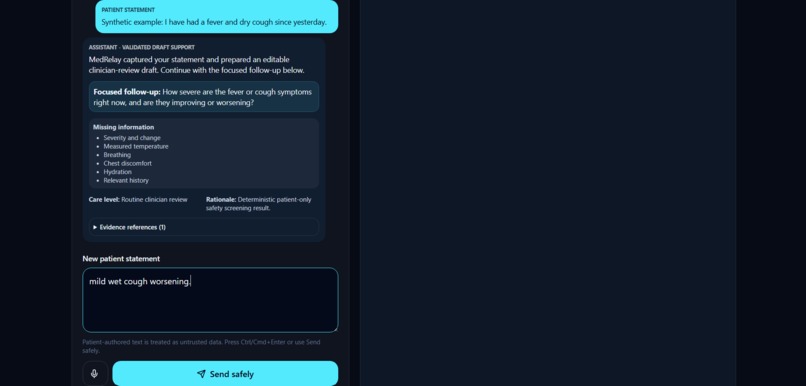
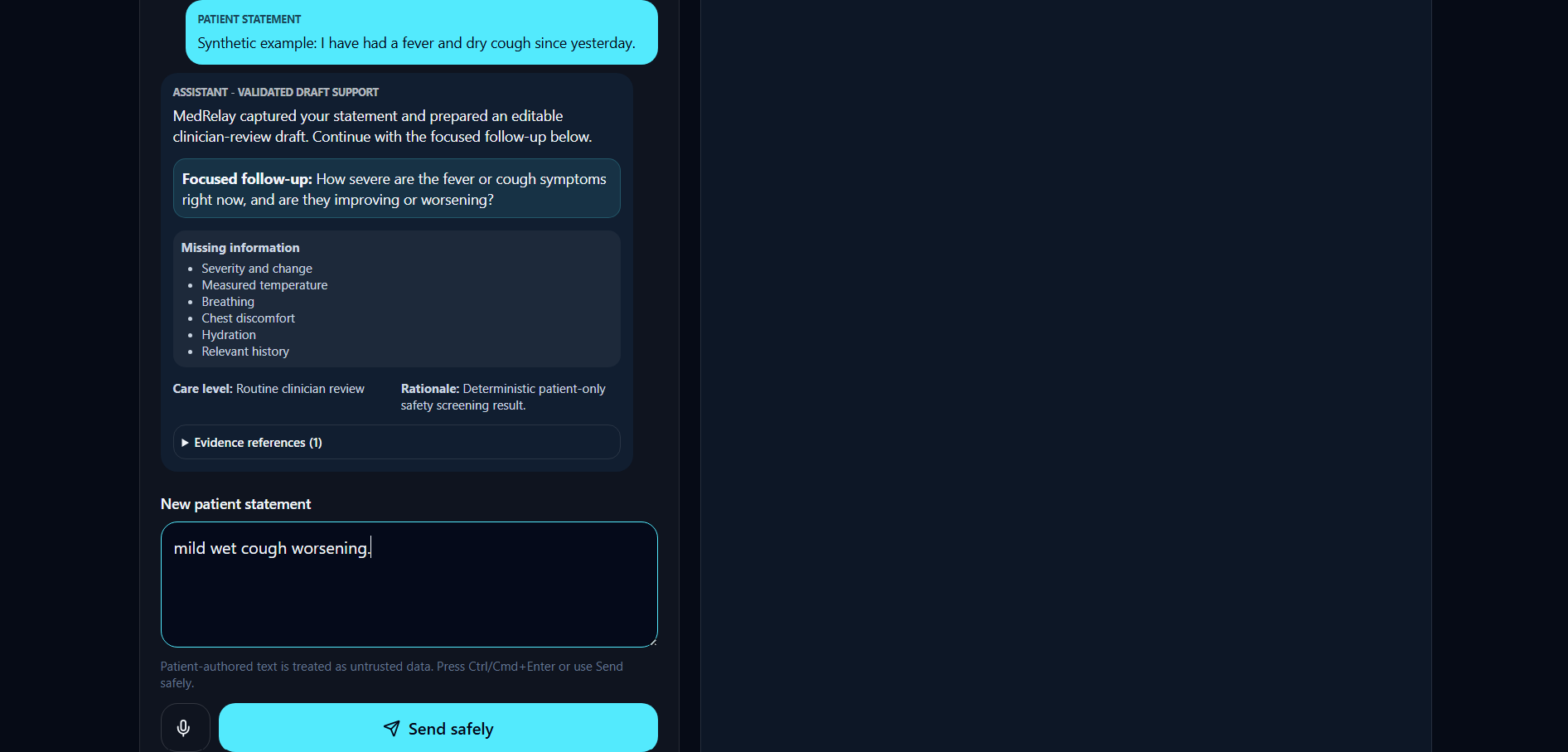
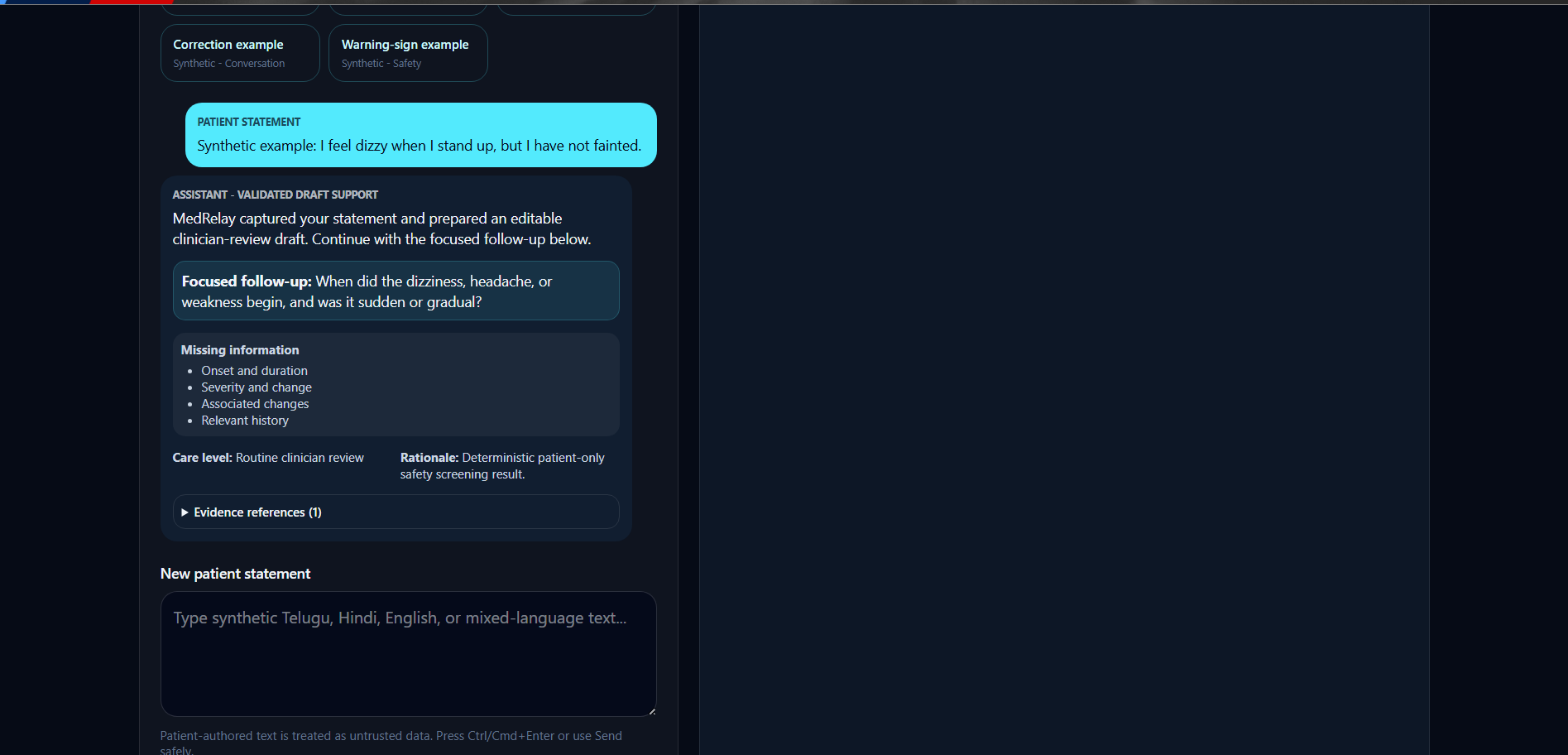
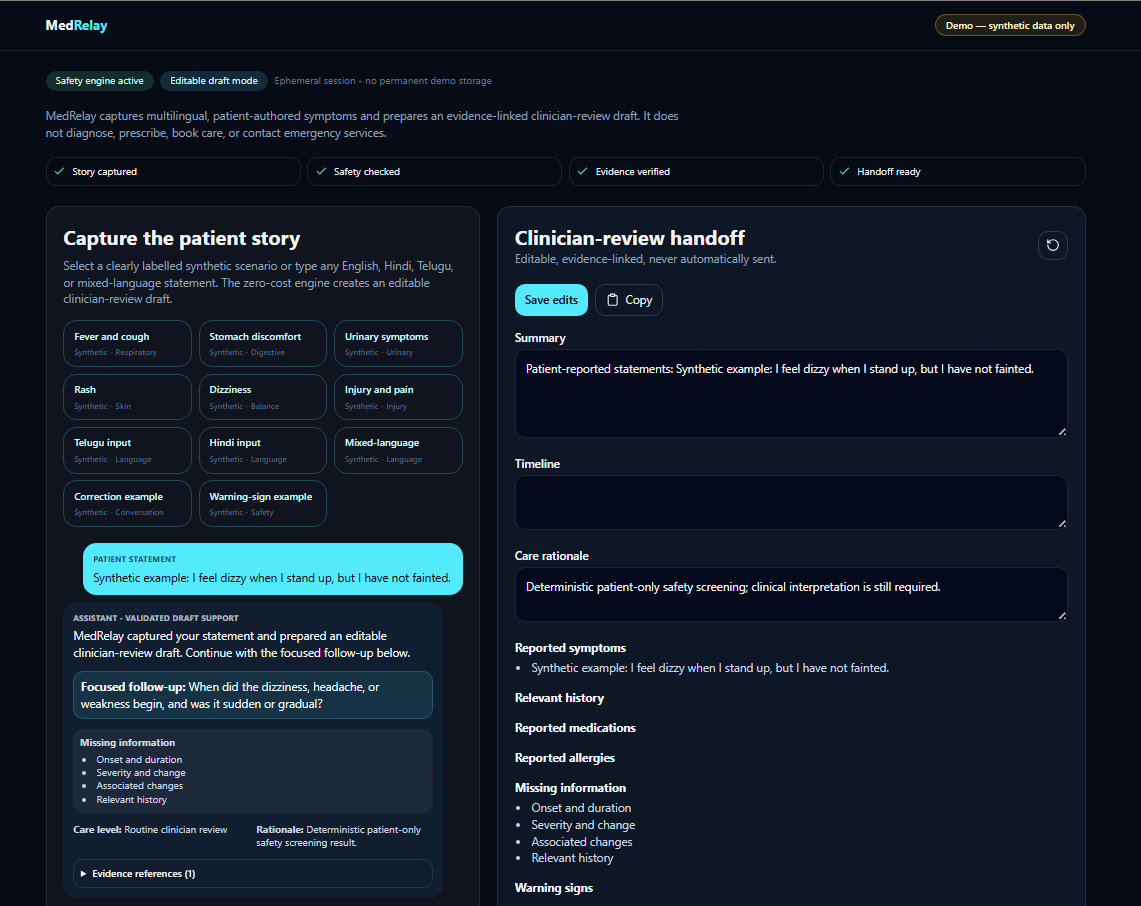
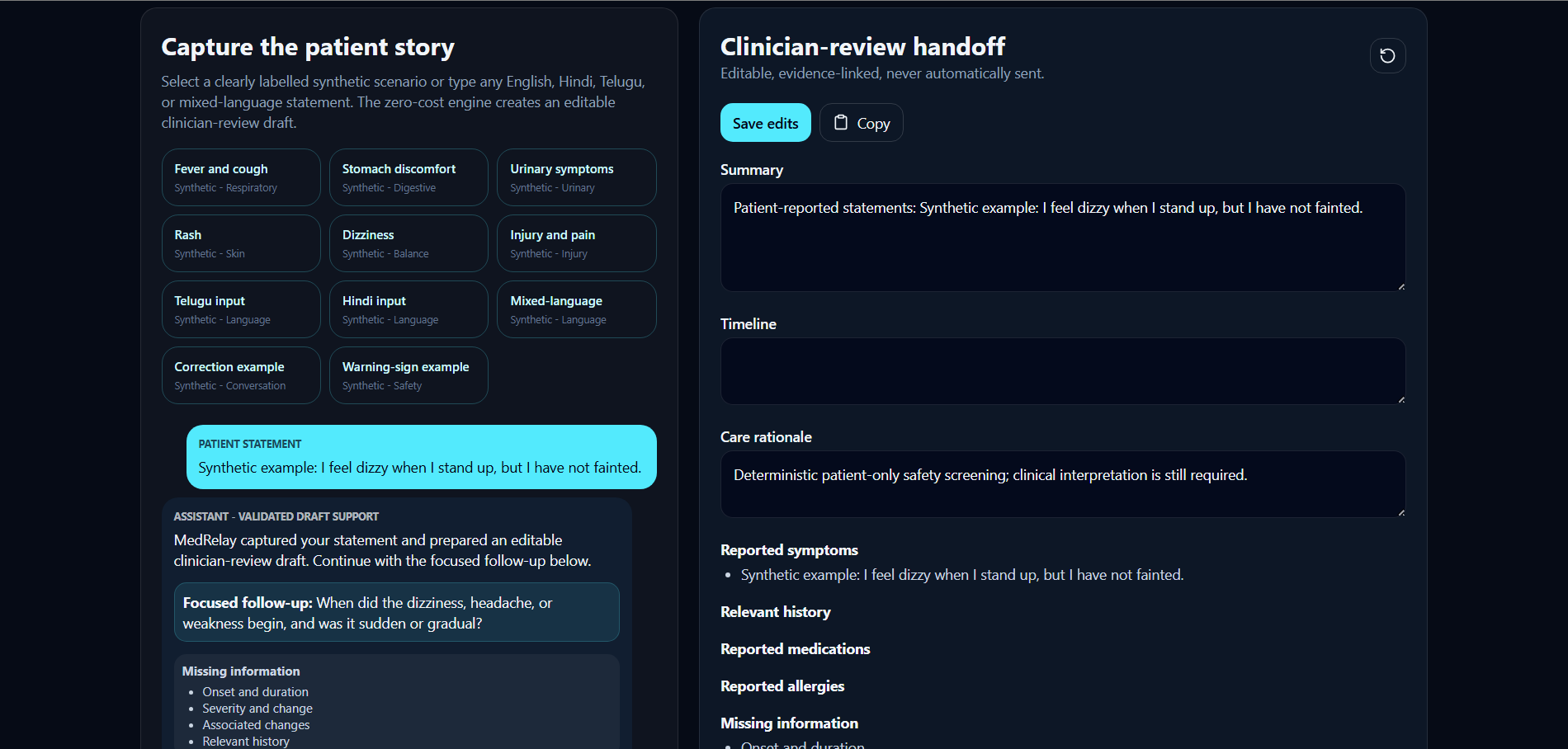
The intake asks symptom-aware follow-up questions while preserving the patient’s original wording.
-
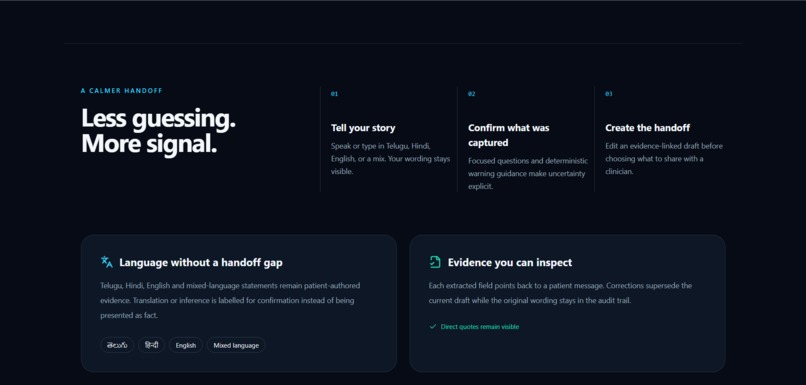
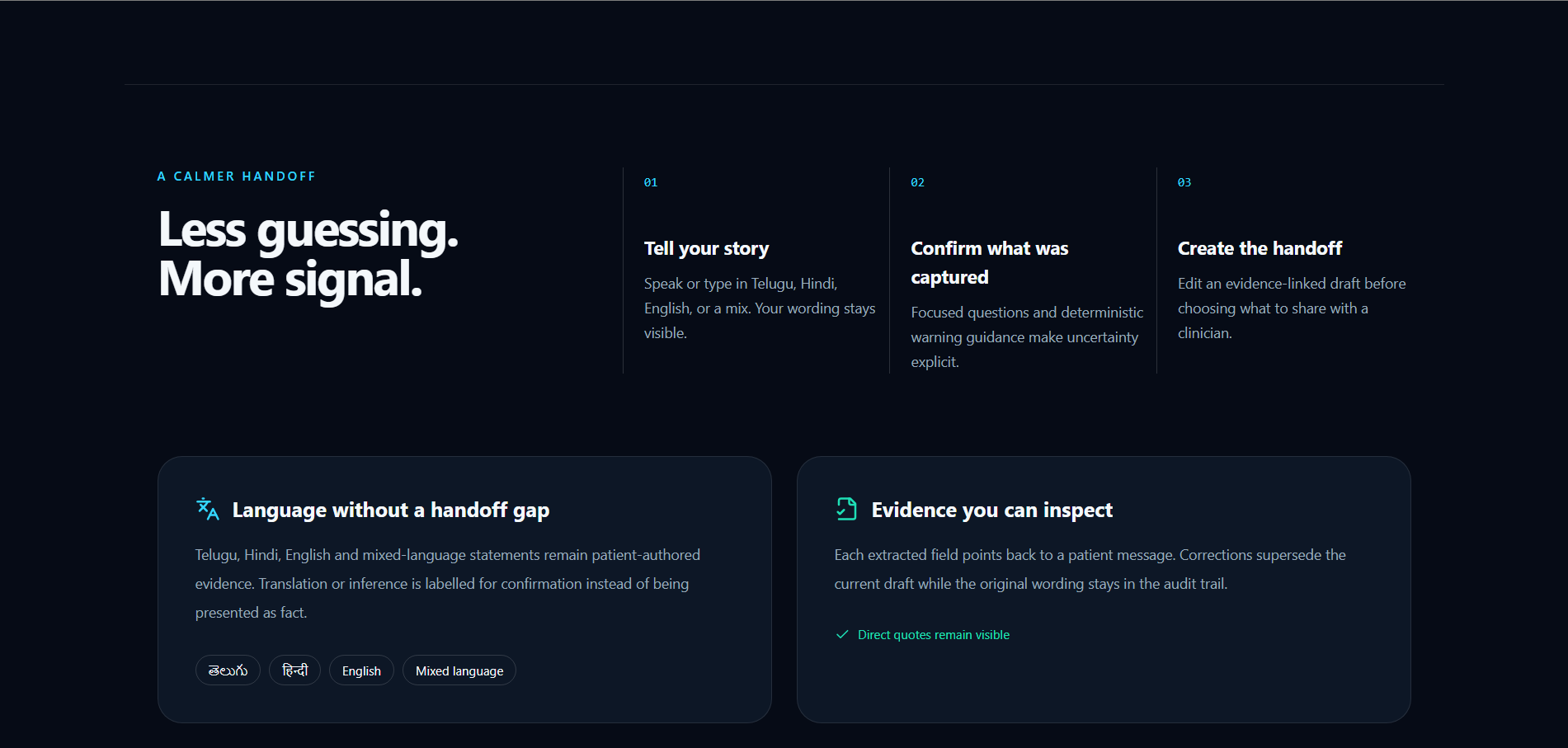
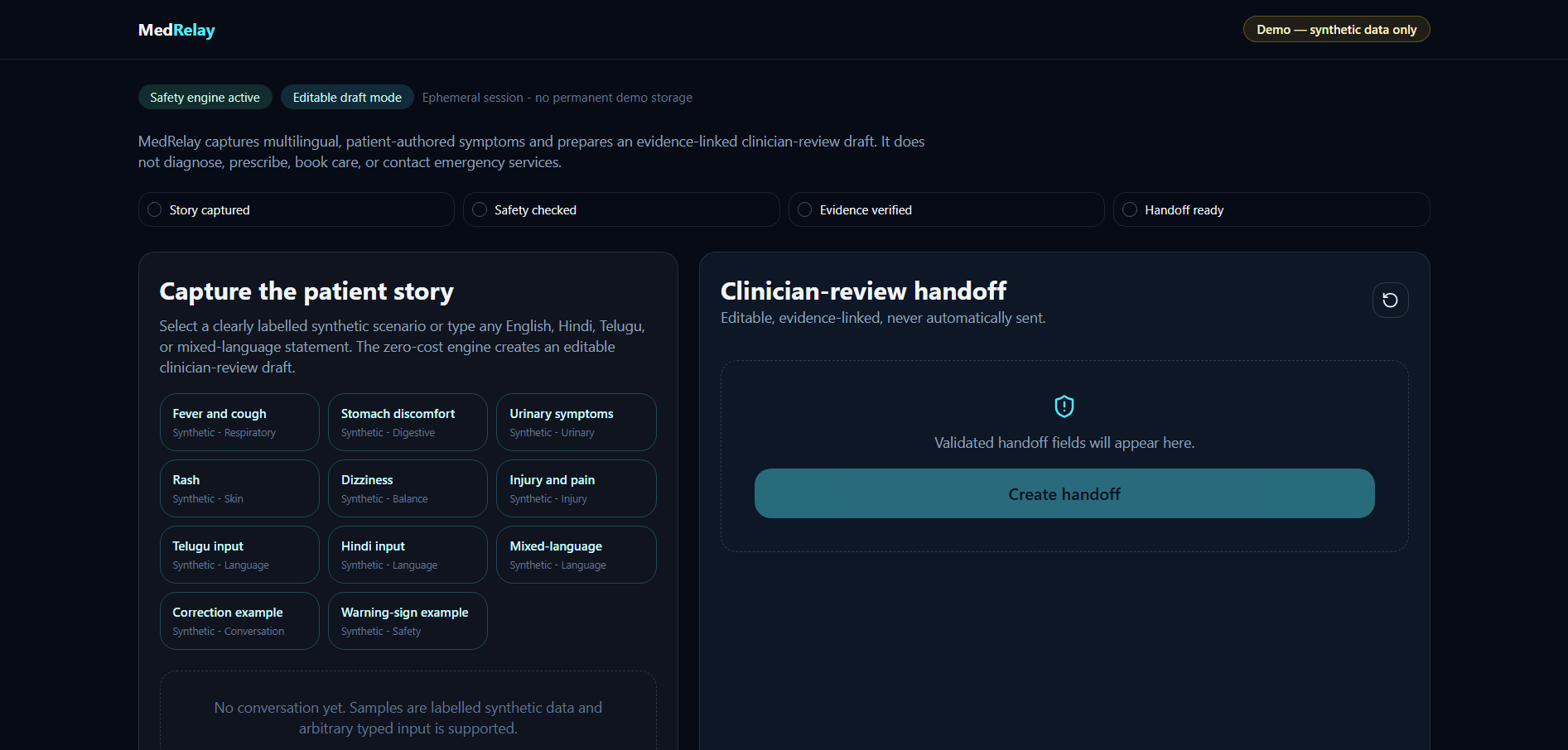
One focused flow: capture the story, screen warning signs, verify evidence, and prepare a safe handoff.
-
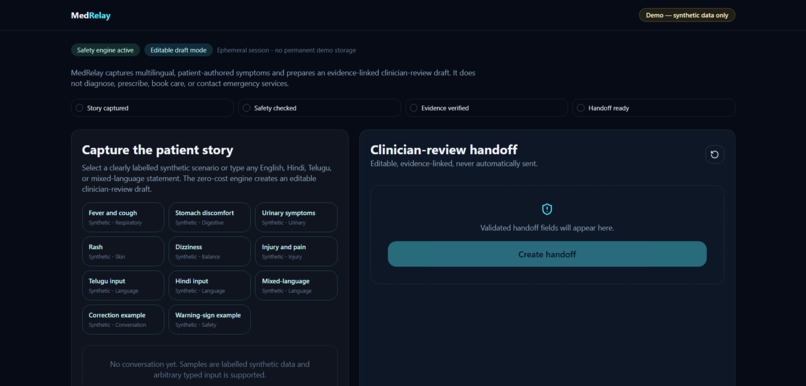
Start with a synthetic scenario or enter patient-authored text in English, Hindi, Telugu, or mixed language.
-
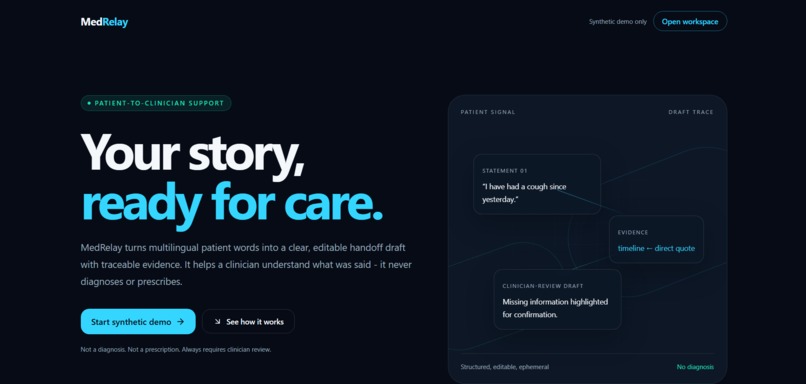
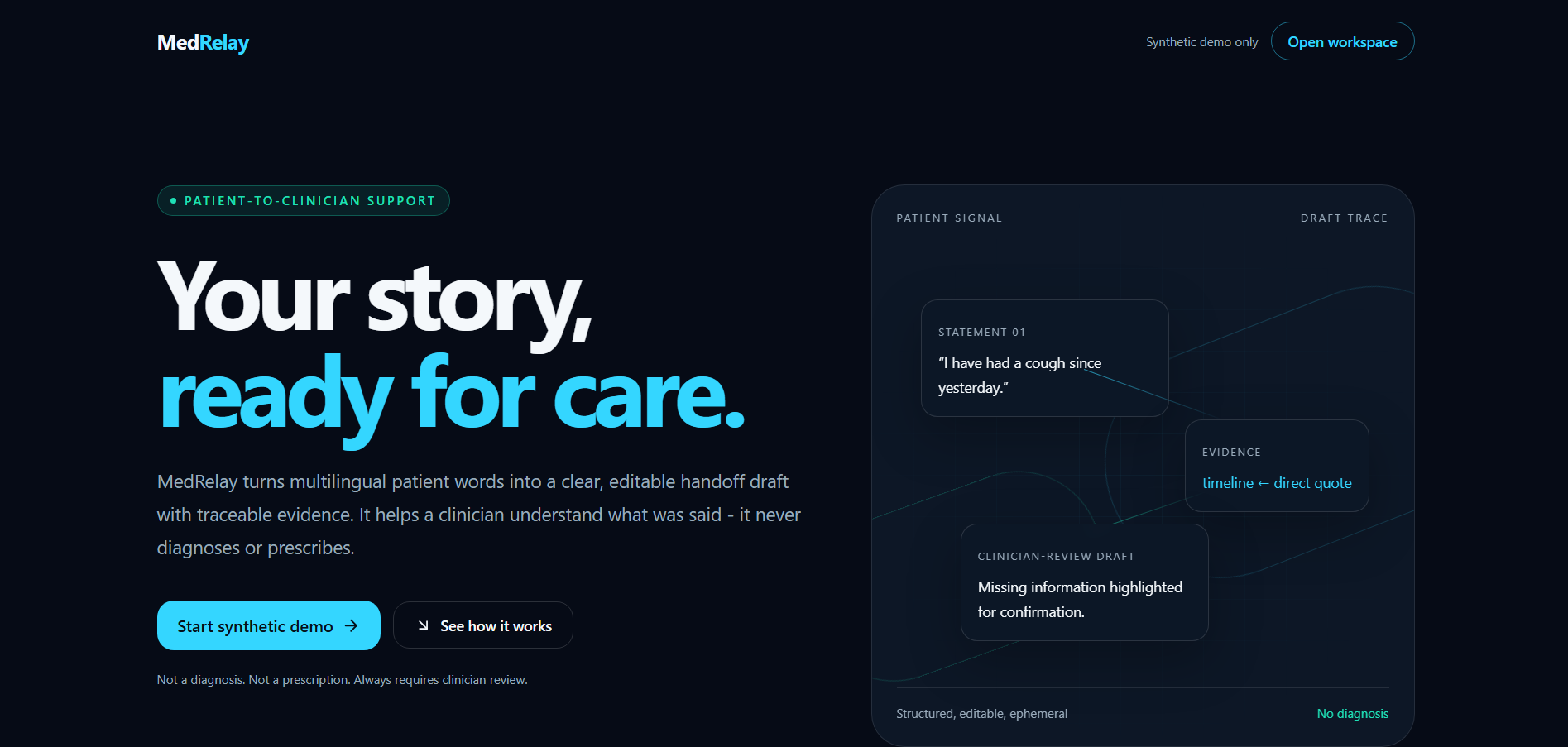
MedRelay turns multilingual patient stories into clear, editable, evidence-linked handoffs for clinician review.
-
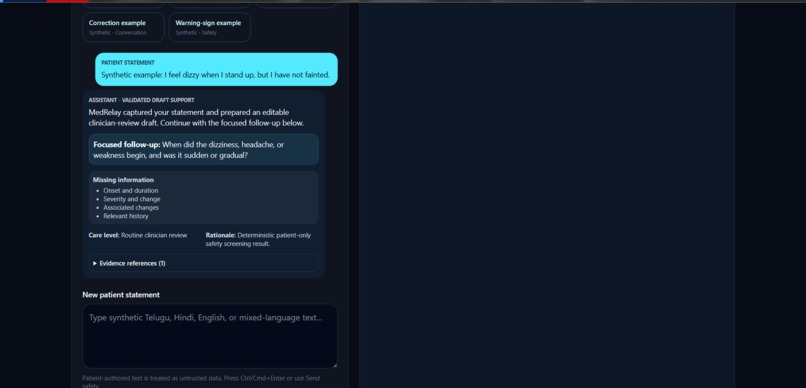
Each response updates missing information and care urgency without diagnosing or prescribing.
-
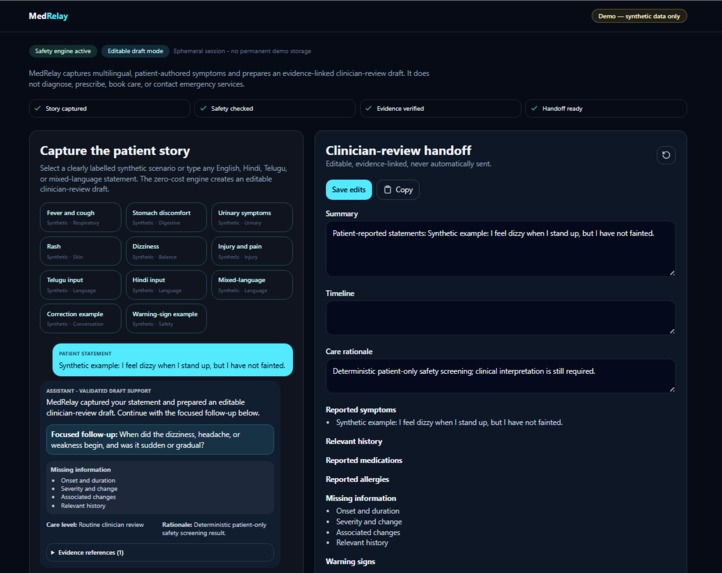
The editable handoff includes a summary, information gaps, warning signs, next steps, and evidence references.
-
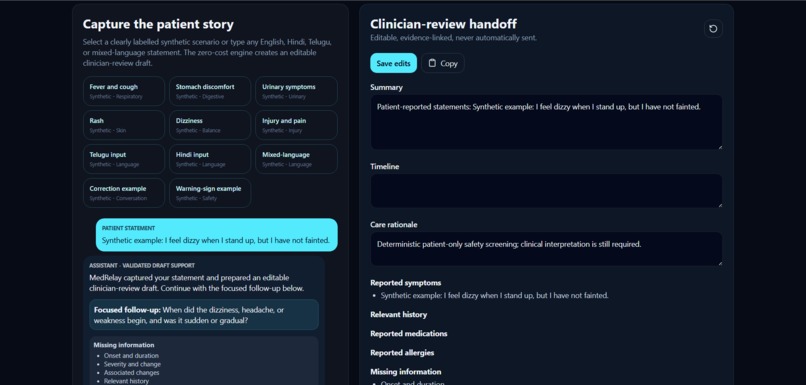
Conversation and clinician-review draft stay side by side, making corrections easy to review and trace.
Inspiration
In the meeting between a patient and a doctor, the former often forgets some things, provides a disorderly symptom description, or finds it difficult to convey what exactly happened and when. In such a way, precious consultation time of both the doctor and the patient is spent on reconstructing the story instead of immediately getting into the issue itself.
MedRelay was created in order to help close this communication gap. This is not an AI doctor. This is an AI-powered handoff assistant that helps to convert a patient's story of symptoms into structured handoff summary meant for clinician review.
What it does
MedRelay guides a user through a conversation-driven symptom intake experience.
It can:
- Understand symptoms communicated via text and voice
- Ask relevant follow-up questions
- Find information that may require urgent attention from a professional
- Communicate uncertainty instead of providing guesses as a fact
- Generate structured handoff based on the conversation
- Suggest the right type of specialist for review
- Help the user proceed with doctor discovery and appointment booking
- Provide relevant information in patient and clinician dashboards
The model does not give any diagnosis or prescribe a treatment independently. The task of the model is to enhance the process of communication and preparation before professional care.
How we built it
MedRelay started as a medical platform prototype in Manus, and during the course of OpenAI Build Week, its core experience was rebuilt and extended with the use of Codex and GPT-5.6.
Codex was used to inspect the current state of the codebase, migrate the previous model layer, enhance the patient to clinician workflow, improve the safety behavior, debug integrations, add tests and documentation for the implementation.
GPT-5.6 drives the conversation and structured handoff workflow of the application. The application uses the schema-controlled responses, so the interface gets predictable fields such as symptom summary, follow-up questions, warning indicators, uncertainty, suggestion of specialty and necessity of clinician review.
The front-end uses React, TypeScript, Three.js, Tailwind CSS and reusable UI components. The back-end uses Node.js, Express, tRPC, Drizzle ORM, authentication, patient workflows based on the database and protected health routes.
Challenges we faced
Migrating an existing prototype
The existing Manus prototype included another model integration and a wider feature set. The task was not just to rename the model. It was required to reconstruct the workflow of the AI around GPT-5.6 while preserving the architecture of the application.
Designing responsible medical AI
Medical language can easily sound more confident than the evidence allows it to be. The experience was redesigned around symptom intake, uncertainty, escalation and clinician review instead of designing the application as an independent diagnostic system.
Balancing visual design and usability
Distinctive 3D medical universe gives a unique first impression, but at the same time, it should not affect accessibility, mobile performance or the primary patient journey. The interface was designed in a way that keeps the visual experience second to the care handoff workflow.
Generating reliable structured results
Natural conversation is flexible, but application interfaces need predictable data. Structured Outputs were used to convert the conversation to predictable fields to render them reliably in patient and doctor dashboards.
Accomplishments that we're proud of
- Built an end-to-end symptom to handoff workflow
- Integrated GPT-5.6 into the core experience of the application
- Used Codex to extend an existing project in a meaningful way
- Created a structured doctor-ready patient summary
- Provided voice-enabled and multi-turn interaction
- Designed explicit uncertainty and clinician-review states
- Connected the experience with specialist discovery and care navigation
- Combined a distinctive 3D interface and functional full-stack product
What we learned
Sometimes the most useful thing that AI can do in healthcare is not prediction. It can also structure information, ask better questions, communicate uncertainty and help humans to make more informed decisions.
We also learned that model quality by itself is not enough for building a reliable application. An application requires structured data, validation, safety boundaries, failover handling, testing and user experience.
What's next for MedRelay
Further development will be aimed at evaluating the experience by clinicians, multilingual intake, improved accessibility, health record integration based on the standards, enhanced care provider matching and larger safety evaluation dataset.
Long-term vision is to have every medical consultation start with a clear patient story while still leaving healthcare professionals in charge.
Built With
- api
- codex
- css
- drizzle
- express.js
- gpt-5.6
- node.js
- openai
- orm
- outputs
- react
- responses
- shadcn/ui
- speech
- structured
- tailwind
- three.js
- trpc
- typescript
- vite
- vitest
- web

Log in or sign up for Devpost to join the conversation.