-
-

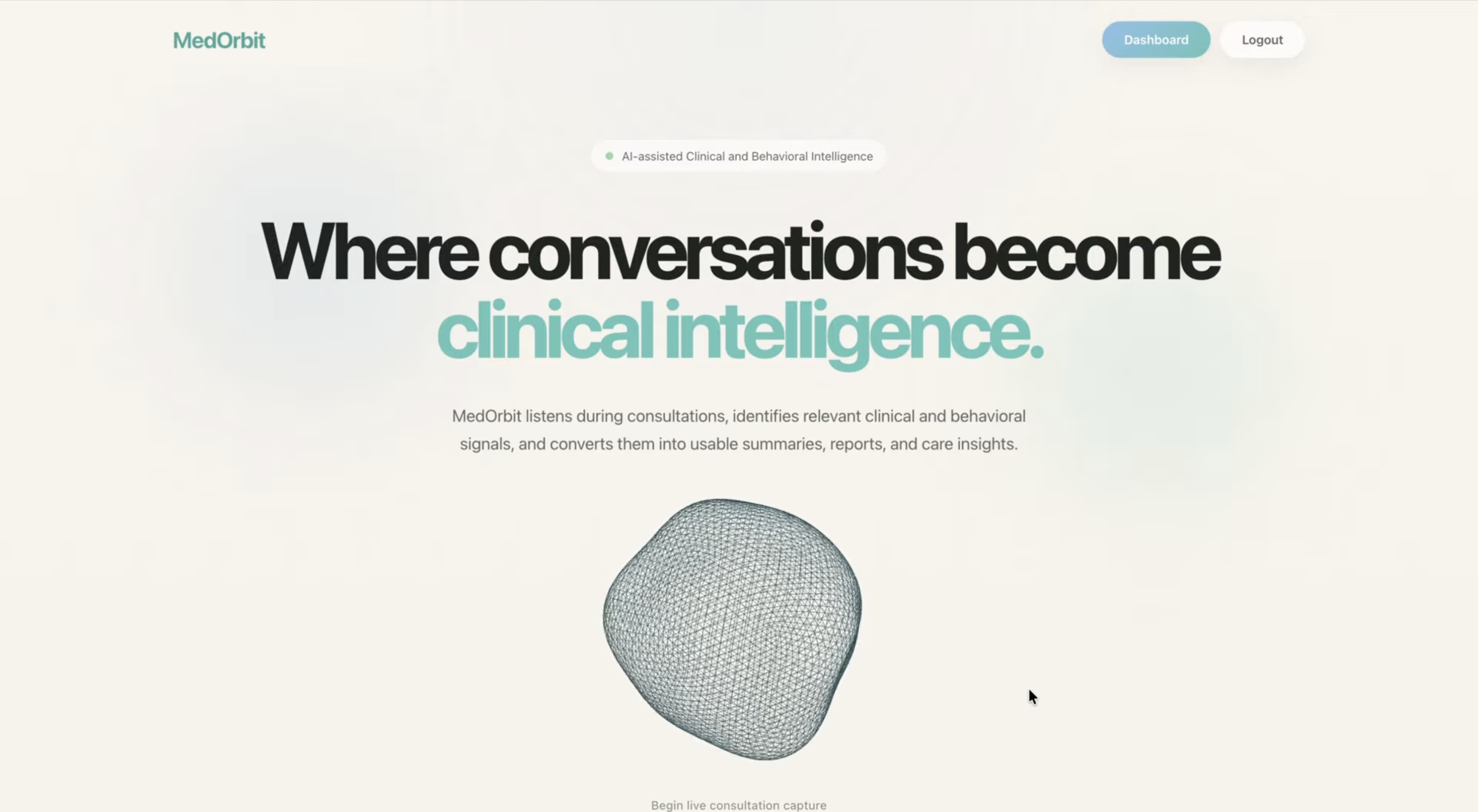
MedOrbit homepage.
Inspiration
In today’s healthcare systems, conversations between doctors and patients carry critical insights—but most of that information is lost, unstructured, or manually documented after the fact.
We were inspired by a simple idea:
What if conversations themselves could become structured clinical intelligence in real time?
At the same time, there is a growing fear that AI might replace professionals. We wanted to flip that narrative—AI should assist and empower doctors, not replace them. MedOrbit is our attempt to bridge that gap.
What It Does
MedOrbit is an AI-assisted clinical and behavioral intelligence platform that transforms live doctor–patient conversations into actionable insights.
With a single interaction (clicking the orb), MedOrbit:
- Captures consultation conversations
- Generates real-time transcript streams
- Extracts behavioral and clinical signals
- Produces structured summaries and draft reports
- Enables doctor review and approval
- Delivers simplified explanations and reminders to patients.
The system ensures a strict boundary:
Patients only see doctor-approved content, never raw or unverified AI output.
How We Built It
We designed MedOrbit as a modular, multi-agent system:
AI Architecture
- Behavioral Agent → detects emotional and behavioral signals
- Triage Agent → extracts symptoms and clinical context
- Super Agent (Orchestrator) → combines outputs into structured reports
System Architecture
- Frontend: React + TypeScript (custom UI with animated interaction layer)
- Backend: FastAPI with role-based APIs
- Database: PostgreSQL (visits, reports, reminders)
- Auth: JWT-based authentication with doctor/patient roles
UX Innovation
Our key differentiator is the blob interaction:
- Users click an animated orb on the landing page.
- It expands into a live consultation workspace.
- Transcript and AI insights appear progressively.
This turns a complex AI pipeline into one intuitive interaction.
Challenges We Faced
1. Real-time conversation processing
Handling live transcription and speaker identification is complex.
Solution: For the MVP, we simulated real-time transcript streaming while keeping the architecture compatible with real audio pipelines.
2. Avoiding “AI hallucination” risk
Healthcare requires strict reliability.
Solution: We introduced a doctor-in-the-loop approval system, ensuring:
- AI outputs are drafts.
- Only approved content reaches patients.
3. UX vs complexity trade-off
We had a powerful backend but needed a simple, intuitive interface. Solution: The orb interaction became the central entry point, abstracting complexity into a seamless flow.
4. End-to-end integration under time constraints
Connecting agents, backend APIs, UI, and demo flow within limited time was challenging.
Solution: We used a demo-safe architecture with deterministic data flows to ensure reliability.
What We Learned
- Designing AI systems is not just about models—it’s about **trust, flow, and usability.
- Real-world AI products must include **human oversight loops.
- Strong UX can make complex systems feel simple and intuitive.
- Building for a hackathon requires balancing innovation with reliability
What’s Next
- Visual Patient Analysis for Psychological Insights
- Real-time speech-to-text integration
- Speaker diarization (doctor vs patient)
- Advanced clinical reasoning models
- EHR integration
- Personalized care recommendations
Core Idea
At its heart, MedOrbit is built on a simple transformation:
$$ \text{Conversation} \rightarrow \text{Structured Insight} \rightarrow \text{Actionable Care} $$
Final Thought
MedOrbit is not about replacing doctors.
It’s about amplifying patients' and doctors' ability to understand, decide, and care, powered by AI.
Built With
- custom
- fastapi-(backend)
- interaction
- jwt-auth
- multi-agent-ai-architecture
- postgresql-(database)
- react-+-typescript-(frontend)
- rest-apis

Log in or sign up for Devpost to join the conversation.