InspirationInspiration
We noticed a dual-crisis in modern healthcare: clinical burnout and patient confusion. Doctors are working unprecedented overtime, often burdened by fragmented systems. When reviewing new patient imaging, they frequently struggle to quickly access and compare previous scans, increasing the risk of human error due to sheer fatigue. On the other side of the spectrum, patients receive complex Complete Blood Count (CBC) reports or raw scan results and are left entirely in the dark, unable to decipher the medical jargon before their next appointment. We built Medora to bridge this exact gap—serving as a safety net for exhausted clinicians and an educational translator for anxious patients.
What it does Medora is a dual-sided healthcare intelligence platform designed to augment clinical workflows and empower patients:
For Healthcare Professionals: Medora provides an intelligent imaging dashboard. When a new scan is uploaded, the AI automatically retrieves and aligns previous imaging, creating a clear longitudinal track. This side-by-side historical context reduces the cognitive load on overworked doctors, helping them identify anomalies faster and significantly reducing human error.
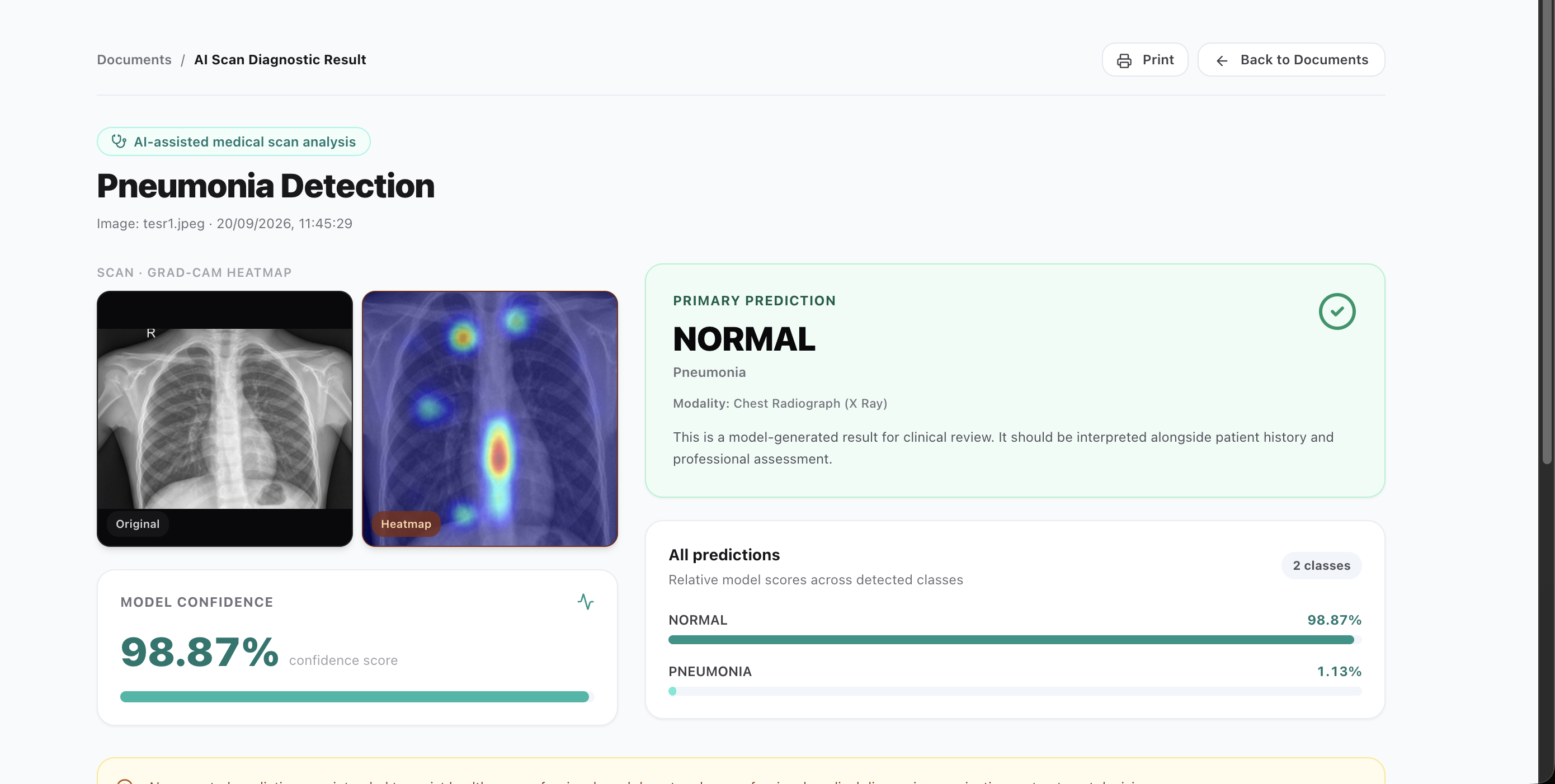
For Patients: Medora acts as an accessible health translator. Patients can simply upload their CBC reports or medical scans, and our AI generates a plain-language summary of their results. To ensure absolute patient safety, the platform operates with strict guardrails: it explicitly states that the AI is not providing a 100% definitive diagnosis and prominently instructs users to consult their doctor for clinical decisions.
How we built it We approached the build by separating the complex AI pipeline from the user-facing interfaces to ensure a seamless experience.
Design & Prototyping: We mapped out the dual-sided UX in Figma, focusing on a clean, clinical minimalist aesthetic that prioritizes readability and trust.
Frontend UI: We utilized Streamlit to rapidly deploy the interactive web application, allowing us to build out separate, secure dashboards for both patients and clinicians.
AI & Processing Pipeline: For the patient-facing CBC and text-based report translation, we integrated the Google Gemini API to parse complex medical jargon and restructure it into accessible summaries.
Deployment: The backend architecture and containerized services were hosted using Google Cloud Run to ensure scalable, low-latency processing when handling file uploads and AI inference.
Challenges we ran into One of the most significant hurdles was managing AI hallucinations, particularly in a high-stakes domain like healthcare. We had to heavily engineer our prompts and pipeline to ensure the model acted strictly as an educational tool rather than a diagnostic authority. Implementing the strict disclaimer overlays and ensuring the AI never spoke with absolute diagnostic certainty required extensive iteration. Additionally, structuring the data pipeline to properly track and chronologically align a patient's historical imaging data alongside new scans proved to be a complex architectural challenge.
Accomplishments that we're proud of We are incredibly proud of successfully building a working, dual-sided platform that addresses two distinctly different user needs within a single ecosystem. Bridging the gap between a high-utility, technical tool for doctors and an empathetic, easy-to-understand portal for patients was a massive win. We also successfully implemented a robust safety-first AI guardrail system, proving that generative AI can be utilized in patient education responsibly.
What we learned We gained a deep appreciation for the ethical implications of building health-tech. We learned that the goal of AI in medicine should never be to replace the doctor, but to augment their capabilities and reduce their administrative and cognitive load. We also learned how critical progressive disclosure is in UX design—patients need information broken down step-by-step to avoid panic, while doctors need data density and immediate historical context to make fast decisions.
What's next for Medora Our immediate next step is to test the platform with actual radiologists and general practitioners to refine the longitudinal imaging tracking features based on real clinical workflows. We plan to expand our parsing capabilities beyond CBCs to handle comprehensive metabolic panels and specialized lab results. Ultimately, we aim to integrate Medora with existing hospital Electronic Health Record (EHR) systems via secure APIs, ensuring that our AI tracking operates natively within the software that doctors already use every day.
Built With
- nextjs
- python
- supabase
