Inspiration Medical insurance claim verification often involves reviewing multiple documents, including prescriptions, hospital bills, diagnostic reports, and treatment records. Manually checking these documents can be time-consuming, and identifying inconsistencies or potential duplicate claims can be challenging. This inspired us to develop MedGuard AI, an AI-agent-based medical claim verification platform integrated with PillBot, our IoT-based medication dispensing system. Our vision is to combine intelligent document verification with hardware-generated medication dispensing records to support more transparent and evidence-driven healthcare claim reviews.
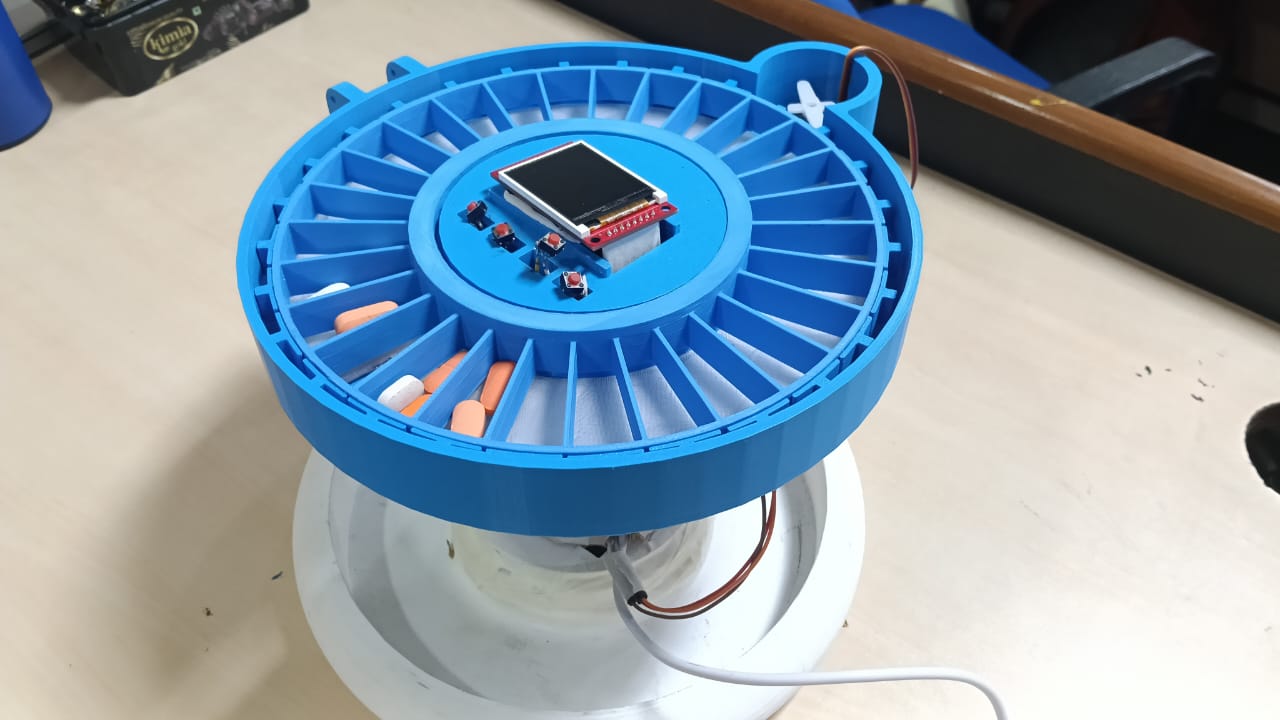
What We Are Building MedGuard AI aims to use specialised AI agents to analyse medical claim documents, cross-verify information, identify potential duplicate submissions, and flag inconsistencies for further investigation. The platform is designed to generate explainable reports that help human reviewers understand the evidence behind each finding. Our PillBot hardware prototype has been developed using an ESP32, DS3231 real-time clock, servo motor, IR sensor, and buzzer to support scheduled medication dispensing and reminders. We are currently working on the AI-agent component that will form the intelligence layer of MedGuard AI. Our planned integration will allow relevant PillBot dispensing events to be compared with authorised prescription and claim records, providing additional context during verification. The AI system will distinguish between verified information, potential discrepancies, and cases requiring further evidence rather than automatically declaring a claim fraudulent.
How We Are Building It We have developed the PillBot hardware prototype and are now focusing on the software architecture for MedGuard AI. Our planned system includes a document intelligence agent for extracting information from medical records, a cross-document verification agent for identifying inconsistencies, a duplicate detection agent for flagging potentially repeated claims, and an investigation agent for coordinating verification tasks. We intend to connect these components through a backend API and integrate them with a dashboard for uploading documents, reviewing findings, and generating evidence-based reports. The PillBot hardware will provide a pathway for transmitting medication dispensing events to the software platform.
What We Are Learning Through this project, we are exploring how AI agents can collaborate to solve complex problems through specialised tasks, tool usage, and structured decision-making. We are also learning how to integrate embedded hardware with backend services, process medical documents, validate extracted information, and build explainable AI workflows. An important part of our learning is understanding how to combine AI-generated insights with reliable verification rules while maintaining data privacy, accuracy, and human oversight in healthcare applications. Challenges We Are Addressing One of our main challenges is designing a reliable verification process for medical documents that may contain incomplete information, inconsistent fields, or OCR errors. Another challenge is integrating hardware-generated dispensing records with medical claim documents while ensuring that sensor events are interpreted correctly. A dispensing event, for example, does not independently prove that a patient consumed the medication. We are also working to design a multi-agent architecture in which each agent has a clearly defined responsibility and its findings are supported by traceable evidence. Our focus is on building a system that identifies discrepancies responsibly rather than making unsupported fraud accusations.
Our Vision Our vision is to develop an intelligent healthcare verification platform that combines AI agents, IoT hardware, and evidence-based analysis to improve the transparency and efficiency of medical claim reviews. By building on our existing PillBot hardware and developing the MedGuard AI software layer, we aim to demonstrate how connected healthcare devices and agentic AI can work together to support better-informed decisions while keeping human reviewers involved in consequential claim decisions.
Built With
- arduino
- artificial
- assistant
- automation
- c++
- control
- embedded
- esp32
- healthcare
- intelligence
- interaction
- learning
- liveperson-agent
- machine
- management
- medication
- motor
- natural
- robotics
- sensors
- smart
- systems
- technology
- wi-fi

Log in or sign up for Devpost to join the conversation.