-
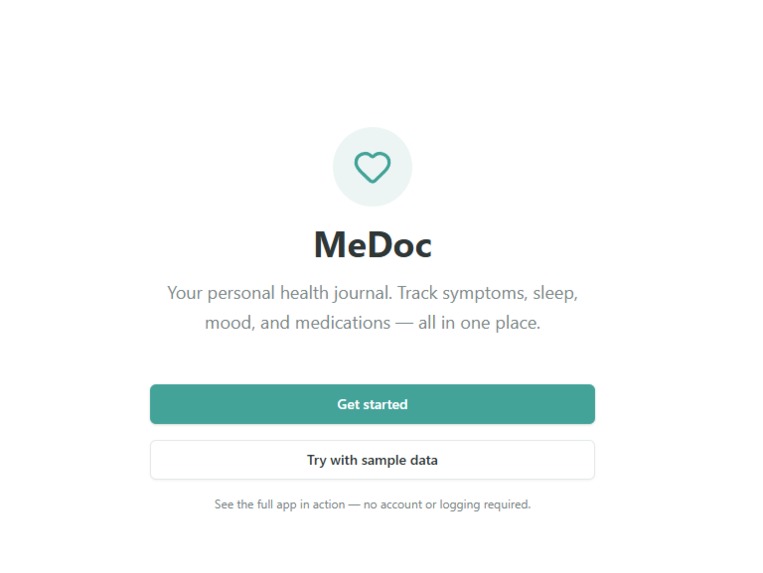
MeDoc Login Screen
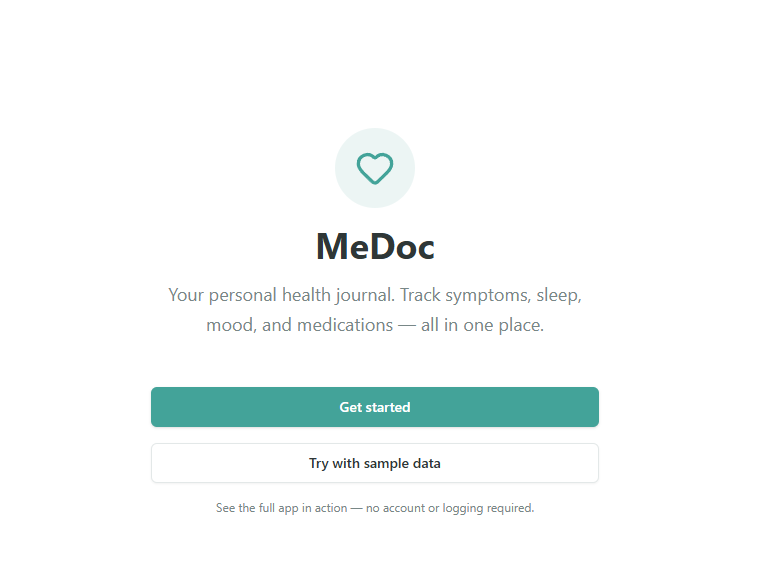
MeDoc — About the Project
Inspiration
A few months ago, my doctor asked me a simple question: "When did the headaches start, and have you noticed anything that triggers them?"
I didn't know. I knew they were happening, but I had no data. No timeline. No pattern. Just a vague feeling that things had been worse "lately."
That's the gap MeDoc fills. Most of us experience our health as scattered moments — a bad night of sleep here, a headache there, a skipped meal, a new medication — and we completely miss the connections between them. Doctors ask for patterns. Patients have only memories.
I built MeDoc because I wanted the tool I wished I'd had walking into that appointment: something that turns the casual way we think and talk about our bodies into structured data, then quietly surfaces the patterns we'd never spot on our own.
What It Does
MeDoc is a chat-first personal health journal that:
- Logs symptoms conversationally. You type "slept badly, maybe 5 hours, migraine started around 2pm" and MeDoc parses it into structured entries (symptom, severity, duration, timestamp, context), shows you a preview card to confirm, and saves it.
- Detects patterns you'd otherwise miss. After 7+ days of data, MeDoc runs correlation analysis across symptoms, sleep, meals, and medications — surfacing hypothesis cards like "4 of your last 5 migraines happened on days you slept under 6 hours."
- Generates doctor-ready PDF reports for any date range — clean, printable, actually useful in a 15-minute appointment.
- Stays private by default. All pattern analysis runs client-side. Your health data never leaves your browser unless you export it.
- Answers questions about your own data — "how many headaches last month?", "what did I eat the day before my last migraine?"
How I Built It
The entire app was built through a deliberate 7-turn conversation with MeDo, each turn designed to build on the last rather than rebuild from scratch:
- Vision & architecture — asked MeDo to produce a requirements document (personas, data model, privacy approach) before writing any code.
- Scaffold — generated the full-stack app with landing page, onboarding, dashboard, timeline, and settings.
- The conversational logger — MeDo's AI plugin parses natural-language entries into structured fields and asks a single clarifying follow-up when something is ambiguous.
- Pattern detection engine — a pure correlation function over the user's entries, surfacing only patterns with a minimum sample size and never framing them as medical fact.
- Integrations — PDF report generation (via MeDo's PDF plugin), CSV export, browser-notification reminders, and a natural-language query bar on the Insights page.
- Polish pass — empty states, skeleton loading, WCAG-AA accessibility, warm microcopy, and a one-click "try with sample data" mode so anyone can experience the full app in 30 seconds.
- Deploy & verify — mobile responsiveness sweep, demo script, public URL.
The Correlation Math (in plain terms)
For a given symptom $S$ and a candidate factor $F$ (e.g., sleep under 6 hours), MeDoc computes a simple lift score over a 24-hour window:
$$\text{lift}(S, F) = \frac{P(S \mid F)}{P(S)}$$
A lift significantly greater than 1, combined with a minimum co-occurrence count ($n \geq 3$), surfaces a hypothesis card. Patterns are always phrased as "possible" — never as diagnosis.
Challenges
- Keeping the AI humble. Health is the one domain where an overconfident AI is dangerous. Every output had to be framed as "possible pattern," never "your trigger is X." Getting MeDo to consistently adopt this voice took specific prompting and a few corrective turns.
- Sample size vs. usefulness. Real correlation analysis needs weeks of data, but hackathon judges won't log for weeks. I solved this with a realistic sample-data generator — not random noise, but seeded patterns so the insight engine actually has something to find within seconds.
- Emergency symptom handling. When a user logs something serious (chest pain, difficulty breathing), MeDoc shows a non-intrusive suggestion to contact a doctor without being alarmist, preachy, or refusing to save the entry. Striking that tone took careful iteration.
- Privacy vs. features. I initially wanted cloud sync and shared family accounts. I killed both. For health data, local-first isn't a nice-to-have — it's the product.
What I Learned
- Planning prompts beat coding prompts. The single most valuable turn with MeDo was the first one, where I asked for a requirements document before any code. Everything after that was course-correction instead of reconstruction.
- Multi-turn conversation is a design tool, not just a convenience. Each turn became a natural checkpoint — test, screenshot, correct, continue. It's a better development loop than most IDEs give you.
- Specific design direction matters. "Notion meets Apple Health — muted teal, not clinical blue" produced a dramatically better UI than "make it look nice."
- The best AI apps know when to shut up. MeDoc's parsing AI asks at most one clarifying question, then gets out of the way. Restraint is a feature.
What's Next
- Weather + barometric pressure as correlation factors (migraine sufferers will know why)
- Opt-in encrypted sync across a user's own devices
- Shareable, anonymized pattern insights so communities of people with similar conditions can learn from aggregate trends — without ever exposing individual data
- Native mobile wrappers so quick-logging becomes a home-screen action
Built with MeDo in 7 conversations. Submitted to the Surprise Us! track of the Build with MeDo Hackathon.
Built With
- medo

Log in or sign up for Devpost to join the conversation.