-
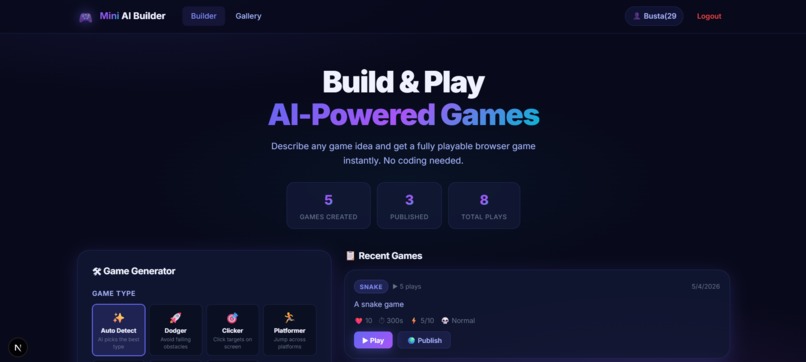
Home page
-
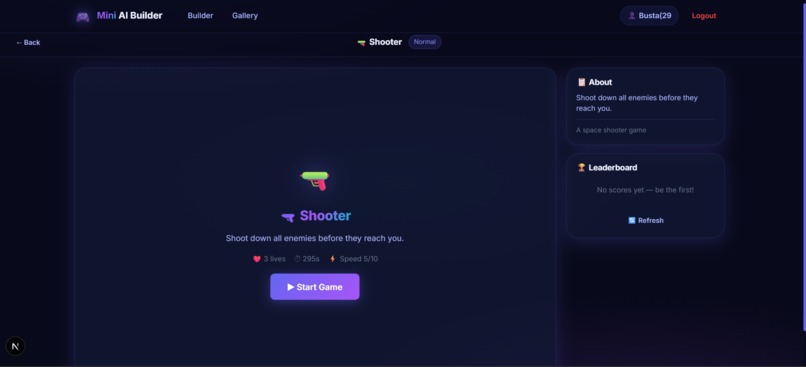
Play page
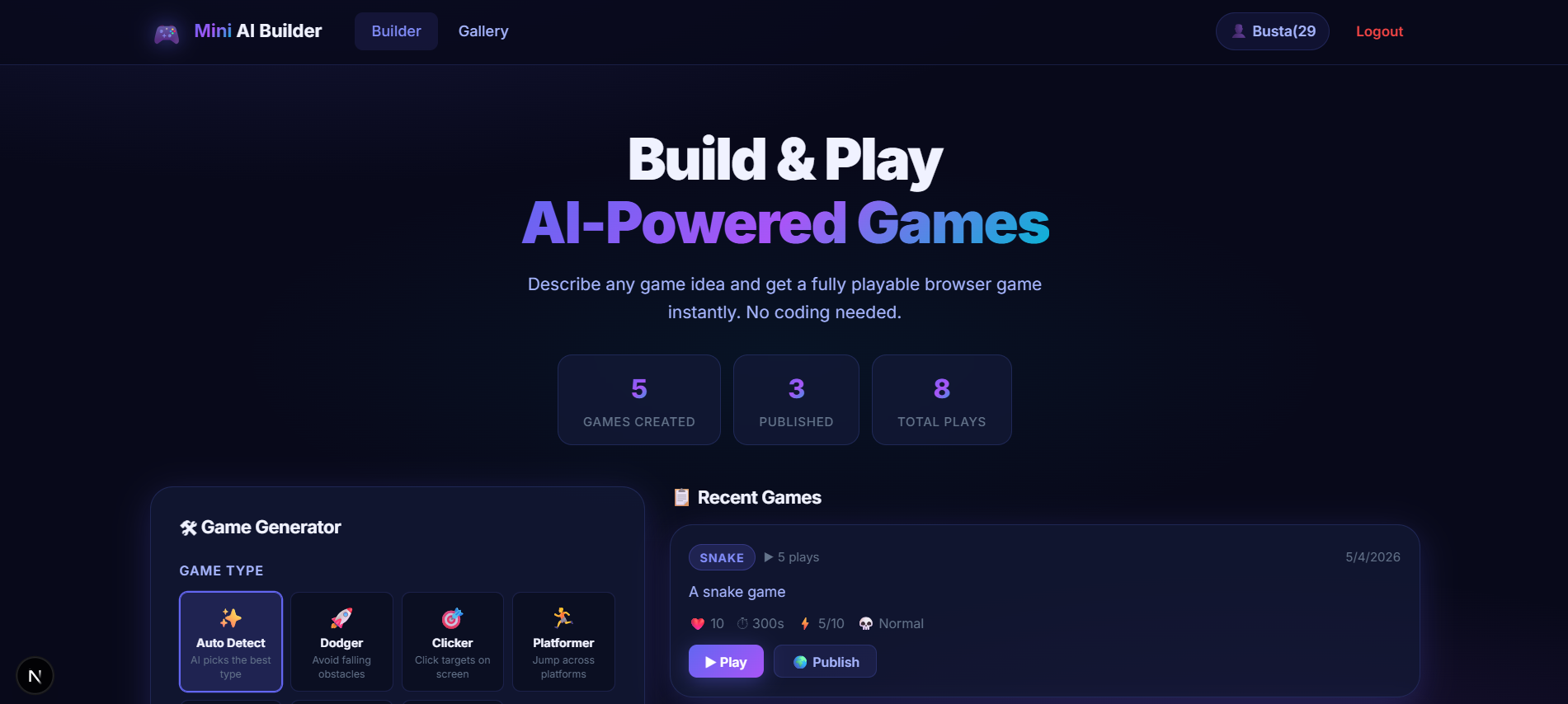
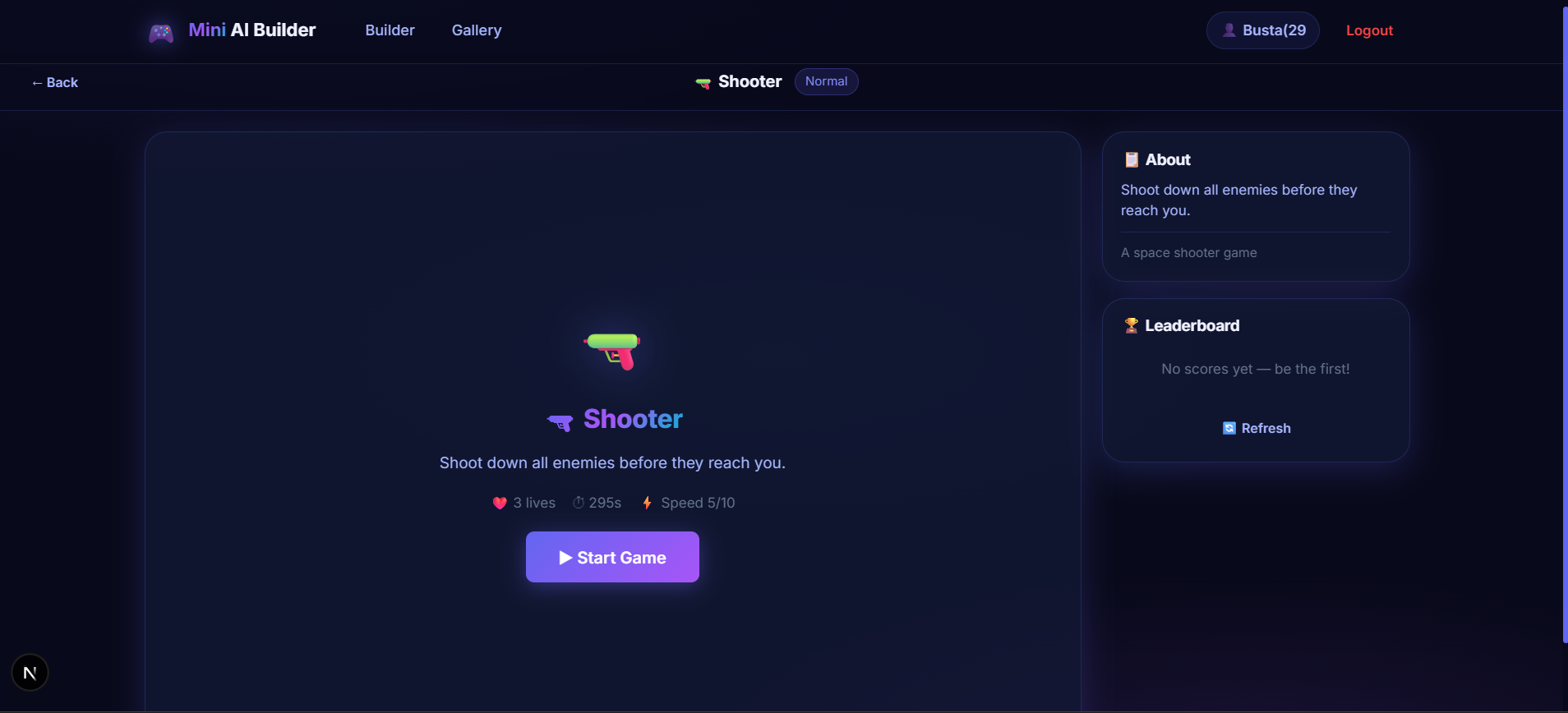
Mini AI Game Builder
Inspiration
Mini AI Game Builder started from a simple frustration: turning a game idea into a playable prototype usually takes too long.
In hackathons and indie projects, momentum is everything — but setup, boilerplate, and repetitive logic often slow teams down before creativity can shine.
We wanted a workflow where anyone could describe a game idea in plain language and instantly get a structured, playable result they could iterate on and share.
What It Does
Mini AI Game Builder is a prompt-to-play platform.
Users type a game idea and the system generates a fully playable browser game with sensible, editable defaults:
- Template type — auto-detected or manually selected from 6 engines
- Lives, duration, speed, difficulty — parsed from natural language or tuned via sliders
- Objective — generated per template type
- Publish & play — one click to go live in the gallery; another to play
The core value is rapid experimentation: moving from concept to a running game in your browser in seconds, not hours.
Key Features (Current Build)
| Feature | Status |
|---|---|
| 6 playable game templates (Dodger, Clicker, Platformer, Snake, Memory, Shooter) | ✅ Live |
| Natural-language prompt parsing → game config | ✅ Live |
| Playable HTML5 Canvas game engine per template | ✅ Live |
| In-game HUD (score, lives, countdown timer) | ✅ Live |
| Per-game leaderboard with score submission | ✅ Live |
| Guest & authenticated score tracking | ✅ Live |
| User registration + login (JWT auth) | ✅ Live |
| Published game gallery with search & template filter | ✅ Live |
| Dashboard stats (games created, published, total plays) | ✅ Live |
| Play session analytics (score + seconds played) | ✅ Live |
| Premium dark glassmorphism UI | ✅ Live |
| Toast notification system | ✅ Live |
How We Built It
A full-stack app with clear separation of concerns:
- Frontend: Next.js 16 (App Router) · TypeScript · CSS Modules · HTML5 Canvas
- Backend: NestJS · TypeScript · JWT + Passport · bcrypt
- Database: MySQL 8 via TypeORM (migrated from MongoDB/Mongoose)
Architecture Highlights
- Prompt parser maps natural-language cues (
"hard","fast","3 lives","60 seconds","snake","shoot") into validated config values across 6 template types. - 6 canvas game engines — fully self-contained, pure HTML5 Canvas, no external game libraries. Each engine is initialized once and cleaned up on unmount via React effect cleanup.
- Stable callback ref pattern — game loops run outside React's render cycle via
requestAnimationFrame. Callbacks are stored inuseRefand proxied into the engine to avoid stale closure bugs. - Auth module — bcrypt-hashed passwords, 7-day JWT, optional auth guards so guests can still generate and play.
- Scores module — leaderboard per game (top 10), play session recording, stat aggregation.
- Gallery — published games sorted by play count, searchable and filterable by template.
- The core loop: prompt → generate → tweak → play → publish → leaderboard.
Challenges We Ran Into
- Prompt ambiguity: Natural language is messy. We built safe fallback defaults and keyword chains per template so any prompt still produces a valid game.
- Canvas ↔ React boundary: The game loop runs outside React. Getting score/lives state to update in React without stale closures required the
useRefdelegate pattern. - Operator precedence parsing: Turbopack (Next.js 16) is stricter than Babel — mixing
??and||without parentheses is a parse error that crashes the entire page. - Database migration: Switched from MongoDB to MySQL mid-project; required rebuilding all entities, relations, and query logic with TypeORM.
- Auth integration with optional guards: Some endpoints needed to work for both guests and logged-in users, requiring a custom
OptionalJwtGuardthat doesn't throw on missing tokens.
Accomplishments We're Proud Of
- Delivered a fully playable multi-template game platform end-to-end.
- Built 6 distinct game engines in pure HTML5 Canvas without any game library dependency.
- Implemented a live leaderboard with real score persistence and play session tracking.
- Built a JWT auth system from scratch with bcrypt, optional guards, and context-aware frontend state.
- Designed a premium glassmorphism UI with animated stats, micro-animations, and full mobile responsiveness.
- Maintained a clean, documented codebase with a full bug fix report throughout rapid development.
What We Learned
- Fast prototyping improves dramatically when generation and editing are both first-class features.
- Strong validation and defaults are essential for reliable AI-assisted UX.
- Clear API contracts between frontend and backend prevent rework — especially after a database migration.
- For creator tools, time-to-first-result is one of the most important product metrics.
- Running game loops outside React requires deliberate patterns (ref delegates) to keep UI state in sync.
You can think of iteration efficiency as:
$$\text{Prototype Velocity} \propto \frac{\text{Idea Clarity} \times \text{Generation Quality}}{\text{Setup Friction}}$$
Our goal was to reduce setup friction while keeping output quality immediately playable and shareable.
What's Next for Mini AI Game Builder
Near-term
- [ ] Shareable play links — public URLs for each published game (no login required to play)
- [ ] User dashboard — see your own games, stats, and leaderboard rankings in one place
- [ ] Mobile touch controls — on-screen D-pad / tap areas for all 6 templates
Mid-term
- [ ] AI remix / version history — fork any published game config and diff against the original
- [ ] Difficulty telemetry — auto-tune speed and spawn rates based on average completion rates
- [ ] More templates — runner, tower defence, rhythm, brick-breaker
- [ ] In-game visual themes — let users choose colour palettes / sprite styles per game
Long-term
- [ ] LLM-powered generation — replace rule-based parsing with a real language model for richer config extraction
- [ ] Export to code — download a self-contained HTML file for any generated game
- [ ] Production deployment — Docker + CI/CD pipeline, analytics, usage dashboards
- [ ] Multiplayer leaderboard — real-time score updates via WebSockets
Built With
- css
- html5
- javascript
- jwt
- mysql
- nestjs
- next.js
- typescript

Log in or sign up for Devpost to join the conversation.