Inspiration
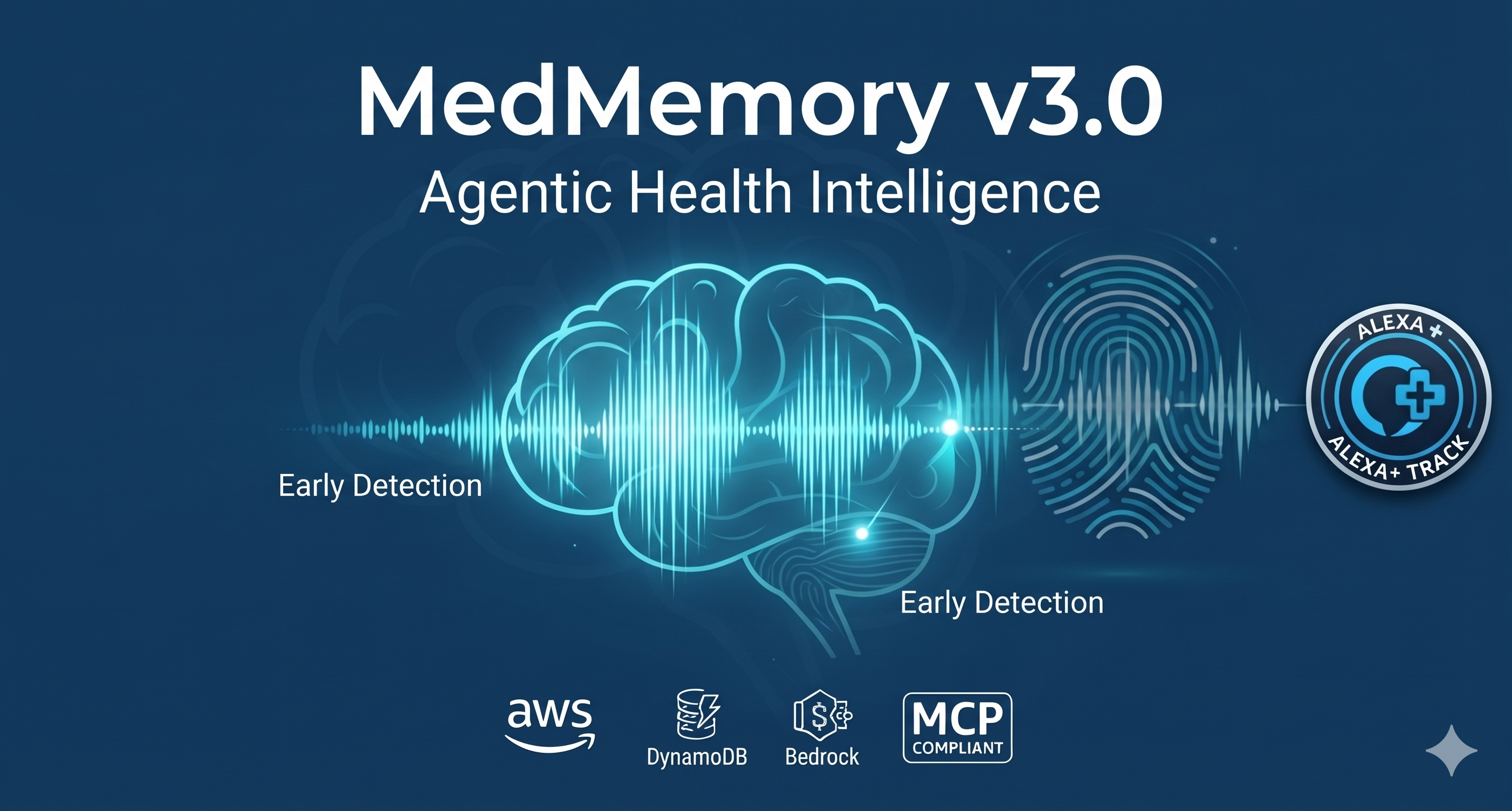
Medication non-adherence among seniors is a massive $100 billion healthcare crisis causing over 125,000 avoidable deaths annually[cite: 3, 5]. Traditional reminder apps fail because they react only after a dose is missed, completely missing the root cause: undetected, silent cognitive decline[cite: 3, 5]. MedMemory v3.0 turns Amazon Alexa+ into a proactive health intelligence platform[cite: 3].
What it does
MedMemory v3.0 introduces three core pillars:
- Cognitive Fingerprint Engine (The Trump Card): Passively monitors six clinical speech markers (speech rate, pause distribution, vocabulary richness, filler-word density, response latency, and syntactic complexity) across routine Alexa interactions, autonomously alerting caregivers via Amazon SNS when deviation exceeds clinical thresholds—days before a missed dose[cite: 4, 8].
- Two-Lane Authority Architecture: Built on the Model Context Protocol (MCP over Streamable HTTP), it separates probabilistic language parsing (Lane A, read-only) from deterministic safety-critical writes (Lane B), making double-dosing and LLM medical corruption structurally impossible[cite: 3, 7, 11].
- Bedrock Guardrails Safety Shield: Intercepts unverified or dangerous medical queries and serves secure fallback anchors[cite: 8].
How we built it
- Integration Spec: Model Context Protocol (MCP) spec 2025-11-25+ over Streamable HTTP[cite: 1, 11, 12].
- Compute: AWS Lambda Function URLs (Python 3.12,
fastmcp)[cite: 1, 11, 12]. - Intelligence Plane: Amazon Bedrock (Nova 2 Lite for language parsing & cognitive scoring, Nova Pro Multimodal for visual descriptor extraction, and Guardrails)[cite: 11, 12].
- Safety Kernel & Persistence: Amazon DynamoDB with conditional writes and KMS encryption[cite: 11, 12].
- Orchestration: Amazon EventBridge Scheduler (daily cognitive scans) & Amazon SNS for out-of-band caregiver alerts[cite: 11, 12].
Challenges we ran into
- Handling fastmcp streamable HTTP transport requirements on AWS Lambda Function URLs without cold-start latency breaches[cite: 17].
- Ensuring strict IAM isolation between read-only LLM parsing (Lane A) and write-capable database operations (Lane B)[cite: 11, 17].
- Tuning Guardrails custom policies to process natural medication logs without false positives[cite: 17].
Accomplishments that we're proud of
- Successfully architected a 100% serverless, HIPAA-ready path-to-compliance system fulfilling all four judging criteria (Technical Implementation, Design, Potential Impact, and Quality of Idea)[cite: 1, 3, 11, 16].
- Packaged our core deviation math into a standalone, MIT-licensed open-source library (
medmemory-cognitive-fingerprint)[cite: 12, 18].
What we learned
- The immense power of separating probabilistic language models from deterministic database kernels to guarantee medical safety.
What's next for MedMemory v3.0
- Expanding clinical trial validations and integrating multi-language support for diverse senior demographics.
Built With
- ai
- amazon-bedrock
- amazon-dynamodb
- amazon-eventbridge
- amazon-sns
- aws-lambda
- fastmcp
- model-context-protocol
- python
- serverless

Log in or sign up for Devpost to join the conversation.