##Inspiration
Health information often becomes fragmented at the moments it matters most. Across families, medications, symptoms, and treatments are remembered through conversation, scattered notes, or memory—especially when care shifts between home, clinic, and hospital.
In real life, people don’t think in structured forms. They speak naturally: “Gave Dad his meds earlier,” “She wasn’t feeling well after the hospital,” “I think the IV was last night.”
Medlog was inspired by a simple idea: what if health history could be captured the same way it’s experienced—through natural conversation—so families don’t have to rely on memory later?
Rather than offering medical advice or replacing clinicians, Medlog focuses on one goal: preserving what actually happened, clearly, responsibly, and in one place.
##What it does
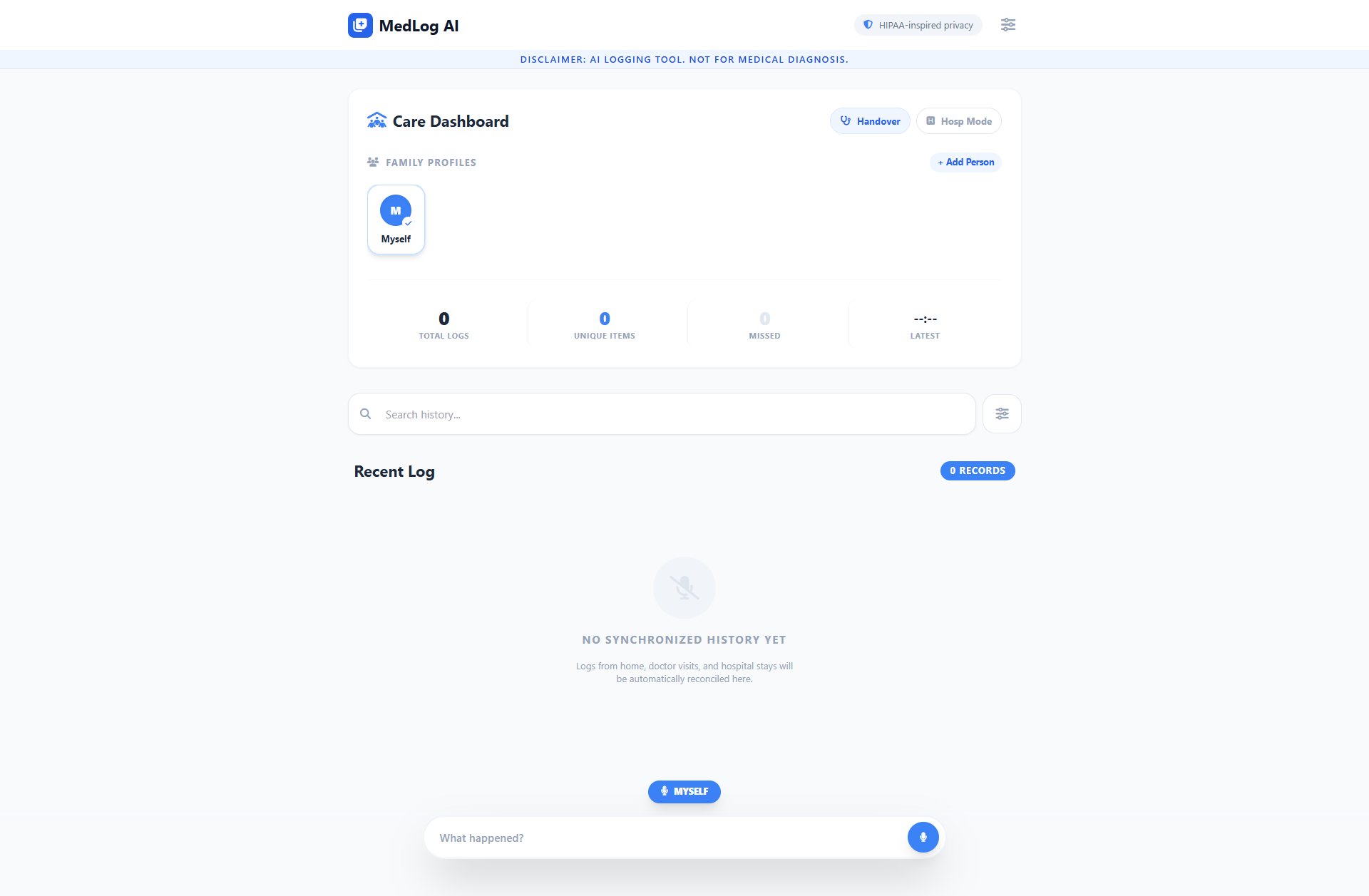
Medlog is a voice-first health memory and reconciliation engine for individuals and families.
Users can speak or type naturally, and Medlog transforms unstructured input into structured, traceable health records. It captures medications, dosages, routes, timing, observations, and context (home, clinic, or hospital) without requiring form-based data entry.
Key capabilities include:
Natural language medical logging via voice or text
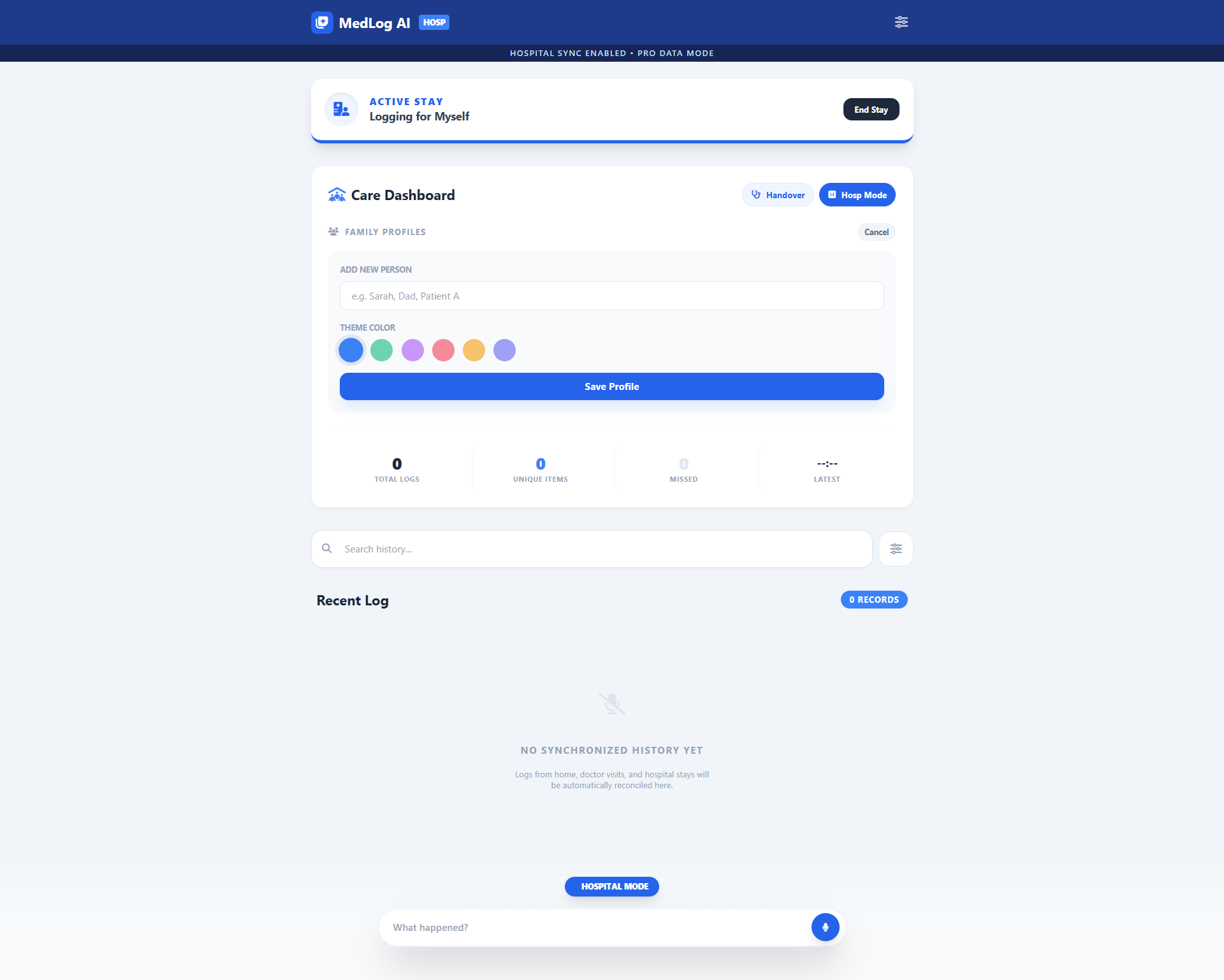
Multi-profile family support with voice-activated switching
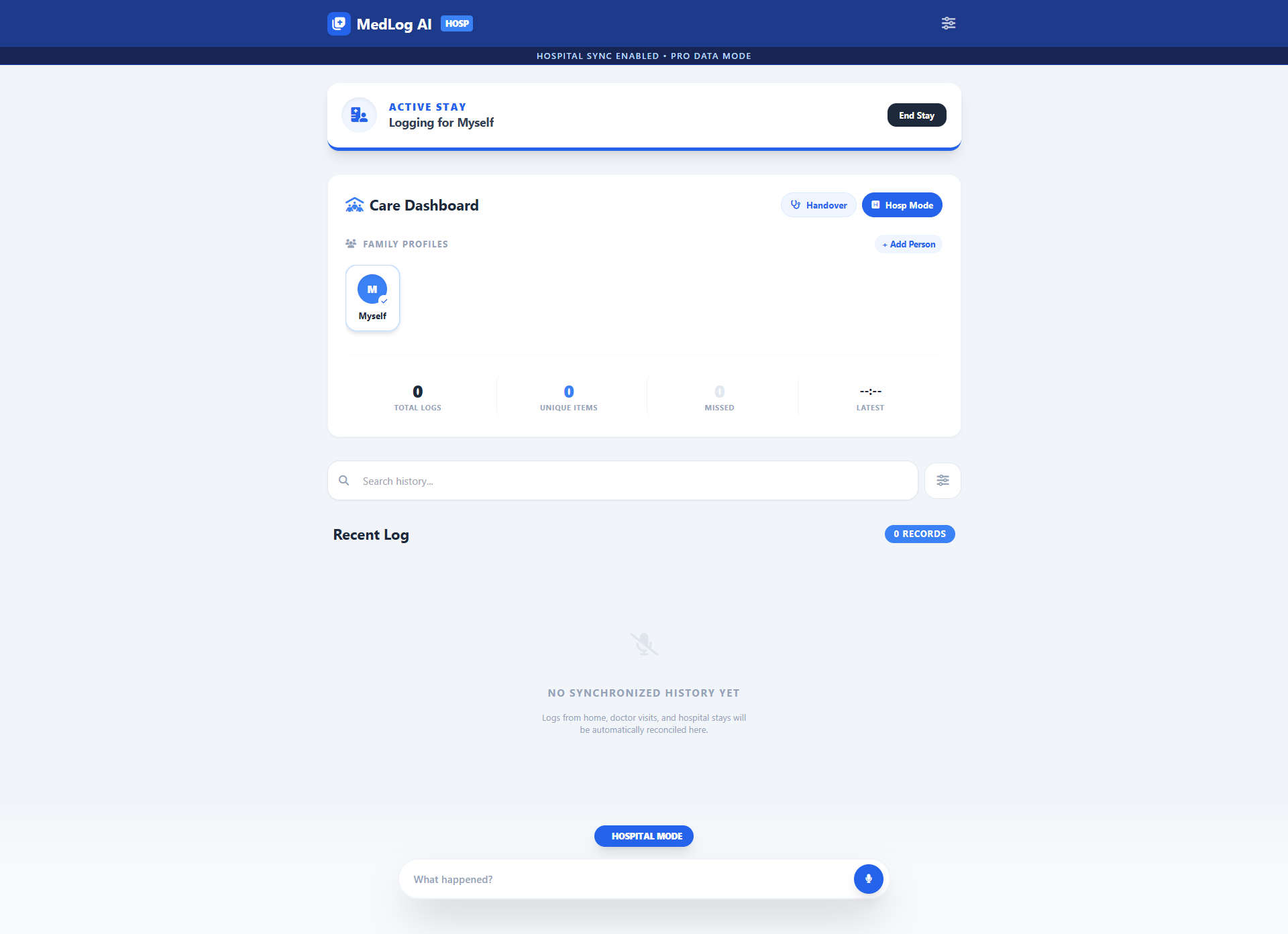
Hospital Mode for professional contexts such as IV or injections
Confidence scoring to surface ambiguity without guessing
Immutable audit trails for every record
Semantic history querying using natural language
Missed-dose awareness indicators (non-judgmental)
Offline-first, privacy-centric data storage
Medlog acts as a shared health memory, not a medical advisor.
##How we built it
We built Medlog using React 19 and TypeScript to create a fast, resilient, and accessible experience for individuals and families managing health information.
At the core of the system is Gemini 3 Flash, which performs low-latency reasoning to transform unstructured natural language—spoken or typed—into structured, explainable health records. Gemini extracts medication details such as names, dosages, units, routes, timing, and context, detects user intent, and assigns confidence scores to highlight ambiguity without inferring missing data.
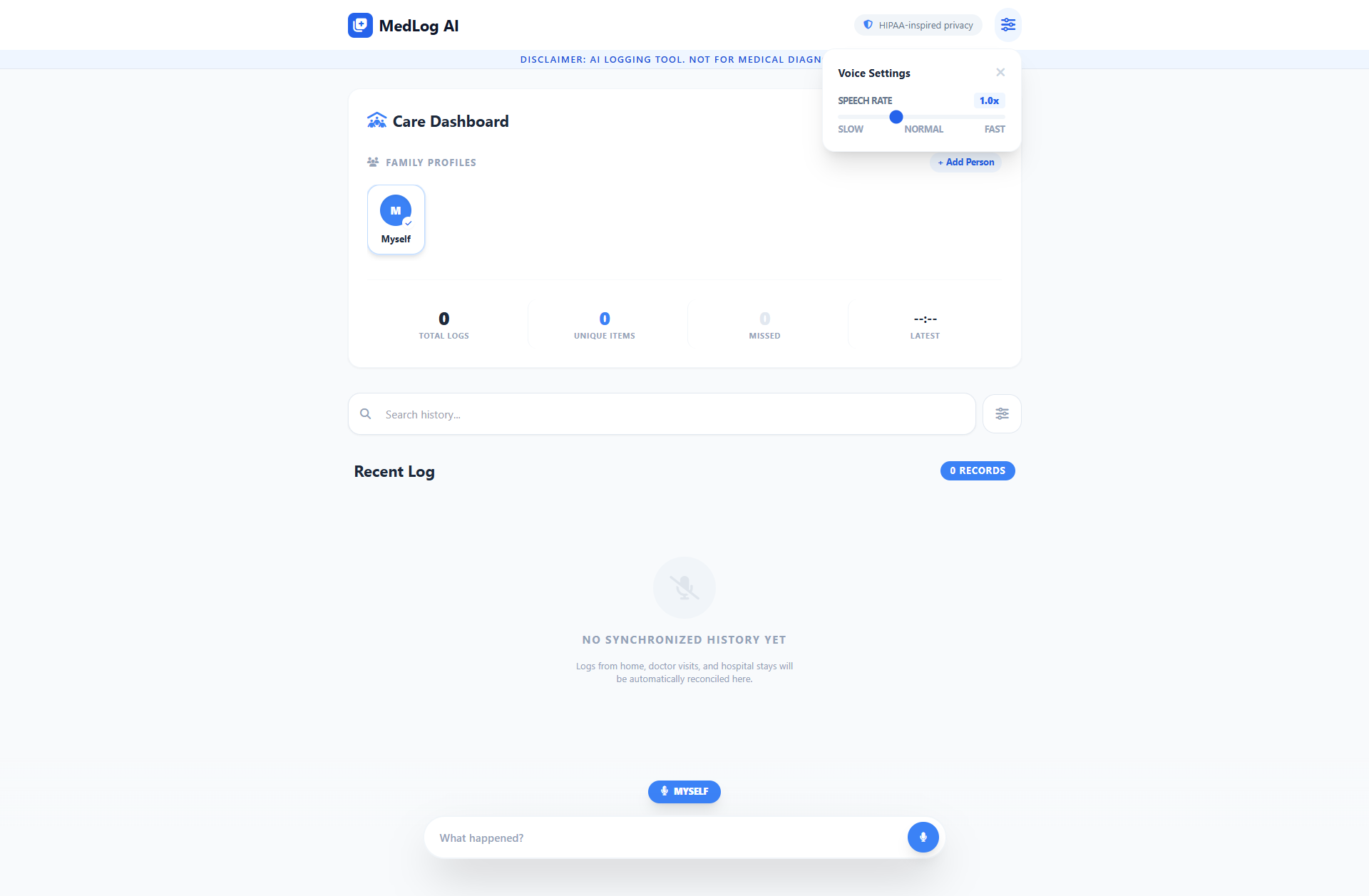
For voice interaction, we integrated the Web Speech API for real-time transcription and used Gemini 2.5 Flash Text-to-Speech to provide calm, empathetic audio confirmations and clarification prompts.
Medlog is designed with a privacy-first, offline-first architecture. All health data is stored locally using the browser’s LocalStorage API, allowing the app to function without network connectivity and giving users full control over sensitive information. A custom Web AudioContext implementation ensures high-quality audio playback for voice feedback, even in mobile or high-stress environments.
##Challenges we ran into
One of the biggest challenges was balancing advanced AI capabilities with responsibility in a health-adjacent domain.
We had to ensure the system never:
Provides medical advice
Validates or recommends dosages
Makes clinical decisions or safety judgments
Handling ambiguity in voice input was another challenge. Instead of guessing, Medlog needed to clearly surface uncertainty or ask for clarification—without disrupting the user experience.
Designing an offline-first system while still leveraging powerful AI reasoning also required careful separation between local data persistence and stateless AI processing.
##Accomplishments that we're proud of
Building a fully functional voice-first health logging system powered by Gemini 3
Successfully transforming messy, real-world speech into structured, traceable records
Implementing confidence scoring and immutable audit trails for transparency
Reconciling health events across home, clinic, and hospital contexts
Delivering a mobile-optimized, accessible UI that works offline
Establishing strong AI safety guardrails in a sensitive domain
##What we learned
We learned that in health-related applications, restraint is a feature.
Surfacing uncertainty, preserving traceability, and respecting human limitations builds more trust than attempting to appear authoritative. Voice-first interfaces significantly reduce cognitive load, and explainable AI helps users feel confident in what the system records—and what it intentionally does not do.
Most importantly, we learned that AI can provide meaningful support without replacing human judgement.
##What's next for Medlog
Next, we plan to:
Add encrypted export options for doctor visits and emergency situations
Enable secure, opt-in sharing across family devices
Improve offline-to-online synchronization when connectivity is available
Expand pattern awareness while maintaining strict non-advisory boundaries
Continue improving accessibility for elderly and multilingual users
Medlog’s long-term goal is to become a trusted, voice-first health memory that helps families maintain clarity when it matters most.
Built With
- gemini2.5flashtexttospeech
- gemini3flash
- localstoragaeapi
- react19
- typescript
- webaudiocontext
- webspeechapi

Log in or sign up for Devpost to join the conversation.