Inspiration
Medical reports often contain complex terminology, laboratory measurements, and clinical language that can be difficult for patients to understand without medical training.
I wanted to build a solution that could help bridge the gap between patients and their healthcare information by transforming technical medical reports into clear, patient-friendly explanations. The goal was to create a tool that empowers patients to better understand their results and have more informed conversations with their healthcare providers.
What it does
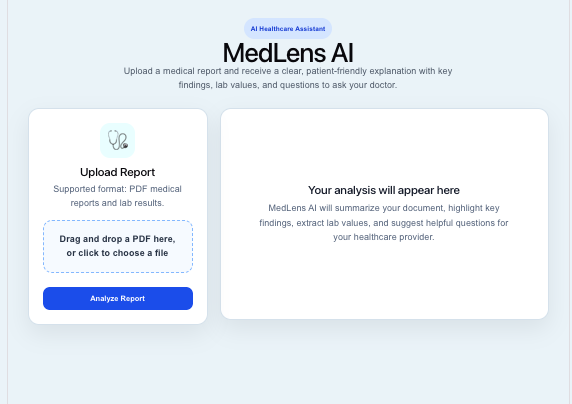
MedLens AI allows users to upload medical reports in PDF format and receive an AI-powered analysis of their results.
The platform:
- Extracts text from uploaded medical reports
- Identifies the document type
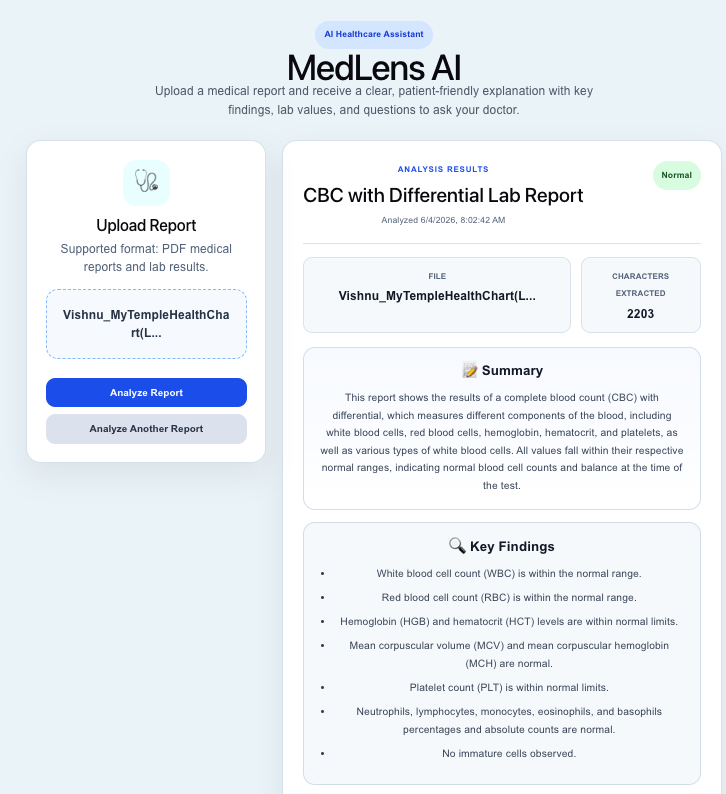
- Generates patient-friendly summaries
- Highlights important findings
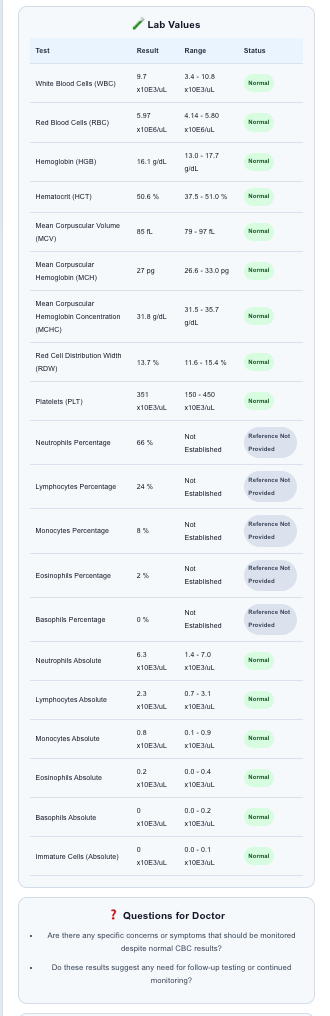
- Extracts laboratory values and reference ranges
- Suggests questions to ask healthcare providers
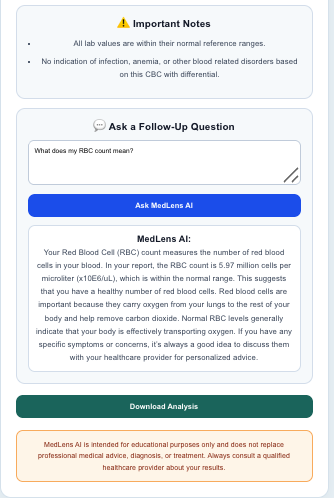
- Provides an AI-powered follow-up assistant for additional explanations
- Generates downloadable analysis reports
The application helps make healthcare information more accessible and understandable for patients.
How I built it
MedLens AI was developed as a full-stack web application.
Frontend
- React
- Vite
- Axios
- CSS
Backend
- FastAPI
- Python
AI & Document Processing
- OpenAI API
- PDFPlumber
- JSON-based structured AI responses
The frontend provides a modern interface for uploading reports, reviewing analysis results, viewing extracted laboratory values, and interacting with the follow-up AI assistant.
The backend handles PDF processing, text extraction, AI communication, report analysis, and follow-up question support.
Challenges I ran into
One of the biggest challenges was ensuring that AI-generated responses remained structured and consistent across different medical reports.
Another challenge was extracting laboratory values and presenting them in a format that was both accurate and easy for patients to understand.
Handling reports that did not provide complete reference ranges also required careful design decisions so the application could remain transparent about available information.
Building a healthcare-focused application also required balancing helpful explanations with clear disclaimers that the platform does not replace professional medical advice.
Accomplishments that I'm proud of
- Built a complete full-stack healthcare application from scratch
- Successfully integrated AI-powered medical report analysis
- Created structured laboratory value extraction and visualization
- Implemented an interactive AI follow-up assistant
- Added downloadable report generation
- Designed a professional user interface focused on usability and accessibility
- Developed a project with real-world healthcare impact
What I learned
Through this project, I gained experience building and deploying AI-powered applications using modern web technologies.
I learned how to:
- Integrate large language models into production-style workflows
- Process and analyze PDF documents
- Design APIs using FastAPI
- Build responsive interfaces with React
- Structure AI responses for consistent frontend rendering
- Design user experiences for healthcare-related applications
This project strengthened both my full-stack development skills and my understanding of practical AI integration.
What's next for MedLens AI
Future versions of MedLens AI may include:
- OCR support for scanned medical reports
- Historical report tracking and storage
- Trend analysis across multiple reports
- Secure user authentication and accounts
- Cloud deployment
- Support for additional healthcare document types
- Enhanced laboratory value interpretation
- Healthcare provider sharing and collaboration features
The long-term vision is to create a platform that helps patients better understand and manage their healthcare information through accessible AI-powered insights.
Built With
- axios
- css
- fastapi
- javascript
- openai-api
- pdfplumber
- python
- react
- vite

Log in or sign up for Devpost to join the conversation.