-
-
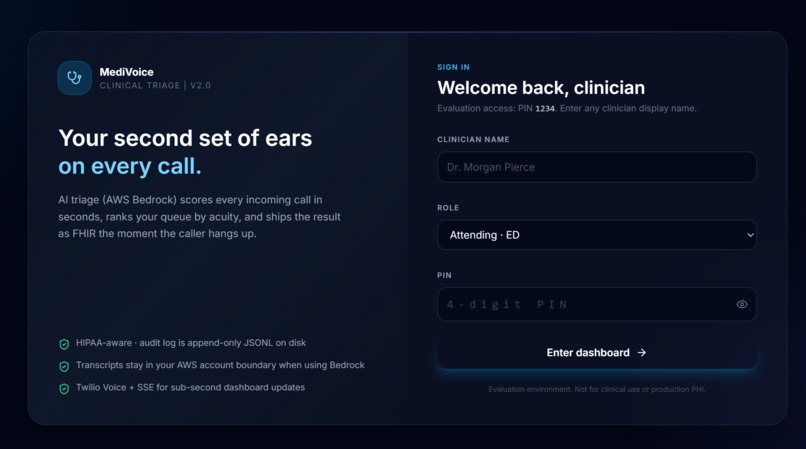
Landing Page
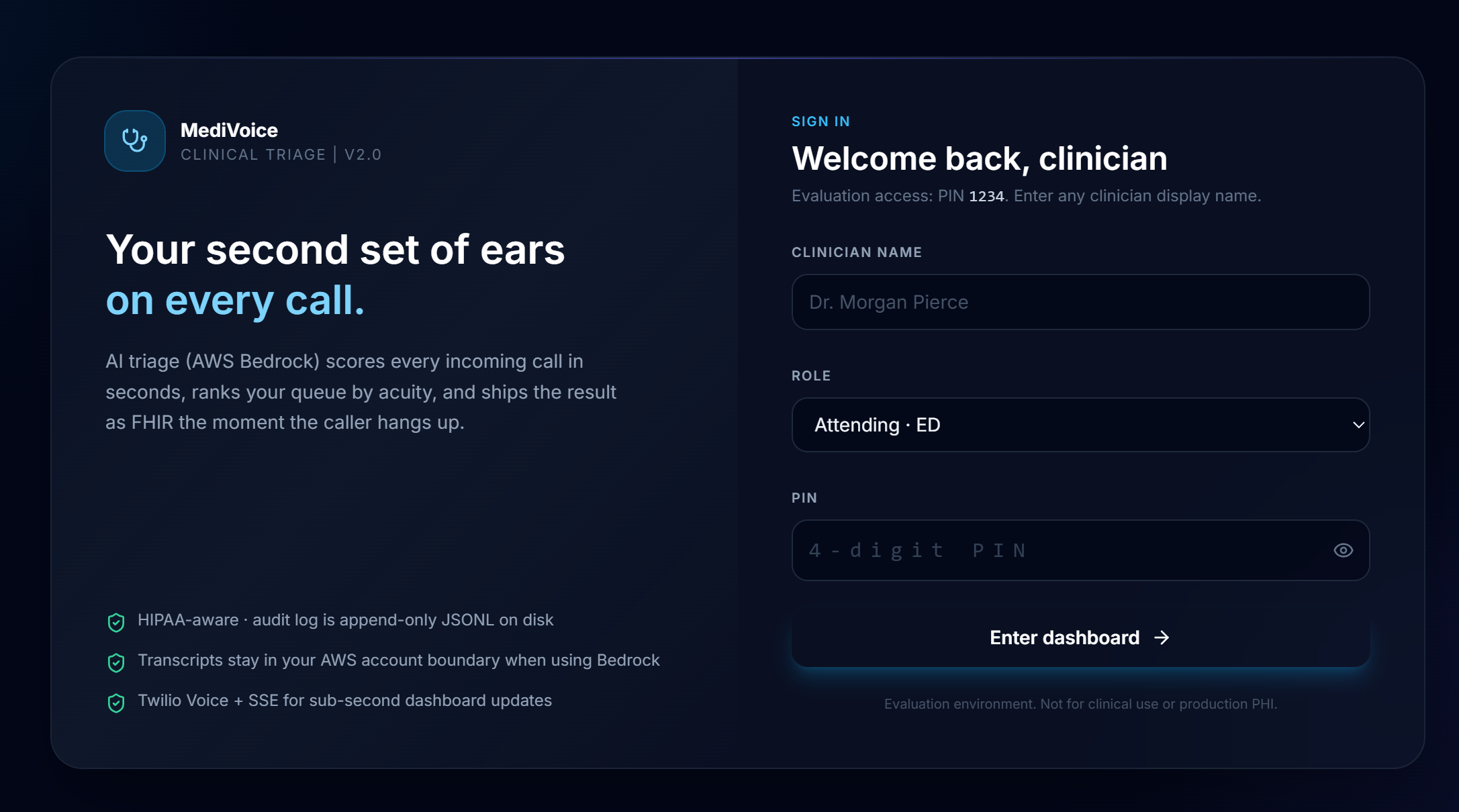
MediVoice AI: The Live Patient-Doctor Link
Inspiration
Medical emergencies are high-stakes, but the intake process is often a serial bottleneck. Nurses must listen to callers one-by-one, remember symptoms, and manually rank acuity. MediVoice AI parallelizes this process, allowing anyone to access immediate care via a standard phone call while automatically re-ranking the emergency queue based on real-time risk.
What it does
MediVoice converts live PSTN audio into structured clinical data. It listens to patients, extracts key medical drivers, and assigns a 0–100 risk score and P1–P3 priority in real-time. This allows high-acuity cases to float to the top of a nurse's dashboard before the caller even hangs up.
How we built it
- Voice Gateway: Twilio Voice captures live speech via a standard phone line and streams data to our backend.
- Clinical Brain: AWS Bedrock running Claude 3 Haiku in
us-east-1. We chose Haiku for its sub-second inference latency, which is mandatory for responsive voice-turn analysis. - Live Infrastructure: We implemented Server-Sent Events (SSE) to create a reactive UI pipeline, pushing AI insights to the dashboard the millisecond they are generated without the overhead of REST polling.
- Interoperability: Triage results are exported as HL7 FHIR-compliant
RiskAssessmentresources, bridging the gap between AI and legacy EHR systems like Epic or Cerner.
Challenges faced
- The Pivot: We originally prototyped on Google Gemini, but quickly hit free-tier rate limits and credit quotas. We migrated the entire triage engine to AWS Bedrock mid-development to ensure production-grade reliability and higher throughput.
- Audio Logic: Configuring TwiML to handle medical crises required removing default 10-second gather caps—implementing a 60-second silence timeout and 3,600-second speech window to ensure zero data loss during patient reporting.
- Connectivity: Routing Twilio webhooks through Cloudflare Tunnels to reach our local FastAPI environment during the rapid iteration phase.
What we learned
We mastered Asynchronous Systems Architecture and the necessity of high-throughput, low-latency models. Transitioning to a scalable AWS stack taught us that in healthcare AI, "intelligence" is secondary to availability and latency.
Built With
- AI: AWS Bedrock (Claude 3 Haiku), Google OR-Tools
- Backend: FastAPI, Python, Twilio API
- Frontend: React (Vite), Tailwind CSS, Lucide-React
- Infrastructure: AWS (us-east-1), SSE (Server-Sent Events), Cloudflare Tunnels
- Standards: HL7 FHIR (RiskAssessment)


Log in or sign up for Devpost to join the conversation.