-
-
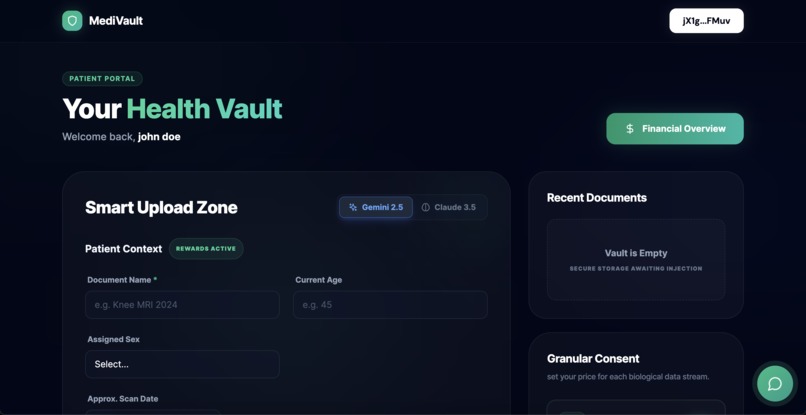
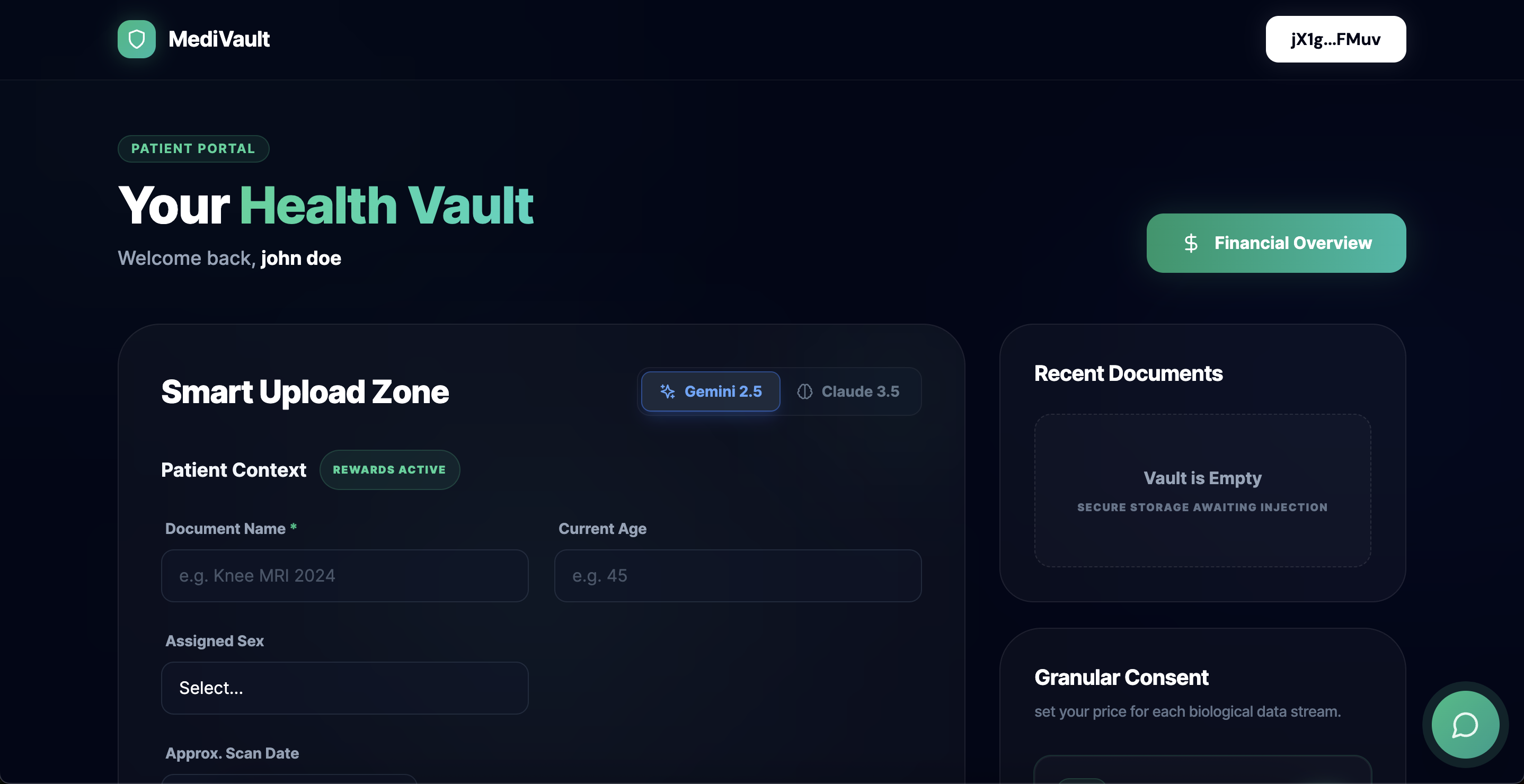
Patient
-
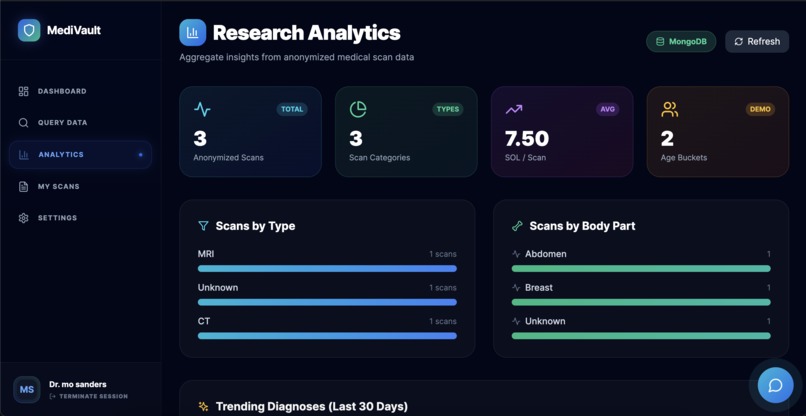
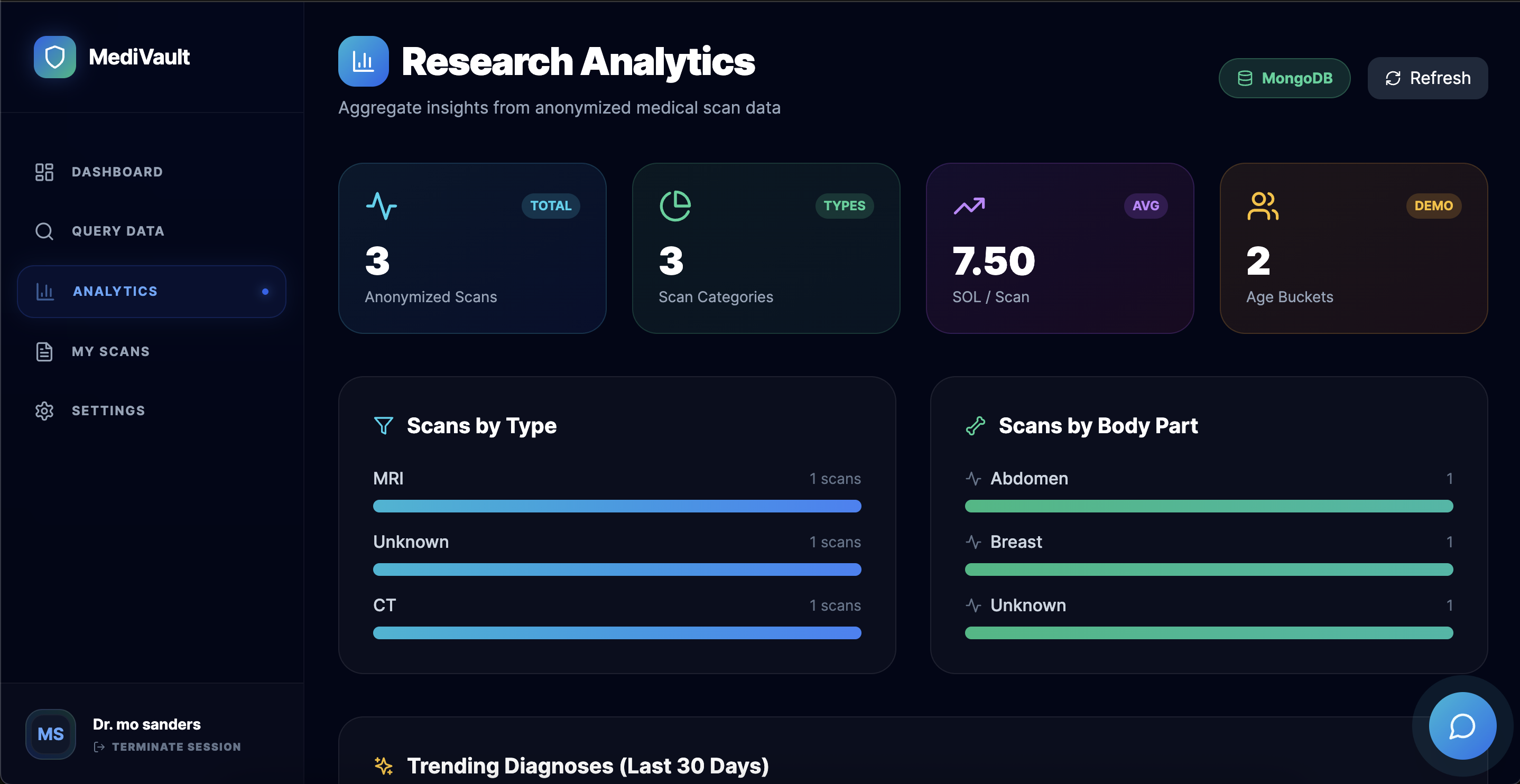
Researcher
💡 Inspiration
The healthcare industry creates exabytes of data annually, yet 97% of it remains siloed, inaccessible to the researchers who need it most. We were inspired by the DeSci (Decentralized Science) movement to solve a fundamental paradox:
Individual patients own the most valuable asset in medical research—their own data—yet they realize $0 value from it.
We built MediVault to flip this model upside down. Instead of large institutions hoarding data, we designed a data-to-earn economy where patients become active partners in scientific discovery—incentivized by crypto rewards ($SOL) and empowered by granular privacy controls.
🏥 What it does
MediVault is a decentralized healthcare data platform that bridges the gap between patient privacy and medical research.
- For Patients: Users can upload medical records (MRIs, X-rays, lab results) which are instantly digitized by AI. Patients maintain 100% ownership, setting their own data pricing and choosing exactly what to share via blockchain-based consent tokens.
- For Researchers: A streamlined portal to search and purchase high-quality, ethically sourced, and fully anonymized datasets.
- The Economy: When a researcher purchases data, the patient receives 70% of the payment instantly in SOL, powered by the Solana blockchain.
⚙️ How we built it
We architected a hybrid Web2 + Web3 solution to bridge the gap between seamless user experience and decentralized incentives.
🧱 The Stack
- AI Engine: Integrated Google Gemini 1.5 Flash to perform pixel-level analysis of uploaded medical scans (MRI, CT, X-Ray).
- Frontend: Built with Next.js 14, using Tailwind CSS and Framer Motion for a glassmorphic, premium medical interface.
- Backend: A robust Express.js / Node.js server handles complex file processing and orchestrates AI pipelines.
- Blockchain: Solana (Devnet) serves as the settlement layer, enabling instant, low-cost micropayments to users for verified data contributions.
- Database: MongoDB for medical metadata and Supabase for secure vault storage.
🚀 The Innovation: Smart Mapping
The core of our technology is the Neural-Symbolic Mapping Layer. Instead of asking the AI to simply “summarize” a scan, we enforce a structured extraction pipeline that converts raw pixels into research-grade, queryable data:
Mapping Logic:
f(image) -> { scanType, bodyPart, diagnosisTags, findings }
😤 Challenges we ran into
- 🧠 AI Hallucination vs. Medical Accuracy: Early models occasionally fabricated findings. We solved this by introducing a Confidence Score (C) validation. If
C < 0.85, the system triggers a mandatory Manual Review flag. We also migrated to Gemini 1.5 Flash for its superior visual reasoning. - 📄 Structuring Unstructured Data: Medical reports are notoriously inconsistent. We engineered a resilient parsing engine inside our
GeminiServiceto handle partial or malformed JSON responses and normalize medical terminology (e.g., "broken bone" → "Fracture"). - 🔍 The “Black Box” Problem: Users don’t trust AI they can’t see. To address this, we built the “Review AI Analysis” modal, allowing users to read the findings and explicitly approve the data before minting their reward.
🏆 Accomplishments that we're proud of
- Successfully extracting structured medical data from real-world scans in under 3 seconds.
- Building a premium-tier UI that makes complex blockchain and medical concepts accessible to non-technical users.
- Implementing a full-stack Solana payout system that rewards patients for their contributions instantly.
🧠 What we learned
- Incentives Drive Quality: Showing users the exact SOL value of their data before upload significantly increased data completeness.
- Speed Matters: Optimizing our AI pipeline to process scans rapidly was critical to delivering the “magic moment.”
- DeSci Is the Future: Patients want to contribute to science—they just need a system that is frictionless, fair, and transparent.
🔮 What's next for MediVault DAO
- HIPAA/PIPEDA Certification: Deepening our compliance for enterprise adoption.
- Mobile Vault: A native iOS/Android app for on-the-go medical record management.
- Research DAO: Giving researchers the ability to pool funds for specific disease-state data collections.
Built With
- css
- express.js
- gemini
- html5
- javascript
- mongodb
- next.js
- node.js
- react
- supabase
- tailwind
- typescript


Log in or sign up for Devpost to join the conversation.