Inspiration
Health data is becoming increasingly accessible, but raw numbers often do not tell users what they actually mean. We wanted to build something that could bridge that gap by turning health observations into understandable trends and insights.
This led us to MediTrack — a platform designed around a simple idea: make health data easier to understand and easier to communicate with healthcare professionals.
What it does
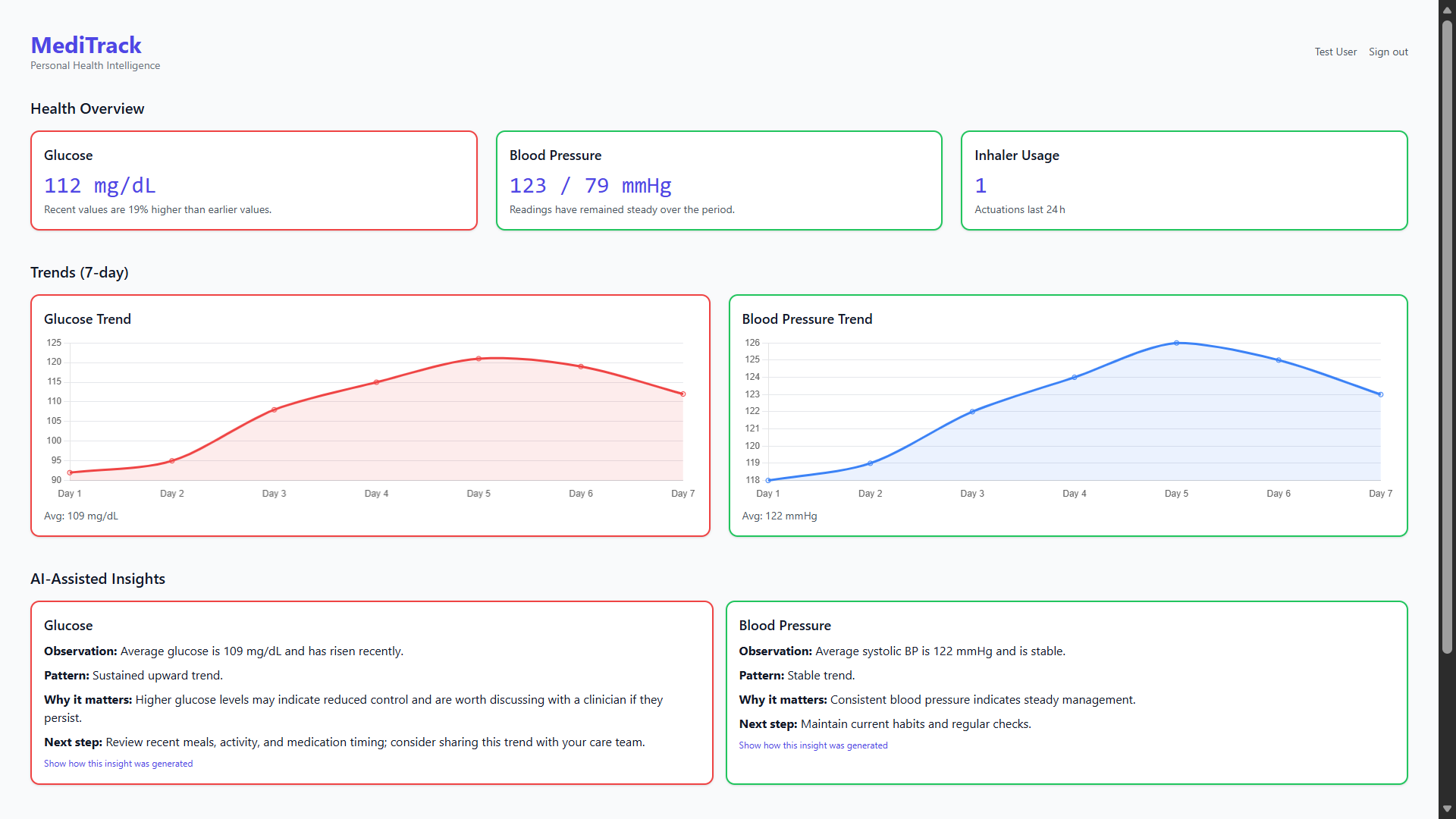
MediTrack is an AI-powered personal health dashboard that helps users:
- Monitor glucose, blood-pressure, and inhaler-usage trends
- Identify meaningful changes in health data
- Generate understandable trend insights
- View transparent risk and attention indicators
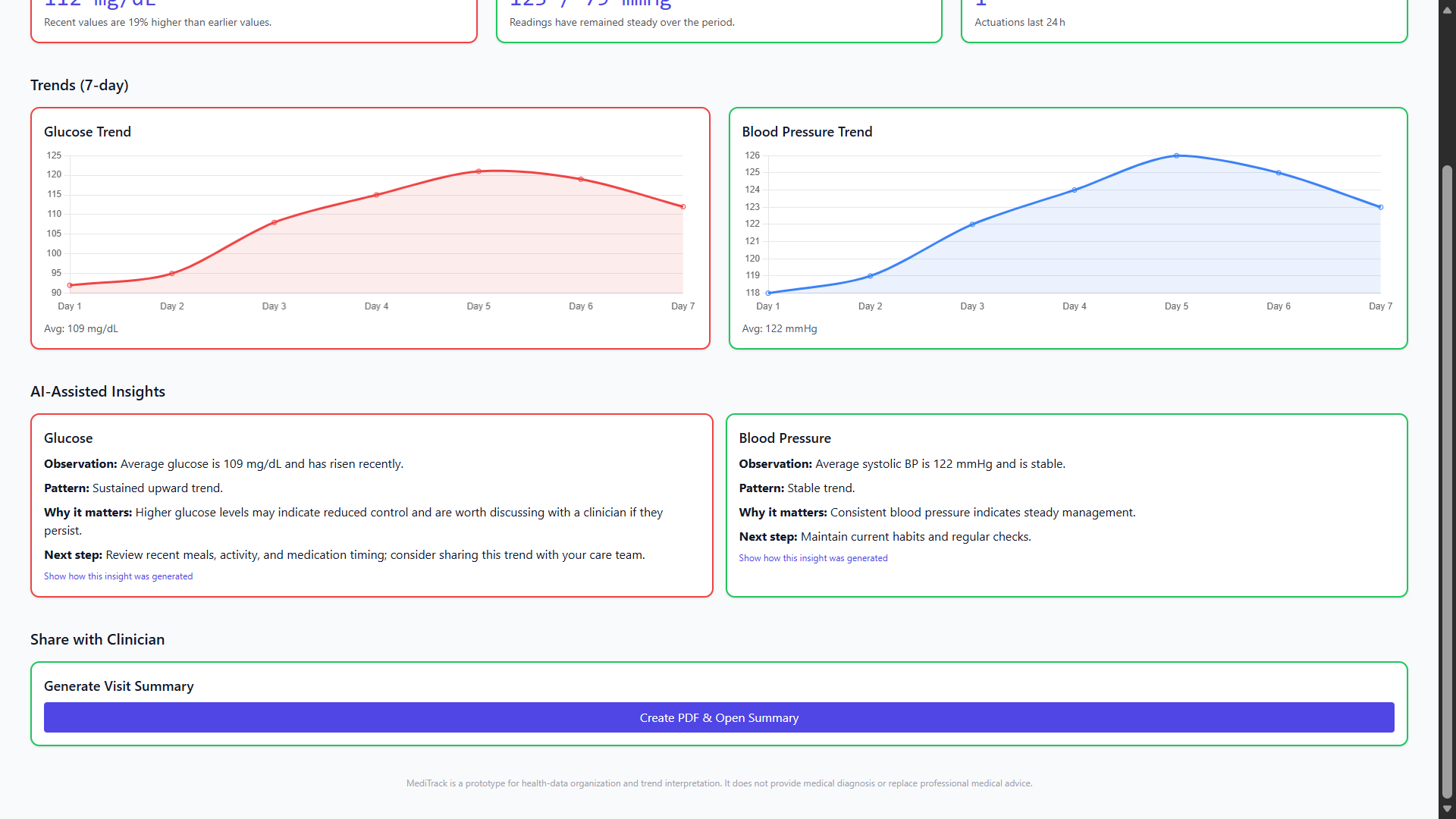
- Create concise, clinician-ready health summaries
- Securely access their personal dashboard
The current prototype uses simulated health data to demonstrate the complete workflow.
How we built it
MediTrack is built as a containerized full-stack application.
Frontend: Next.js, React, TypeScript, Tailwind CSS and Chart.js
Backend & Data: Node.js, Prisma, PostgreSQL and Redis
Authentication: NextAuth
Infrastructure: Docker and Docker Compose
The system follows a modular architecture where health observations can be processed into trends and insights before being presented through the dashboard.
For the prototype, we use deterministic simulated data so the same health scenario can be reproduced consistently during demonstrations. The trend-analysis layer interprets changes in the data and generates transparent, user-friendly insights.
Challenges we ran into
One of our biggest challenges was making the dashboard reliable while working with dynamic charts and React rendering.
We encountered issues including unstable chart sizing, continuously increasing page height, authentication configuration, Docker build failures, and TypeScript compatibility with Chart.js.
Instead of hiding these problems, we traced them to their underlying causes and fixed them while keeping the existing architecture intact.
Another challenge was deciding how to present health-related insights responsibly. We deliberately designed MediTrack as a health-data interpretation and decision-support prototype, rather than claiming to diagnose conditions or replace healthcare professionals.
Accomplishments that we're proud of
We are proud that MediTrack evolved from an initial dashboard concept into a working full-stack prototype with:
- A functional authentication flow
- Containerized development and deployment
- PostgreSQL-backed data infrastructure
- Prisma database integration
- Interactive health-trend visualizations
- Deterministic demonstration data
- Transparent trend interpretation
- AI-assisted insight presentation
- Clinician-oriented summary generation
- A modular architecture that can be extended with real health-data integrations
Most importantly, we built the project around a complete user journey rather than simply creating a collection of UI screens.
What we learned
We learned that building a useful product is not only about adding technologies.
We learned how important it is to maintain a stable architecture, debug problems systematically, validate assumptions, and distinguish between what is actually implemented and what is planned.
We also learned that AI-generated insights need to be understandable and transparent, especially in sensitive domains such as healthcare. A useful system should explain the pattern behind an insight rather than simply presenting a mysterious score.
What's next for MediTrack
The current prototype establishes the foundation for a much broader platform.
Our next steps include:
- Integrating real health and wearable data sources
- Adding a dedicated machine-learning inference layer
- Improving personalized trend detection
- Expanding clinician collaboration features
- Adding longitudinal health-history analysis
- Strengthening privacy and security
- Deploying the platform to scalable cloud infrastructure
- Conducting proper validation before making any clinical claims
Our long-term vision is for MediTrack to become a bridge between health data, understandable intelligence, and better patient–clinician communication.
Built With
- ai
- chart.js
- node.js
- prisma
- react
- typescript


Log in or sign up for Devpost to join the conversation.