Inspiration
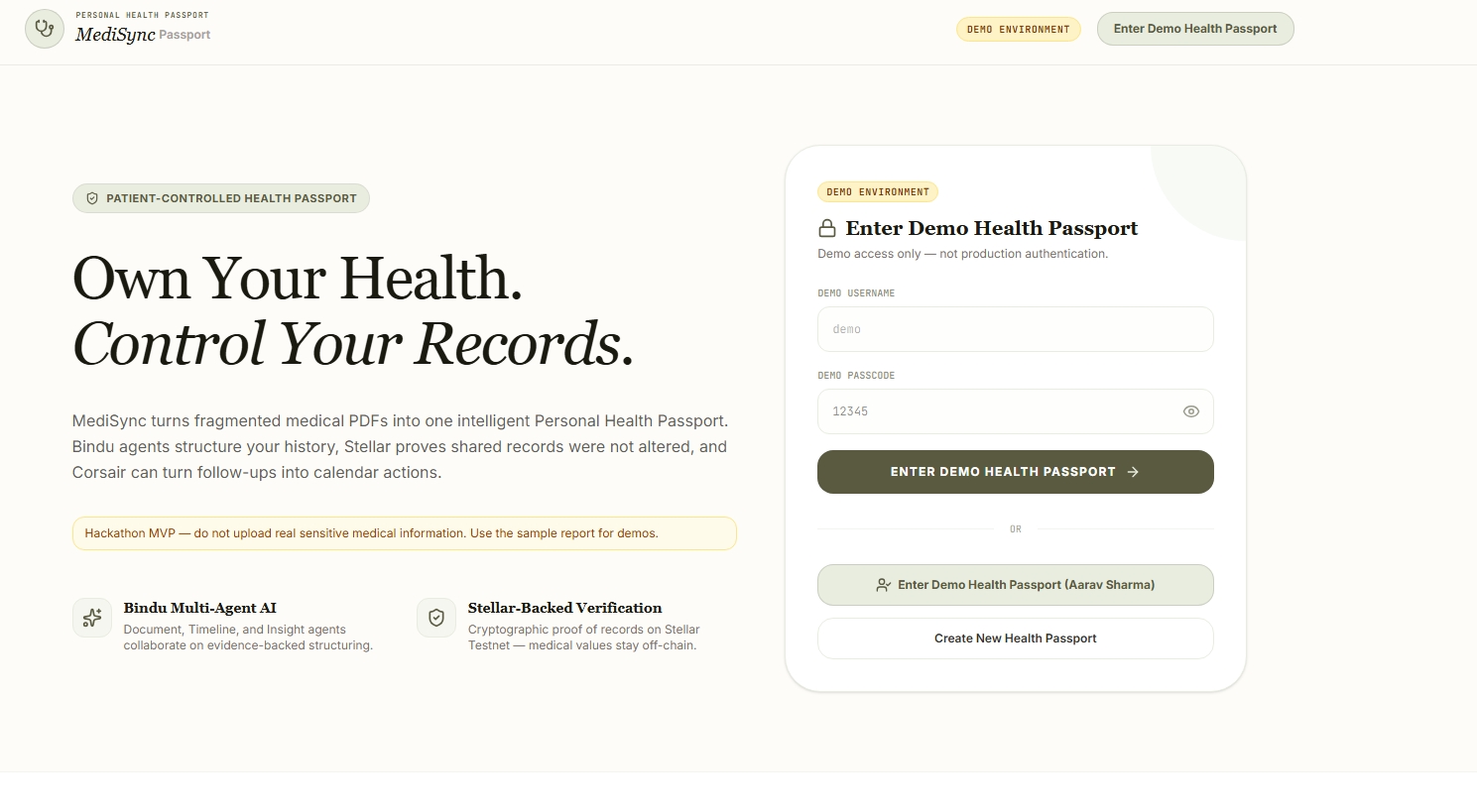
Healthcare data is often scattered across hospitals, clinics, laboratories, prescriptions, and paper reports. Patients may have to repeatedly explain their medical history or search through multiple documents.
I asked ourselves: What if the patient's entire health history could stay with the patient?
That question inspired MediSync Passport — a digital health passport built around one simple principle:
Your health. Your data. Your control.
What it does
MediSync Passport gives patients a single, AI-powered place to manage and understand their health history.
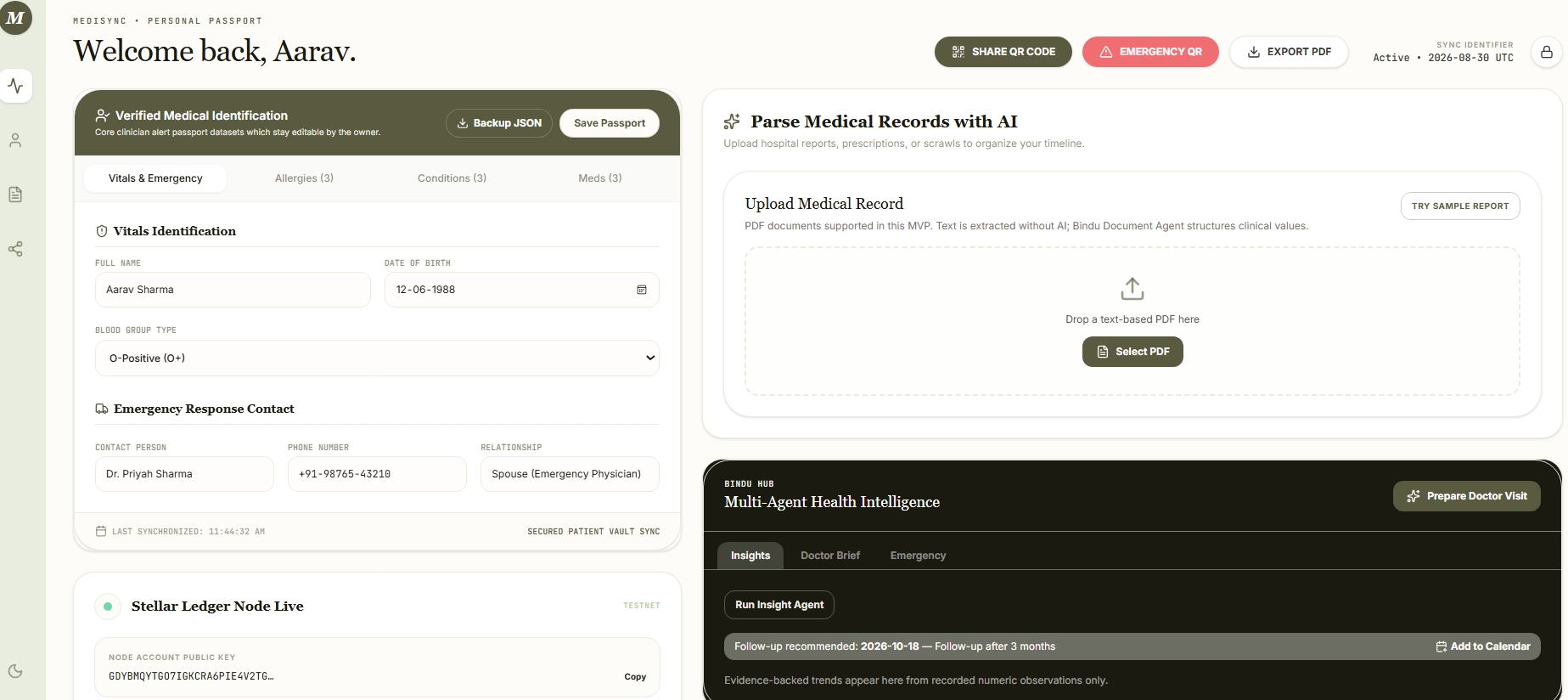
- 🧑⚕️ Patient Health Passport — Store blood group, allergies, conditions, medications, emergency contacts, and medical records.
- 🤖 AI Record Processing — Upload prescriptions and reports and automatically extract doctors, diagnoses, medicines, test results, and relevant clinical information.
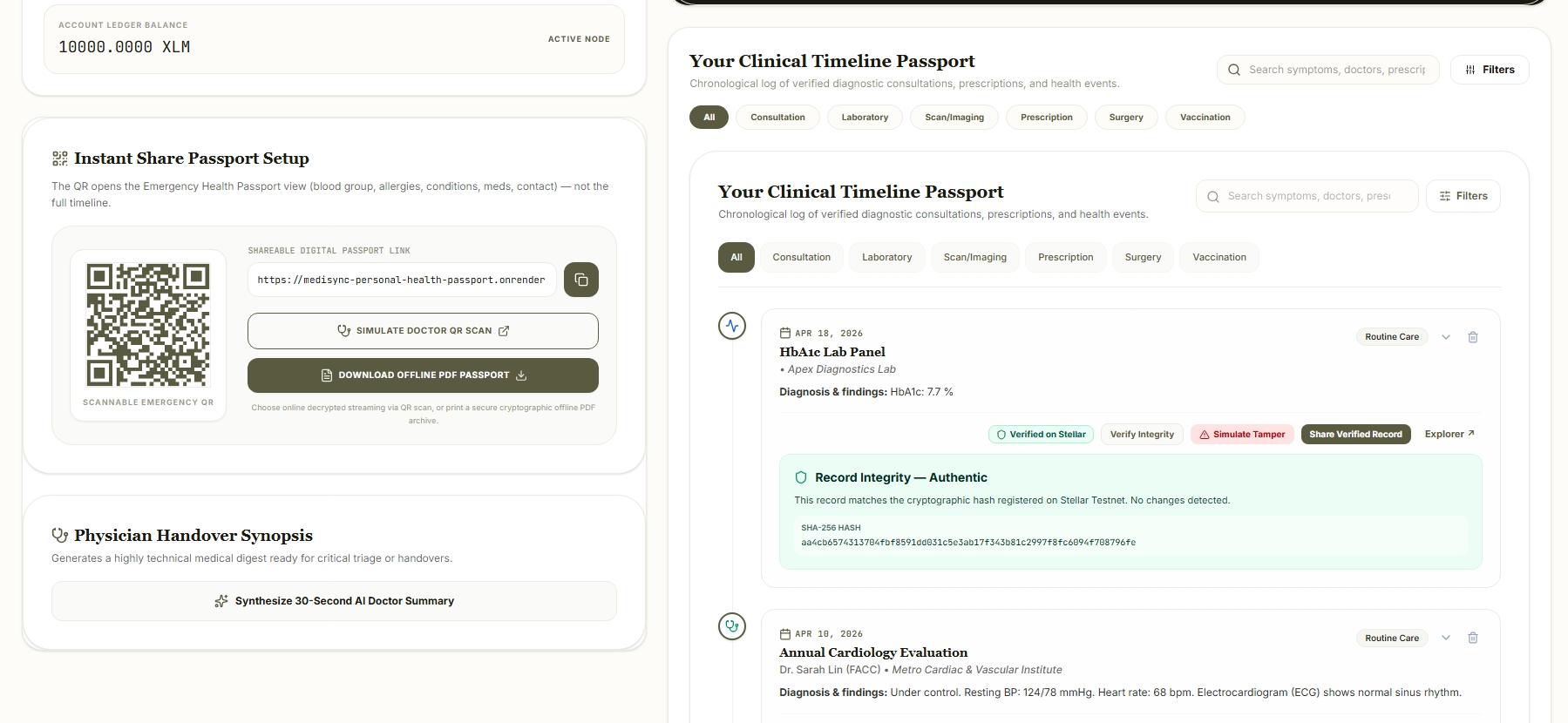
- 📅 Clinical Timeline — Organize medical events chronologically with search and filtering.
- 🧠 AI Health Insights & Planner — Analyze available health context and generate structured insights.
- 🔗 Secure Sharing — Share relevant medical history with clinicians through secure QR codes or links in a read-only view.
- 🔐 Verifiable AI & Blockchain — Use W3C DID/Ed25519 signatures, mTLS identity, x402 tracking, and Stellar-based infrastructure for transparency and verification.
- 💾 Data Portability — Export health data as JSON or generate a PDF health passport.
How I built it
MediSync Passport is a full-stack application built with React, TypeScript, Vite, Tailwind CSS, Node.js, Express, and Google Gemini.
The frontend handles the patient passport, document uploads, clinical timeline, AI insights, and clinician-facing views. The backend manages document extraction, health insights, planning workflows, and application services.
I also developed AI agents for document processing, timeline understanding, insights, and orchestration.
For the decentralized security layer, we integrated Stellar and Soroban smart contracts, along with Freighter, W3C DID, Ed25519, mTLS, and x402.
Challenges I ran into
One of our biggest challenges was making the AI layer reliable across a multi-step healthcare workflow. AI availability and model reliability issues could cause workflows such as the Planner Agent to fail.
I addressed this by migrating our AI endpoints to the latest Gemini Flash model and improving workflow stability.
Another challenge was designing secure sharing while keeping the patient in control. Instead of making healthcare providers gatekeepers of the passport, we designed sharing around patient-initiated access through secure QR codes and links.
I also explored how cryptographic proofs, DID signatures, secure transport identity, and blockchain verification could make AI interactions more transparent.
Accomplishments that I'm proud of
I'm proud of bringing AI, patient-controlled healthcare data, secure sharing, and blockchain verification together into one working platform.
Some highlights we're especially proud of:
- Turning unstructured medical documents into organized health records.
- Building a searchable clinical timeline.
- Creating AI-powered health insights and planning workflows.
- Implementing patient-controlled QR-based sharing.
- Adding cryptographic and Stellar-backed verification.
- Supporting JSON data portability and PDF health passports.
- Building the platform as a complete full-stack healthcare experience rather than just an AI demo.
What I learned
MediSync Passport taught me that healthcare technology requires much more than simply adding AI.
I learned the importance of:
- Data ownership — patients should remain at the center of their health data.
- Trust — AI-generated information needs transparency and verification.
- Data portability — users should not be locked into one platform.
- User experience — medical information must be understandable and easy to navigate.
- Security by design — healthcare security needs to be considered from the beginning.
I also learned how AI agents, cryptographic verification, and blockchain infrastructure can work together in a larger healthcare workflow.
What's next for MediSync Passport
MediSync Passport is still evolving. My next steps include:
- Stronger access-control mechanisms
- More advanced AI health insights
- Better interoperability with healthcare standards
- Improved clinician workflows
- More robust security and verification
- Further real-world validation
My long-term vision is to make health records portable, understandable, secure, and truly patient-controlled.
Healthcare shouldn't begin with:
"Can you bring your previous reports?"
It should begin with:
"Here is my health history."
That's the future we're building with MediSync Passport.
Built With
- ai-agents
- blockchain
- digital-health
- ed25519
- express.js
- freighter
- generative-ai
- google-gemini
- healthcare
- healthtech
- mtls
- node.js
- qr-code
- react
- soroban
- stellar
- tailwind-css
- typescript
- vite
- w3c-did
- x402


Log in or sign up for Devpost to join the conversation.