

Inspiration
Accessing reliable healthcare guidance quickly is still a challenge for many people around the world. With the rise of AI and autonomous agents, we saw an opportunity to build something that could bridge the gap between medical expertise and everyday users—without needing them to navigate complex systems or search engines. The inspiration behind Medisync AI was to bring expert-level, trustworthy, and personalized medical insights to people through a network of intelligent agents working together.
What it does
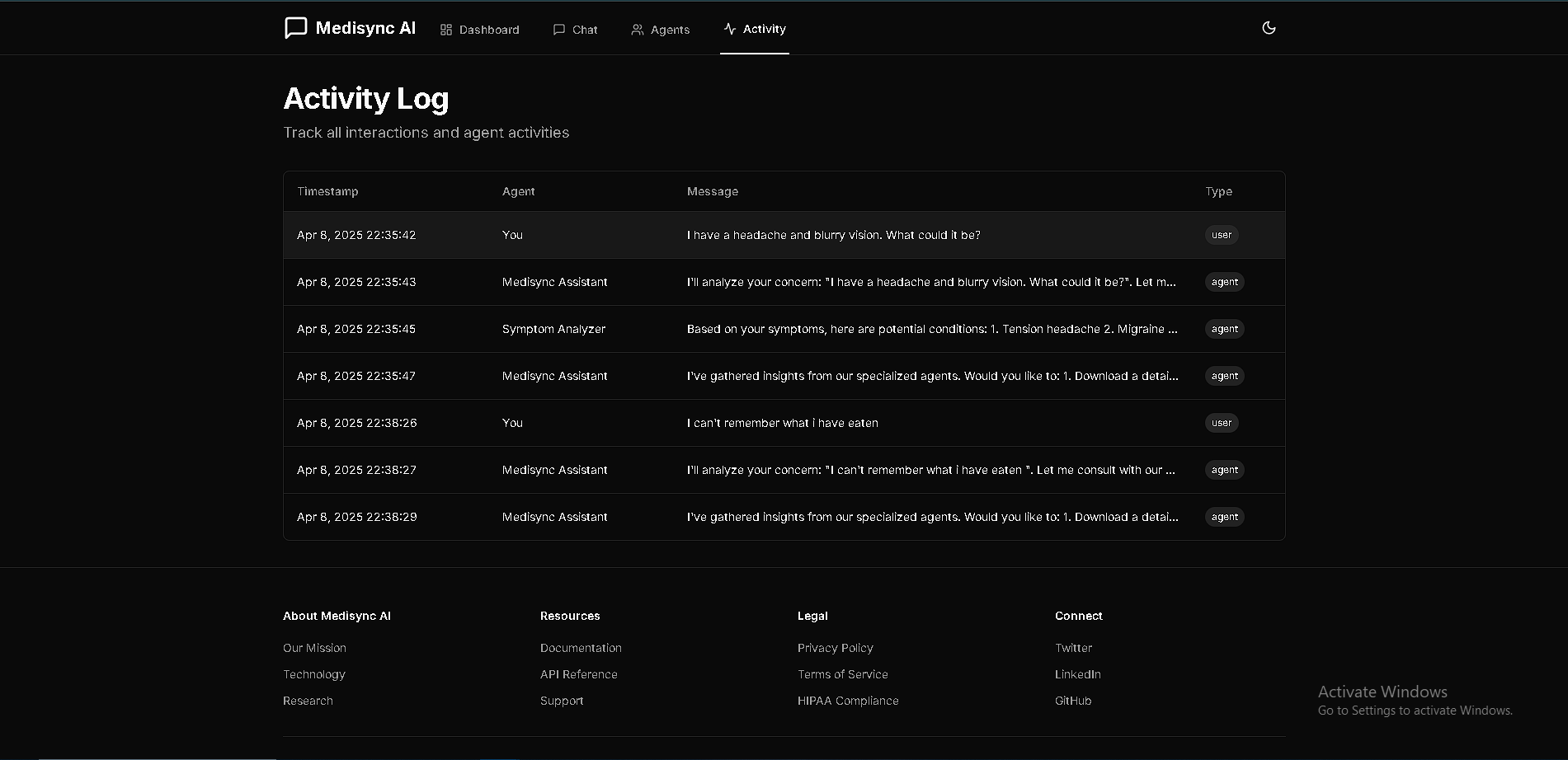
Medisync AI is a personalized medical assistant powered by a network of specialized AI agents. Each agent is designed to handle a specific healthcare task—such as symptom checking, drug interaction analysis, treatment recommendations, and more. When a user submits a query, the assistant dynamically discovers and orchestrates interactions with the relevant agents via Agentverse. The assistant then compiles and delivers an easy-to-understand response, tailored to the user’s input and context.
How we built it
We developed Medisync AI using a modular and scalable approach:
- The frontend is built with Next.js and Tailwind CSS for responsiveness, performance, and fast rendering.
- The Personalized Assistant Agent is built using Fetch.ai’s uAgents framework.
- Specialized agents—such as Symptom Checker, Drug Interaction Analyzer, and Treatment Advisor—were also built using uAgents and registered on Agentverse.
- The Assistant leverages the Agentverse Search and Discovery API to identify relevant agents for each user query in real-time.
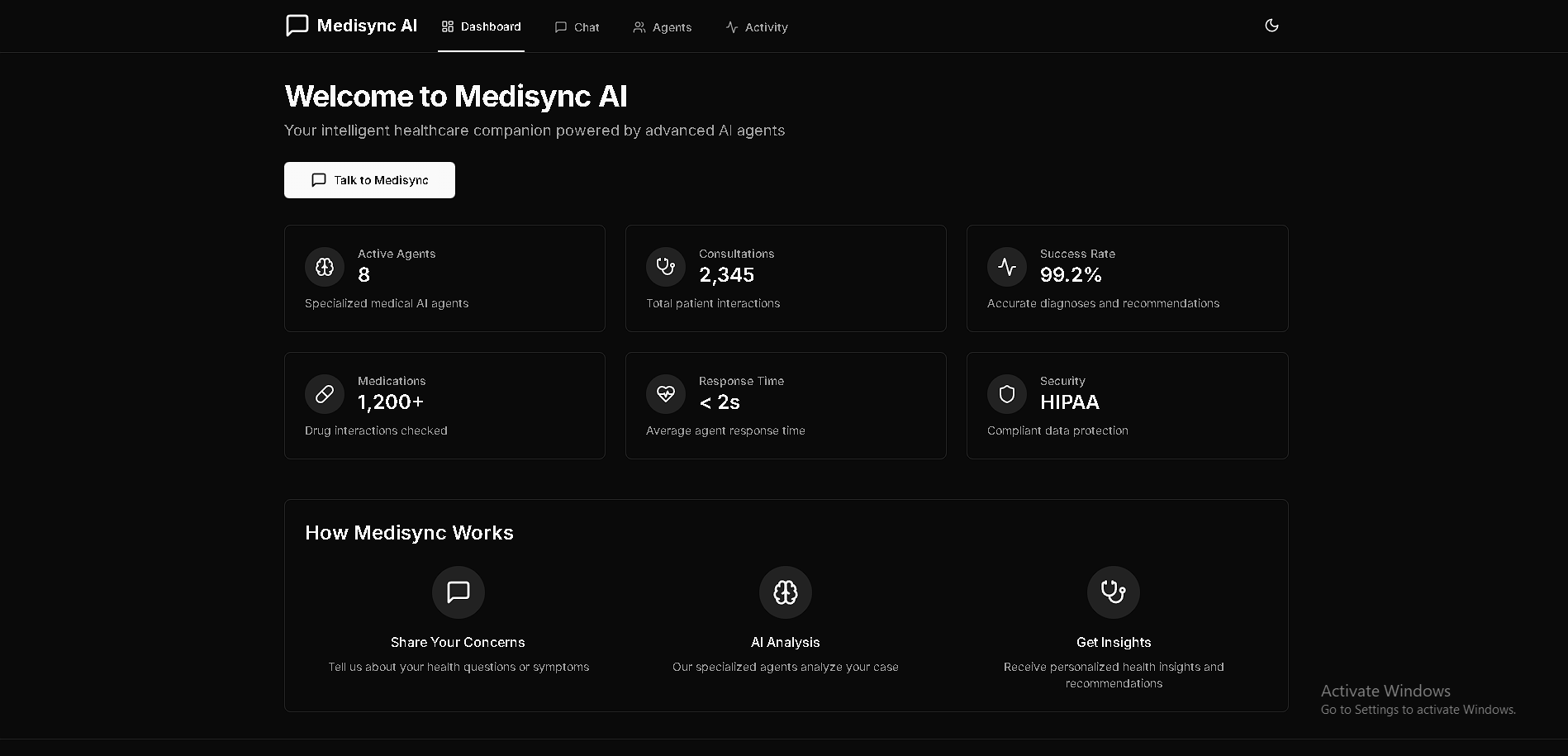
- We designed a clean and intuitive user interface that includes real-time chat and a visual workflow of agent collaboration.
- For testing, we implemented a local mock agent mode to simulate agent responses and ensure a smooth experience before integrating live agents.
Challenges we ran into
Coordinating communication between multiple autonomous agents in real-time presented several technical challenges. Designing the assistant logic to dynamically query the right agents based on the user’s intent required careful orchestration. We also encountered issues preserving context in multi-turn conversations and had to optimize how we presented agent responses in a way that was both accurate and understandable to users. Lastly, time was a constraint—turning a vision this large into a functioning system within a limited timeframe required tight scope control.
Accomplishments that we're proud of
We successfully built and registered a suite of functional AI agents, all connected via Agentverse, and demonstrated real-time orchestration through a Personalized Assistant Agent. The frontend interface is production-grade, clean, and responsive. We’re also proud of how intuitive the assistant feels, especially given the complexity happening behind the scenes. Our architecture is modular, meaning it's easy to scale with additional agents or plug in new health-related features.
What we learned
We gained a deep understanding of how to design and implement autonomous multi-agent systems. Working with Agentverse and the uAgents framework gave us hands-on experience with decentralized AI communication. We also learned how to balance technical depth with user experience—ensuring that complex backend logic translates into something users can understand and trust. Collaboration across agents, real-time task routing, and state preservation in conversations were all valuable lessons in distributed AI design.
What's next for Medisync AI
We plan to integrate real-time health data from wearables and electronic medical records, which would allow for even more personalized insights. We're also exploring partnerships with medical providers to add verified agents backed by licensed professionals. Expanding multilingual support and introducing voice interaction is also on the roadmap. Our long-term vision is to make Medisync AI accessible to users worldwide, delivering intelligent, reliable healthcare support at scale.
Built With
- agentverse
- fastapi-(for-testing-agents)
- fetch.ai
- fetch.ai-uagents
- gemini-api
- json
- langchain
- next.js
- python
- react
- rest-apis
- tailwind-css
- typescript

Log in or sign up for Devpost to join the conversation.