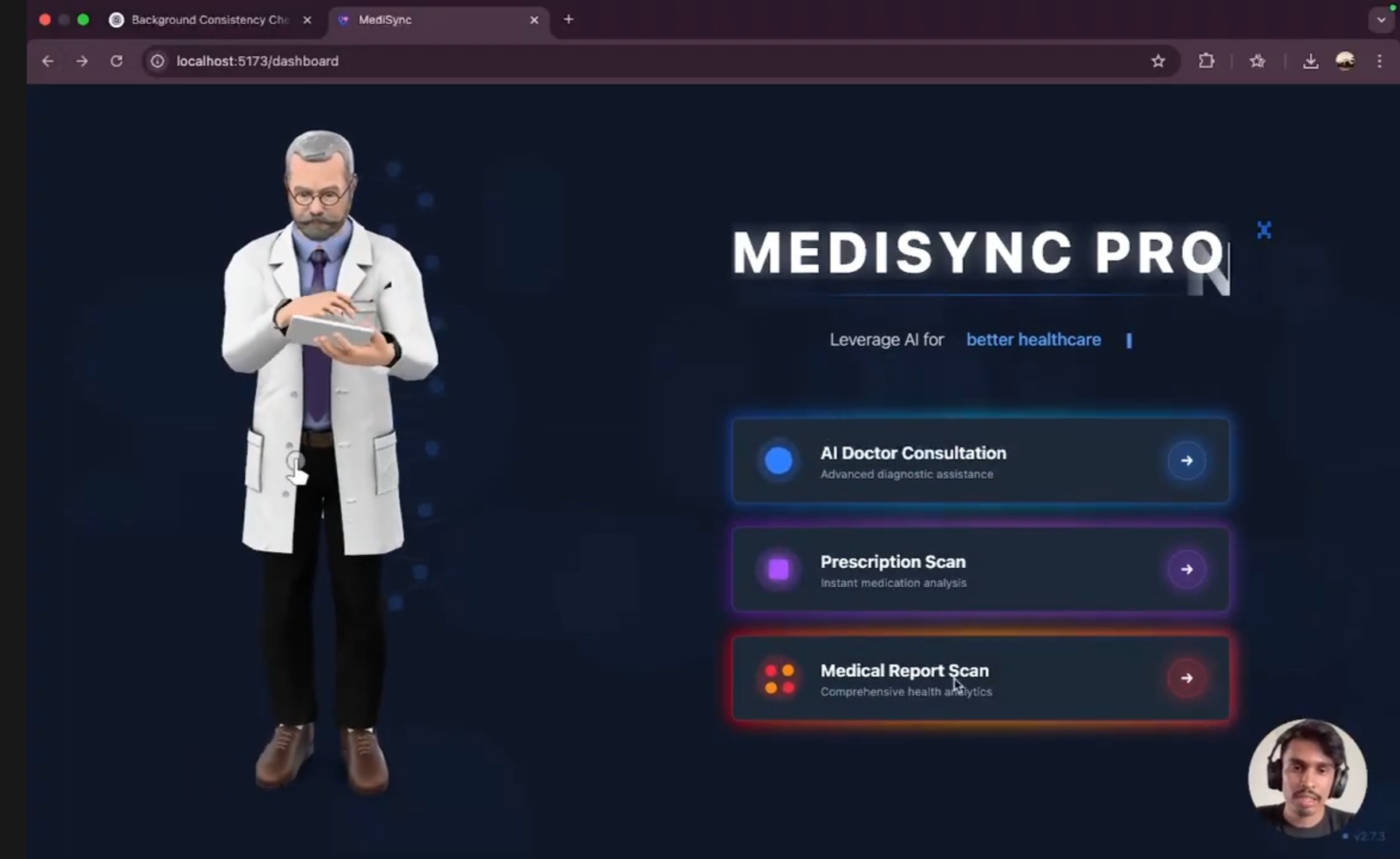
MediSync AI: Strategic Human–AI Collaboration Framework
High-Performance Innovation for Interoperable Healthcare
1. Inspiration: The "Last Mile" Challenge
The inspiration for MediSync AI stems from a critical observation in modern digital health: the "Last Mile" problem. While AI models have reached superhuman performance in medical licensing exams and diagnostic benchmarks, they remain largely isolated from the actual clinical workflow.
We were inspired by the vision of a "Healthcare AI Endgame"—a world where AI doesn't just provide a second opinion but acts as a proactive advocate, coordinating between specialists and ensuring that patient data (often trapped in silos) is synthesized into actionable intelligence. The HackHounds 2026 environment provided the perfect high-energy ecosystem to prototype this vision of "Agents Assembling" to solve complex human problems.
2. Problem Statement: The Fragmentation of Clinical Intelligence
In the current healthcare landscape, clinical data is fragmented across various standards and systems. Even when data is interoperable (e.g., via FHIR), the intelligence derived from that data remains siloed.
Analytical Problem Breakdown:
- Cognitive Overload: Clinicians must synthesize hundreds of data points (vitals, labs, history) manually.
- Siloed Specialization: A cardiologist might not see the diagnostic nuances identified by a lab analyzer in real-time.
- Static Data: Electronic Health Records (EHR) are often "data graveyards" where information is stored but not actively utilized for preventive advocacy.
Mathematically, we can represent the complexity of clinical synthesis $C$ as a function of data entropy $H$ and the number of disparate sources $S$: $$C = \sum_{i=1}^{S} H(d_i) \cdot \omega_i$$ Where $\omega_i$ represents the weight of clinical relevance for each source. MediSync AI aims to minimize $C$ for the clinician by maximizing the mutual information $I$ between agents.
3. The Solution: Interoperable Multi-Agent Systems (A2A)
MediSync AI is not a single chatbot; it is a Strategic Human-AI Collaboration Framework. It introduces a multi-agent architecture where specialized "Cognitive Engines" collaborate via an Agent-to-Agent (A2A) protocol to reach a consensus.
Core Components:
- MediSync Advocate: The primary interface that synthesizes FHIR data into a human-readable "Clinical Insight" layer.
- Specialist Agents (CardioBot, LabAnalyzer): Specialized models that focus on specific domains, providing deep-dive analysis when triggered by the advocate.
- Interoperability Layer: A standards-compliant framework that ensures all agent communication is grounded in structured healthcare data.
4. How It Works: The Intelligence Pipeline
The system operates through a four-stage pipeline:
- Data Ingestion & Normalization: The system ingests FHIR-structured JSON. It normalizes disparate observations (e.g., Blood Pressure, Glucose) into a unified temporal state.
- Advocacy Analysis: The MediSync Advocate (powered by Gemini 3 Flash) performs a primary sweep, identifying triage levels and immediate risks.
- Agent-to-Agent (A2A) Collaboration: When a clinician asks a complex question, the Advocate initiates a "Consensus Protocol." It shares the relevant context with Specialist Agents, who then debate the clinical implications.
- Consensus Output: The final output is a synthesized recommendation that has been "vetted" by multiple AI perspectives, reducing hallucination and increasing clinical reliability.
5. Tech Stack: The Engineering Foundation
We built MediSync AI using a modern, high-performance stack designed for scalability and speed:
- AI Engine:
Google Gemini 3 Flashvia the@google/genaiSDK. We chose Flash for its sub-second latency, which is critical for real-time clinical environments. - Frontend Framework:
React 19withVite. - Styling & UI:
Tailwind CSS v4for utility-first styling andshadcn/uifor high-fidelity components. - Data Visualization:
Rechartsfor atmospheric, real-time vitals tracking. - State & Motion:
Motion(formerly Framer Motion) for staggered agent responses and immersive UI transitions. - Standards: Designed with
FHIR(Fast Healthcare Interoperability Resources) data structures in mind.
6. Challenges Faced: Engineering the "Wow Factor"
One of the primary challenges was simulating Conversational Interoperability (COIN). Ensuring that agents didn't just talk at each other but actually collaborated required sophisticated prompt engineering and context propagation.
Another challenge was the UI/UX of Information Density. In a 24-hour hackathon, it's easy to build a messy dashboard. We spent significant time on "Architectural Honesty"—ensuring the UI felt like a professional medical instrument rather than a generic SaaS app. We used a "Mission Control" aesthetic with dark-mode glassmorphism to reduce eye strain for clinicians.
7. Lessons Learned: The Power of Synergy
The biggest lesson was the realization that Human-AI Synergy is superior to AI autonomy. By positioning the AI as an "Advocate" and the human as the "Strategic Lead," we created a system that feels empowering rather than replacing.
We also learned the technical nuances of the Model Context Protocol (MCP). Even in a prototype, thinking about how tools (like risk calculators) can be exposed to agents changes the entire architecture of the application.
8. Future Scalability: The Roadmap to Production
MediSync AI is designed to scale from a hackathon prototype to a production-grade healthcare platform.
Scalability Vectors:
- Real FHIR Integration: Connecting to live Epic/Cerner sandboxes via OAuth2/SMART on FHIR.
- Edge Deployment: Utilizing Gemini Nano for on-device, privacy-first processing of sensitive patient data.
- Extended Agent Marketplace: Allowing hospitals to "plug in" their own specialized models (e.g., an OncologyBot or a billing-compliance agent).
- Predictive Modeling: Moving from reactive analysis to predictive risk scoring using historical temporal data.
Mathematically, the scalability of our agent network $N$ can be modeled as: $$P(N) = \frac{K}{1 + e^{-r(N-N_0)}}$$ Where $P$ is the performance/value of the system, $K$ is the maximum clinical utility, and $r$ is the rate of interoperability adoption. As $N$ increases, the value of the MediSync network grows exponentially until it reaches clinical saturation.
9. Closing Statement
MediSync AI represents a shared commitment to discipline, precision, and innovation. By combining human strategic direction with the computational rigor of Gemini, we have built a system that doesn't just process data—it advocates for the patient.
HackHounds 2026: 24 Hours. One Pack. Endless Possibilities.
Built With
- css
- geminiapi
- html
- python
- react
- typescript

Log in or sign up for Devpost to join the conversation.