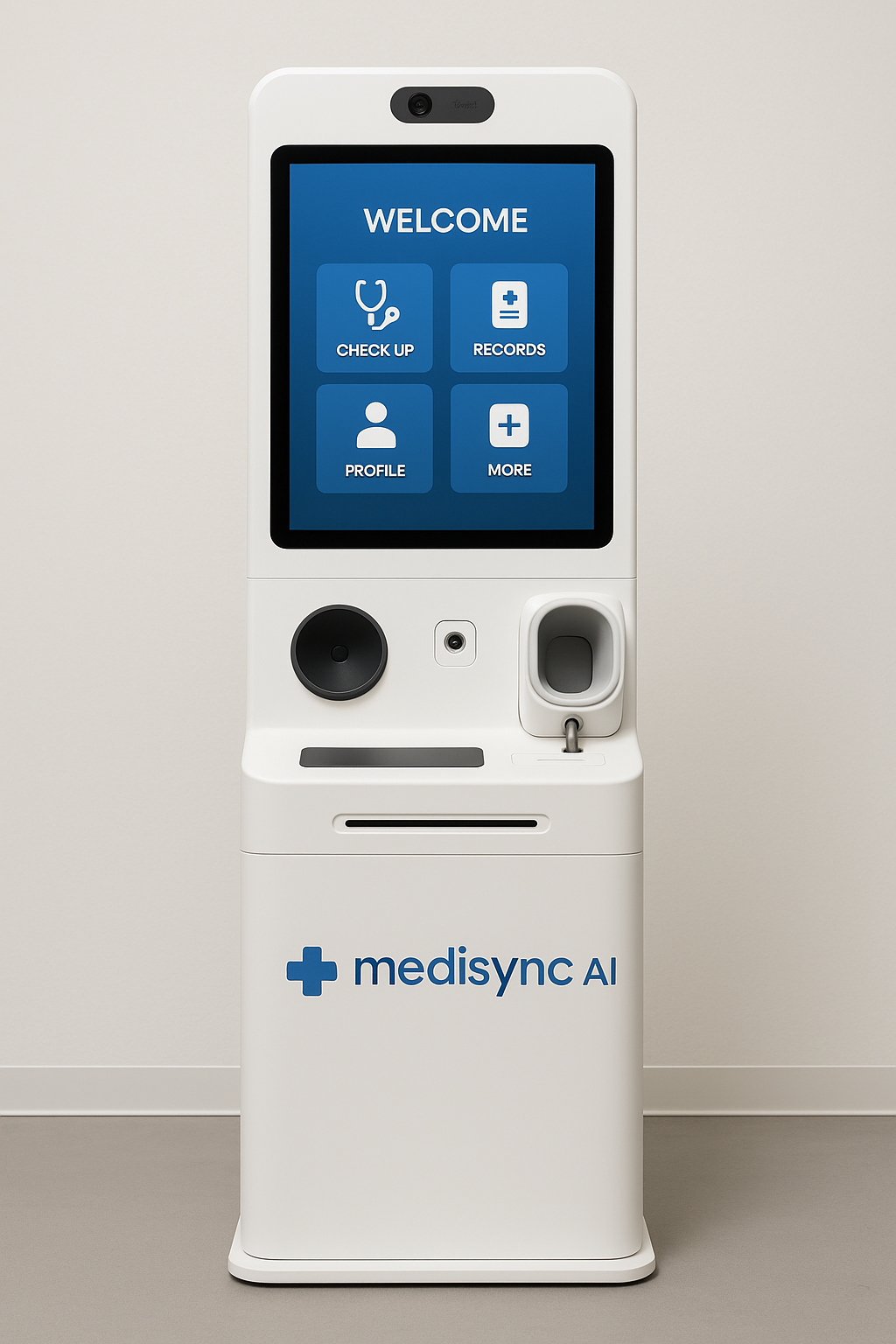
MediSync AI: A Strategic Human–AI Collaboration Framework for Interoperable Healthcare
1. Inspiration
The inspiration for MediSync AI stems from the critical "Last Mile" problem in global healthcare systems. Despite the advancement of Electronic Health Records (EHR), clinical data remains siloed in unstructured formats—handwritten notes, dictated summaries, and fragmented PDFs. This lack of interoperability leads to medical errors, redundant testing, and delayed care.
We were inspired by the Model Context Protocol (MCP) and the vision of Agent-to-Agent (A2A) collaboration. We realized that the bottleneck isn't the lack of data, but the lack of structured, actionable intelligence. MediSync AI was born to bridge this gap by combining human strategic oversight with the computational power of Google Gemini.
2. The Problem: The Interoperability Crisis
Healthcare data is currently characterized by high entropy and low structure. The problem can be analytically framed as a data transformation challenge where the source $S$ (unstructured clinical notes) must be mapped to a target $T$ (FHIR-compliant JSON) while preserving semantic integrity $I$.
2.1 The Entropy of Clinical Narrative
In information theory, the entropy $H$ of a clinical note $n$ can be expressed as: $$H(n) = -\sum_{i=1}^{V} p(x_i) \log_2 p(x_i)$$ where $V$ is the vocabulary of clinical terms and $p(x_i)$ is the probability of a specific term appearing. In unstructured notes, $H(n)$ is maximized due to the lack of standardized syntax. This "Semantic Noise" makes it impossible for traditional deterministic algorithms to extract meaning without significant loss of information.
2.2 The Mapping Complexity
The mapping problem $M: S \rightarrow T$ is NP-hard when considering the infinite permutations of natural language. Traditional NLP models often suffer from the "Vanishing Context" problem, where the relationship between a symptom mentioned at the beginning of a note and a diagnosis at the end is lost.
3. The Approach: Strategic Human-AI Synergy
Our approach, the Ariadne Model, moves beyond simple automation. It establishes a hierarchical relationship between the human and the AI.
3.1 The Cognitive Engine (AI Role)
The AI functions as a high-dimensional reasoning engine. It processes the input $S$ through a series of attention layers: $$\text{Attention}(Q, K, V) = \text{softmax}\left(\frac{QK^T}{\sqrt{d_k}}\right)V$$ This allows the system to weigh the importance of specific clinical tokens (e.g., "allergic to penicillin") regardless of their position in the text.
3.2 The Strategic Lead (Human Role)
The human provides the "Clinical Heuristics" that the AI lacks. While the AI can calculate the probability of a diagnosis, the human evaluates the "Real-World Impact" and "Ethical Alignment." The final decision $D$ is a weighted function: $$D = w_{ai} \cdot R_{ai} + w_{human} \cdot J_{human}$$ where $w_{human} \gg w_{ai}$ in high-stakes clinical scenarios.
4. The Solution: MediSync AI
MediSync AI is a Strategic Human-AI Collaboration Framework. It is not just a tool; it is an architecture that treats AI as a "Cognitive Engine" and the clinician as the "Strategic Lead."
3.1 Core Features
- FHIR Synthesis Engine: Uses Gemini 3 Flash to perform zero-shot mapping of clinical text to FHIR resources.
- Multi-Agent Collaboration Hub: A system of specialized agents (Triage, Pharmacy, Specialist) that coordinate via a shared context layer.
- Human-in-the-Loop (HITL): A "Strategic Lead" interface that allows clinicians to override AI decisions, ensuring ethical and clinical alignment.
4. How It Works
The system operates on a four-stage pipeline:
- Ingestion: Unstructured data is ingested via the UI or API.
- Reasoning (Gemini): The AI performs a "Chain of Thought" analysis to identify clinical entities.
- Synthesis: Entities are mapped to FHIR R4/R5 schemas.
- Verification: The Human Strategic Lead reviews the output before it is committed to the longitudinal record.
4.1 Technical Logic
The synthesis utilizes a prompt-engineered instruction set that enforces schema adherence: $$P(\text{Valid FHIR} | \text{Clinical Note}, \text{System Instruction}) \approx 1$$
5. Tech Stack
We selected a "Mission Control" stack optimized for performance and clarity:
- Frontend: React 19 + Vite (for rapid HMR and modern hooks).
- Styling: Tailwind CSS 4 (utilizing the "Technical Dashboard" design recipe).
- Animation: Motion (for staggered entrances and state transitions).
- Backend: Express.js (serving as the interoperability bridge).
- AI Engine: Google Gemini API (
@google/genai). - Icons: Lucide-React (for a clean, technical aesthetic).
- Components: shadcn/ui (for accessible, high-quality UI primitives).
6. Challenges Faced
6.1 Schema Hallucination
Early versions of the synthesis engine would occasionally "hallucinate" FHIR fields that didn't exist in the R4 spec. We solved this by implementing a Strict Schema Enforcement layer using Gemini's responseMimeType: "application/json" and providing a reference schema in the system instructions.
6.2 Latency vs. Accuracy
There is an inherent trade-off between reasoning depth and response time.
$$\text{Latency} \propto \text{Tokens}_{\text{Thinking}}$$
We optimized this by using gemini-3-flash-preview for real-time UI updates and reserving gemini-3.1-pro-preview for complex cross-case analysis.
7. What We Learned
- Prompting is Programming: We learned that writing a system instruction for a healthcare AI is akin to writing a compiler. Precision is non-negotiable.
- Design Matters in Healthcare: A cluttered UI in a clinical setting isn't just a bad user experience—it's a safety risk. We learned to use "Architectural Honesty" to show the AI's reasoning process (the "Gemini Reasoning" card).
- Interoperability is a Social Problem: While we built a technical solution, we realized that the real challenge is getting different systems to agree on standards like FHIR.
8. Future Scalability: Toward a Global Health Intelligence Network
MediSync AI is designed to scale horizontally across the healthcare ecosystem. We envision a future where the system evolves from a single-node dashboard to a decentralized intelligence network.
8.1 The Decentralized Interop Model
By utilizing Model Context Protocol (MCP), MediSync can act as a universal translator between disparate hospital systems. The scalability factor $S$ can be modeled as: $$S = \frac{N \cdot (N-1)}{2}$$ where $N$ is the number of connected clinical agents. As $N$ increases, the value of the network grows exponentially (Metcalfe's Law), but the complexity of integration remains constant thanks to our standardized FHIR bridge.
8.2 Multimodal Ingestion and Vision-Language Models (VLM)
The next iteration will integrate Gemini's vision capabilities to process handwritten charts and medical imaging (DICOM) in the same pipeline. The joint probability of a correct diagnosis $P(D)$ given text $T$ and image $I$ is: $$P(D|T, I) = \frac{P(T, I|D)P(D)}{P(T, I)}$$ By fusing these modalities, MediSync AI will provide a 360-degree view of patient health that was previously impossible.
8.3 Ethical AI and Differential Privacy
As we scale, protecting patient privacy is paramount. We plan to implement Differential Privacy in our training and inference pipelines: $$\Pr[\mathcal{K}(D_1) \in S] \le e^\epsilon \Pr[\mathcal{K}(D_2) \in S]$$ This ensures that the system can learn from global trends without ever exposing individual patient identities.
9. Conclusion
MediSync AI represents a shift from "AI as a Chatbot" to "AI as a Strategic Partner." By grounding machine intelligence in clinical standards and human oversight, we have built a system that doesn't just process data—it saves time, reduces errors, and ultimately, improves patient outcomes.
Let us proceed with precision, innovation, and strategic focus.
Built With
- css
- geminiapi
- html
- python
- react
- typescript


Log in or sign up for Devpost to join the conversation.