-
-
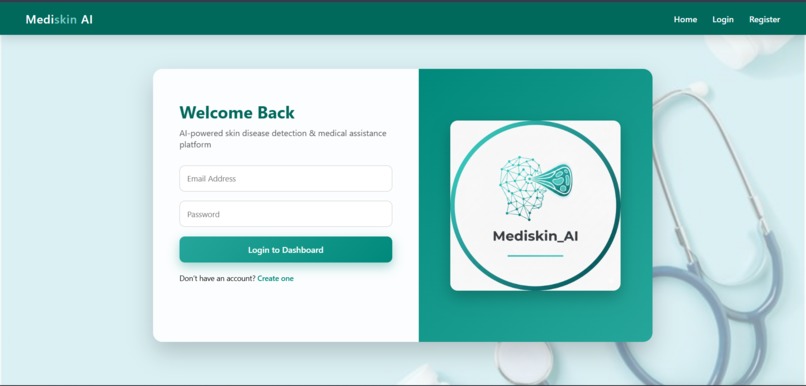
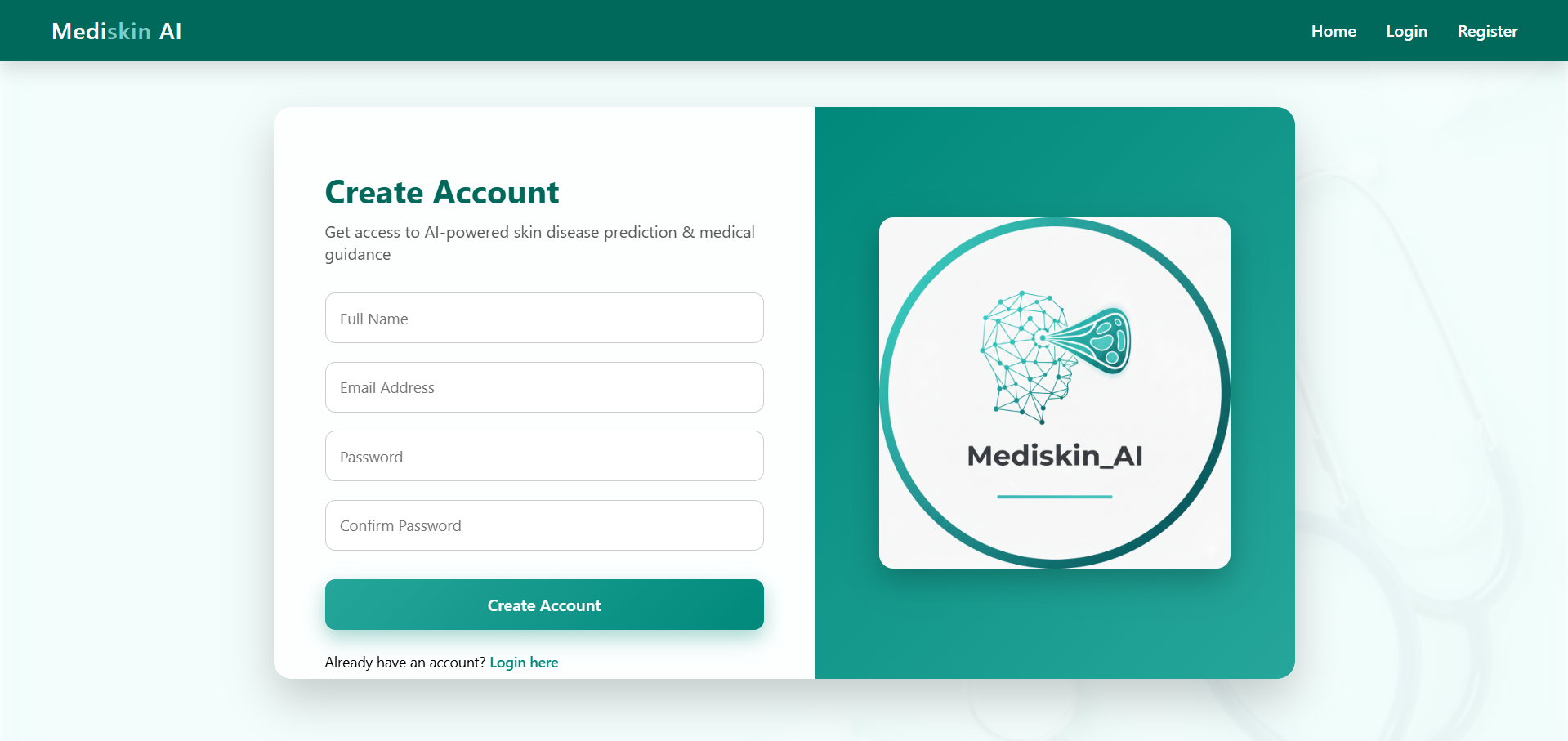
Login
-
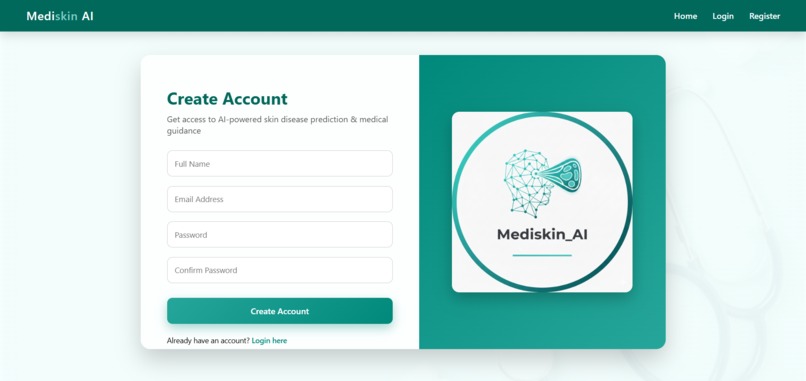
Register
-
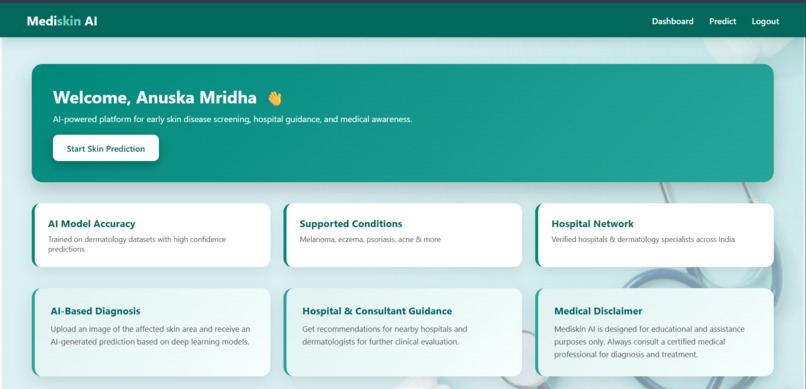
Dashboard
-
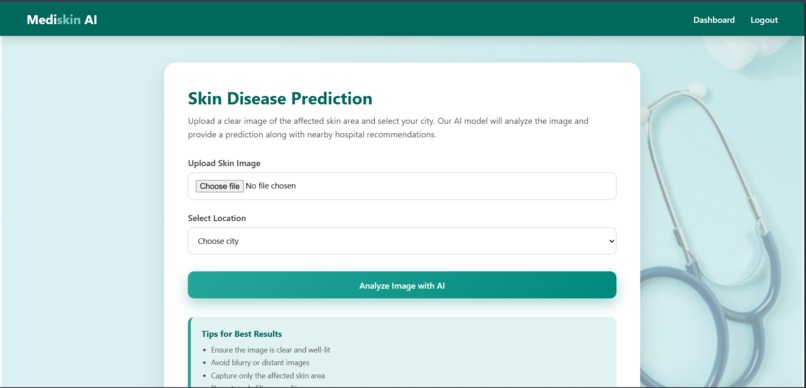
Prediction(1)
-
Prediction(2)
-
Result
-
Result(2)
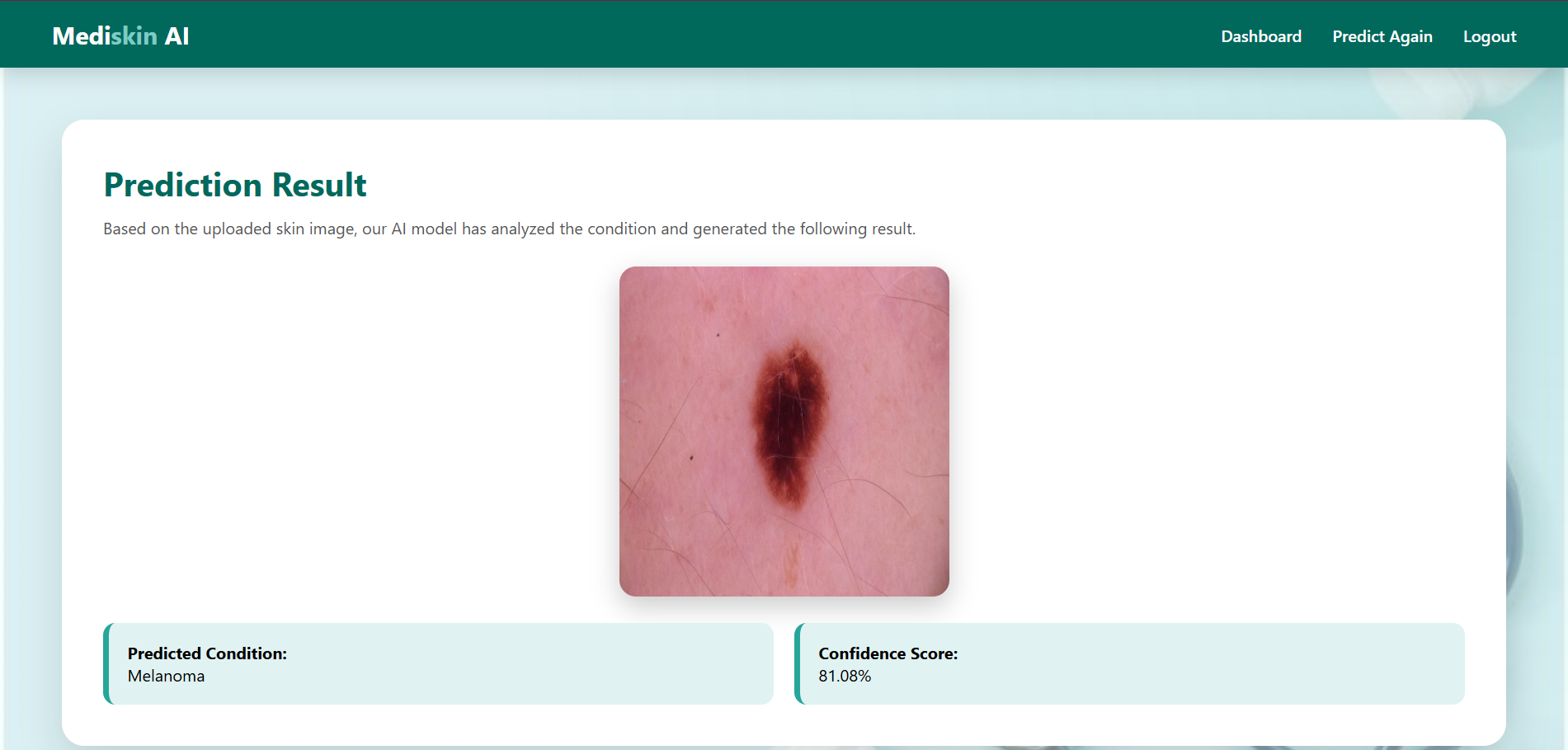
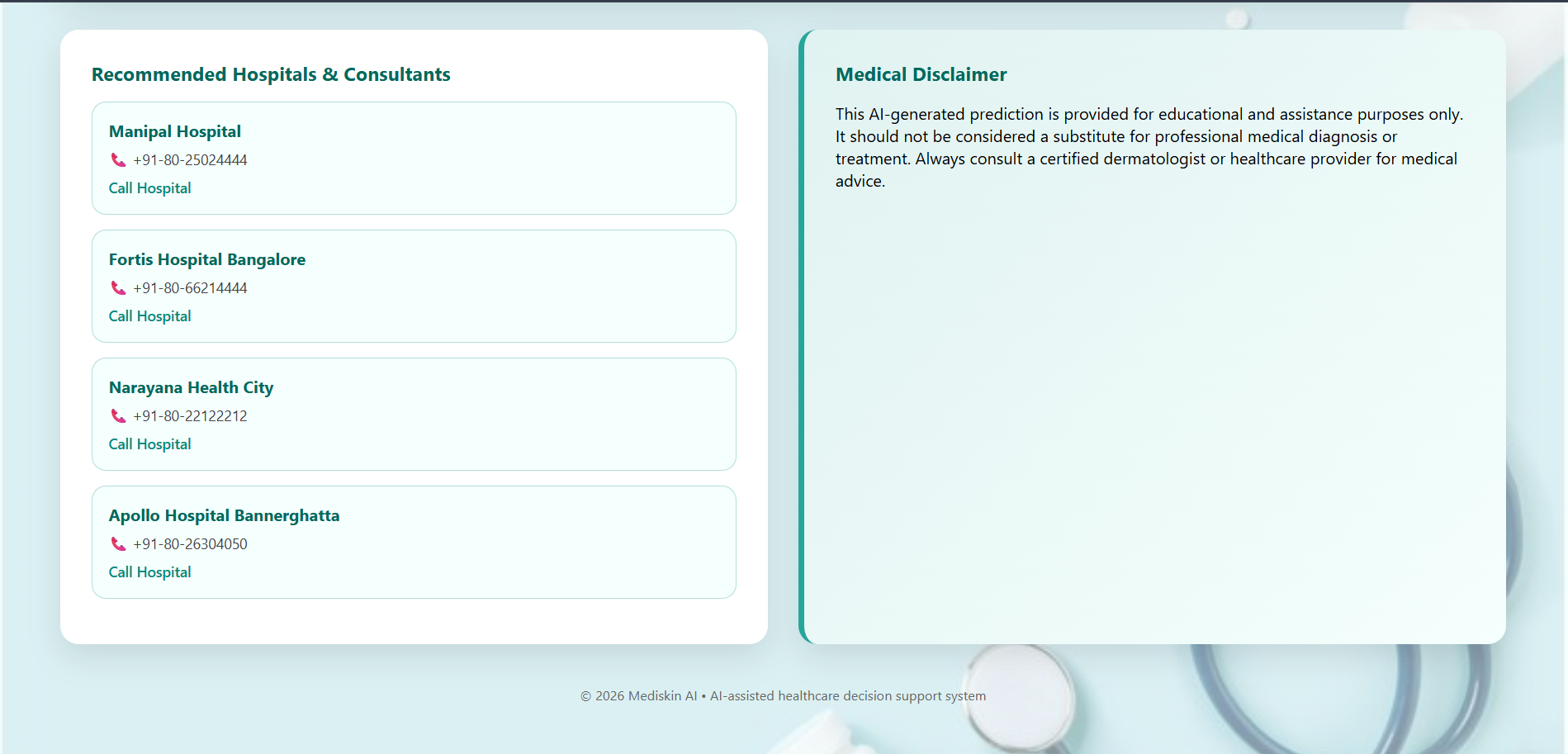
Mediskin AI – AI Platform for Skin Disease Detection
💡 Inspiration
Skin diseases are among the most common health issues worldwide, yet early diagnosis is often delayed due to lack of awareness, accessibility, or hesitation in consulting a dermatologist.
During my learning journey in Artificial Intelligence and Web Development, I realized that AI-powered image analysis can play a crucial role in assisting early screening of skin conditions.
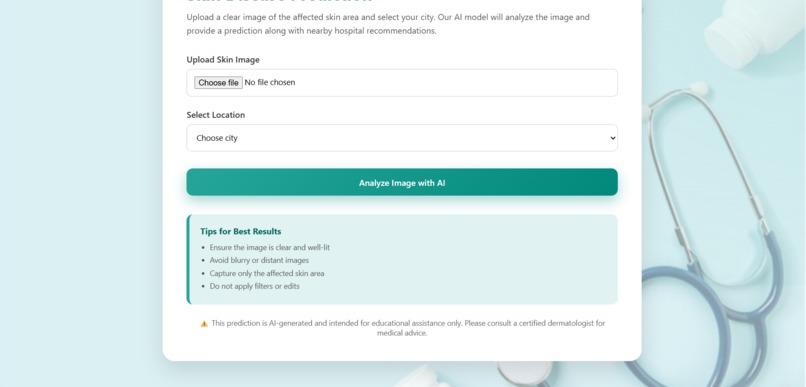
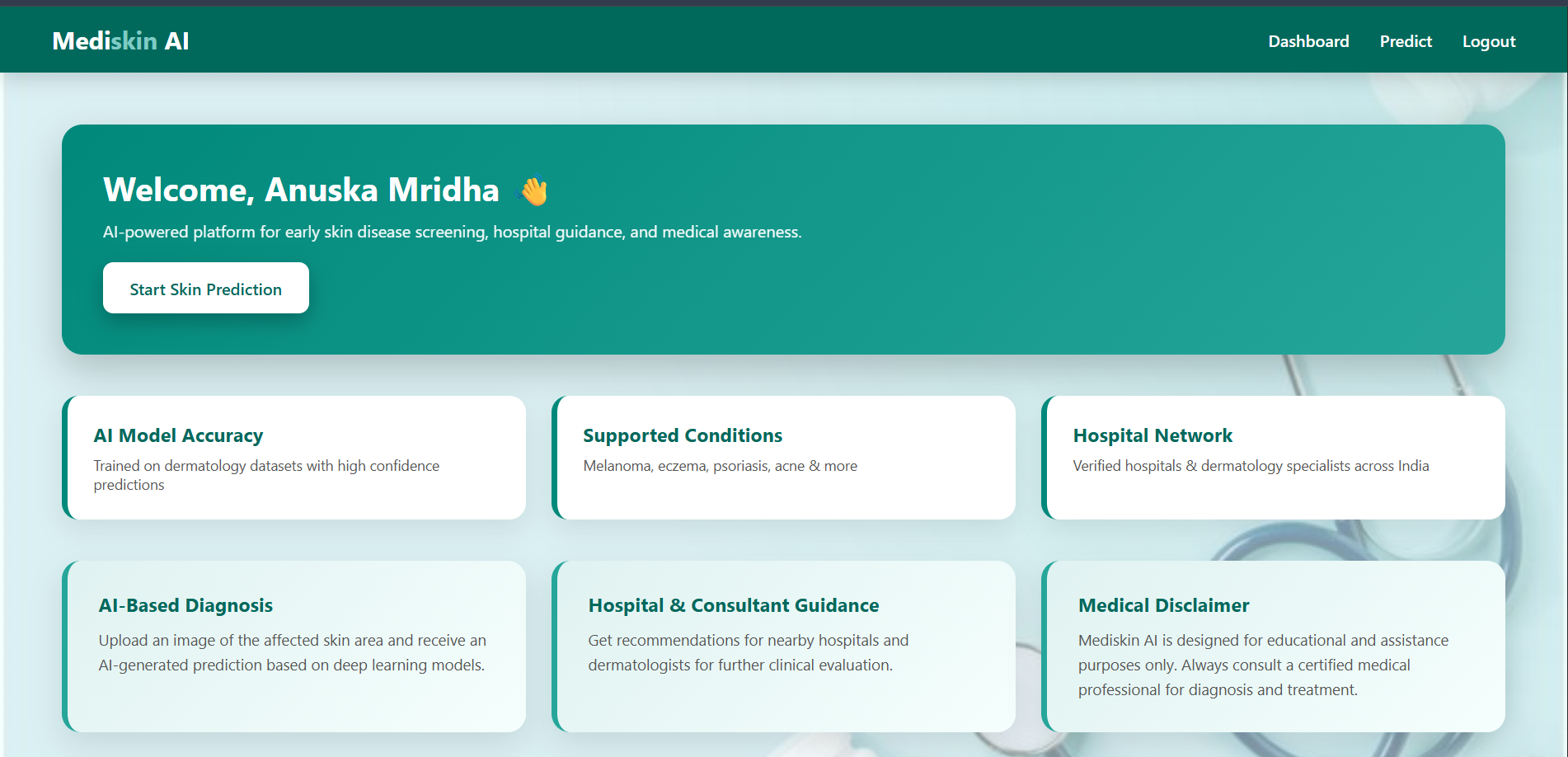
The inspiration behind Mediskin AI was to create a simple, accessible, and educational platform where users can upload a skin image and receive an AI-generated prediction along with guidance on nearby hospitals.
The goal was not to replace doctors, but to help users take the first step toward medical consultation.
🧪 About the Project
Mediskin AI is a web-based application that uses deep learning and image processing to analyze skin images and predict possible skin diseases.
Key Features
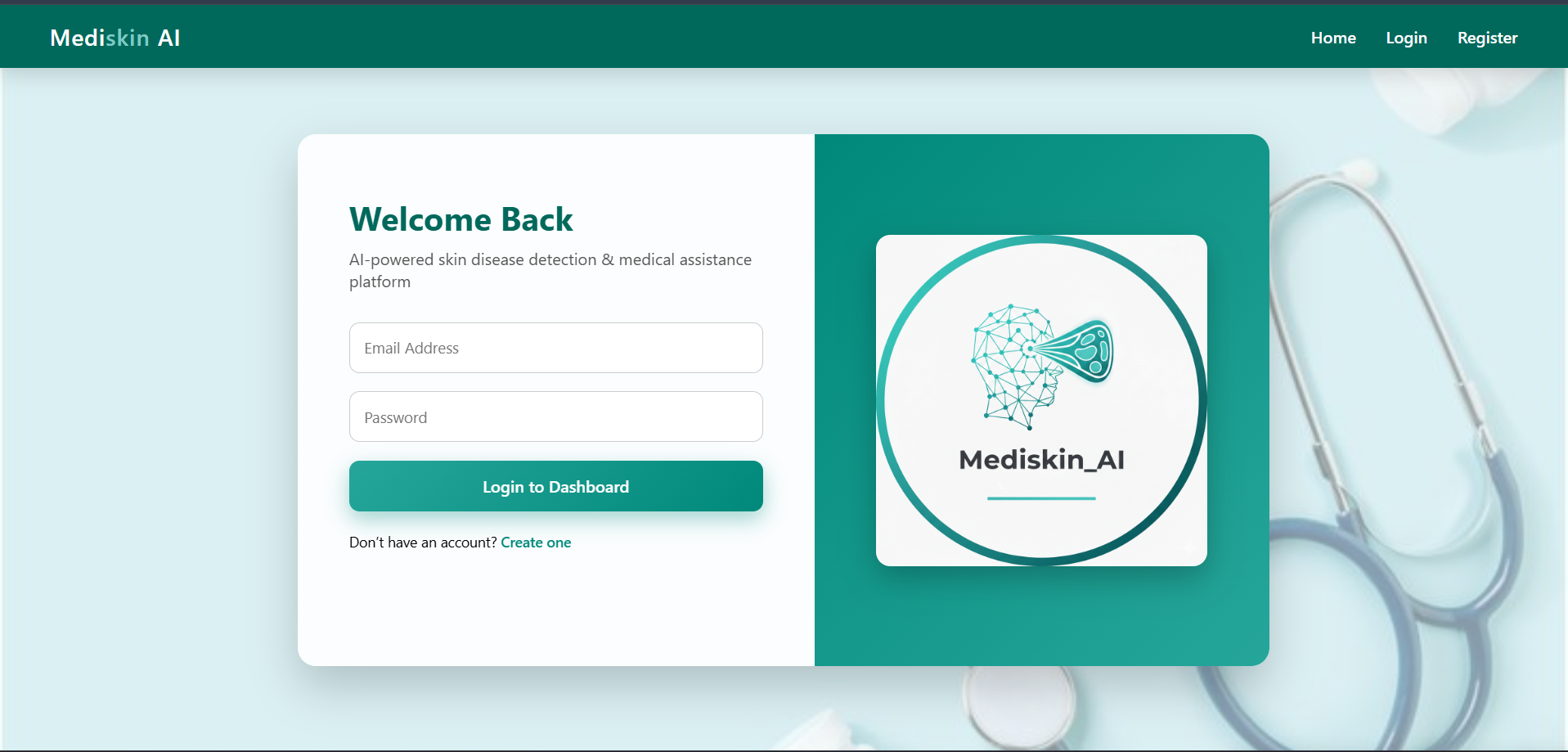
- Secure user authentication (login & registration)
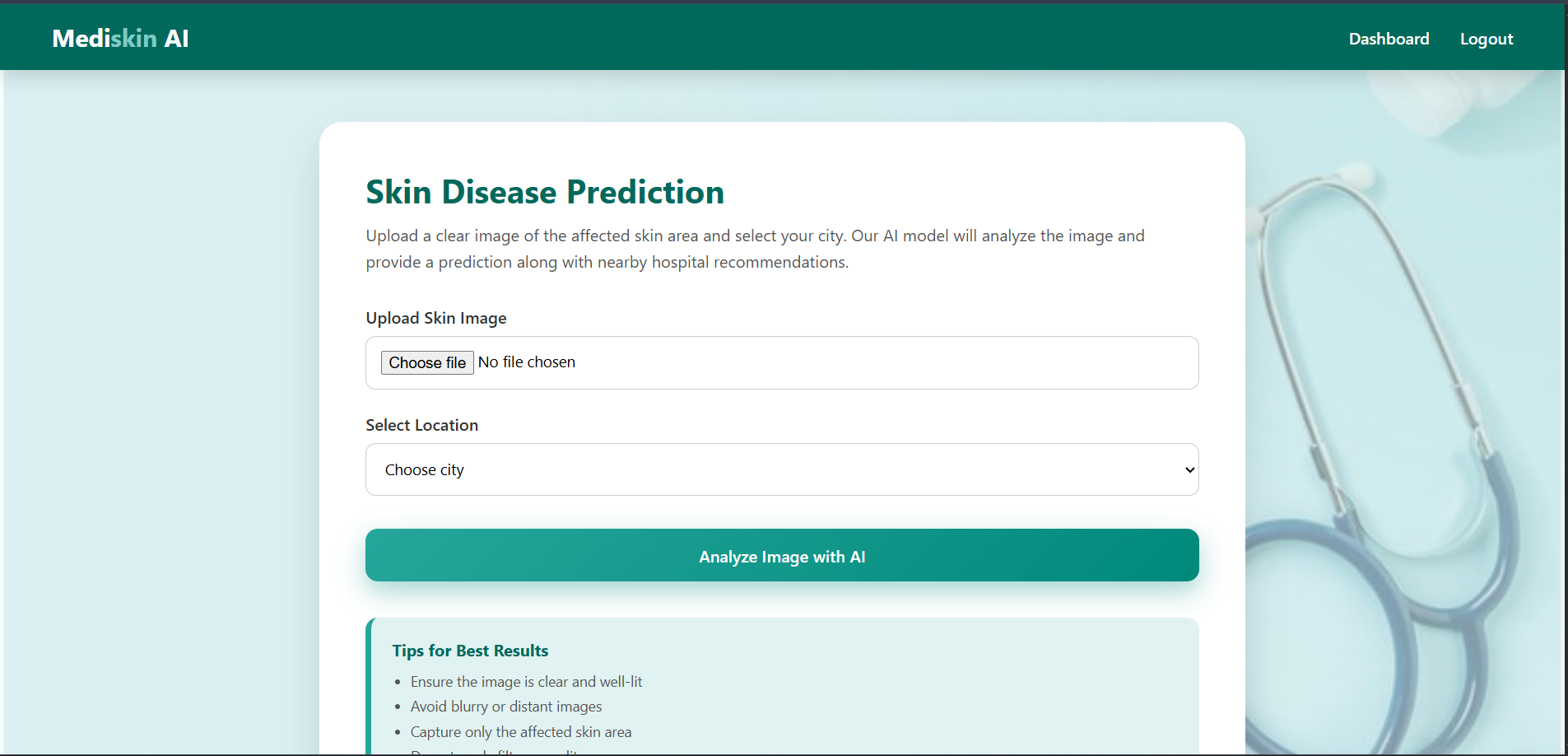
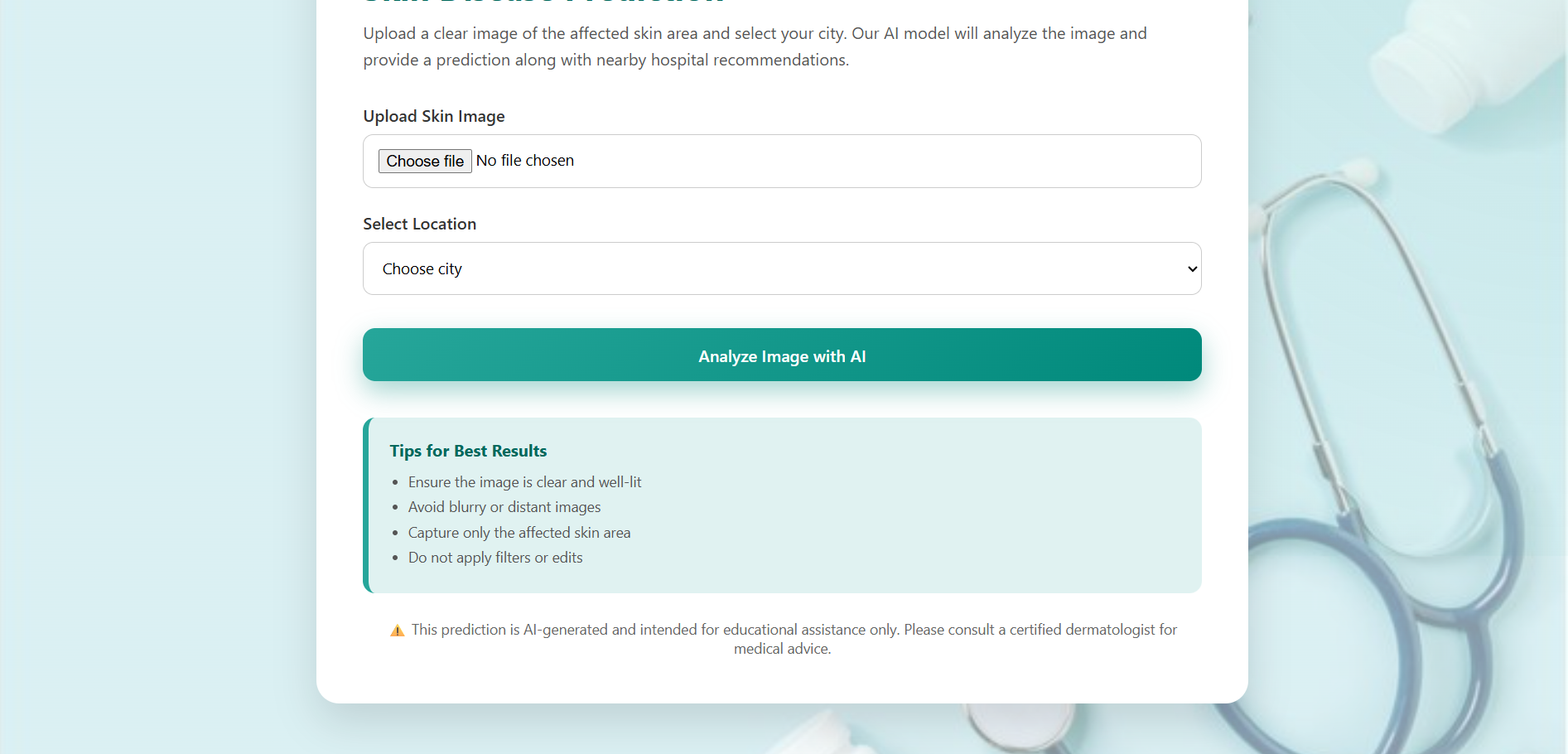
- Image upload and validation
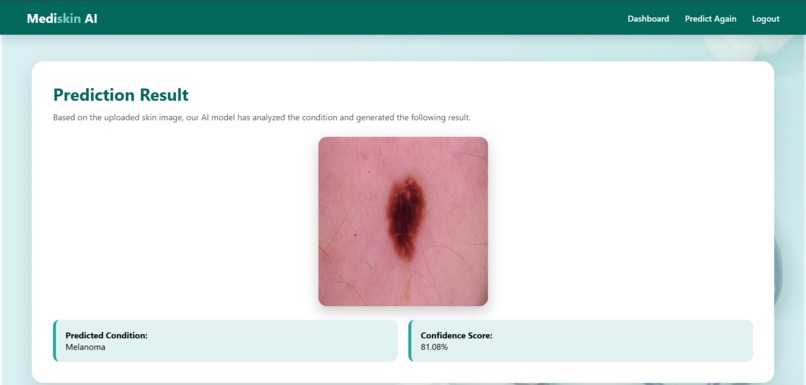
- AI-based skin disease prediction
- Confidence score for predictions
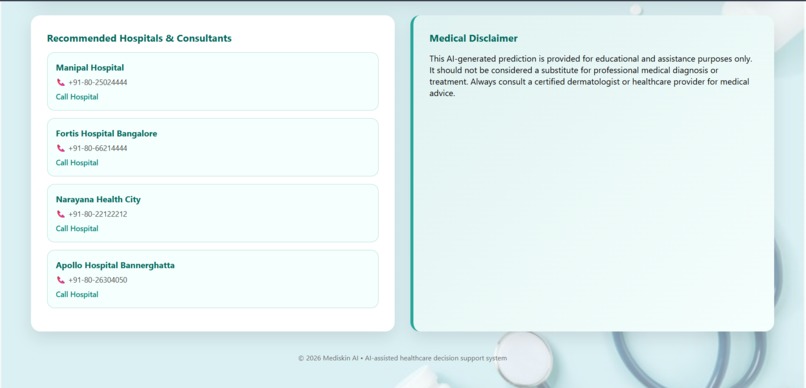
- Location-based hospital recommendations
- Medical disclaimer for ethical usage
- Clean, professional, healthcare-focused UI
This project demonstrates the end-to-end integration of AI with a real-world web application.
🛠️ How I Built the Project
The project was built using a modular and scalable approach, combining backend logic, AI model integration, and frontend design.
🔄 Workflow Overview
- User registers or logs in securely
- User uploads a skin image
- The image is preprocessed and passed to a trained CNN model
- The model predicts the skin condition and outputs a confidence score
- Nearby hospitals are displayed based on the selected location
- Results are shown in a clean UI with a medical disclaimer
🤖 AI Model Logic (Simplified)
The model predicts a class ( c ) such that:
[ c = \arg\max_i P(y_i \mid x) ]
Where:
- ( x ) = input skin image
- ( y_i ) = predicted skin disease class
- ( P(y_i \mid x) ) = model confidence
⚙️ Challenges Faced
Building Mediskin AI involved several real-world challenges:
- Model accuracy tuning: Ensuring predictions were meaningful and confidence scores were reliable
- Image handling: Managing uploads, validation, and preprocessing
- UI consistency: Designing a clean, medical-grade interface using a limited color palette
- Integration: Smoothly connecting Flask routes, templates, and the AI model
- Ethical considerations: Adding clear medical disclaimers to prevent misuse
Each challenge helped me understand practical constraints beyond theory.
📚 What I Learned
Through this project, I gained hands-on experience in:
- Practical application of Convolutional Neural Networks (CNNs)
- Backend development using Flask
- Secure authentication and session handling
- Frontend design principles for healthcare platforms
- Importance of user trust, accessibility, and ethical AI
- Building with an end-to-end deployment mindset
This project significantly strengthened my confidence in building AI-powered full-stack applications.
🏆 Accomplishments I’m Proud Of
- Successfully built an end-to-end AI-powered healthcare web application
- Implemented secure user authentication
- Developed an image-based skin disease prediction system
- Displayed confidence scores for transparency
- Added location-based hospital recommendations
- Designed a clean, professional healthcare UI
- Included medical disclaimers for responsible AI usage
The platform works smoothly from user input to AI output, demonstrating a real-world application of AI.
🚀 What’s Next for Mediskin AI
Future improvements include:
- Expanding the dataset for better accuracy and generalization
- Adding dermatologist-verified recommendations
- Integrating real-time location services
- Implementing model explainability (why a prediction was made)
- Cloud deployment for public access
- Multilingual support to improve accessibility
With further development, Mediskin AI has the potential to become a robust AI-assisted healthcare support platform.
✨ From pixels to prevention — Mediskin AI.


Log in or sign up for Devpost to join the conversation.