-
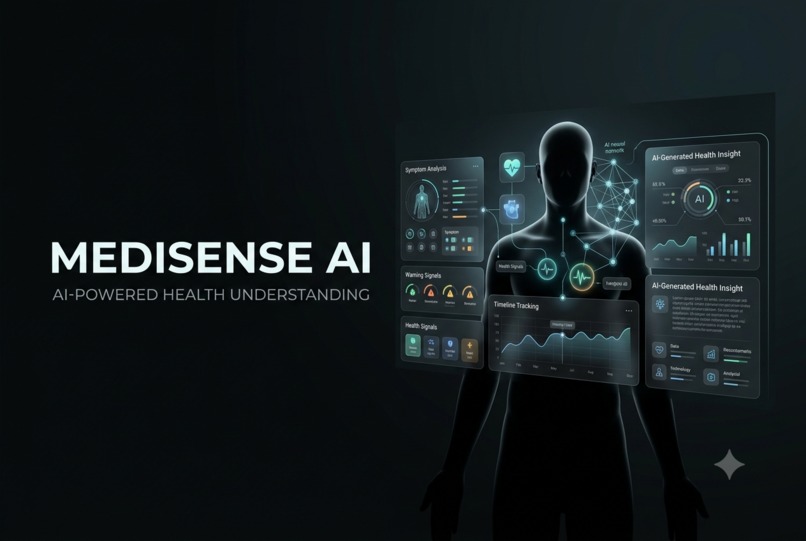
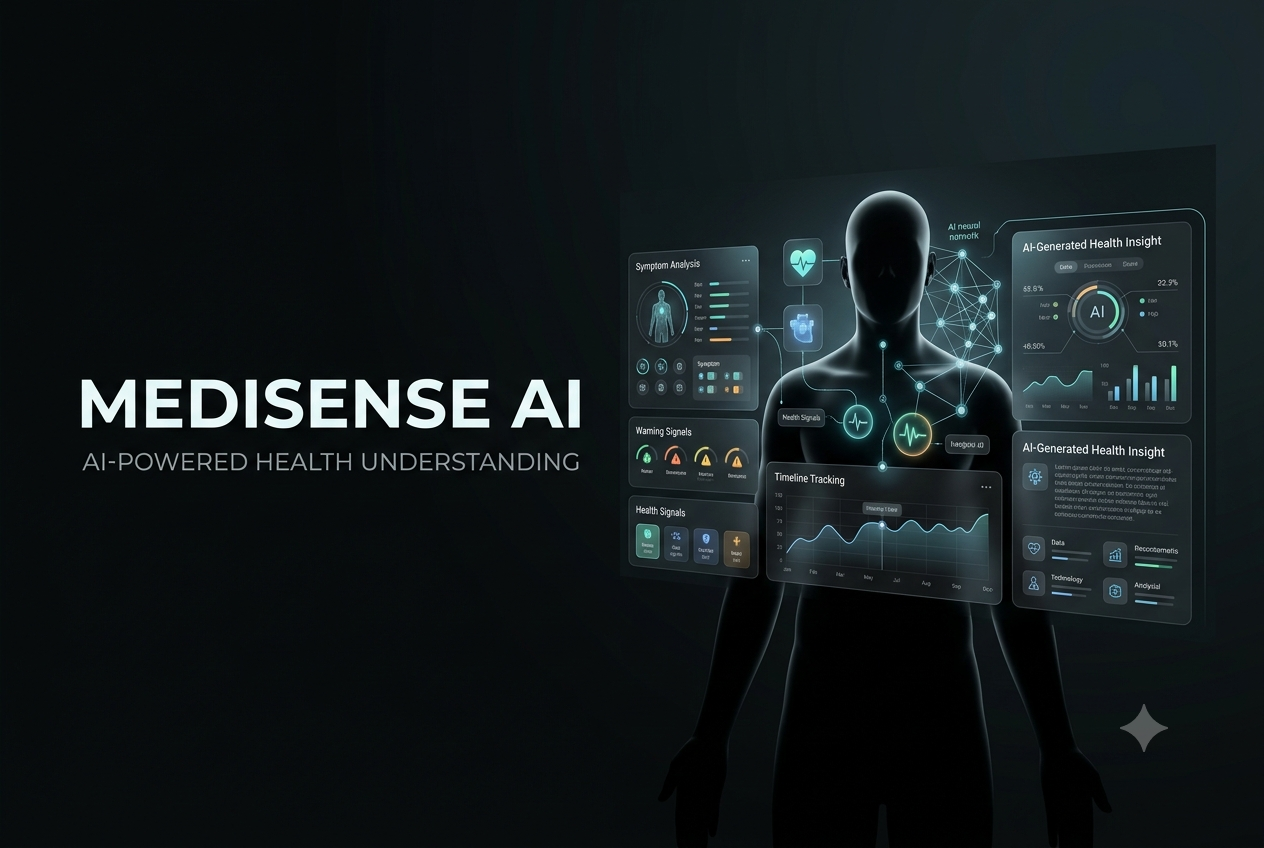
MediSense AI — Understand Your Health. Recognize Warning Signs. Prepare for Better Care.
-
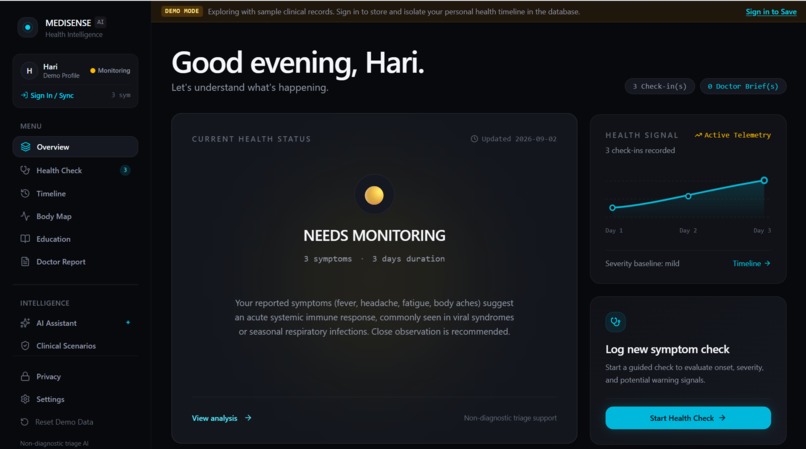
A smarter starting point for understanding your health.
-
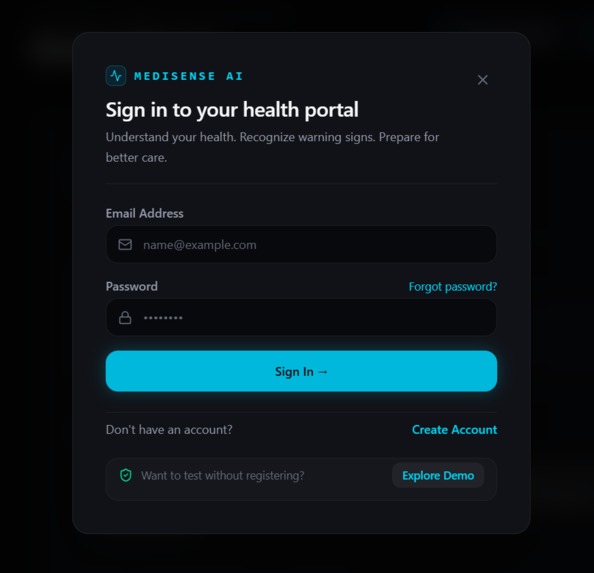
A private space for your personal health journey
-
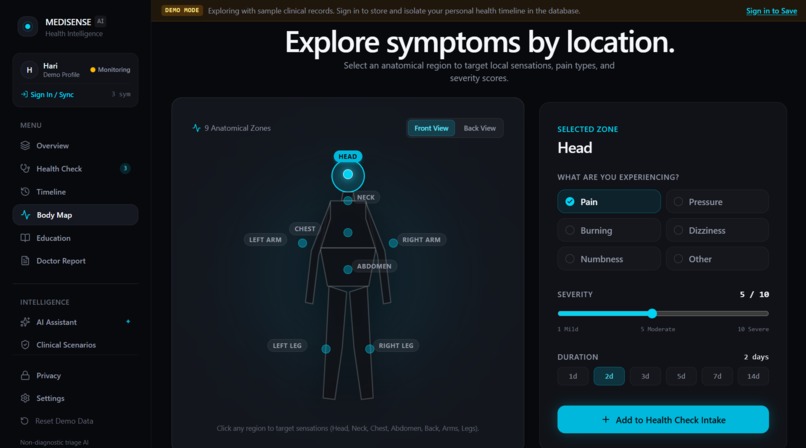
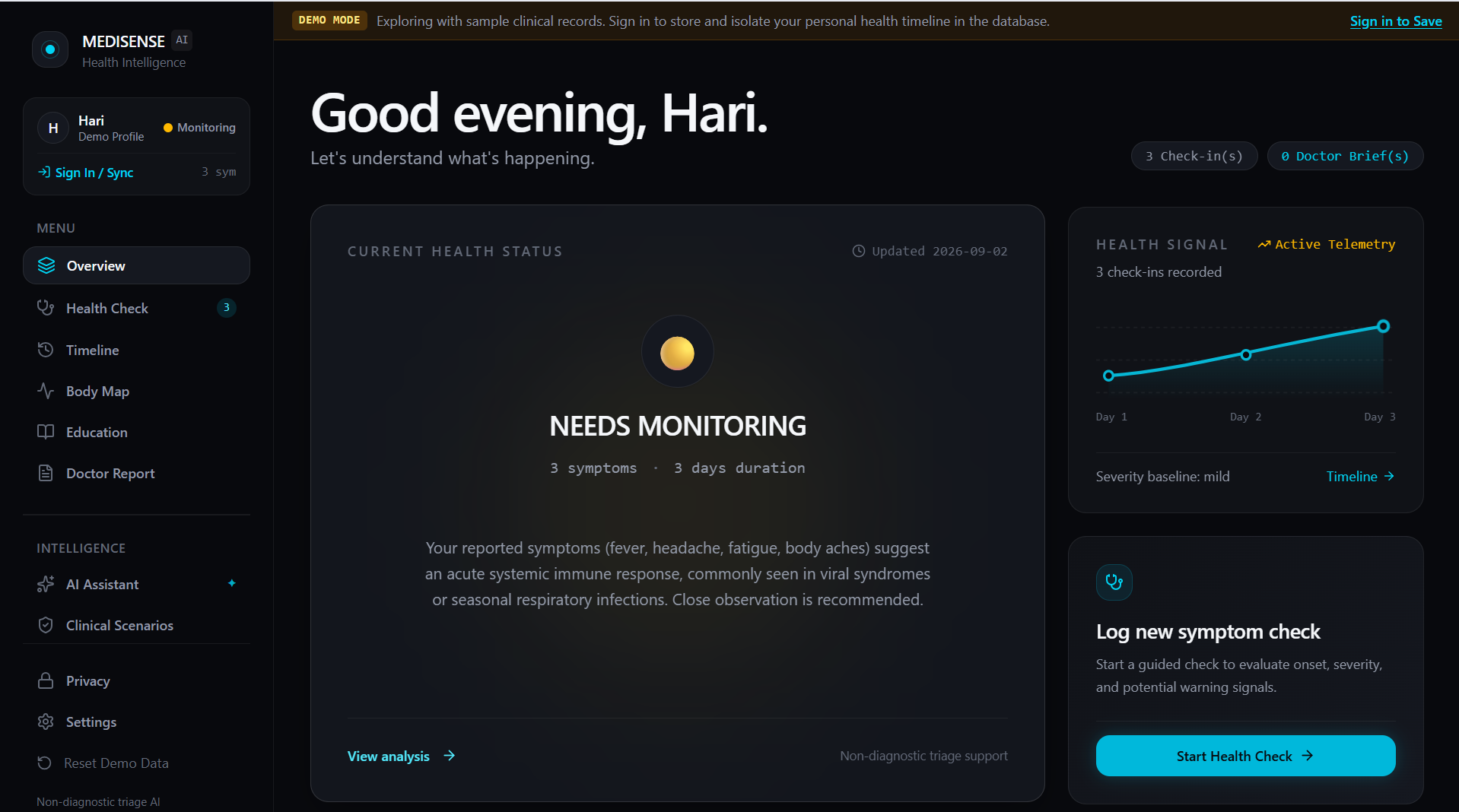
Your health, organized into one clear and intelligent workspace.
-
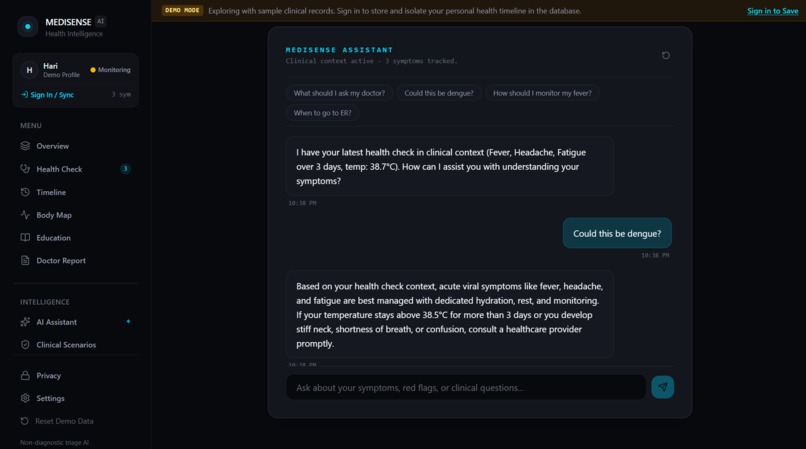
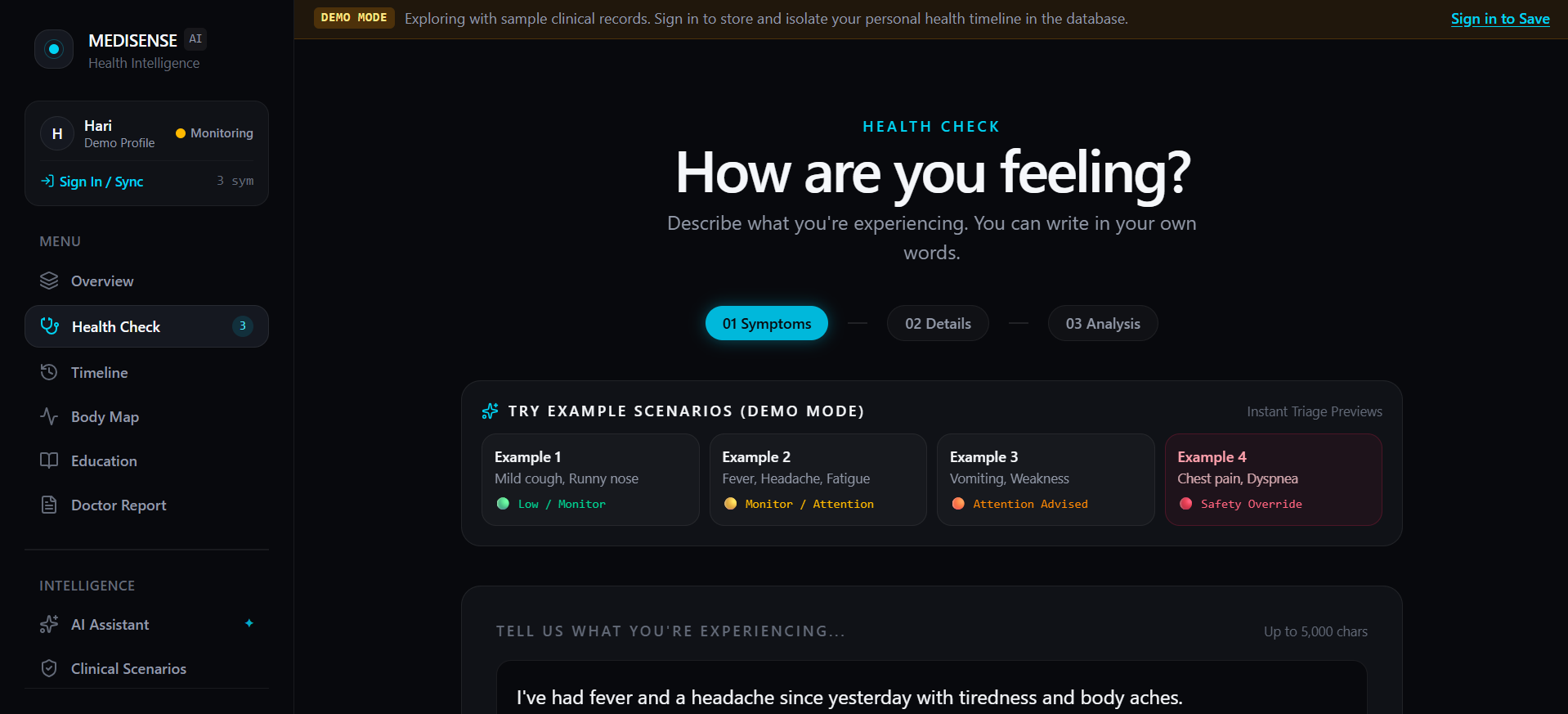
AI analyzes symptoms while a safety layer checks for potential warning signs.
-
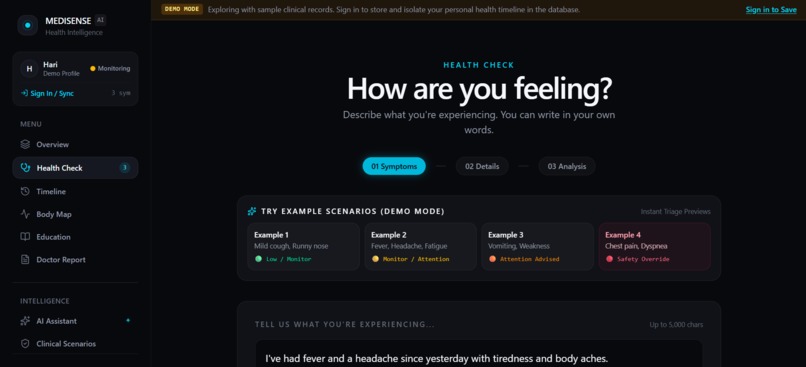
Clear health insights designed to help you understand what deserves attention.
-
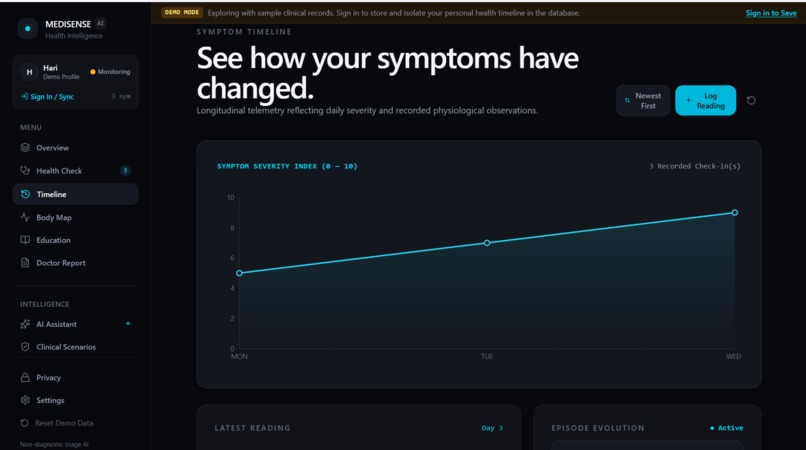
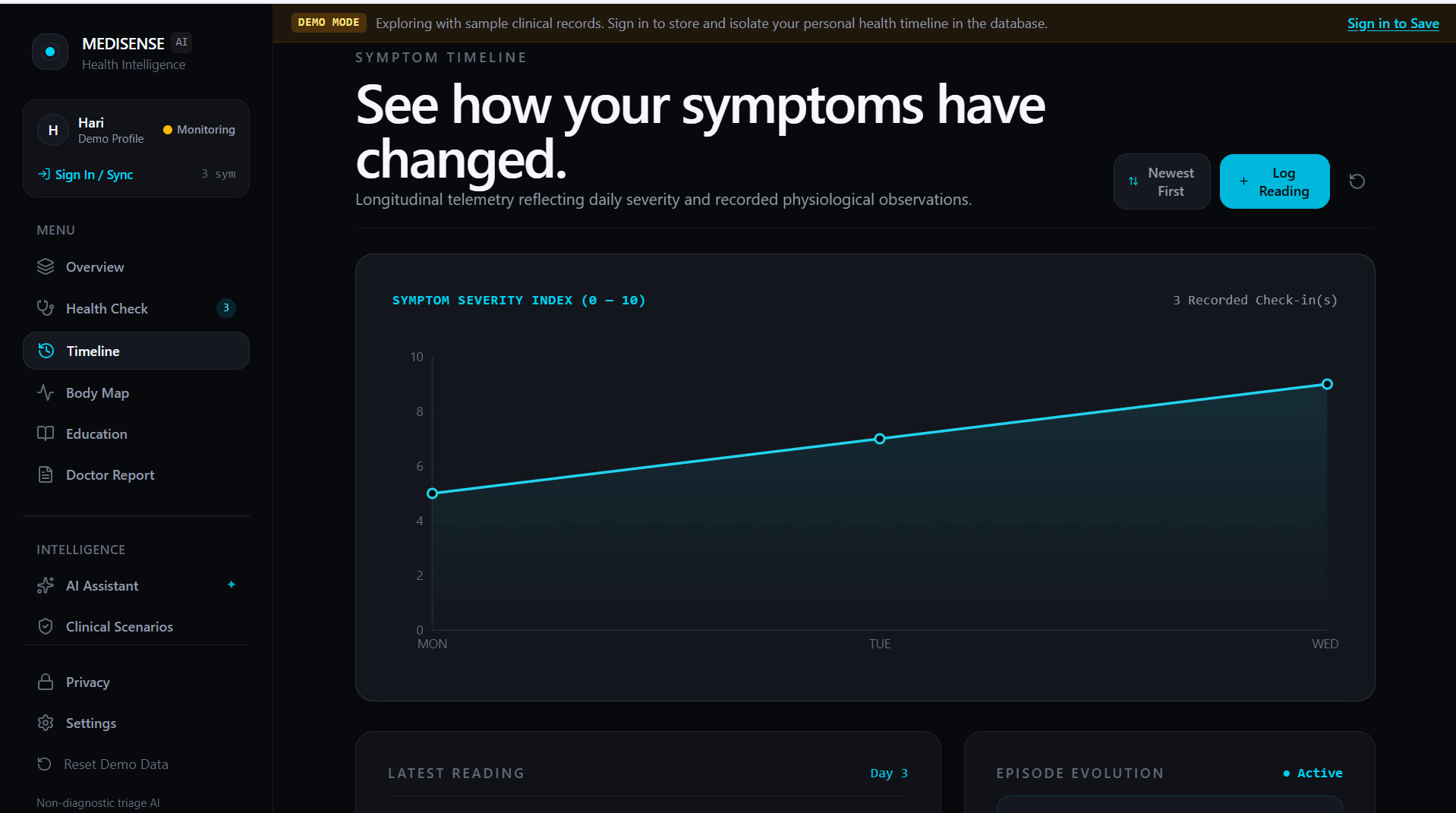
Track how your symptoms change over time—not just how you feel today.
Inspiration
Healthcare information can often feel confusing when someone experiences unfamiliar symptoms. People may search the internet and find overwhelming or contradictory information, while others may not know what information is important to communicate to a healthcare professional.
We wanted to explore a simple question: Can AI help people understand and organize their health information without pretending to replace a doctor?
That idea inspired us to build MediSense AI, an AI-powered health understanding assistant focused on early awareness, explainable information, and better preparation for healthcare conversations.
What it does
MediSense AI allows users to describe what they are experiencing in natural language and turns that information into a structured, easy-to-understand health summary.
It can:
- Extract and organize symptoms from natural-language descriptions
- Ask relevant follow-up questions
- Identify predefined potential warning-sign patterns
- Provide explainable health information using AI
- Show what information was considered when generating an insight
- Track symptoms and changes over time
- Provide educational explanations of health concepts
- Generate questions users can discuss with healthcare professionals
- Create a structured doctor-visit report
- Maintain a personal health timeline when users choose to save their information
MediSense AI is designed as a health understanding and organization tool, not a diagnostic system.
How we built it
We built MediSense AI as a full-stack web application with a modern, responsive interface designed around a dark Bento Grid aesthetic.
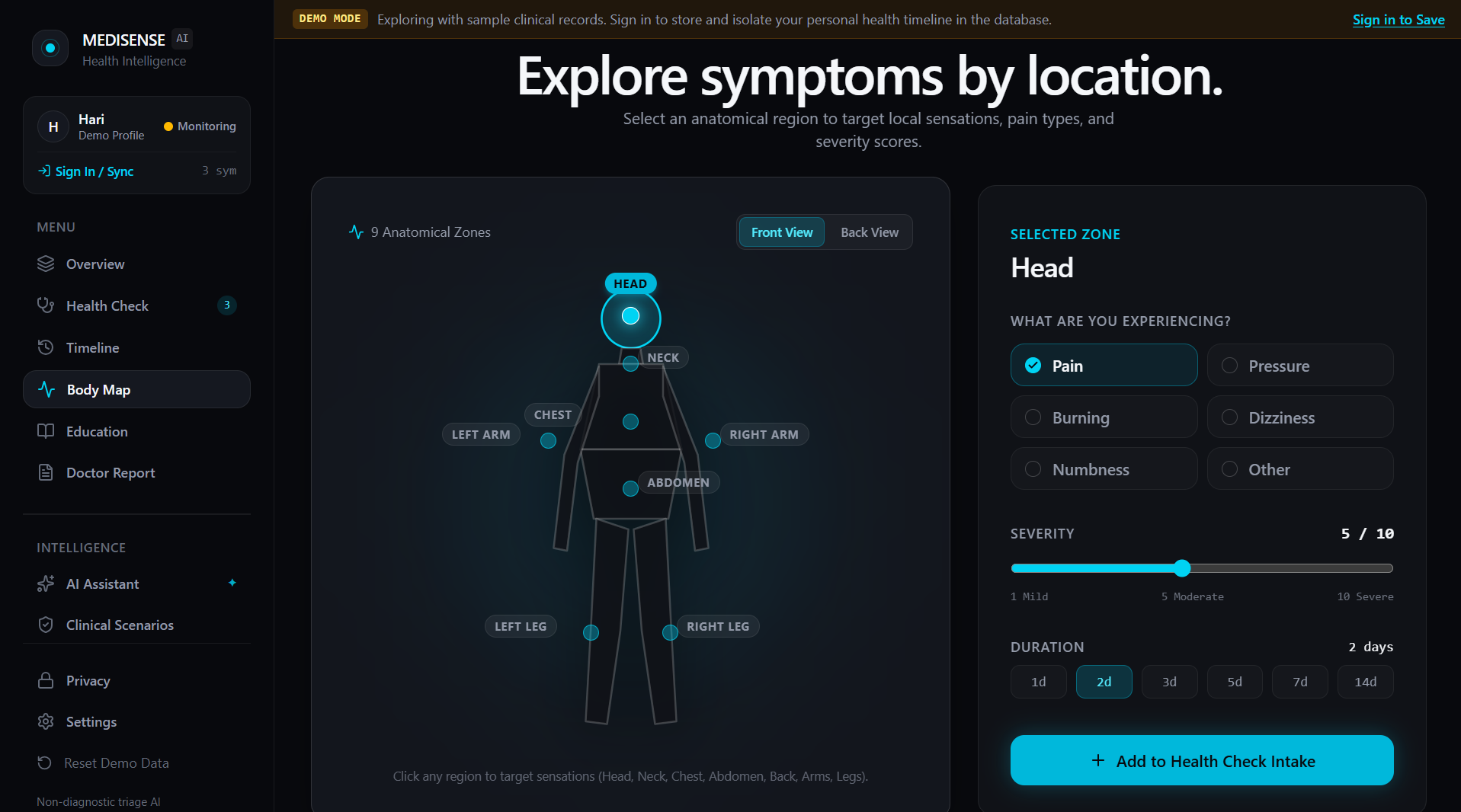
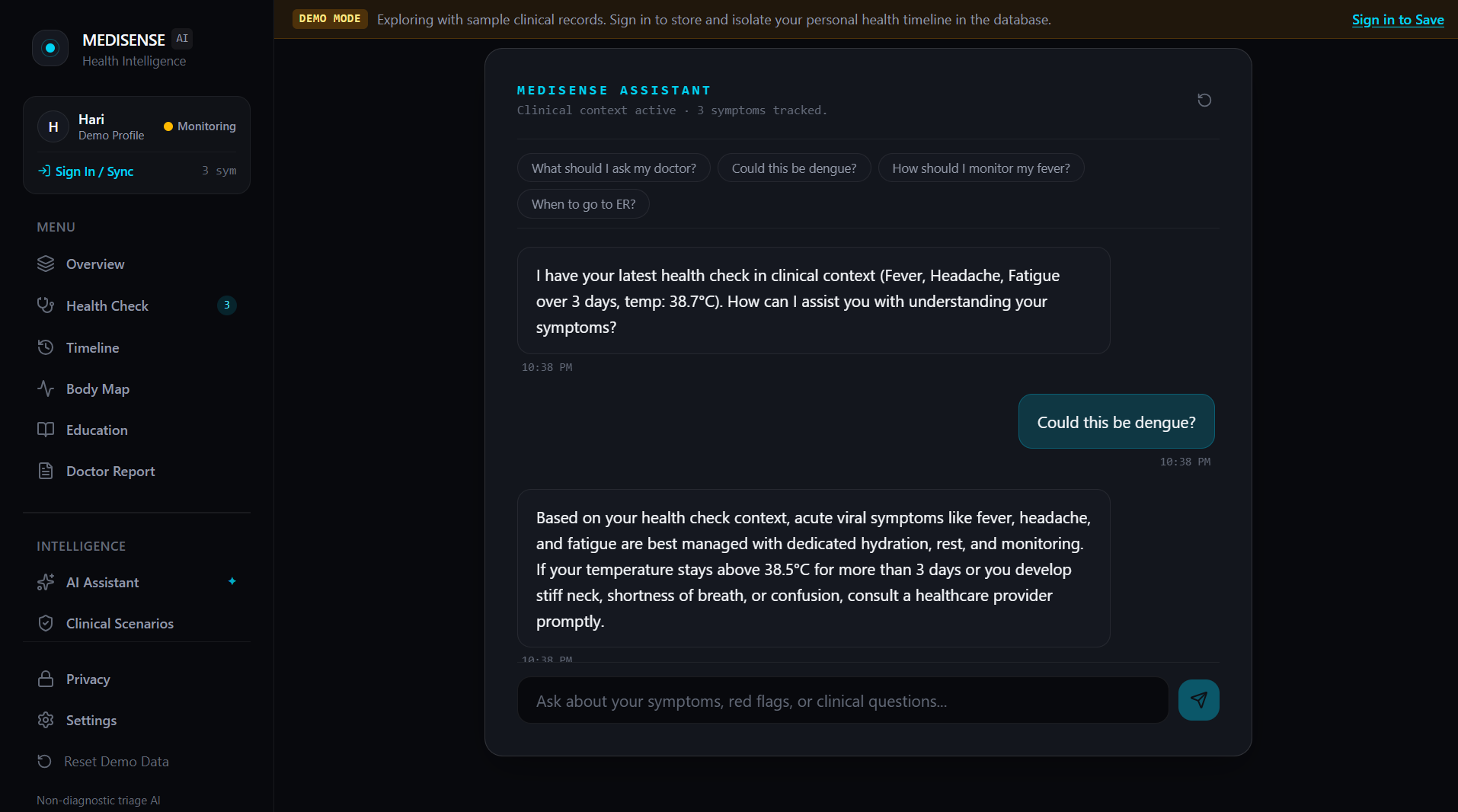
The frontend handles the interactive experience, including symptom input, the body map, analysis visualization, timeline, dashboard, AI assistant, and report interface.
A backend API handles authentication, data processing, AI requests, and database operations.
We integrated Gemini for natural-language understanding, symptom organization, explanations, educational content, and report generation.
One of the most important architectural decisions was separating the deterministic safety engine from the AI model. Potentially urgent symptom combinations are checked using predefined rules rather than relying only on an LLM. The AI output is then structured and validated before reaching the user interface.
We also implemented persistent user data, health-check history, timeline entries, report generation, authentication, input validation, and error handling.
Challenges we ran into
One of our biggest challenges was figuring out how to use generative AI responsibly in a healthcare context.
An AI model can produce convincing answers even when information is incomplete, so simply asking an LLM to "diagnose symptoms" would be unsafe and unreliable.
We therefore had to design boundaries around the AI, including:
- Separating safety checks from generative AI
- Preventing definitive diagnoses
- Avoiding fabricated probabilities and medical certainty
- Validating structured AI responses
- Handling ambiguous symptom descriptions
- Designing useful fallback behavior when the AI or database is unavailable
- Protecting users' health information
- Making sure one user's data cannot be accessed by another user
Another challenge was balancing functionality with simplicity. We wanted MediSense AI to feel powerful without overwhelming users with complicated medical terminology or an interface filled with unnecessary information.
Accomplishments that we're proud of
We are particularly proud of turning a simple AI health concept into a complete interactive product experience.
Some of our biggest accomplishments include:
- Building a complete end-to-end health-check workflow
- Integrating Gemini into a structured AI pipeline
- Creating an independent deterministic safety layer
- Designing an explainable AI result experience
- Building a persistent symptom timeline
- Creating a doctor-visit report workflow
- Adding contextual AI health education
- Building an interactive body map for symptom organization
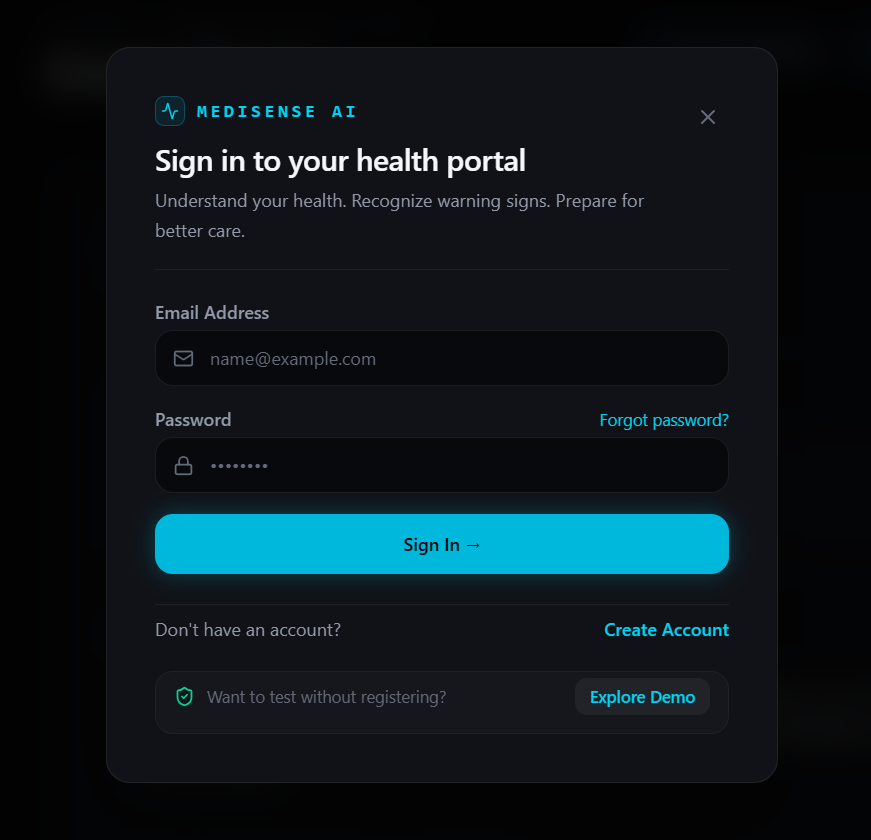
- Implementing authentication and user-specific data protection
- Designing a polished, responsive interface rather than a basic chatbot
Most importantly, we are proud that responsible AI is part of the architecture rather than just a disclaimer added at the end.
What we learned
This project taught us that building AI for healthcare is very different from building a normal AI application.
We learned that a good AI product is not just about getting an impressive model response. It is also about constraints, validation, safety, user experience, and knowing what the system should not do.
We learned how to integrate an LLM into a structured backend pipeline, validate model outputs, design deterministic safety rules, manage persistent user data, build responsive interfaces, and think about privacy when handling sensitive information.
Most importantly, we learned that AI should support human decision-making rather than create false confidence.
What's next for MediSense AI
We want to continue developing MediSense AI into a more comprehensive health-understanding platform.
Future possibilities include:
- Multilingual and voice-based health interaction
- Integration with wearable health data
- Understanding laboratory reports and medical documents
- Evidence-backed health education with verified sources
- More advanced symptom progression visualization
- Clinician-facing summaries
- Accessibility improvements for different users
- Better personalization while maintaining strict privacy boundaries
- More extensive safety and reliability testing
Our long-term vision is to build technology that helps people understand their health information earlier, communicate it more clearly, and make better-informed decisions about when to seek professional care.
Built With
- express.js
- firebase
- firebase-authentication
- firestore
- gemini-api
- generative-ai
- google-ai
- node.js
- react
- recharts
- tailwind-css
- typescript
- vite


Log in or sign up for Devpost to join the conversation.