


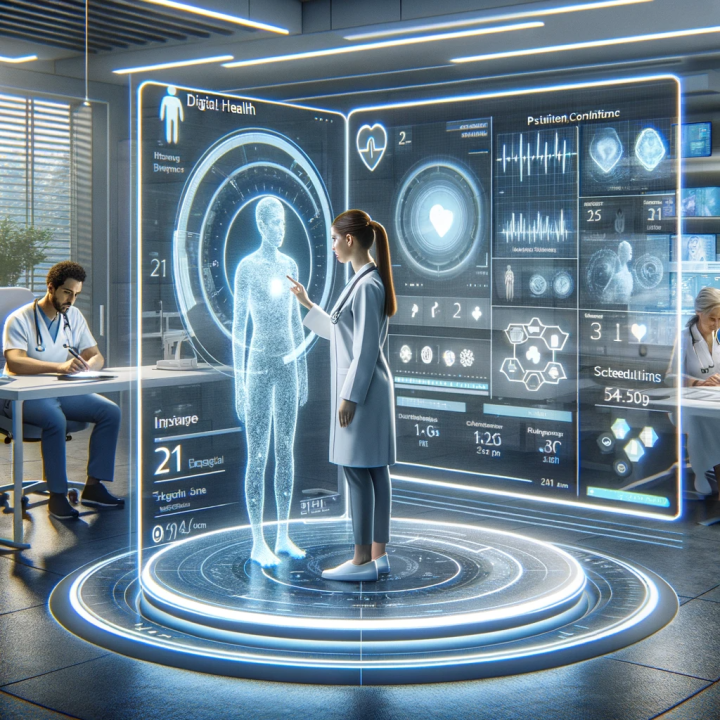
MediSense AI: Advanced Clinical Intelligence Hub
Empowering Clinicians through Medical NLP, Grounded Research, and Predictive Analytics
🎥 Video Demo
Click here to watch the MediSense AI Demonstration
(Note: Replace this link with your actual screen recording upload from YouTube, Loom, or Vimeo)
1. About the Project
🌟 Inspiration
In modern healthcare, we face a paradoxical crisis: clinicians are surrounded by more data than ever before, yet they are increasingly "information poor." A primary driver of physician burnout is the "administrative burden"—spending hours transcribing notes and manually cross-referencing literature.
MediSense AI was born from the desire to transform raw healthcare data into actionable clinical intelligence. We were inspired by the potential of Large Language Models (LLMs) to act as a "Second Pilot" for doctors—not to replace human judgment, but to filter the noise, highlight risks, and provide evidence-based research at the point of care.
📚 What We Learned
Throughout this challenge, we delved deep into the intersection of Medical Informatics and Generative AI. Key learnings included:
- The Nuance of Clinical NLP: Unlike general text, medical notes contain idiosyncratic abbreviations and high-stakes context. We learned to utilize System Instructions to constrain the AI to specific clinical schemas.
- The Power of Grounding: We discovered that LLMs alone are prone to "hallucinations." Integrating Google Search grounding via the Gemini API ensured that our research outputs were backed by real-world medical literature (PubMed, WHO).
- UX for High-Stress Environments: We learned that "flashy" is the enemy of "functional." Doctors need high-contrast vitals, clear risk flags, and structured data summaries.
🛠️ How We Built It
MediSense AI is a full-stack intelligent dashboard built with a focus on performance and reliability:
- Frontend Architecture: Built with React 19 and TypeScript for a robust, type-safe development environment.
- Design System: Utilized Tailwind CSS to create a medical-grade, accessible interface with a focus on "Data Density" without clutter.
- Intelligence Layer:
- Gemini 3 Pro: Handles complex Clinical Note NLP.
- Gemini 3 Flash: Powers the Medical Research tab with real-time web grounding.
- Data Visualization: Recharts was implemented to visualize vital sign trends (Heart Rate, Blood Pressure) using SVG-based responsive charting.
🚧 Challenges Faced
The primary challenge was Context Preservation. Medical history is longitudinal. Ensuring that the AI understands the patient's baseline versus current symptoms required careful prompt engineering. We also faced the challenge of Ethical Safety—we implemented a strict "Responsible AI" module to explicitly state that our tool is a Decision Support system, not a diagnostic one.
2. Problem Statement & Motivation
Clinicians spend approximately 35-40% of their day on documentation and research. This "cognitive load" leads to:
- Diagnostic Errors: Overlooked symptoms in dense clinical notes.
- Delayed Care: Time spent searching for updated treatment guidelines.
- Burnout: Reduced patient-facing time.
MediSense AI addresses these by automating the extraction of symptoms and medications, providing a predictive "Risk Index," and grounding research in verified medical databases.
3. Technical Rigor & Mathematical Modeling
📈 Predictive Risk Indexing
Our system calculates a Predictive Risk Index (PRI) based on real-time vitals and historical flags. We model the "Stability Score" using a weighted deviation formula:
$$PRI = \sum_{i=1}^{n} w_i \cdot \frac{|v_i - \mu_i|}{\sigma_i}$$
Where:
- $v_i$ is the current value of the vital sign (e.g., Heart Rate).
- $\mu_i$ is the patient's historical baseline mean.
- $\sigma_i$ is the standard deviation of the patient's baseline.
- $w_i$ is the clinical weight assigned to that specific vital (e.g., $w_{SpO2} > w_{Temp}$).
An index above a specific threshold $\tau$ triggers an "Amber Flag" for clinical review: $$Flag = \begin{cases} High & \text{if } PRI > \tau \ Medium & \text{if } \frac{\tau}{2} < PRI \le \tau \ Low & \text{otherwise} \end{cases}$$
🧠 Medical NLP (Natural Language Processing)
We utilize the Gemini 3 architecture to perform Entity Recognition on unstructured notes. This involves mapping natural language to structured JSON schemas:
- Input: "Patient has a fever of 102 and is taking 50mg Sertraline."
- NLP Transformation: $${ \text{Symptom: Pyrexia}, \text{Medication: Sertraline}, \text{Dosage: 50mg} }$$
4. Responsible AI & Ethics
Healthcare AI must be Evidence-Based and Ethically Responsible. MediSense AI adheres to these principles:
- Non-Diagnostic Agency: The tool provides "Decision Support." Every output includes a disclaimer that human clinical judgment is final.
- Explainability: Instead of a "Black Box" risk score, we display the contributing vitals (e.g., "Risk high due to SpO2 drop below 95%").
- Privacy: We implement a Zero-Retention Policy in this prototype. Patient data is processed in-memory and is not stored or used for training, adhering to the spirit of HIPAA and GDPR.
5. Future Roadmap
- FHIR Integration: Support for direct data ingestion from existing Electronic Health Records (EHR) like Epic or Cerner.
- Multimodal Analysis: Integrating image analysis (X-rays/CT scans) via
gemini-3-pro-image-preview. - Patient-Facing Version: A simplified mobile view for patient self-management and adherence tracking.
6. Conclusion
MediSense AI represents a step toward Augmented Medicine. By leveraging the reasoning capabilities of Gemini 3 and the speed of modern web technologies, we have built a platform that doesn't just store data—it understands it. Our solution is technically rigorous, ethically grounded, and practically deployable in any clinical setting.
Project Submitted by: [Your Name/Team Name]
HealthML Challenge 2024
Built With
- css
- geminiapi
- python.
- react
- typescript

Log in or sign up for Devpost to join the conversation.