-
-
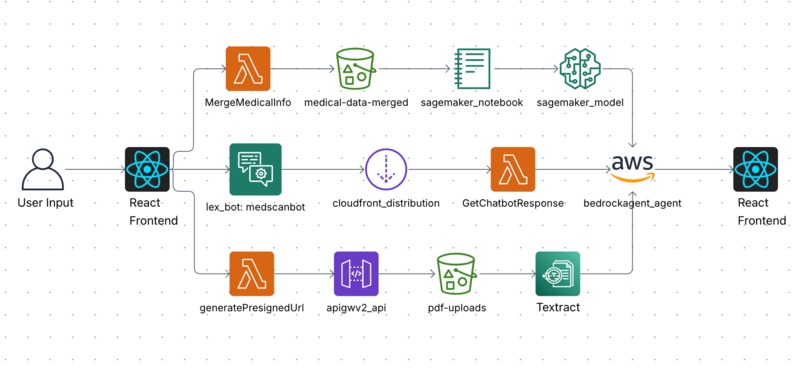
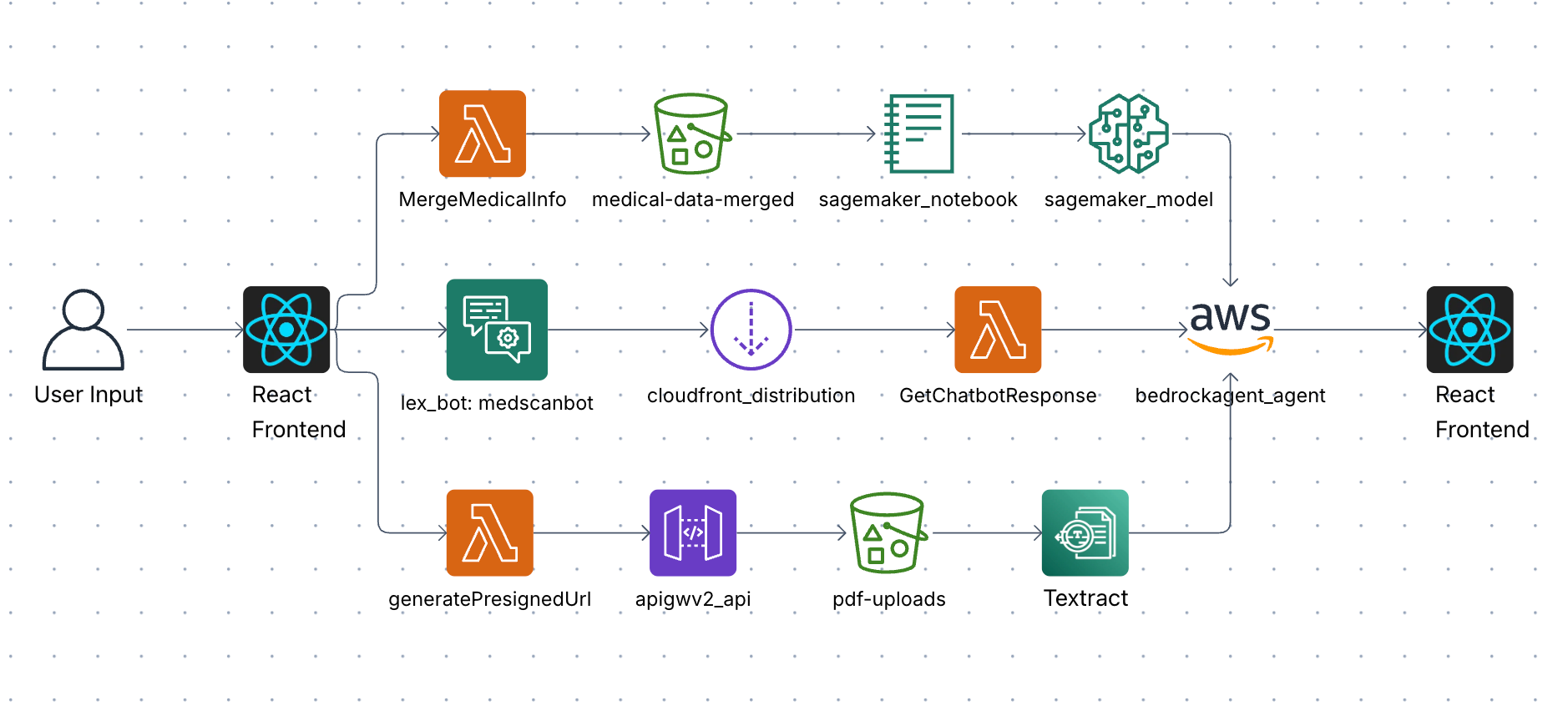
Architecture of our project
AI Assistant Track
Inspiration
Modern healthcare systems are overwhelmed, and patients often face delays, confusion, or lack of clarity around their symptoms and diagnoses. We wanted to create a tool that empowers users to access fast, intelligent, and secure clinical support — whether they're interpreting medical records or just unsure about what their symptoms mean. MediScanAI is our attempt to put medical intelligence in everyone's hands using the power of AI and AWS.
What it does
MediScanAI is a smart clinical companion that helps users:
Check symptoms and receive AI-generated summaries with likely conditions and care recommendations.
Upload medical documents (e.g., lab reports or discharge summaries) for structured analysis and diagnostics.
Chat with an AI medical assistant trained on clinical data to ask questions and receive guidance.
Receive test and treatment recommendations based on symptom patterns and uploaded records.
Ensure secure, HIPAA-compliant processing of sensitive health data using AWS services.
How we built it
We built MediScanAI using the following architecture:
FrontEnd : The frontend was built using React with TypeScript and styled with custom CSS for a clean, responsive design. It includes a form that collects medical data and sends it to an AWS Lambda function, which connects to SageMaker and Bedrock to generate AI-powered medical results. A separate chatbot feature is integrated using Amazon Lex, which also connects to Bedrock to provide real-time conversational diagnoses. Both features allow users to receive personalized recommendations directly in the browser.
BackEnd : Combination of LLM like Amazon BedRock and Amazon Lex were used to create chatbot and perform language analysis. We used Amazon SageMaker to train our model on the dataset that we got. S3 buckets were used to store all the data and other information from the patients, and finally Textract were used to analyze the image of patient data page. Lambda functions were used to connect each service.
Flow : There are three main flows, one for survey, one for pdf, and one for chatbot.
For survey, frontend connects to lambda function that leads to sagemaker, then the model output pushes to lambda which goes through bedrock to generate final result.
For pdf, frontend reads the pdf using lambda function, then saves in within s3 bucket, and use textract to analyze the image. The analyzed image goes through agent in Bedrock and produces final result and print it on frontend.
Finally, for chatbot, frontend uses lex to communicate with the patient, then uses lambda to push saved data to bedrock, which uses data to generate final result.
Challenges we ran into
Structuring unstructured medical documents like PDFs into usable clinical data was tough — we had to fine-tune document parsers and leverage NLP models.
Balancing accuracy with responsiveness in AI outputs required model pruning and inference optimization in SageMaker.
Ensuring HIPAA-compliant workflows, even in a demo environment, pushed us to research best practices around AWS encryption and access control.
Accomplishments that we're proud of
Built a full-stack, cloud-native medical app within the hackathon time window.
Successfully integrated document parsing, symptom inference, and AI chat into a single seamless UX.
Deployed scalable ML endpoints using SageMaker and secured our application with industry-grade AWS tools.
Designed with real-world clinical usability in mind, not just demo performance.
What we learned
AWS’s serverless ecosystem is incredibly powerful for rapid, secure application development — especially when paired with SageMaker for ML workflows.
Medical data processing brings both technical and ethical complexities, and we gained a deep respect for the responsibility that comes with building healthcare tech.
Collaborative workflows using GitHub + Cloud9 + CodePipeline can dramatically accelerate development when used right.
What's next for MediScanAI
Expand language support for global accessibility.
Refine the medical chatbot using larger language models fine-tuned on clinical conversations.
Integrate FHIR compatibility for interoperability with hospital systems and EHR platforms.
Develop a mobile-first version to serve users in remote or underserved regions
Built With
- amazon-bedrock
- amazon-cloudfront
- amazon-lambda
- amazon-lex
- amazon-sagemaker-ai
- amazon-textract
- amazon-web-services
- html
- javascript
- jupyter-notebook
- python
- react


Log in or sign up for Devpost to join the conversation.