-
-
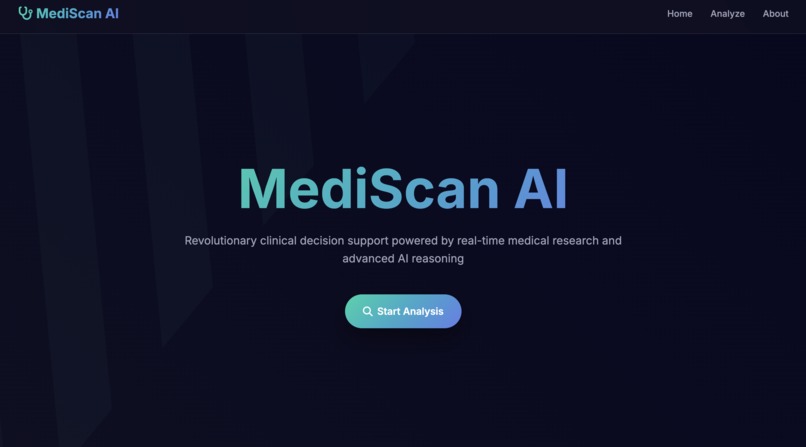
MediScan Ai
-
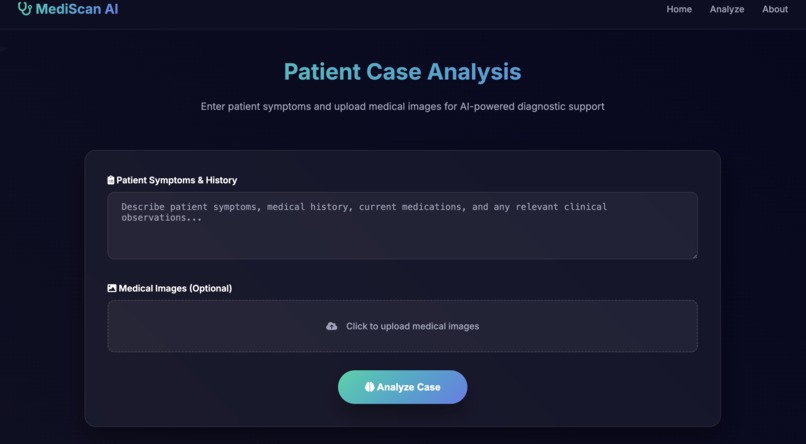
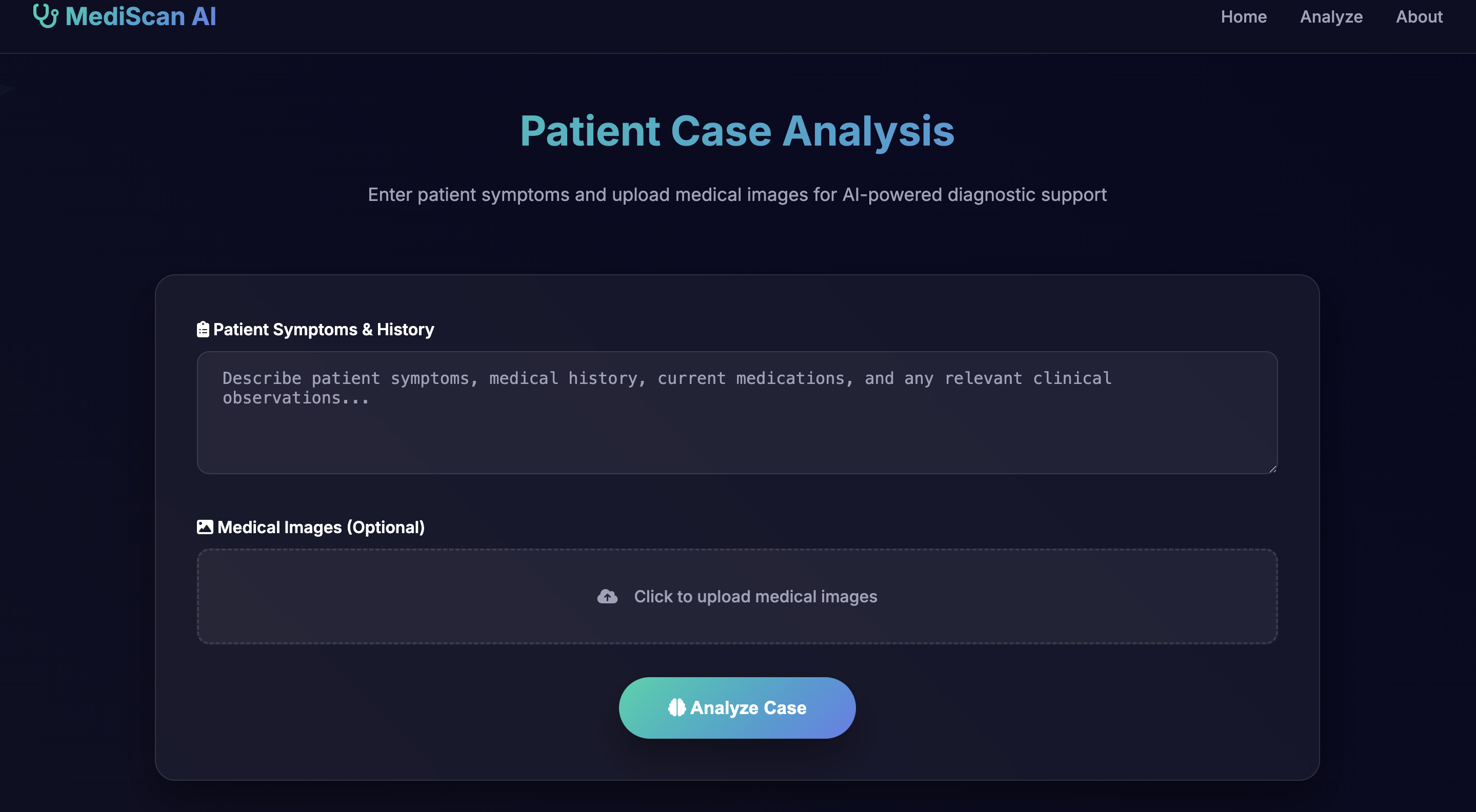
User Interface
-
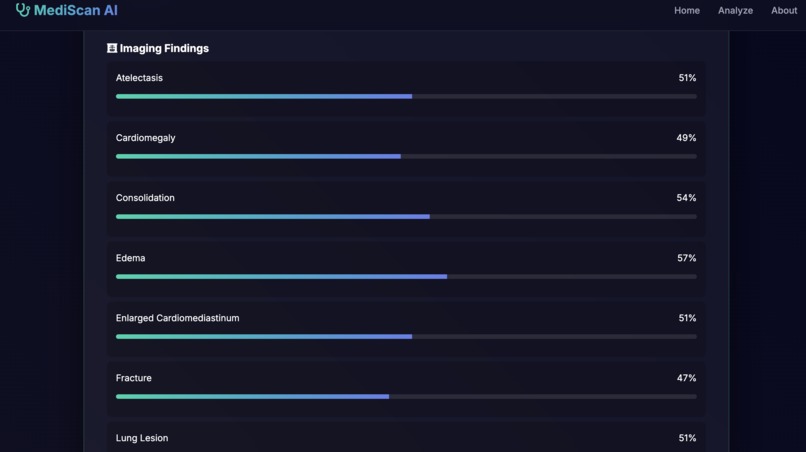
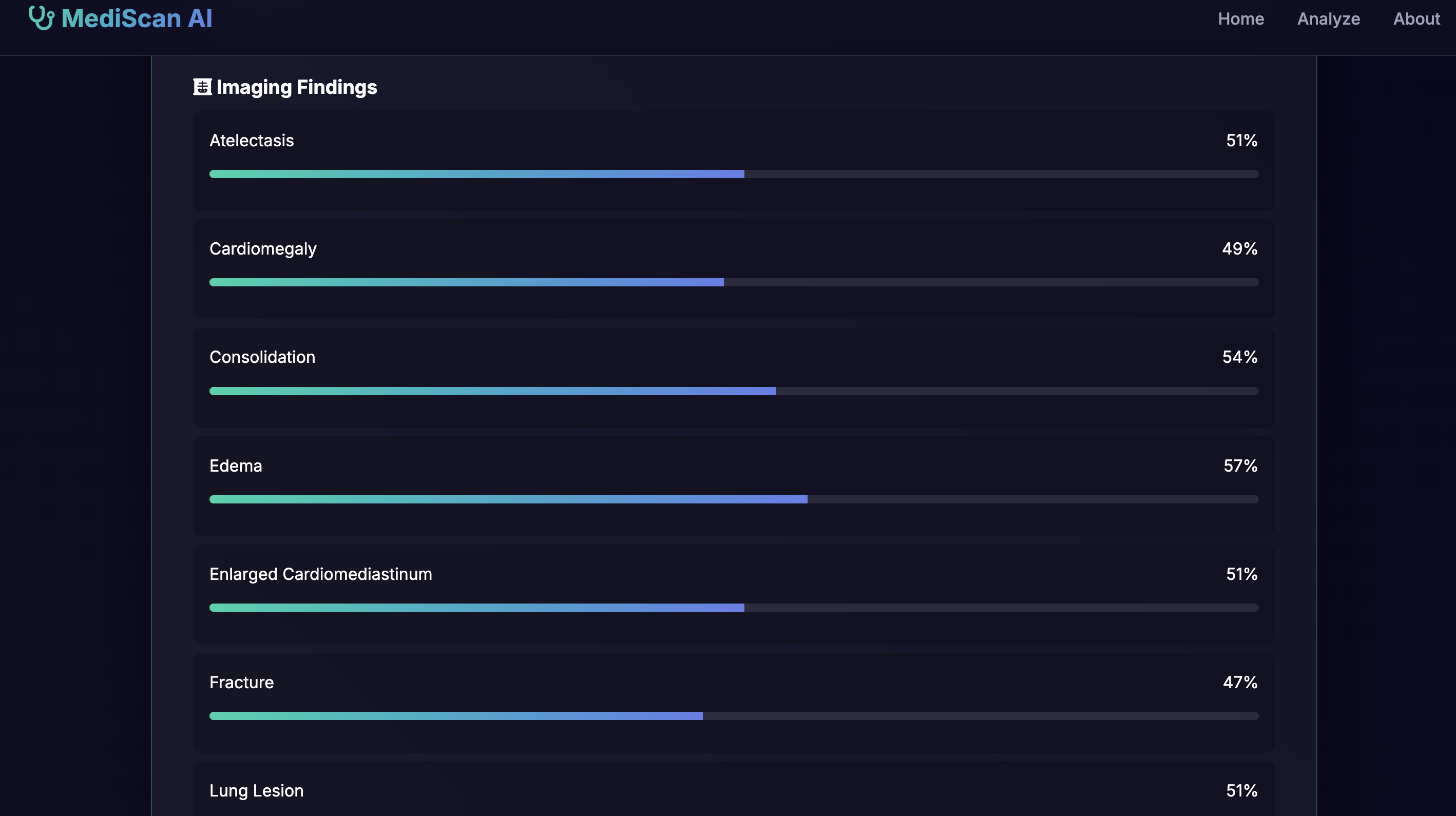
One of the output interface
Inspiration
The inspiration behind MediScan AI came from the urgent global need for accessible and scalable healthcare diagnostics. Many regions lack access to radiologists or diagnostic professionals. We envisioned a system that could:
Assist clinicians with instant AI-powered second opinions,
Support under-resourced areas with basic diagnosis,
Combine multimodal inputs (symptoms + image),
And serve as a learning assistant for medical trainees.
By integrating computer vision and large language models, we wanted to bridge the gap between clinical knowledge, imaging expertise, and patient care.
What it does
MediScan AI is a lightweight, privacy-conscious medical diagnosis tool that:
Accepts user-submitted symptoms and optional medical images (like chest X-rays).
Analyzes images with a modified DenseNet121 (CheXpert-inspired) model to identify possible radiological abnormalities.
Queries a Perplexity AI (Sonar) model to provide contextual symptom analysis, differential diagnosis, and care recommendations.
Combines findings into a unified response including:
Top likely conditions,
Confidence scores,
Image findings (if uploaded),
Red flags and next steps.
How we built it
We built MediScan AI using the following components:
Backend: Flask (Python), serving routes for analysis and health checks.
Model: Fine-tuned DenseNet121 for CheXpert image classification.
LLM Integration: Perplexity AI's Sonar API for natural language medical reasoning.
Frontend: Lightweight HTML + JS interface for uploading and viewing results.
Deployment Ready: Docker-compatible and runs on local GPU/CPU.
All code is modular and designed for real-time performance and ease of extension.
Challenges we ran into
Rate limits with third-party APIs (Gemini/Perplexity), especially during testing and demos.
File handling and size restrictions on web uploads — large medical files needed compression or transformation.
SSL verification issues on newer Python versions during model download via torch.hub.
Creating a reliable fallback when external services fail (e.g., using default advice when Perplexity API quota is hit).
Accomplishments that we're proud of
Successfully integrating image-based AI and text-based LLMs in a single pipeline.
Designed a fallback-proof architecture: even when APIs or models are missing, the app still responds meaningfully.
Achieved a clean and intuitive UI that medical professionals or patients could use without needing technical skills.
Created a fully open-source and extensible platform — ideal for clinical trials or education.
What we learned
Real-world medical AI applications require thoughtful UX, not just smart models.
Reliable fallbacks and graceful degradation are essential when building with APIs.
The balance between explainability and performance is crucial — especially in healthcare.
How to work with torchvision models, Flask routing, and Perplexity's API efficiently.
What's next for MediScan Ai
Integrate LLM-based reasoning for image findings (e.g., explain what "Pleural Effusion" means to the patient).
Add support for DICOM files and real-time radiograph viewing.
Explore EHR integration to analyze structured patient records.
Release a mobile-optimized version for use in remote areas.
Evaluate our model performance with medical professionals for validation and feedback.
For Try it Out Links:
Shared through email - Private Github Repo (Based of Reminder Email for valid submission)
Built With
- ai
- api
- flask
- html
- javascript
- perplexity
- python
- sonas

Log in or sign up for Devpost to join the conversation.