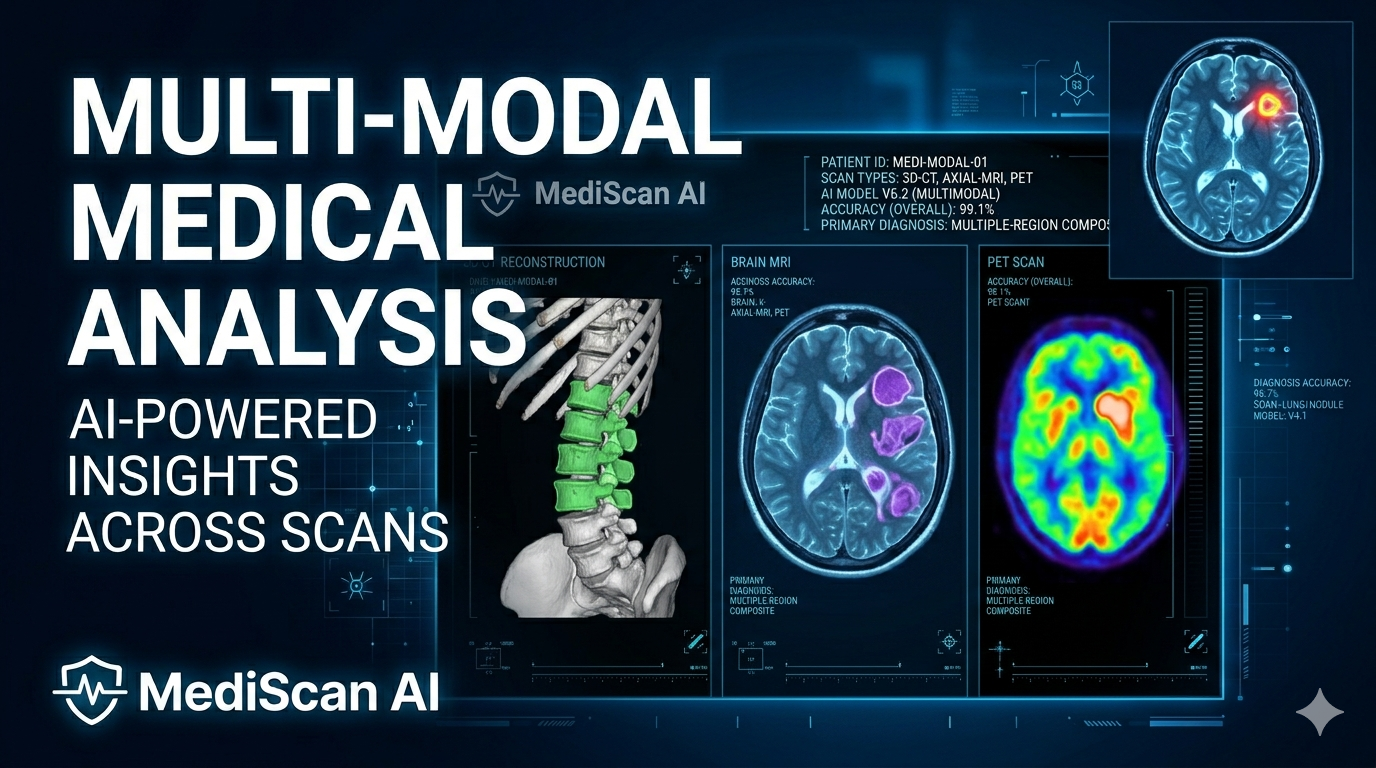
- Problem Statement
Medical imaging plays a crucial role in diagnosing life-threatening conditions such as brain disorders, fractures, and internal injuries. However, the process of analyzing CT scans and X-ray images is highly time-intensive and depends heavily on the expertise of radiologists.
In many healthcare settings, especially high-volume hospitals, radiologists face challenges such as:
Large volumes of imaging data leading to delays in diagnosis Risk of human error due to fatigue or oversight Variability in interpretation between professionals Limited access to experienced radiologists in remote areas
These challenges can result in delayed or inaccurate diagnoses, ultimately affecting patient outcomes.
- Proposed Solution
MediScan AI is an AI-powered diagnostic assistant designed to support radiologists by providing fast and reliable analysis of medical images.
The system uses deep learning models trained on medical imaging datasets to:
Analyze brain CT scans for detecting abnormalities such as tumors or internal damage Analyze X-ray images to identify fractures and structural issues
The goal is not to replace doctors, but to act as an intelligent support system that enhances diagnostic accuracy, reduces workload, and speeds up decision-making.
- Project Description
MediScan AI integrates multiple machine learning models into a unified platform that allows users to upload medical images and receive AI-assisted insights.
Core Functionalities: Image preprocessing for improving input quality Deep learning-based classification and detection Separate models for CT scan and X-ray analysis Real-time prediction output
The system is built with a simple and intuitive interface so that it can be easily used in clinical environments without requiring technical expertise.
- Technology Stack Programming Language: Python Frameworks: TensorFlow / PyTorch Libraries: OpenCV, NumPy, Pandas Frontend/UI: Streamlit (or web-based interface) Model Type: Convolutional Neural Networks (CNNs)
- Key Features 🧠 Brain CT Scan Analysis using AI 🩻 X-ray Image Diagnosis ⚡ Fast and Automated Predictions 🎯 Improved Accuracy with Deep Learning 🖥️ User-Friendly Interface for Easy Usage
- Challenges Faced
During the development of MediScan AI, several challenges were encountered, especially in building and optimizing machine learning models:
Limited and Imbalanced Dataset: Medical datasets were either limited or had uneven distribution of classes, which affected model training and accuracy. Model Generalization Issues: The model initially performed well on training data but struggled with new/unseen images, requiring careful tuning and validation. Image Quality Variations: Differences in image resolution, noise, and lighting conditions in CT scans and X-rays made preprocessing a critical step. Computational Constraints: Training deep learning models required significant computational resources, which limited experimentation and increased training time. False Positives/Negatives: Ensuring the model minimizes incorrect predictions was challenging, as even small errors can be critical in medical applications.
- Expected Outcome Faster and more efficient diagnosis process Reduced workload for radiologists Improved consistency in medical image interpretation Early detection of critical conditions Enhanced patient care and outcomes
- Conclusion
MediScan AI represents a step toward integrating artificial intelligence into healthcare to support medical professionals. By combining deep learning with medical imaging, the system enhances diagnostic efficiency and accuracy while maintaining the essential role of human expertise.
The project demonstrates how AI can be practically applied to solve real-world healthcare challenges and contribute to smarter, technology-driven medical solutions.


Log in or sign up for Devpost to join the conversation.