-
-
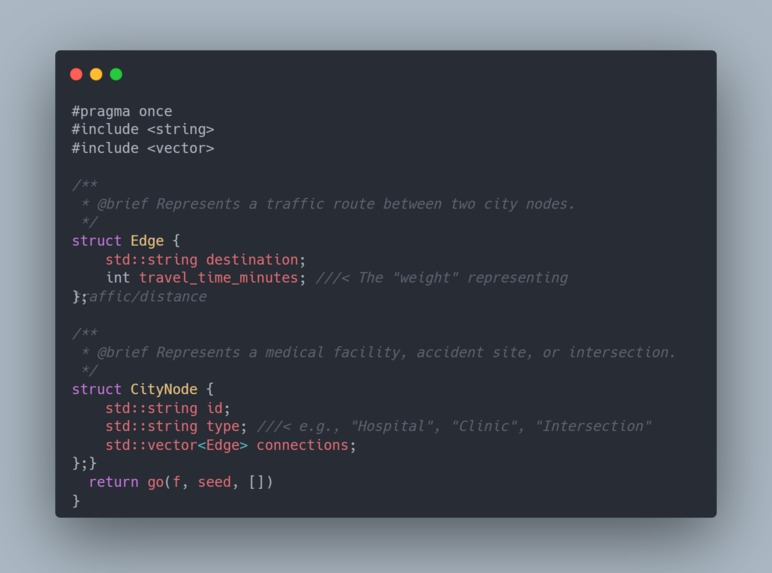
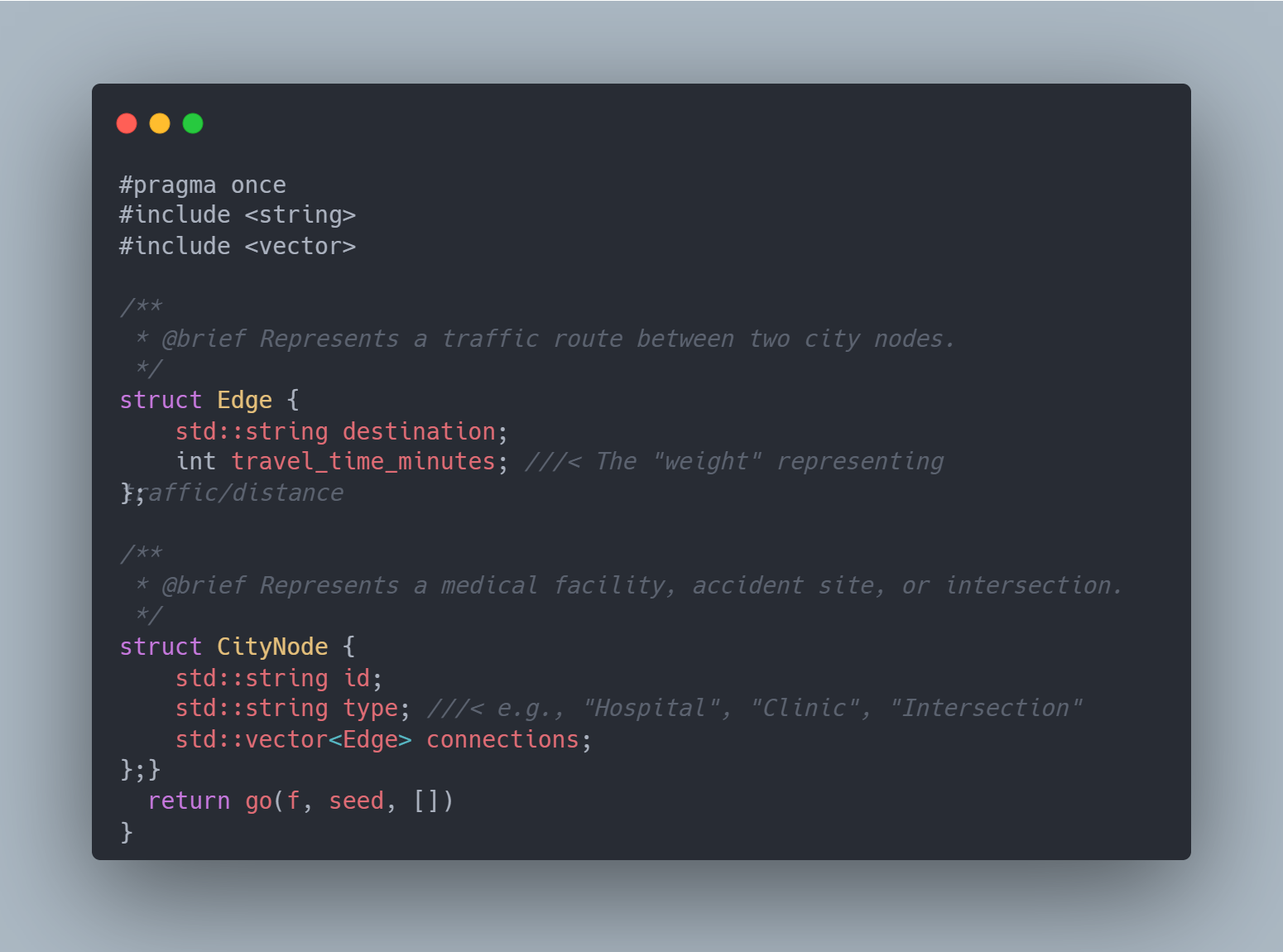
example of the code
Inspiration
When responding to medical emergencies, time is the ultimate barrier to survival. Inspired by the United Nations' SDG 3 (Good Health and Well-being), we wanted to tackle the logistical nightmare of urban traffic during crises. Ambulances and medical supply drones need the absolute fastest path, bypassing gridlock. We realized that a highly optimized, math-driven backend routing engine could shave crucial minutes off transit times.
What it does
MediRoute is a high-performance C++ backend routing engine designed for emergency dispatchers. Instead of calculating the shortest physical distance, it calculates the fastest route based on real-time traffic weights. If an accident occurs at Node A, and supplies are needed from Node D, MediRoute parses the city's infrastructure data and outputs the optimal path for emergency vehicles to take, ensuring maximum efficiency.
How we built it
We focused entirely on clean architecture and high-performance execution:
- The Core: Built purely in C++, leveraging standard template libraries (STL) for memory-safe data structures.
- The Algorithm: We implemented a custom version of Dijkstra's shortest-path algorithm utilizing a Priority Queue. This ensures the engine finds the optimal route in $O(E \log V)$ time complexity.
- Data Ingestion: The city map and traffic bottlenecks are decoupled from the logic. The system dynamically reads a
city_map.csvfile, allowing it to scale to any urban grid instantly. - Documentation Strategy: We took on the challenge of building this without a README. Instead, we strictly enforced Doxygen-style comments and modular folder structures (
src/,include/) so the PresentMe AI repo-analyzer could autonomously map our architecture.
Challenges we ran into
Designing a graph data structure that was both memory-efficient and easy to dynamically update via CSV files was tricky. Furthermore, relying entirely on self-documenting code rather than a traditional README.md forced us to be incredibly precise with our variable naming conventions and module separations.
Accomplishments that we're proud of
We successfully built a complex, algorithm-heavy C++ application from scratch that runs instantly. Getting the priority queue logic to flawlessly bypass a "shorter" physical route because of a "heavier" traffic weight proved the mathematical soundness of our engine.
What we learned
We vastly deepened our understanding of graph theory, C++ memory management, and decoupled software architecture. We also learned how to write AI-optimized code—structuring our project so an AI could read and present it without human-written markdown.
What's next for MediRoute
The next step is integrating a live traffic API (like Google Maps or Mapbox) instead of a static CSV file, allowing the graph weights to update in real-time based on actual city gridlock.
What it does
Built With
- algorithms
- cpp
- github
- presentme

Log in or sign up for Devpost to join the conversation.