-
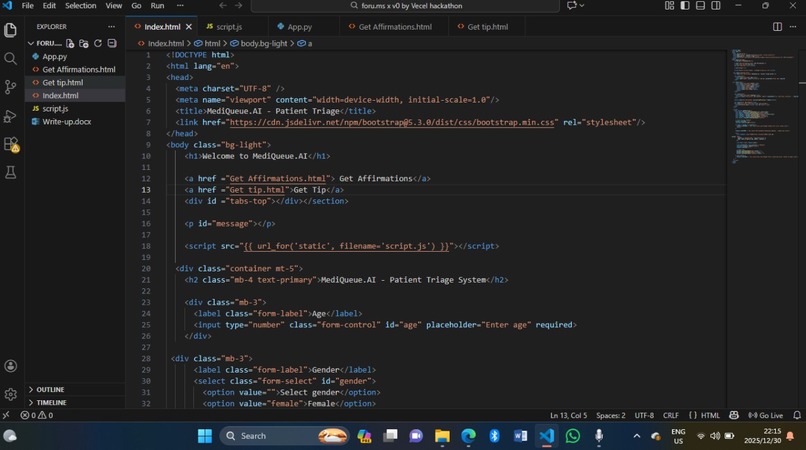
Patient Triage Web App Interface* A simple UI for collecting patient age, gender, and symptoms to assess priority level using AI.
-
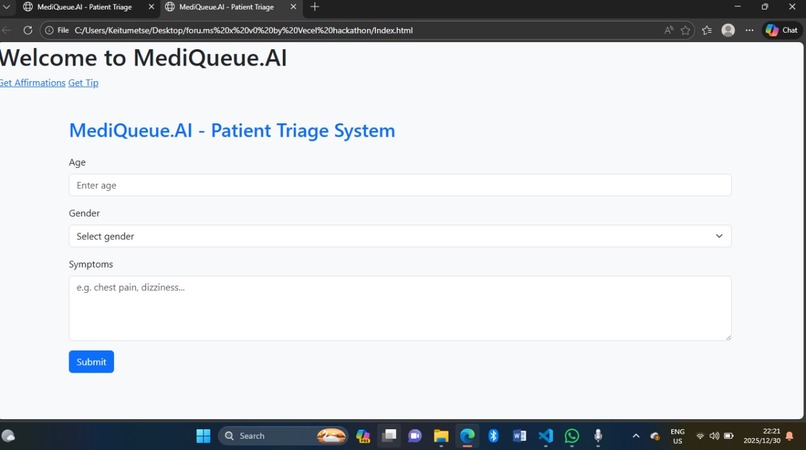
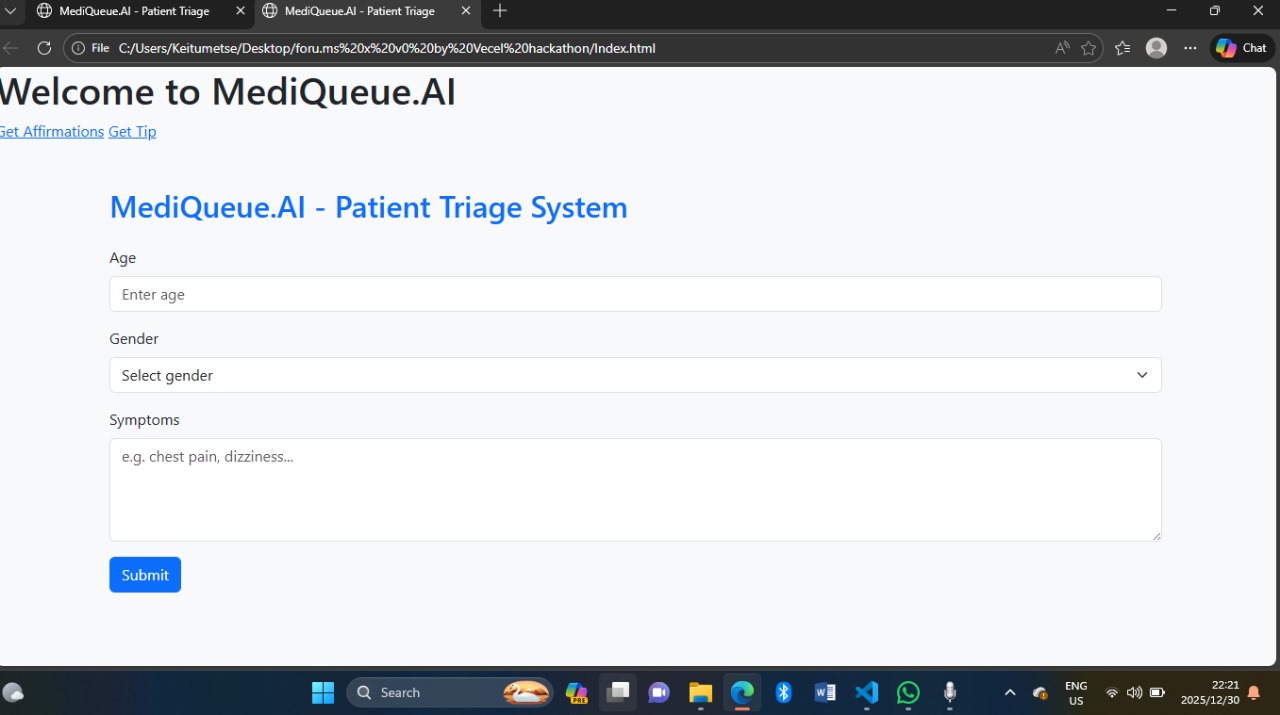
Clean UI for MediQueue.AI lets users input age, gender & symptoms to assess triage priority. Includes tips & affirmations links.
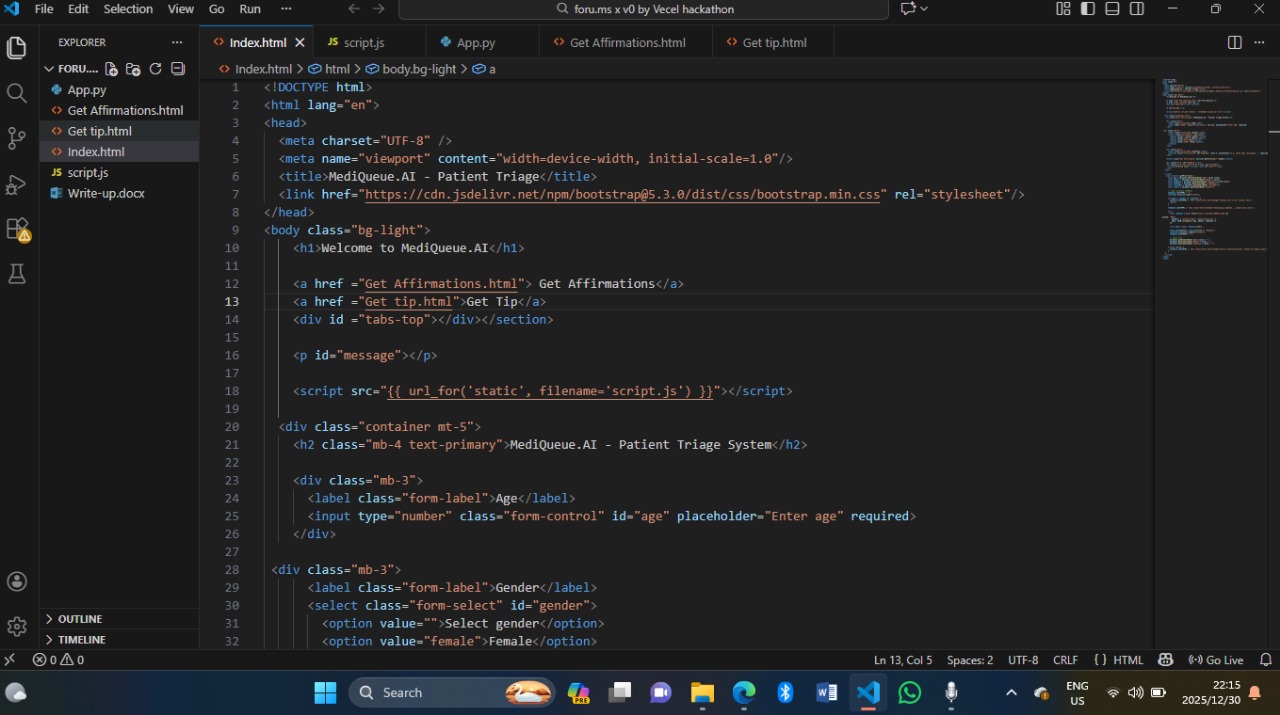
About MediQueue.AI
Inspiration The idea for MediQueue.AI was inspired by the common frustration many patients experience in hospitals and clinics due to long, unorganized wait times. Observing the inefficiency in managing queues, especially in busy healthcare settings, motivated us to build a smart system that could streamline patient flow, reduce waiting times, and improve communication between patients and healthcare providers.
What We Learned Throughout the development of MediQueue.AI, we gained deep insights into queue management algorithms, real-time communication systems, and AI-driven prediction models. We also enhanced our skills in integrating various technologies like cloud services, databases, and frontend-backend communication. Additionally, we learned the importance of user-centric design in healthcare technology to ensure accessibility and ease of use for patients and staff.
How We Built It MediQueue.AI was built using a combination of modern technologies:
- Frontend: React.js for creating an interactive and responsive user interface.
- Backend: Node.js with Express to handle API requests and business logic.
- Database: MongoDB to store patient data, queue information, and appointment details.
- AI Component: Machine learning models to predict wait times based on historical data.
- Cloud Platform: Hosted on AWS to ensure scalability and reliability.
- Real-time Communication: WebSocket integration to provide live queue updates to patients.
Our approach involved building modular components, starting with a basic queue system, then integrating AI prediction and real-time notifications. We continuously tested and refined the system based on user feedback.
Challenges Faced We encountered several challenges during development:
- Data Privacy: Ensuring patient data was securely stored and handled in compliance with healthcare regulations.
- Real-time Accuracy: Maintaining accurate and timely updates in dynamic queue situations required optimizing WebSocket connections and backend processing.
- AI Prediction: Training models with limited historical data to provide reliable wait time predictions was difficult, and required iterative tuning.
- User Experience: Designing an intuitive interface that could be easily used by patients of varying tech skills was critical and challenging.
- Integration with Existing Systems: Adapting the solution to work alongside existing hospital management software involved complex API integrations.
Despite these challenges, the project was a rewarding experience that pushed our technical and problem-solving skills and reinforced the impact technology can have on healthcare efficiency.
Built With
- javascript
- python
- restful.apis

Log in or sign up for Devpost to join the conversation.