-
-
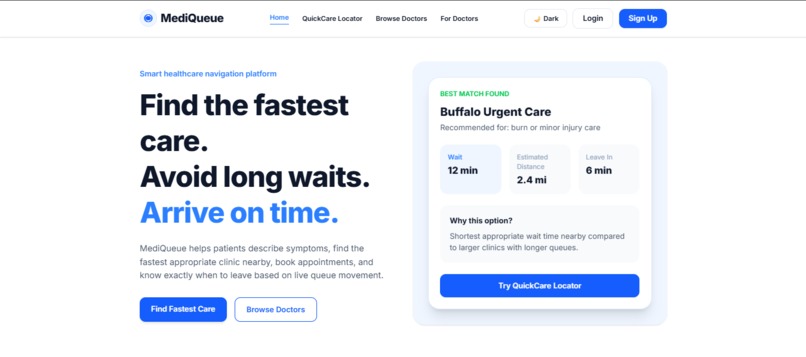
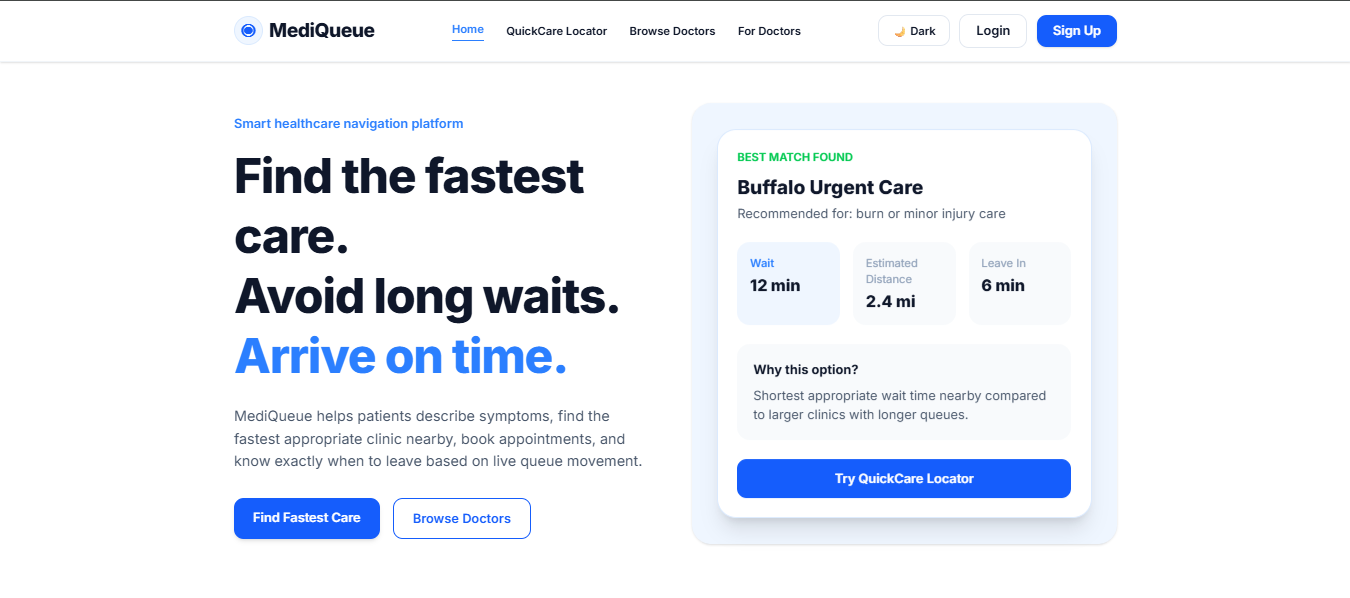
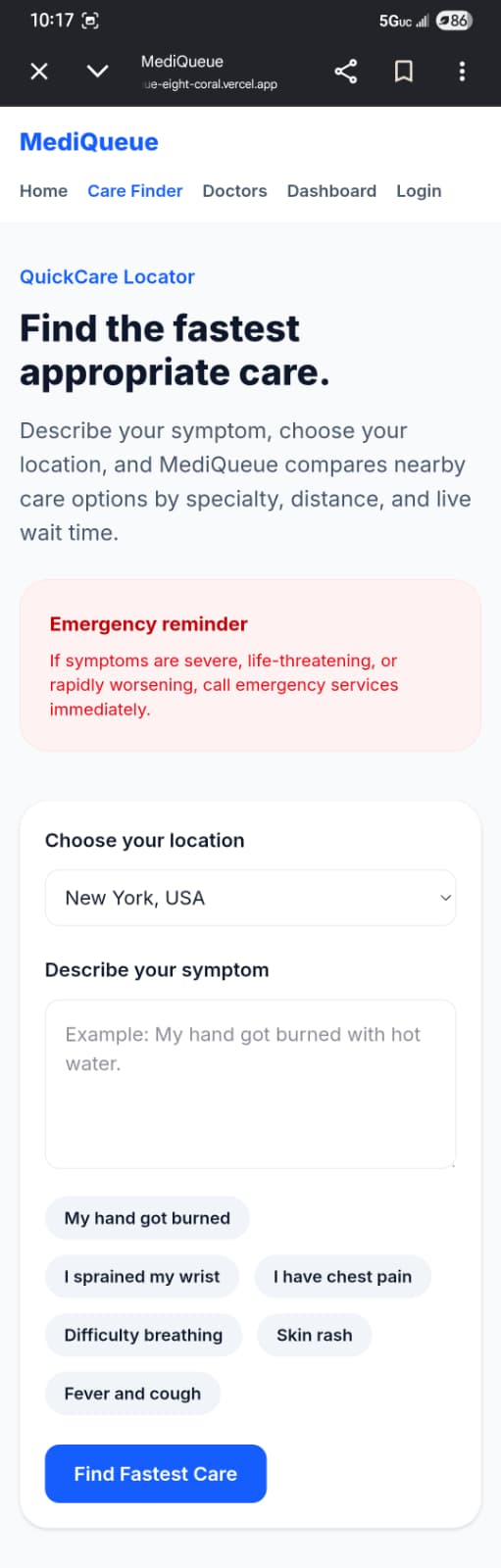
Homepage: MediQueue helps patients find the fastest appropriate care using symptom analysis and estimated total time to get best treatment..
-
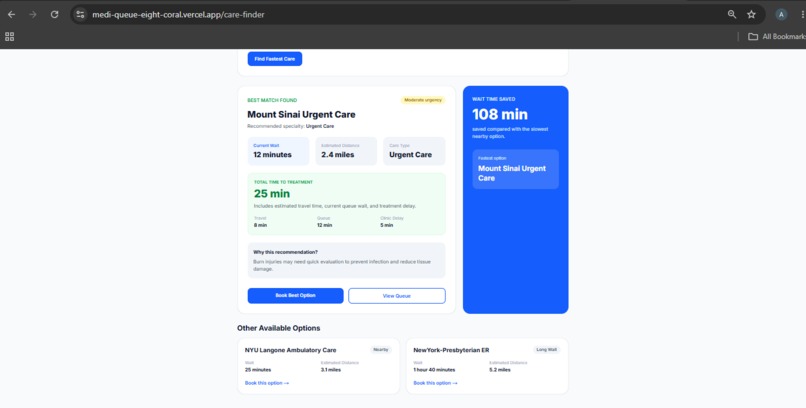
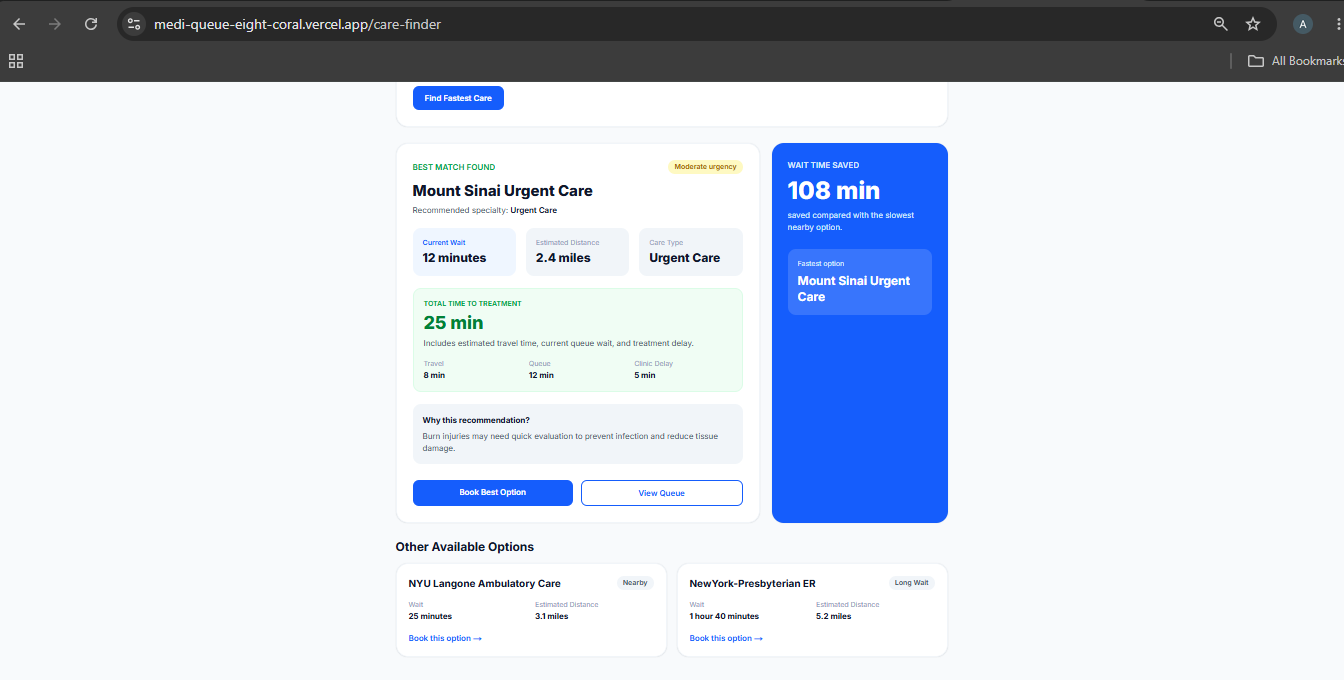
Smart Care Finder compares travel time, live queue length, and treatment delay to recommend the fastest appropriate clinic.
-
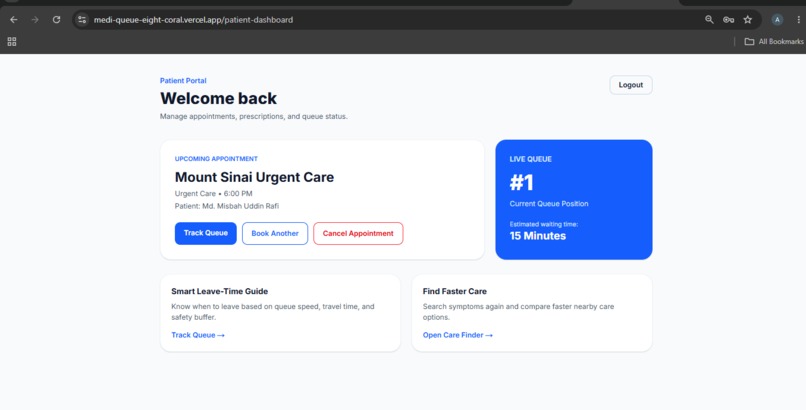
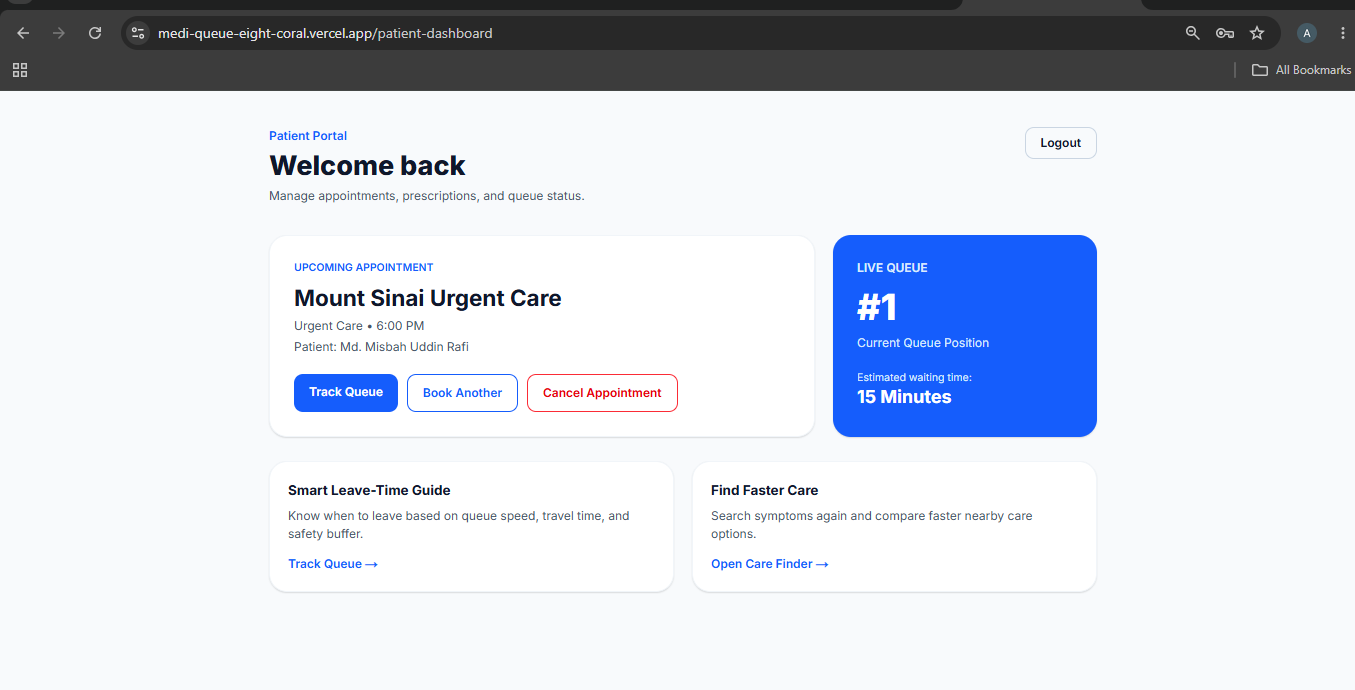
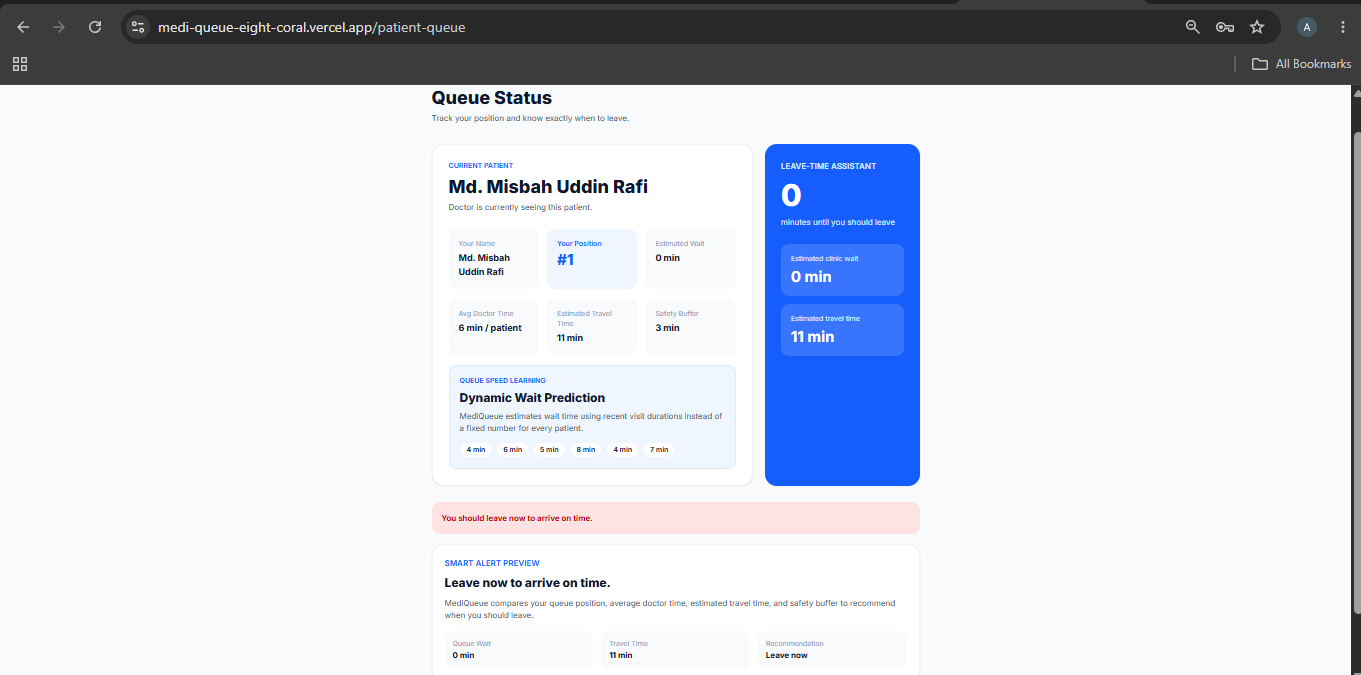
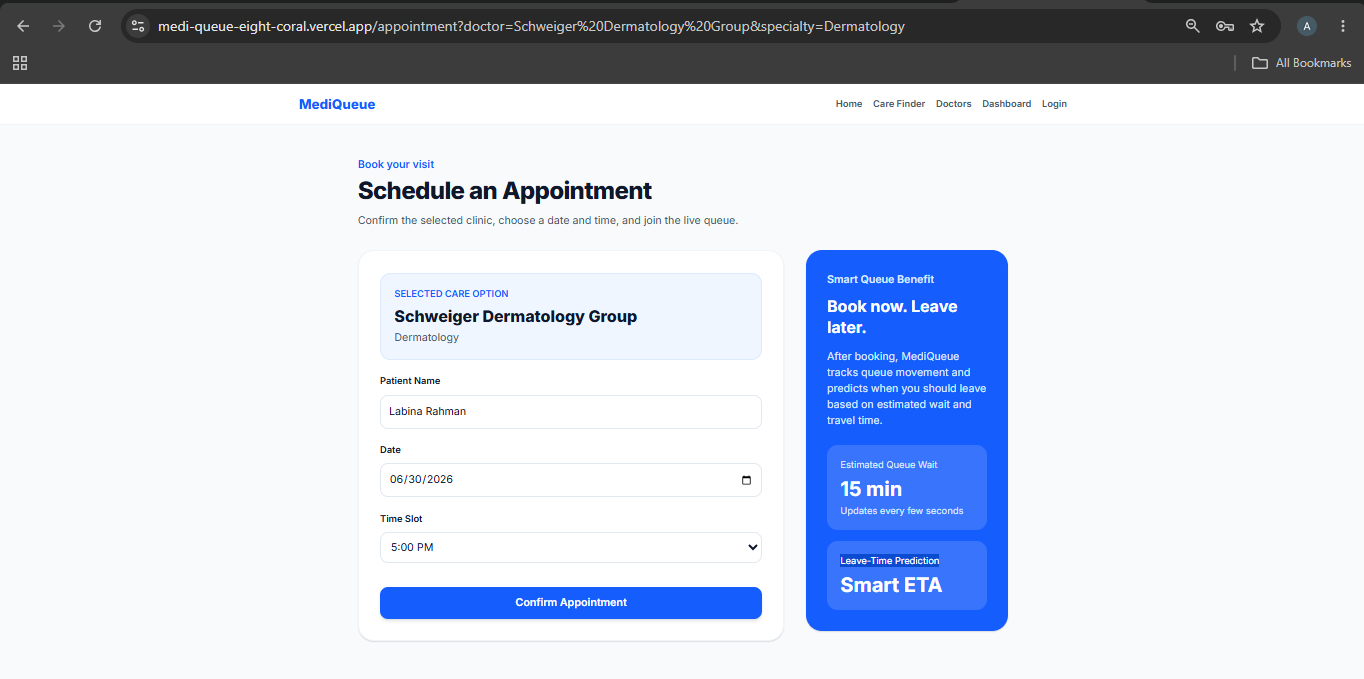
Patients can track their live queue position, monitor estimated waiting time, and know exactly when to leave for their appointment.
-
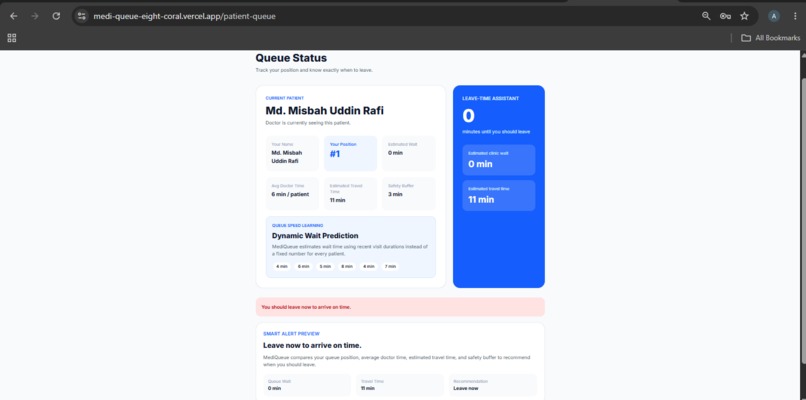
Dynamic queue prediction continuously estimates waiting time using recent patient visit durations instead of a fixed average.
-
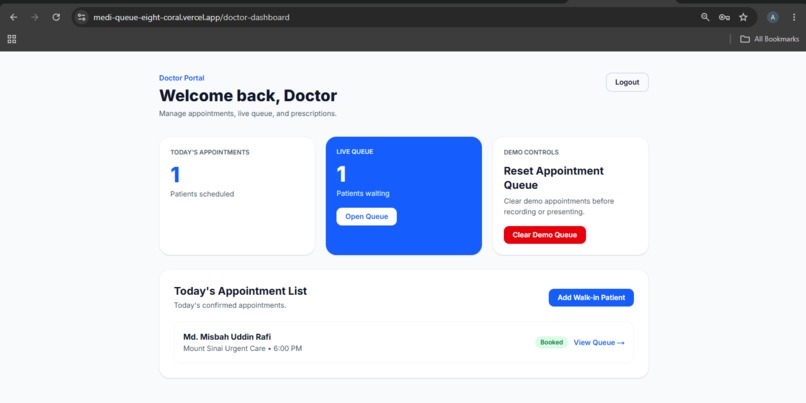
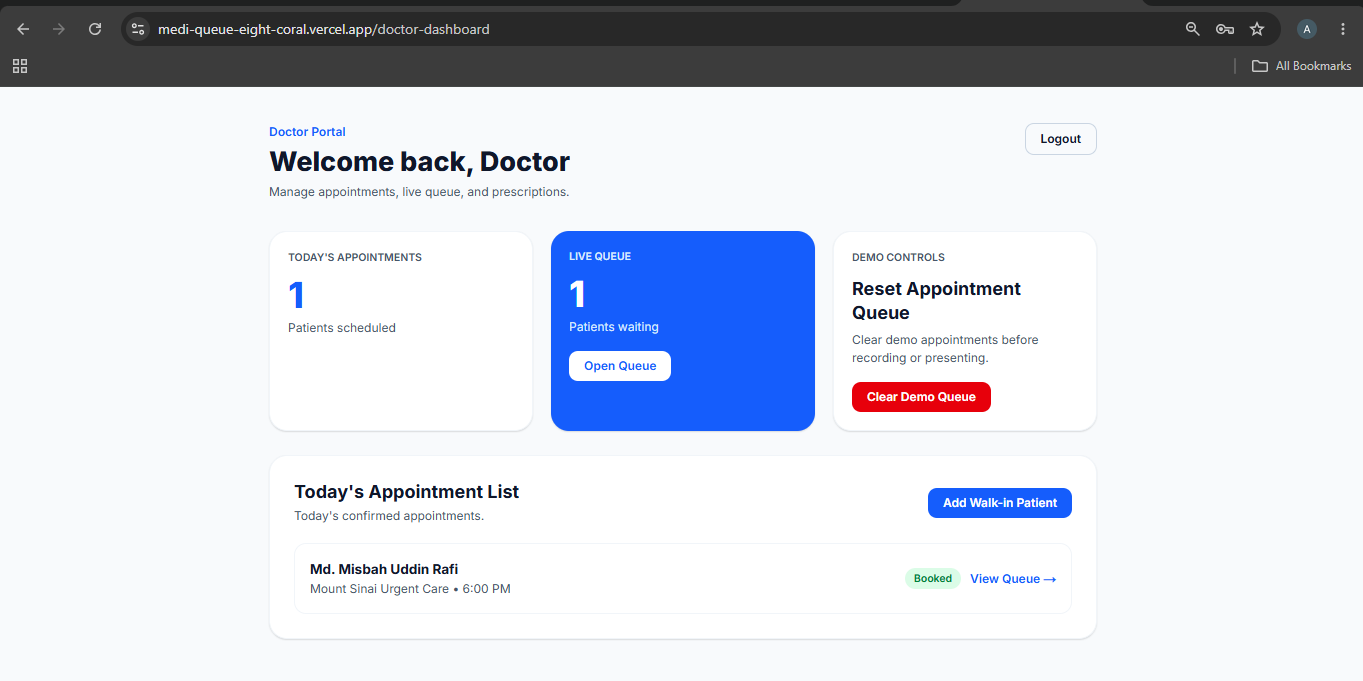
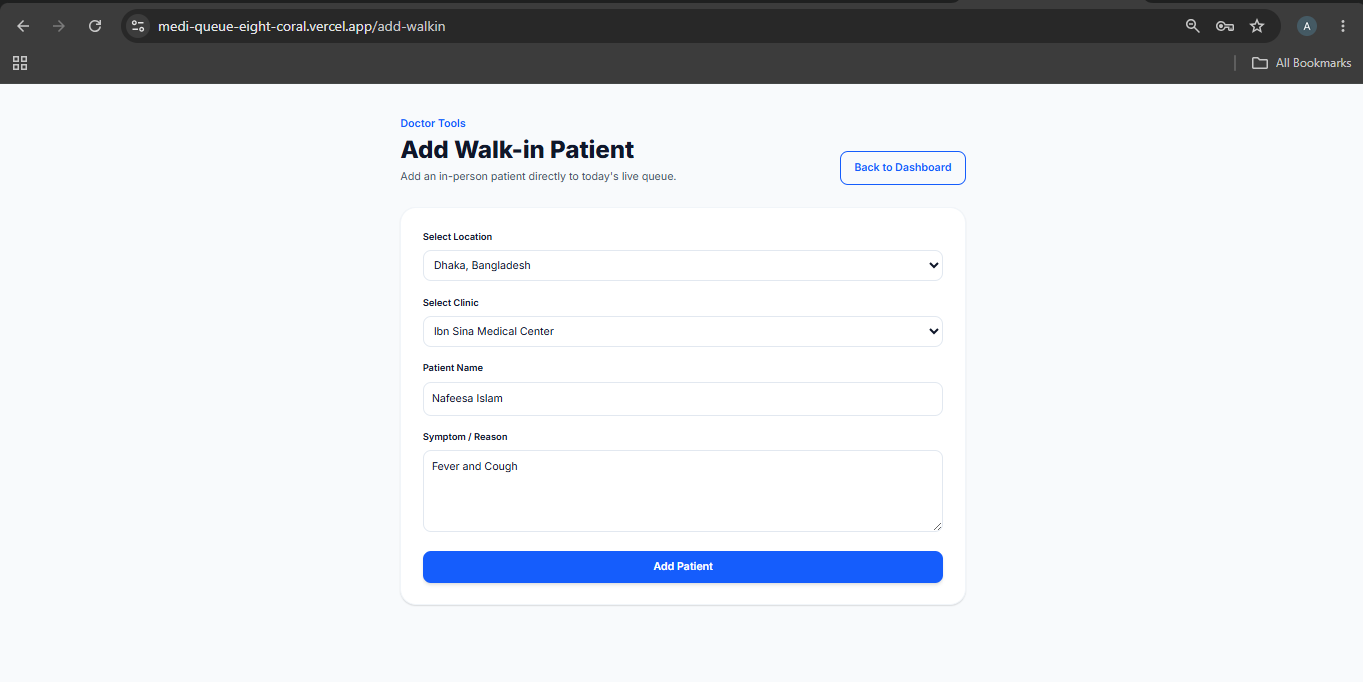
Doctors manage appointments, monitor the live queue, and add walk-in patients directly from a unified dashboard.
-
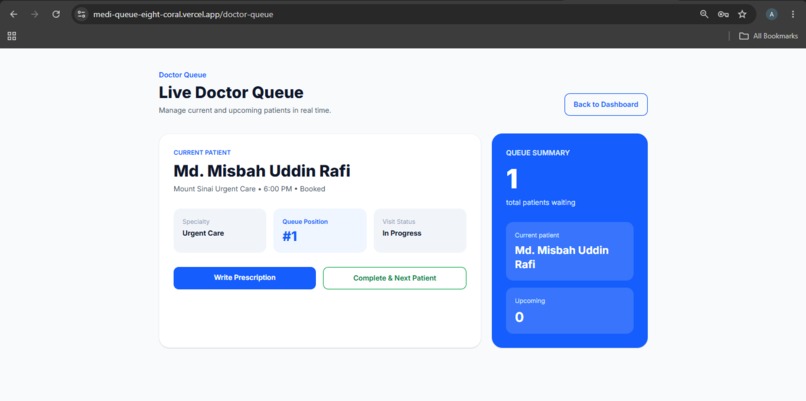
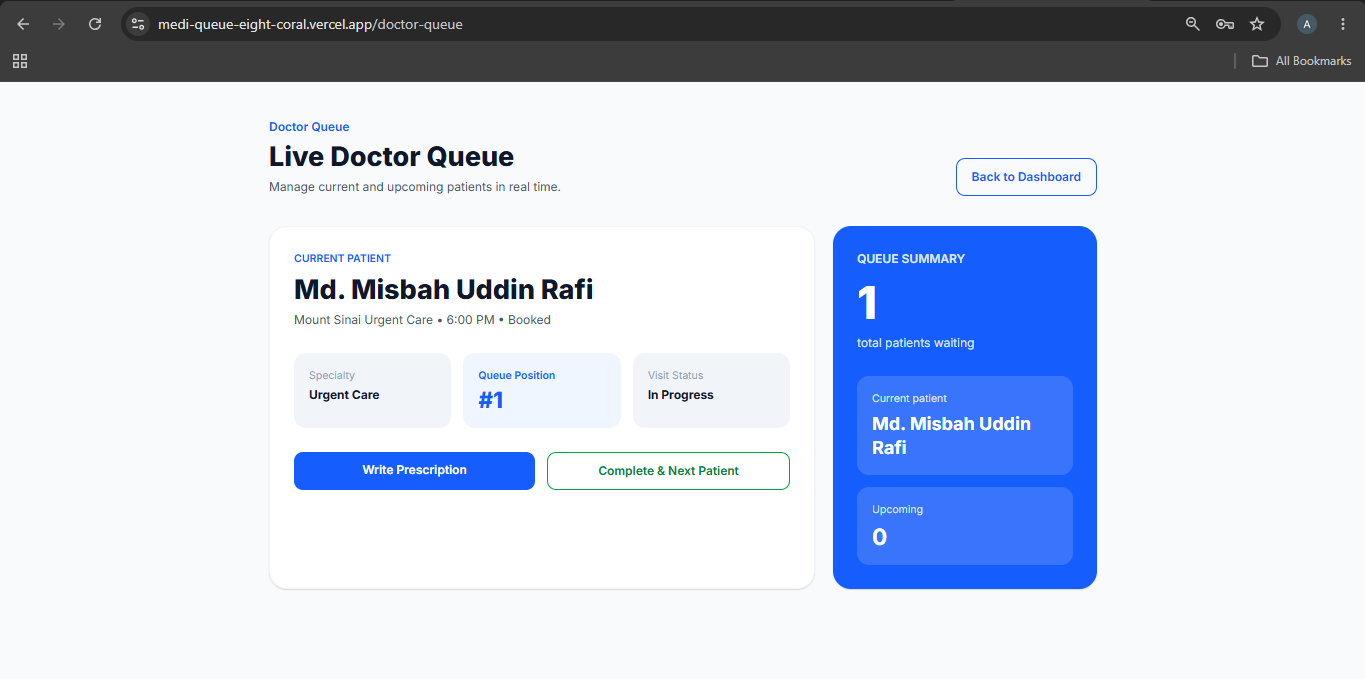
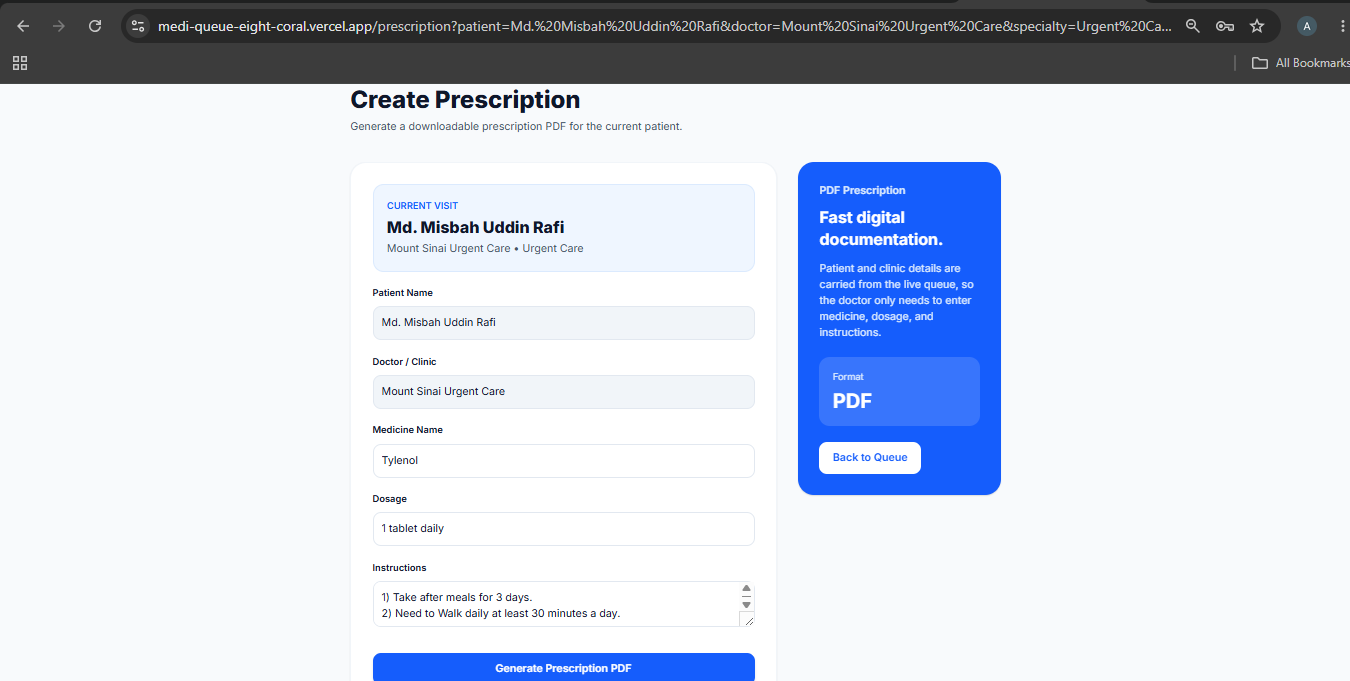
Healthcare providers can move patients through the live queue, mark completed visits, and generate digital prescriptions.
-
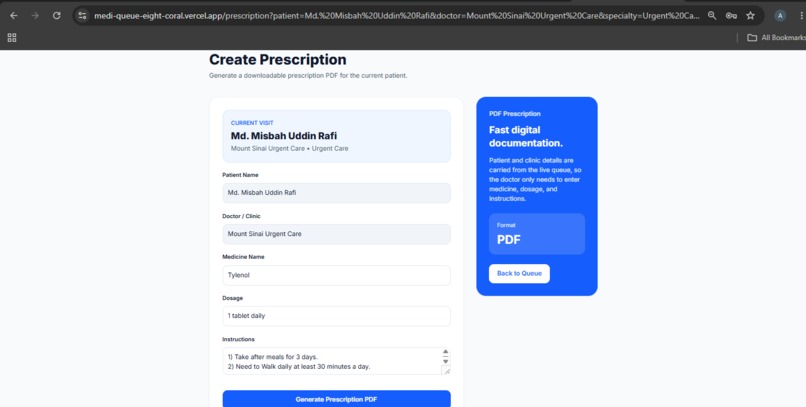
Doctors generate downloadable digital prescription PDFs that are automatically associated with the correct patient and clinic.
-
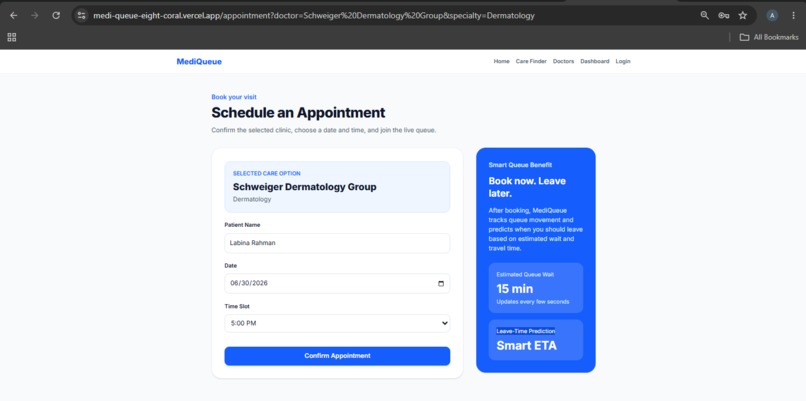
Patients book appointments after selecting the best healthcare option recommended by MediQueue.
-
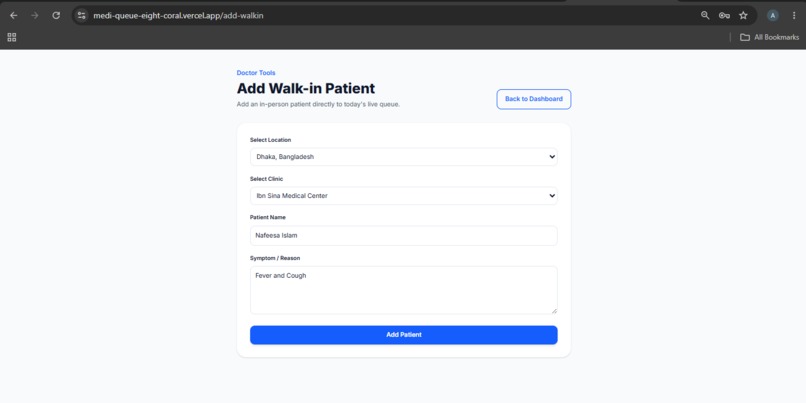
Clinics can quickly register walk-in patients, allowing both scheduled and in-person visits to appear in the same live queue.
-
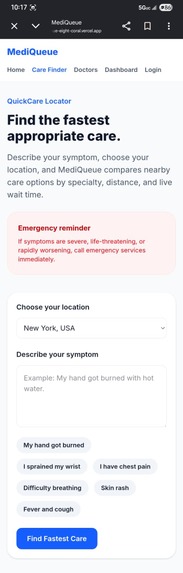
Responsive interface optimized for desktop and mobile devices.
Inspiration
A simple healthcare problem inspired MediQueue.
When someone gets sick or injured, the first question is often: "Where should I go?" Many people choose the nearest large hospital without knowing if a faster or more appropriate option is available nearby. As a result, patients spend hours waiting in crowded facilities, sometimes for conditions that could have been treated much sooner elsewhere.
We realized that most healthcare tools focus on booking appointments after a patient has already chosen a provider. Very few help patients make that decision in the first place.
We wanted to build a system that helps patients find the right care faster, reduce unnecessary waiting, and make the healthcare experience less stressful.
What it does
MediQueue is simply a smart healthcare navigation and queue management platform that helps patients find the fastest appropriate care, not just the nearest one.
Here, Patients describe their symptoms and select their location. and MediQueue evaluates the urgency. Then, recommends the most appropriate specialty and also compares nearby care options using travel time and live queue information furthermore the estimates of total time to treatment before recommending the best option.
After booking an appointment, patients can:
Track their live queue position View estimated waiting time Receive smart leave-time guidance based on queue movement Cancel appointments if needed Monitor dynamic queue predictions that adapt to recent patient visit durations
For healthcare providers, MediQueue offers tools to:
View and manage a live patient queue Add walk-in patients directly from the doctor dashboard Move patients through the queue in real time Generate downloadable digital prescription PDFs Manage appointments and improve patient flow
Instead of spending hours waiting in crowded hospitals, patients know where to go, when to leave, and which clinic can treat them the fastest.
How we built it
We built MediQueue using:
- Next.js for the frontend and application routing
- Firebase Authentication for user login and account management
- AWS DynamoDB for appointment storage and queue data
- JavaScript and React for application logic
- Tailwind CSS for the user interface
- jsPDF for prescription generation
- Vercel for deployment
Appointments are stored in DynamoDB and updated in real time throughout the patient and doctor workflows.
Challenges we ran into
One of our biggest challenges was moving from static demo data to a real backend.
Early versions of MediQueue relied entirely on mock appointment data. Migrating everything to DynamoDB meant redesigning appointment creation, cancellation, queue synchronization, doctor workflows, walk-in patient registration, and prescription generation.
Another challenge was keeping patient and doctor views perfectly synchronized. Whenever a patient booked, cancelled, or completed an appointment, every page needed to reflect those changes immediately without inconsistencies.
We also spent significant time improving authentication, role-based authorization, responsive layouts, deployment issues, production builds, and state management. Solving these challenges taught us how different building a production-ready application is from building a classroom project.
Accomplishments that we're proud of
We're proud that MediQueue evolved into much more than a traditional appointment booking application.
Some of our favorite features include:
Smart Care Finder with symptom-based recommendations Emergency symptom detection Total Time to Treatment prediction Dynamic queue speed prediction Smart leave-time guidance Live patient queue tracking Doctor queue management Walk-in patient registration Digital prescription PDF generation Role-based authentication for patients and doctors Multi-location healthcare recommendations Responsive design with dark mode support Full deployment backed by AWS DynamoDB
Most importantly, we built a complete end-to-end workflow that connects patients and healthcare providers within the same system.
What we learned
This project taught us that building a real product is very different from building individual features.
We learned how to integrate a production backend, synchronize shared data across multiple user roles, design complete user journeys, implement authentication and authorization, deploy full-stack applications, and debug issues that only appear in production environments.
Most importantly, we learned that technology creates the greatest impact when it solves the right problem. Instead of simply making appointment booking easier, MediQueue helps patients make better healthcare decisions before they even book.
What's next for MediQueue
Our current version demonstrates the concept using curated healthcare providers and simulated queue information.
In the future, we would like to:
Integrate with real hospital and clinic scheduling systems Connect to live healthcare provider APIs for real-time availability Automatically detect the patient's location using GPS Improve queue prediction accuracy using historical appointment patterns and machine learning Support multilingual accessibility Send smart notifications when it's time to leave for an appointment Expand support to hospitals, urgent care centers, primary care clinics, and telehealth providers
Our long-term vision is simple: to help patients spend less time waiting, help healthcare providers balance patient flow more effectively, and make finding appropriate healthcare faster and less stressful.
Built With
- aws-dynamodb
- aws-sdk
- firebase
- javascript
- jspdf
- next.js
- react
- tailwind-css
- vercel


Log in or sign up for Devpost to join the conversation.