About MEDIQ AI
Inspiration
Emergency departments operate in an environment where every minute matters. Patients arrive with different levels of urgency, hospital staff must coordinate limited resources, ICU capacity can change rapidly, ambulances need to be managed efficiently, and administrators need to make decisions while the situation is constantly changing.
We were inspired by a simple question:
What if a hospital could see the problem before it becomes a crisis?
Many hospital systems are designed primarily to record and display information. We wanted to explore a different approach: a system that could bring hospital information together, analyze operational conditions, identify emerging pressure, and provide predictive insights to healthcare teams.
This idea led us to MEDIQ AI - Predictive Hospital Emergency Management System.
Our goal is not to replace doctors or nurses. Instead, MEDIQ AI is designed as an intelligent decision-support and emergency-management platform that helps healthcare teams understand what is happening, anticipate what may happen next, and respond more effectively.
The core philosophy of MEDIQ AI is:
Monitor → Analyze → Predict → Alert → Recommend → Act
Instead of only reacting after an emergency situation becomes critical, hospitals can use predictive intelligence to prepare earlier.
What it does
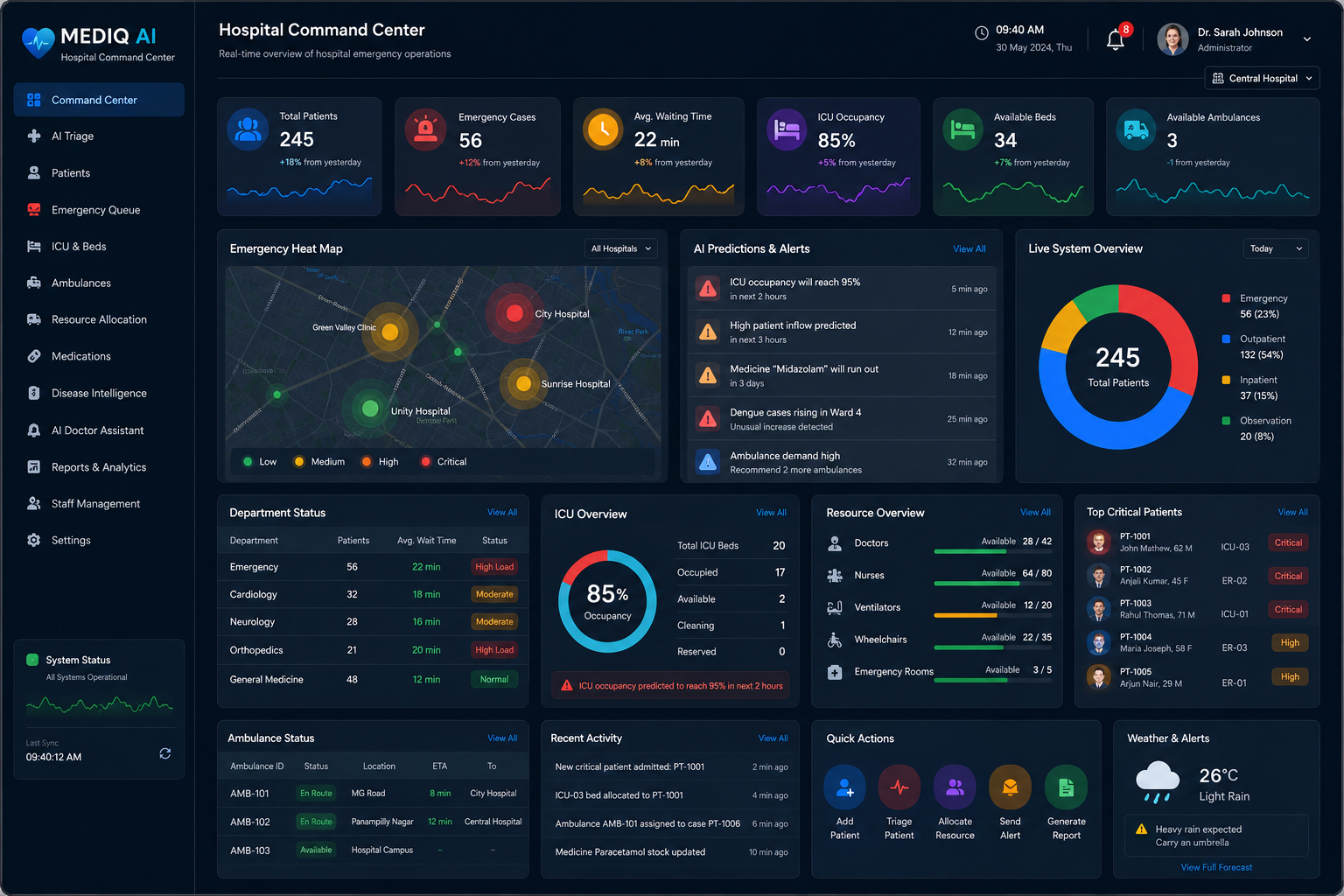
MEDIQ AI is an AI-powered hospital emergency management platform that combines real-time operational monitoring, predictive analytics, intelligent recommendations, and role-based dashboards into one unified ecosystem.
The platform is designed for doctors, nurses, emergency department teams, hospital administrators, ambulance operators, and patients.
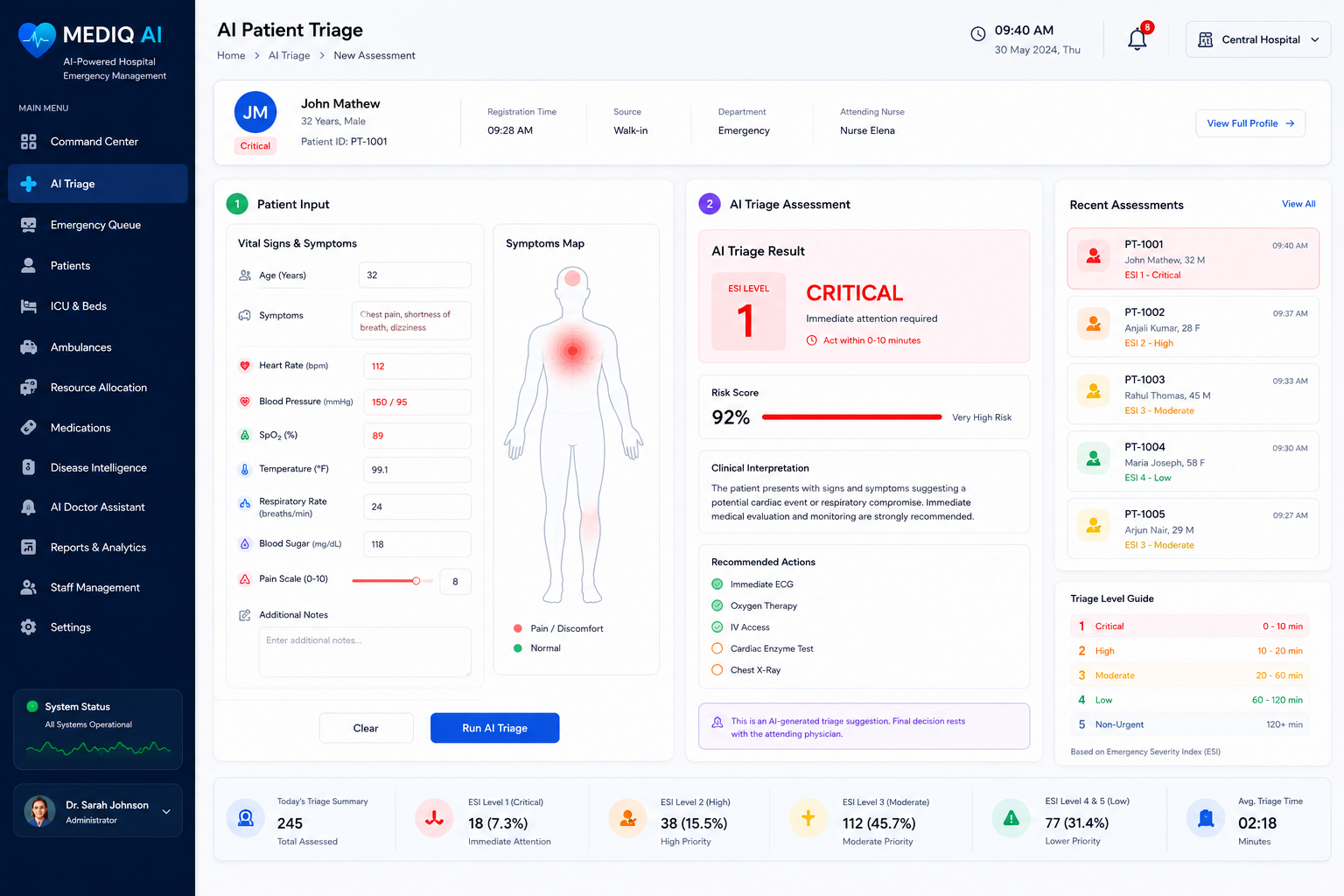
1. AI Patient Triage
MEDIQ AI analyzes patient information such as:
- Age
- Symptoms
- Heart rate
- Blood pressure
- Oxygen level
- Temperature
The system uses this information to help prioritize patients according to emergency severity.
The goal is to move from a simple:
First Come → First Served
approach toward:
Most Critical → First Treated
The system is intended to support healthcare professionals rather than independently make clinical decisions.
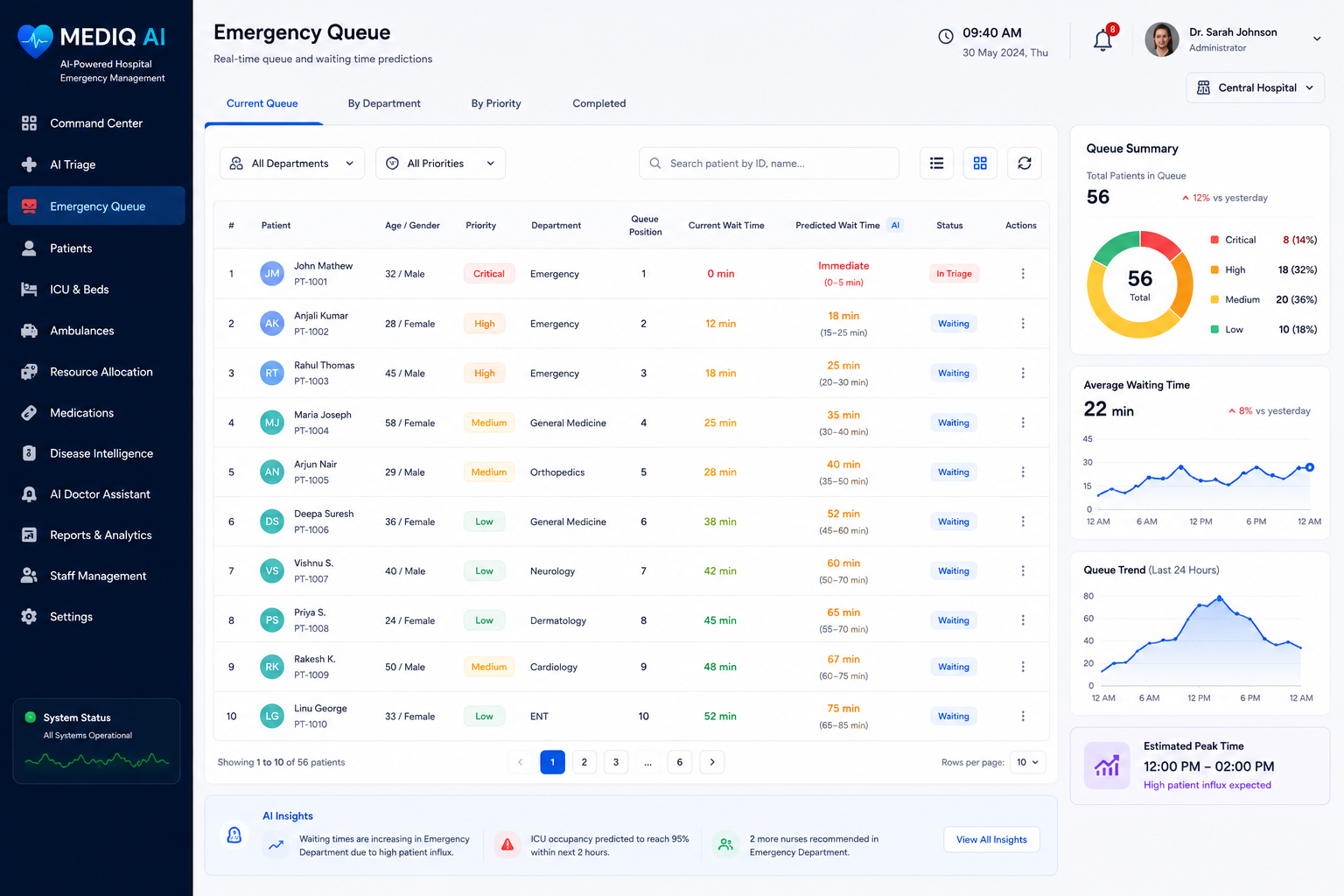
2. Emergency Queue & Waiting-Time Prediction
Emergency departments can experience rapidly changing queues.
MEDIQ AI provides estimated waiting times and uses predictive intelligence to anticipate how waiting times may change as patient demand and hospital capacity change.
For example, the system can identify that one patient may have an estimated waiting time of 18 minutes while another may have an estimated waiting time of 42 minutes.
The goal is to provide hospital teams with better visibility into the emergency queue rather than simply displaying a static list.
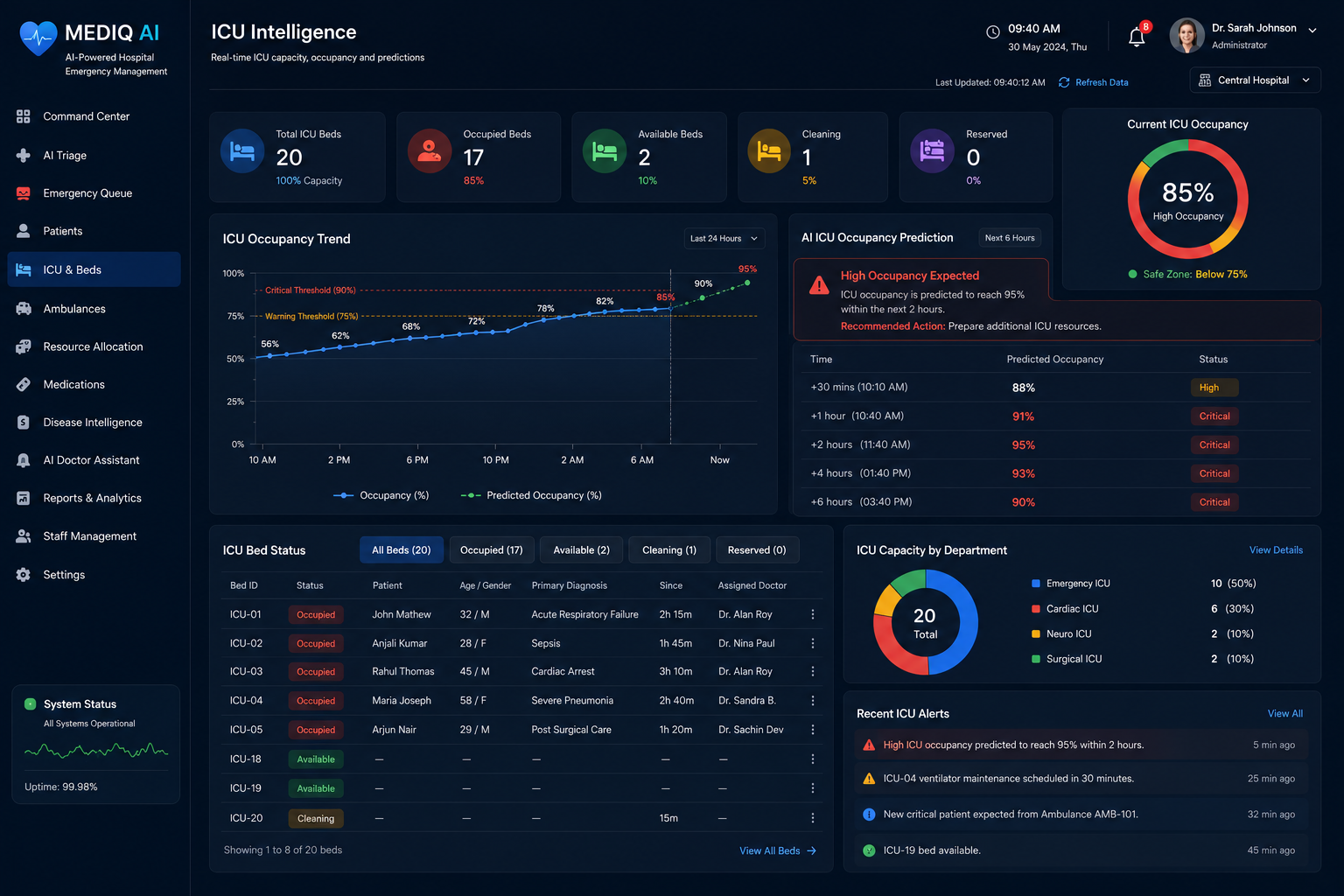
3. ICU & Bed Intelligence
ICU capacity is one of the most important operational constraints in emergency care.
MEDIQ AI monitors:
- Total ICU beds
- Occupied beds
- Available beds
- Beds under cleaning
- Reserved beds
The system can also provide predictive capacity alerts.
For example:
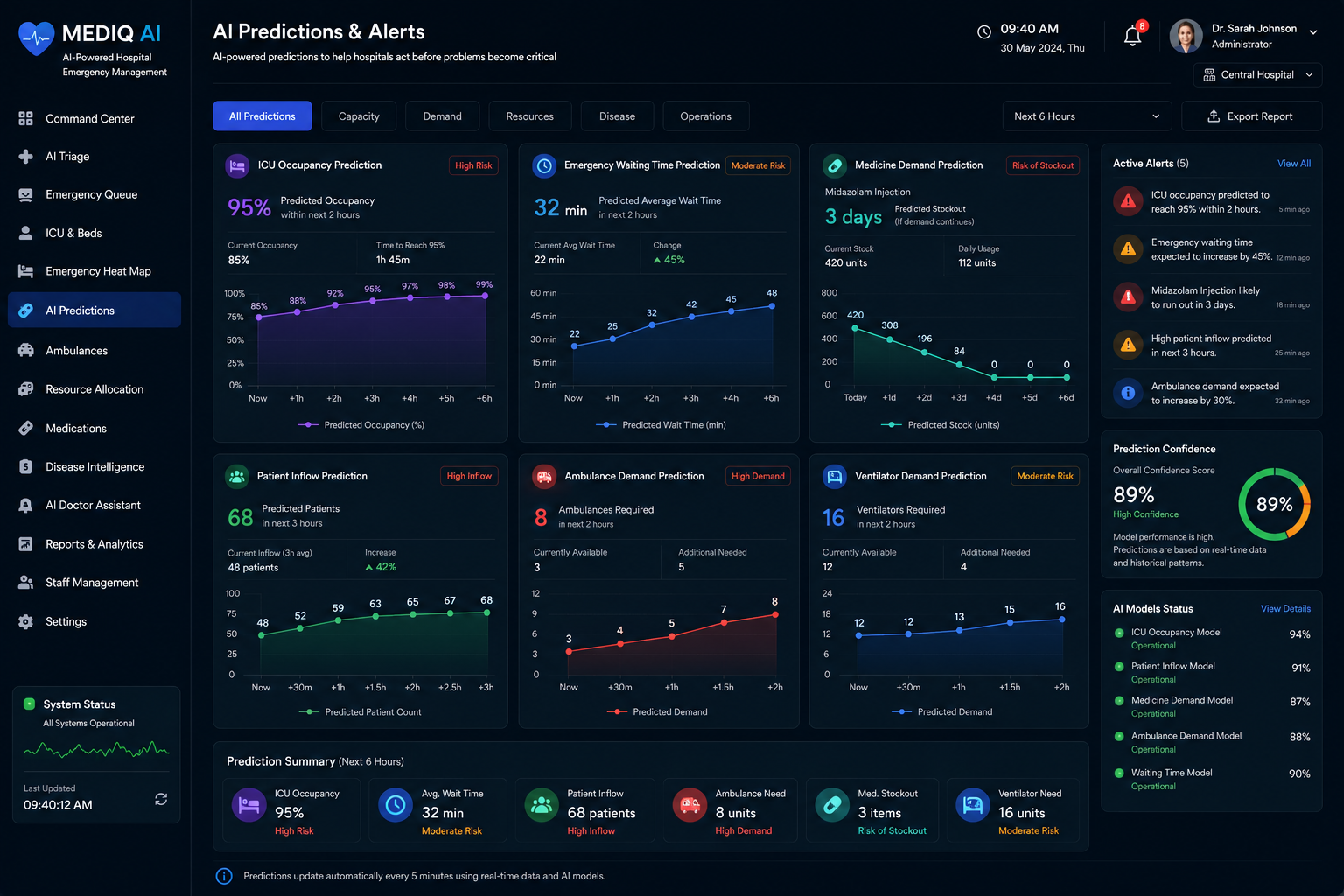
Predicted ICU occupancy: 95% within the next 2 hours.
This allows administrators to identify potential capacity pressure earlier and prepare accordingly.
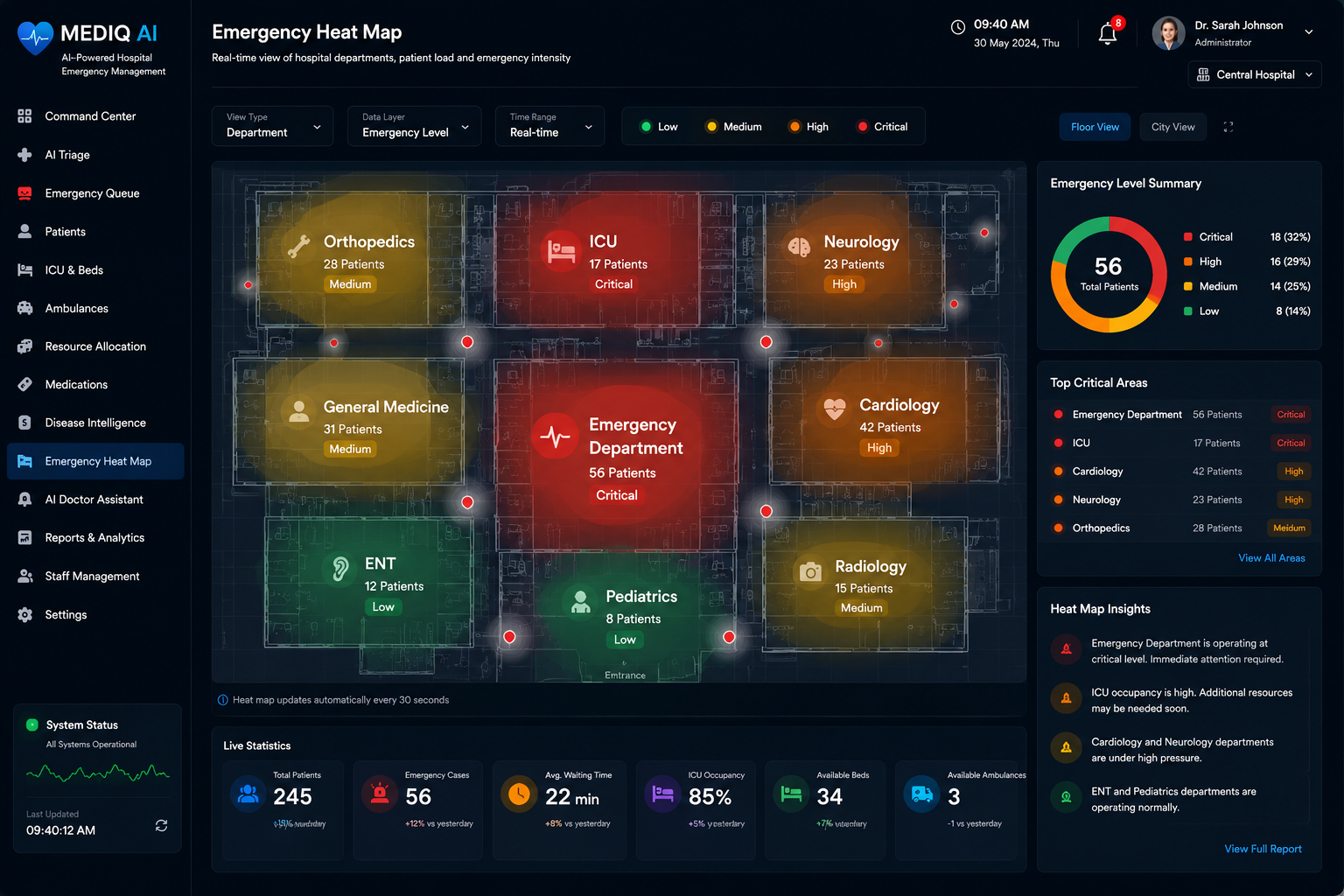
4. Emergency Heat Map
MEDIQ AI provides an emergency heat-map view that allows hospital teams to understand where emergency pressure is increasing.
Emergency conditions can be represented through severity levels:
- Low
- Medium
- High
- Critical
This visual layer helps administrators understand the current situation quickly and identify areas where additional attention or resources may be required.
5. AI Predictions & Alerts
Prediction is the central intelligence layer of MEDIQ AI.
The platform is designed to identify potential operational problems before they become critical.
Examples include:
- Increasing emergency patient demand
- ICU capacity pressure
- Increasing waiting times
- Medicine stockout risk
- Resource shortages
- Increasing disease-related cases
Instead of simply showing current data, MEDIQ AI aims to answer:
"What is likely to happen next?"
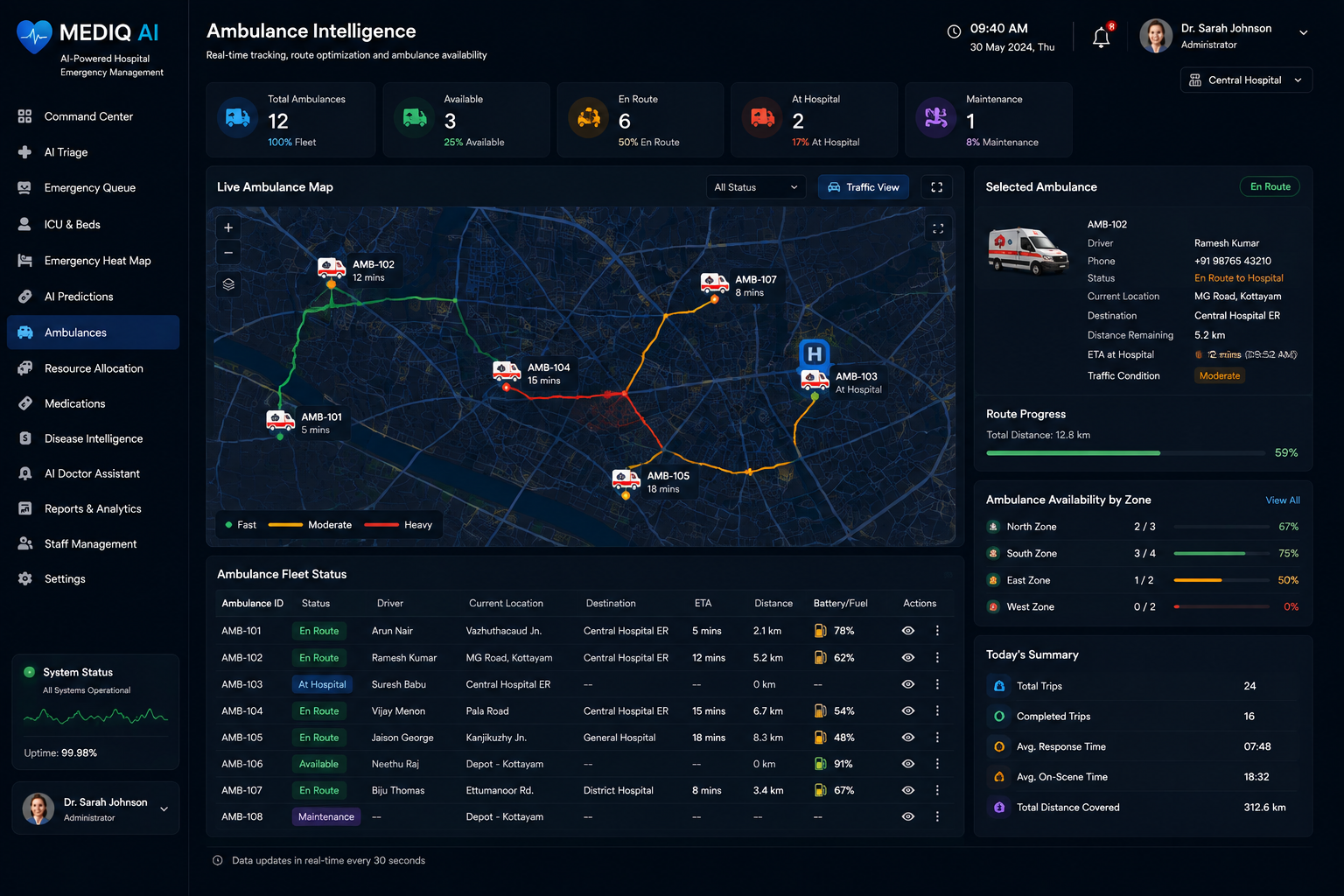
6. Ambulance Intelligence
MEDIQ AI includes an ambulance intelligence concept using map-based information.
The system can display:
- Current ambulance location
- Estimated arrival time
- Traffic conditions
- Hospital destination
- Route information
The platform can also conceptually recommend an appropriate available ambulance based on operational conditions rather than relying only on physical distance.
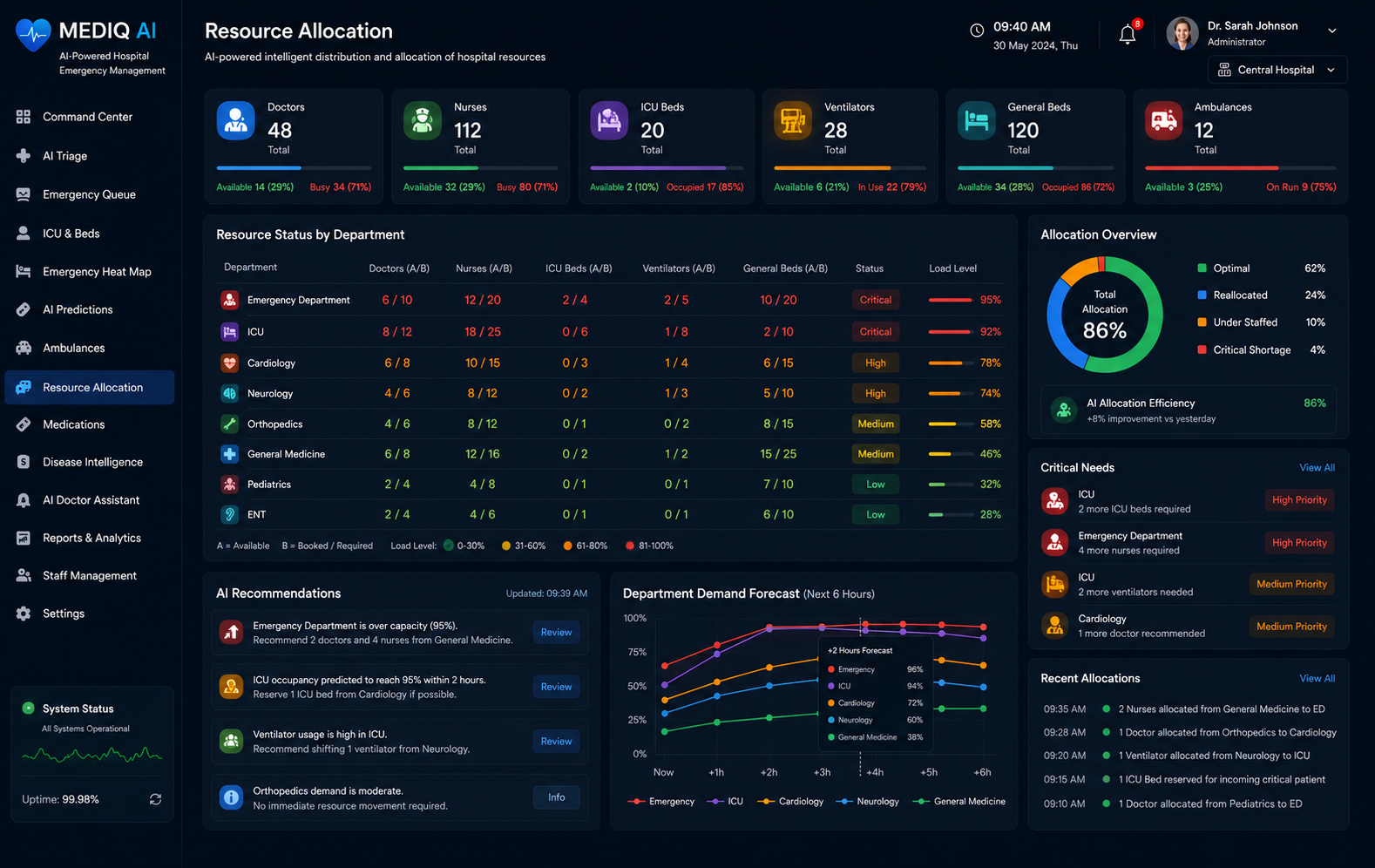
7. Intelligent Resource Allocation
Hospital resources are limited and demand changes throughout the day.
MEDIQ AI is designed to provide intelligent recommendations for resources such as:
- Doctors
- Nurses
- Ventilators
- Ambulances
- ICU beds
When demand increases in one department, the system can identify resource pressure and recommend possible allocation adjustments.
The objective is to help hospital administrators make faster, data-informed operational decisions.
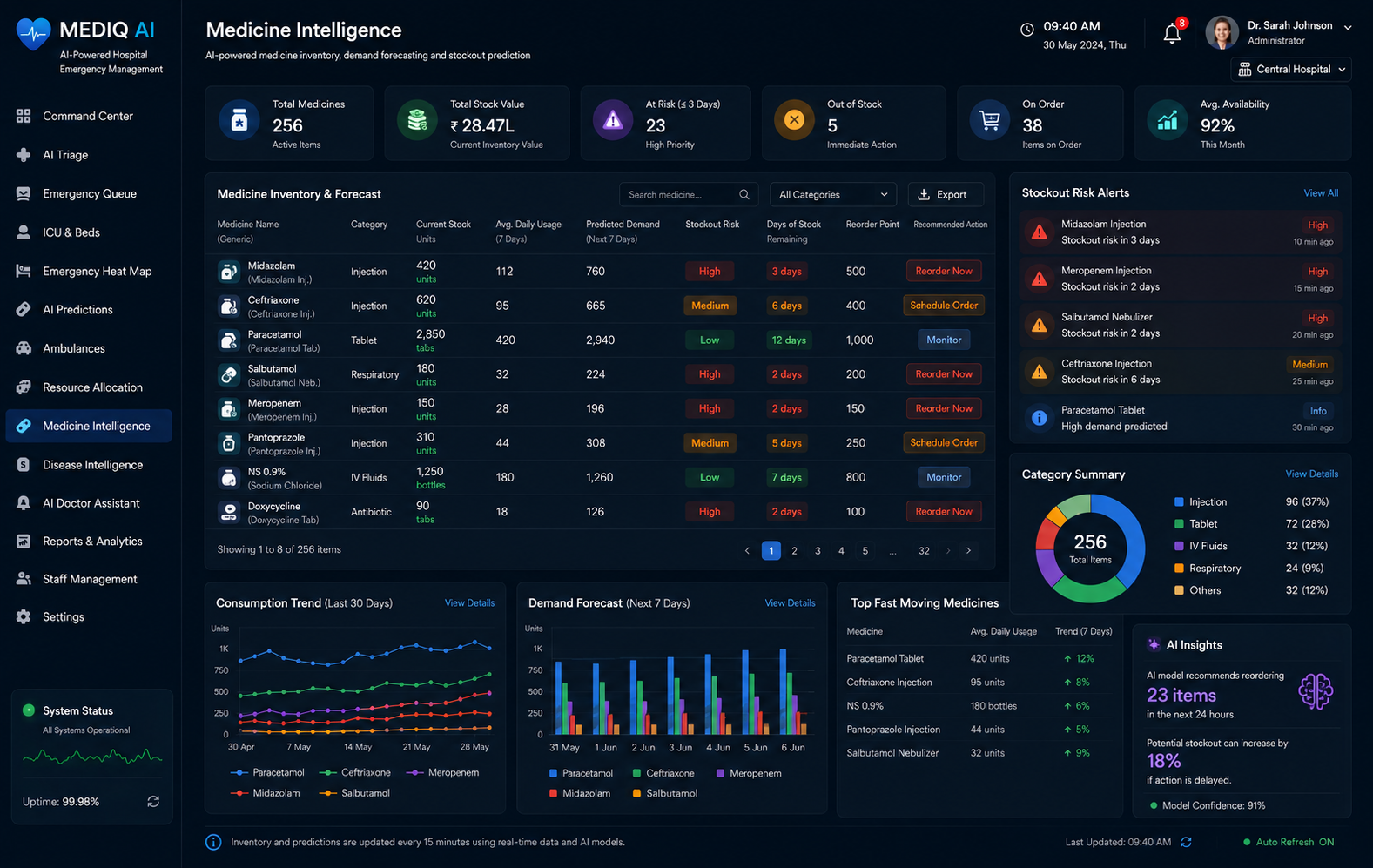
8. Medicine Intelligence
Instead of simply displaying current medicine inventory, MEDIQ AI introduces predictive medicine demand analysis.
For example:
Medicine stockout risk detected.
The system can estimate future demand and identify medicines that may require replenishment.
This can help procurement teams take action before a shortage becomes an operational problem.
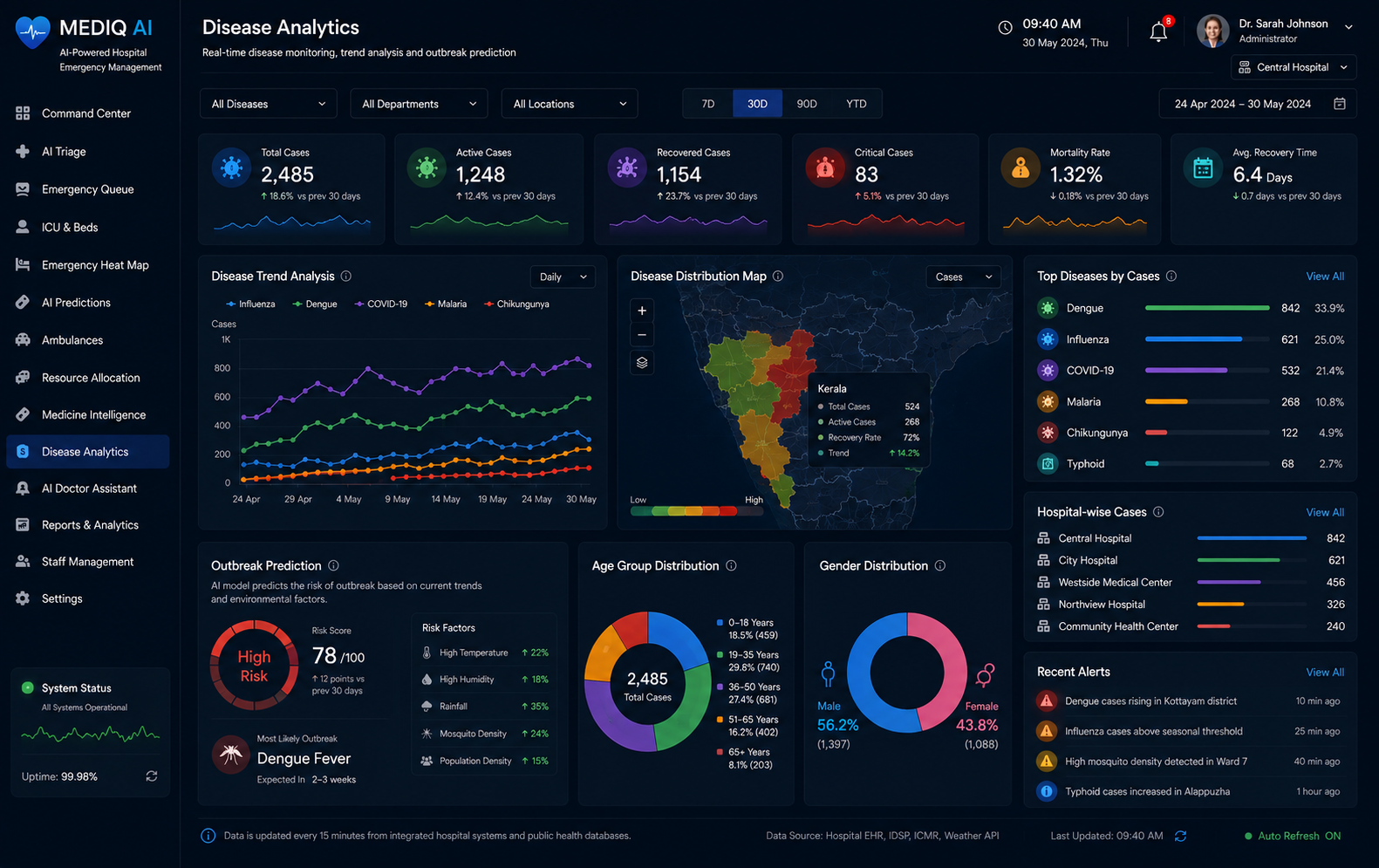
9. Disease & Emergency Analytics
MEDIQ AI can analyze trends in emergency cases and identify unusual increases.
For example, a sudden increase in fever or dengue-related cases could trigger an analytical alert:
Unusual increase detected.
The purpose is to provide early operational awareness so hospitals can prepare resources when demand patterns change.
This feature is intended as an analytics and early-warning capability, not as a replacement for medical diagnosis.
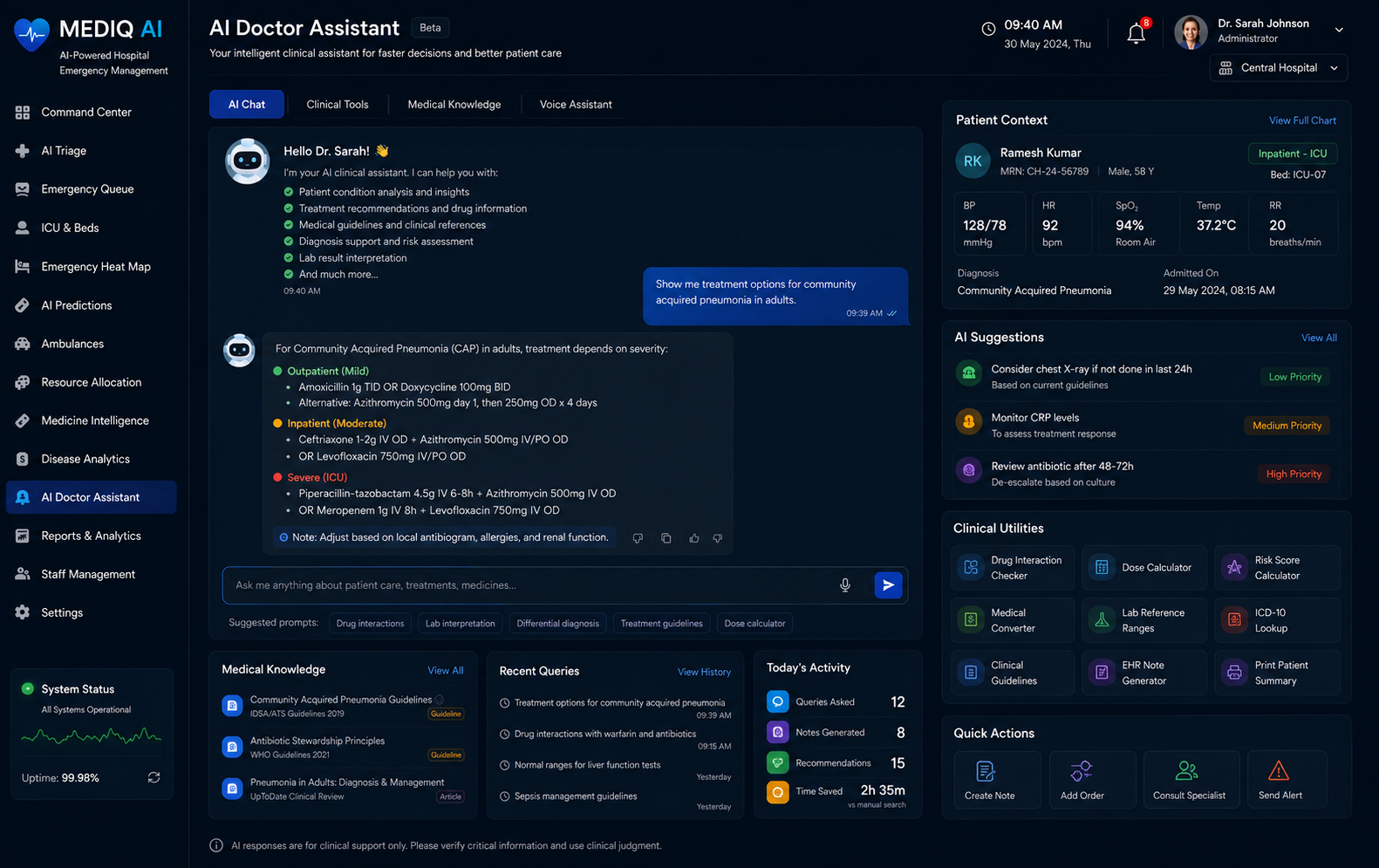
10. AI Doctor Assistant
MEDIQ AI also includes an AI-assisted clinical information interface.
A doctor could enter an emergency description such as:
"Patient has chest pain and oxygen 82%."
The AI assistant can provide structured clinical considerations, suggested investigations, and relevant emergency protocols for review.
This feature follows an important principle:
AI assists clinicians. Humans make the final clinical decisions.
MEDIQ AI is not designed to replace qualified healthcare professionals.
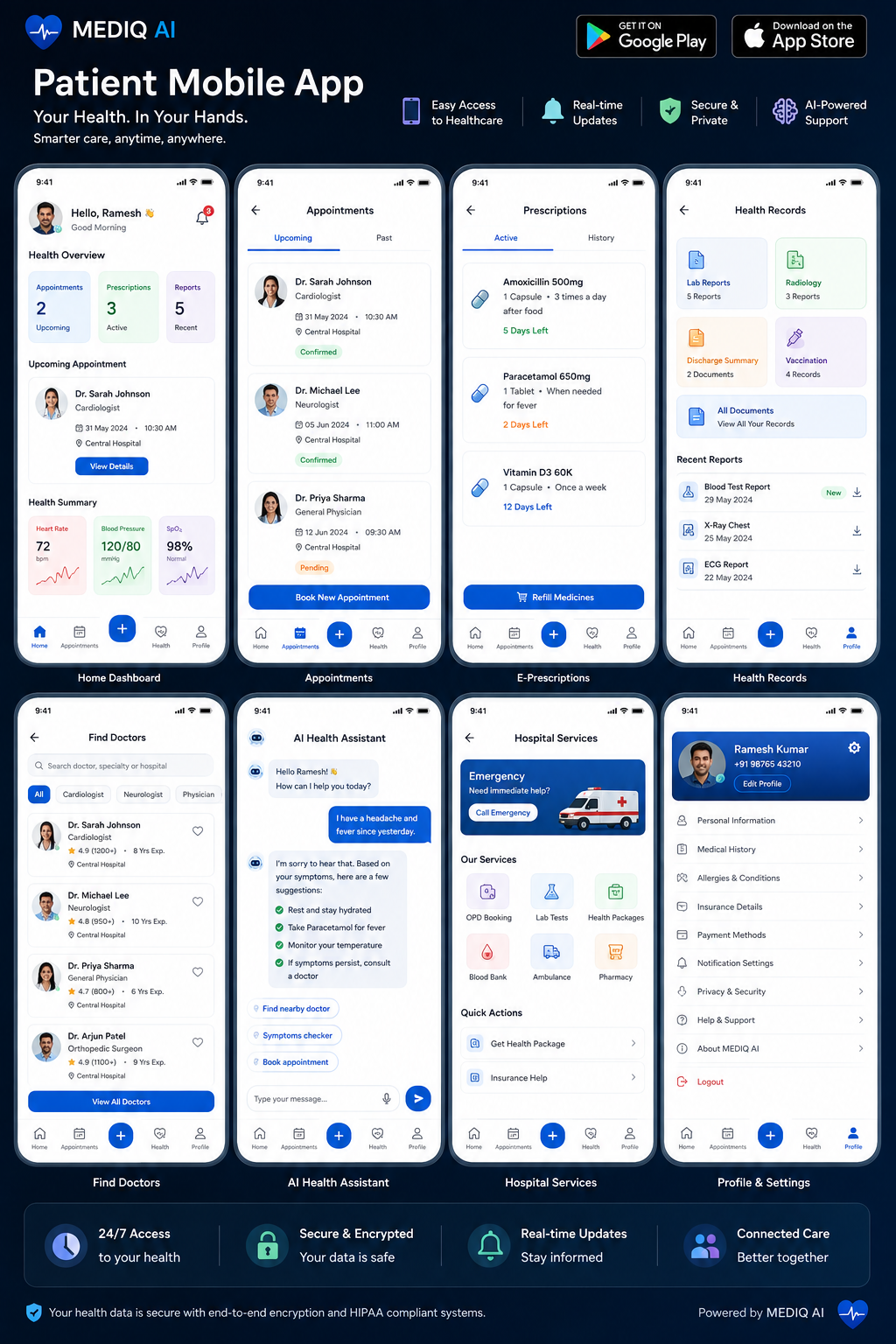
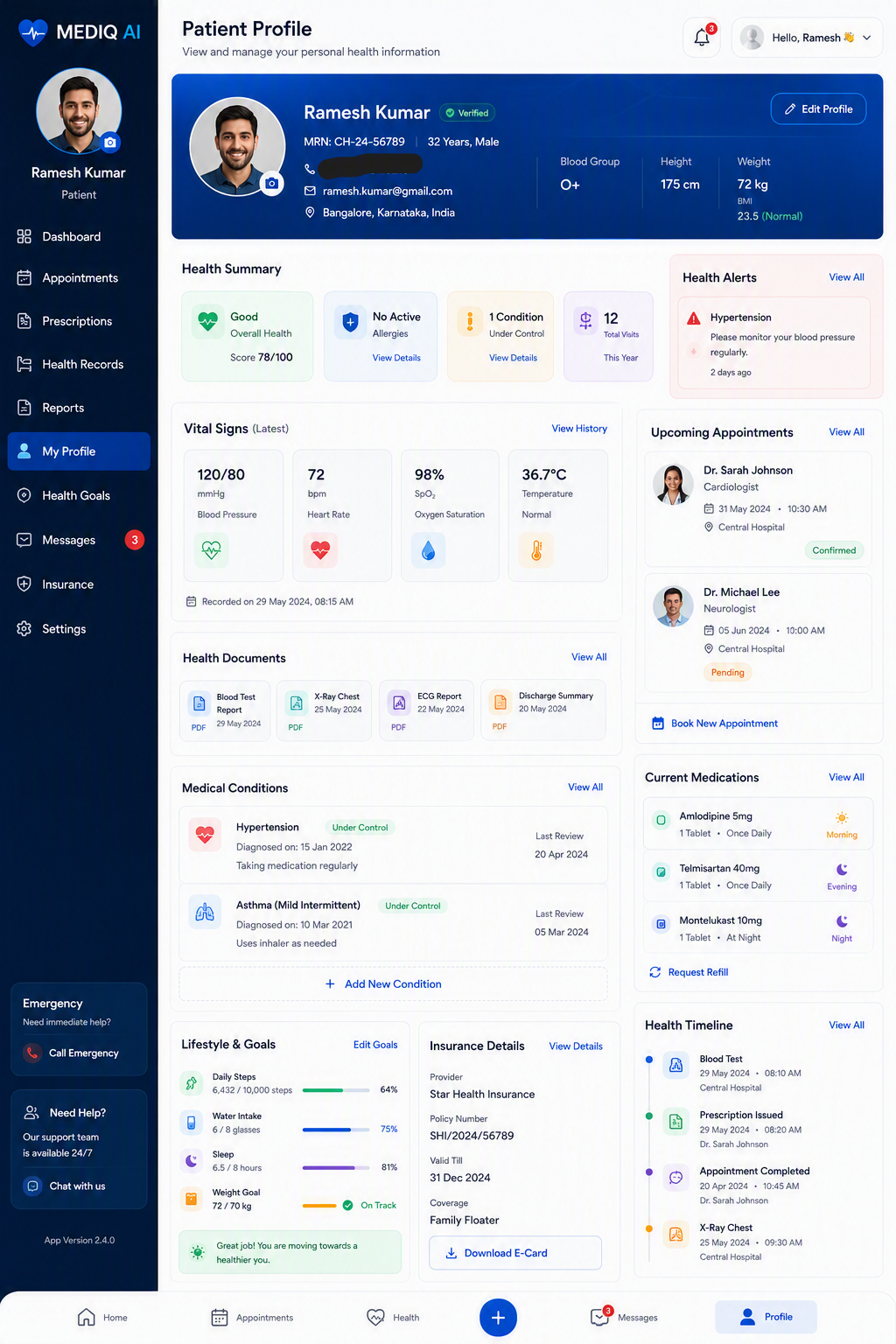
11. Patient Mobile Experience
The patient-facing experience is designed to provide better visibility during the hospital journey.
Patients can potentially:
- Check their queue position
- View estimated waiting time
- Track ambulance status
- Receive queue notifications
- Access emergency instructions
- Locate hospital departments
- View appointment status
This creates a connection between hospital operations and the patient experience.
How we built it
MEDIQ AI was designed as a modular platform so that different hospital functions can communicate through a common backend and intelligence layer.
The overall architecture follows this flow:
Patient / Hospital Data
↓
Backend API
↓
AI Prediction & Intelligence Engine
↓
Triage AI
Waiting-Time Prediction
ICU Prediction
Forecasting
Recommendation Engine
↓
Unified Dashboards
↓
Doctor | Nurse | Administrator | Patient
Technology Stack
Frontend
- React
- Next.js
- Tailwind CSS
Backend
- Python
- FastAPI
Database
- PostgreSQL
AI & Machine Learning
- Python
- Scikit-learn
- XGBoost
- TensorFlow / PyTorch where required
- LLM API for the clinical-assistance component
Maps
- Google Maps API / Mapbox
Data Visualization
- Chart.js
- Recharts
Authentication
- Secure role-based authentication
Deployment
- Vercel
- Render
The database is designed around entities such as:
- Patients
- Doctors
- Nurses
- Ambulances
- Beds
- ICU
- Medicines
- Departments
- Emergency Cases
- AI Predictions
- Notifications
This modular architecture allows individual capabilities to evolve without redesigning the entire system.
Challenges we ran into
One of our biggest challenges was scope.
Hospital emergency management is a very large problem, and there are many areas where AI could potentially help. We initially identified capabilities ranging from patient triage and ICU prediction to ambulance intelligence, medicine forecasting, disease analytics, and patient applications.
The challenge was deciding what should be part of the core system and what should remain future scope.
We addressed this by organizing MEDIQ AI around a core predictive emergency-management platform while treating more advanced capabilities as modular extensions.
Another challenge was designing a system that is technically ambitious while remaining understandable to healthcare users.
A hospital administrator should not need to understand the underlying machine-learning model to understand an alert.
Therefore, the interface focuses on converting complex data into:
- Clear dashboards
- Predictions
- Alerts
- Trends
- Recommendations
- Actionable information
A further challenge is responsible use of AI in healthcare.
Healthcare decisions can have serious consequences, so we designed MEDIQ AI as a decision-support system rather than a replacement for medical professionals.
This principle influences the AI Doctor Assistant and the way predictive outputs are presented.
Finally, maintaining consistency between multiple modules was an important architectural challenge. Patient information, emergency cases, beds, staff, ambulances, medicines, predictions, and notifications need to work as part of one connected ecosystem rather than as isolated features.
Accomplishments that we're proud of
We are proud of turning a broad healthcare problem into a structured technology platform with a clear central idea:
From reactive emergency management to predictive hospital intelligence.
We designed MEDIQ AI around a unified architecture rather than creating unrelated hospital tools.
We are particularly proud of the way the platform connects:
Patient Data
→ AI Analysis
→ Prediction
→ Alerts
→ Recommendations
→ Hospital Action
The project also brings together several technical areas:
- Artificial Intelligence
- Machine Learning
- Data Analytics
- Real-Time Monitoring
- Predictive Analytics
- Healthcare Technology
- Dashboard Design
- Cloud Architecture
- API Development
- Role-Based Systems
Another accomplishment is the role-based product experience.
Different users can interact with information relevant to their responsibilities:
Hospital Administrators
focus on hospital-wide capacity, emergency pressure, resources, predictions, and alerts.
Doctors
focus on patients, triage, medical information, reports, prescriptions, and AI-assisted clinical information.
Nurses
focus on queues, patient monitoring, bed assignments, and alerts.
Patients
focus on queue position, waiting time, ambulance information, notifications, and appointments.
This separation makes the system more practical than presenting the same information to every user.
What we learned
Building MEDIQ AI helped us understand that healthcare technology is not only about adding AI to an application.
The difficult part is determining:
What information matters?
Who needs it?
When do they need it?
What decision can it support?
We learned the importance of designing AI around real operational workflows rather than treating AI as an isolated feature.
We also learned that prediction is only useful when it leads to action.
For example:
Prediction:
ICU occupancy may reach a critical level.
is more valuable when followed by:
Alert → Recommendation → Resource Planning
This led us to think about MEDIQ AI as a complete decision-support cycle rather than simply a collection of machine-learning models.
We also learned the importance of responsible AI in healthcare. An AI system should communicate uncertainty appropriately and support qualified professionals rather than present itself as an autonomous medical authority.
Finally, the project taught us the importance of modular architecture and scope management. A large vision is valuable, but a strong product requires a focused core that can be demonstrated clearly and expanded over time.
What's next for MEDIQ AI
Our current vision is to evolve MEDIQ AI from a hospital emergency-management prototype into a broader intelligent healthcare operations platform.
Short-Term
We plan to strengthen the core predictive capabilities:
- More robust patient triage
- Improved waiting-time prediction
- ICU occupancy forecasting
- Real-time resource monitoring
- Advanced emergency analytics
- Better alert prioritization
- Stronger role-based dashboards
Medium-Term
We want to expand the platform with:
- Advanced ambulance intelligence
- Medicine demand forecasting
- Disease trend analytics
- Patient mobile services
- Remote patient monitoring
- Wearable-device integration
- Voice-based healthcare assistance
Long-Term Vision
Our long-term vision is to create a more intelligent hospital environment where physical systems and digital intelligence work together.
Potential future integrations include:
- Robot-assisted pharmacy systems
- Smart medicine lockers
- Automated medicine delivery
- Voice AI nurse assistants
- Wearable health monitoring
- Remote patient monitoring
- Hospital digital twins
The ultimate goal is to create a hospital that can continuously understand its operational state, anticipate emerging pressure, and help healthcare teams respond before small problems become major emergencies.
Our Vision
Healthcare emergencies cannot always be prevented.
But the systems managing them can become smarter.
MEDIQ AI aims to help hospitals move from:
Reacting to emergencies
to
Anticipating them.
MEDIQ AI
Predictive intelligence when every second matters.
Built With
- fastapi
- healthcare
- postgresql
- python
- react


Log in or sign up for Devpost to join the conversation.