-
-
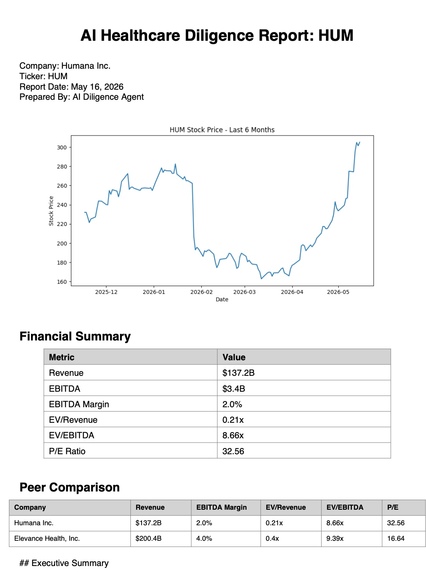
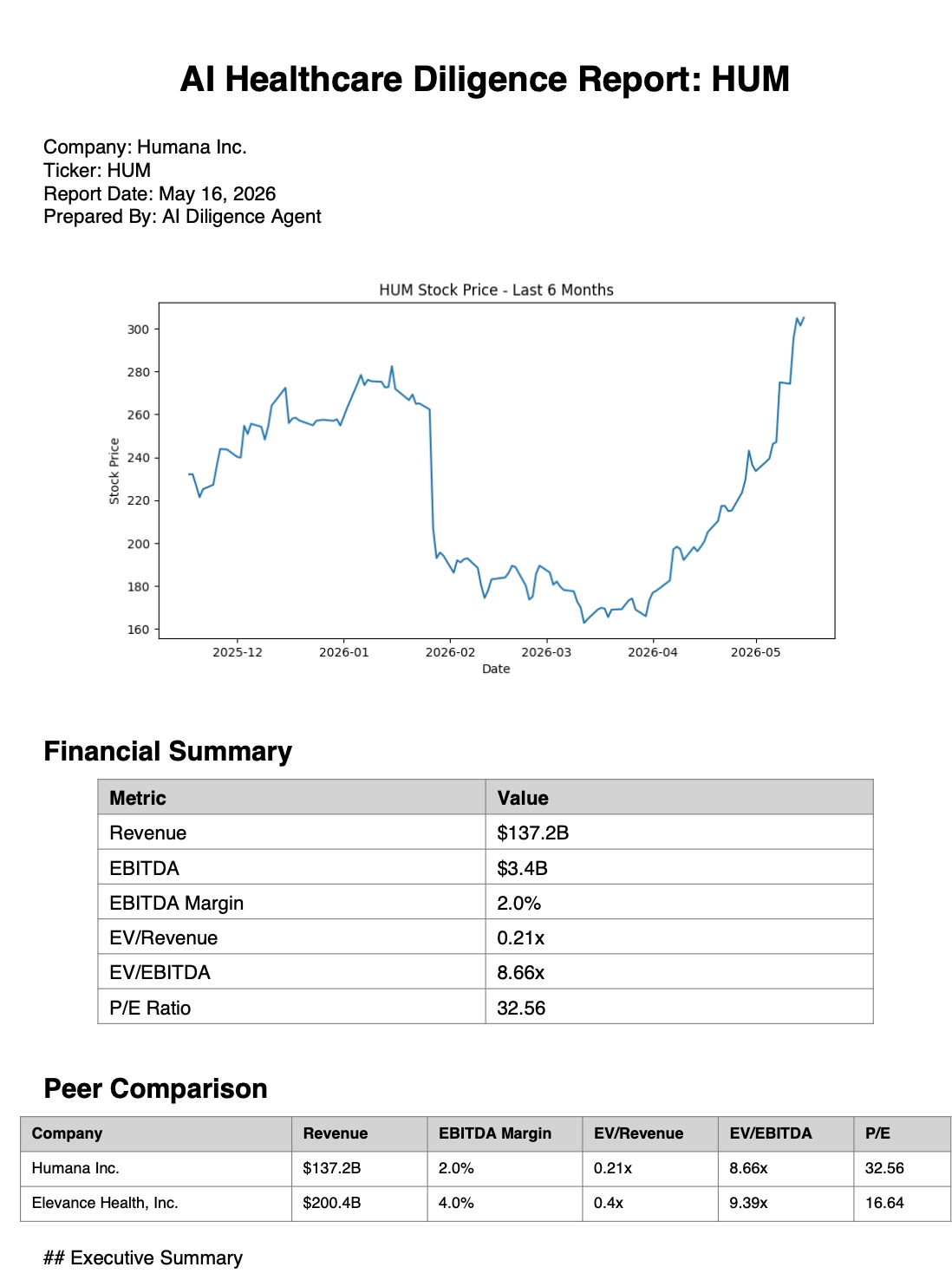
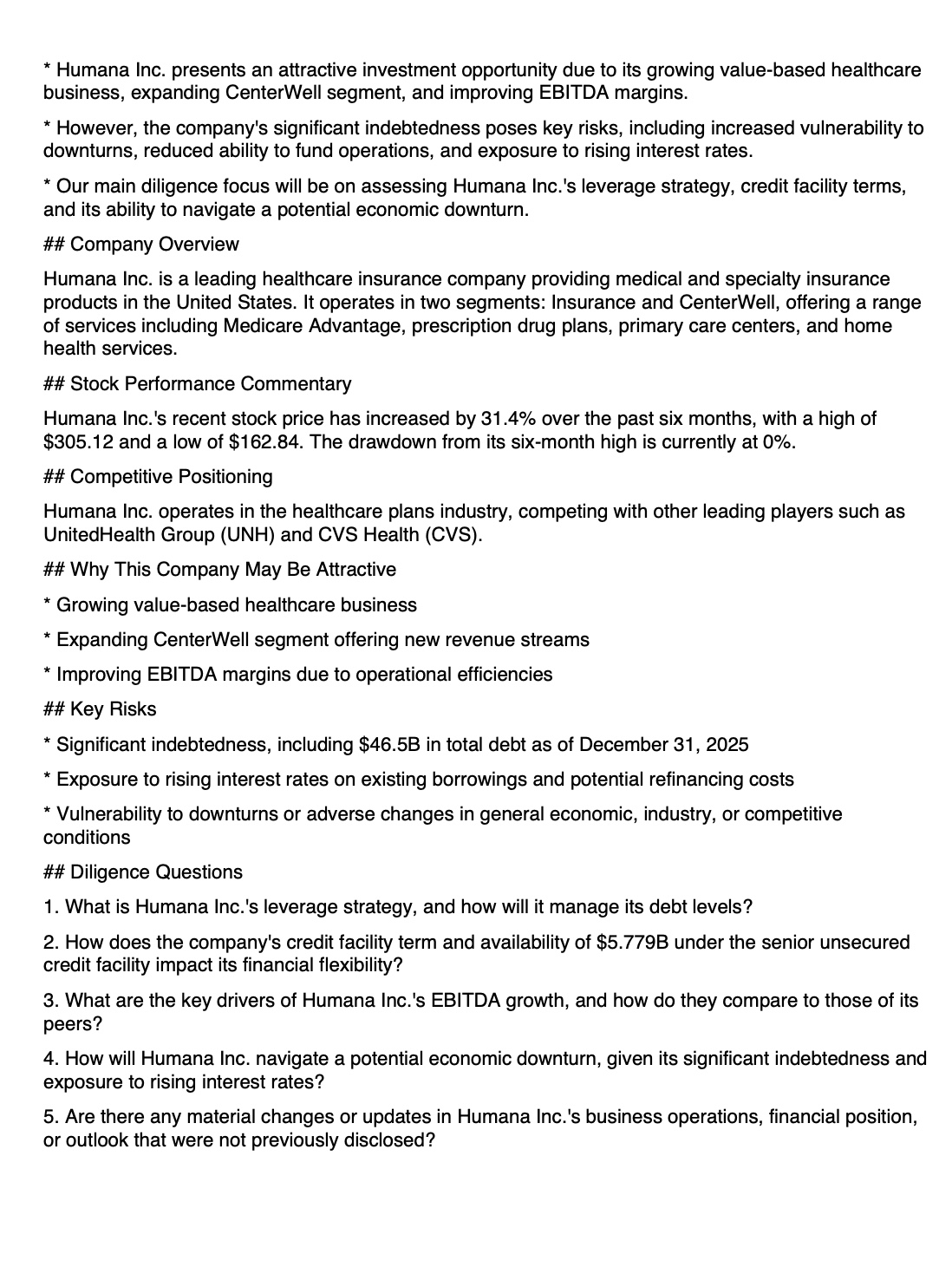
Structured healthcare intelligence report generated from SEC filing analysis and AI-powered risk extraction workflows.
-
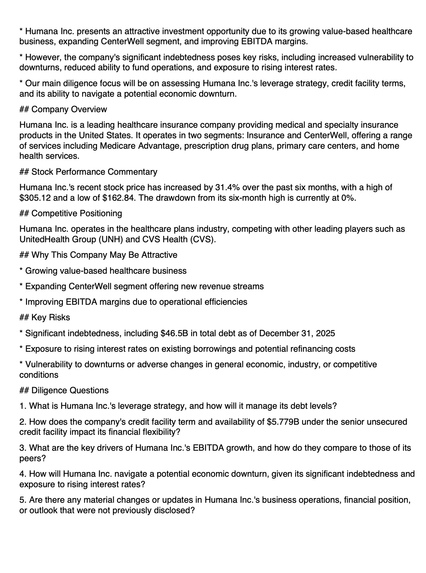
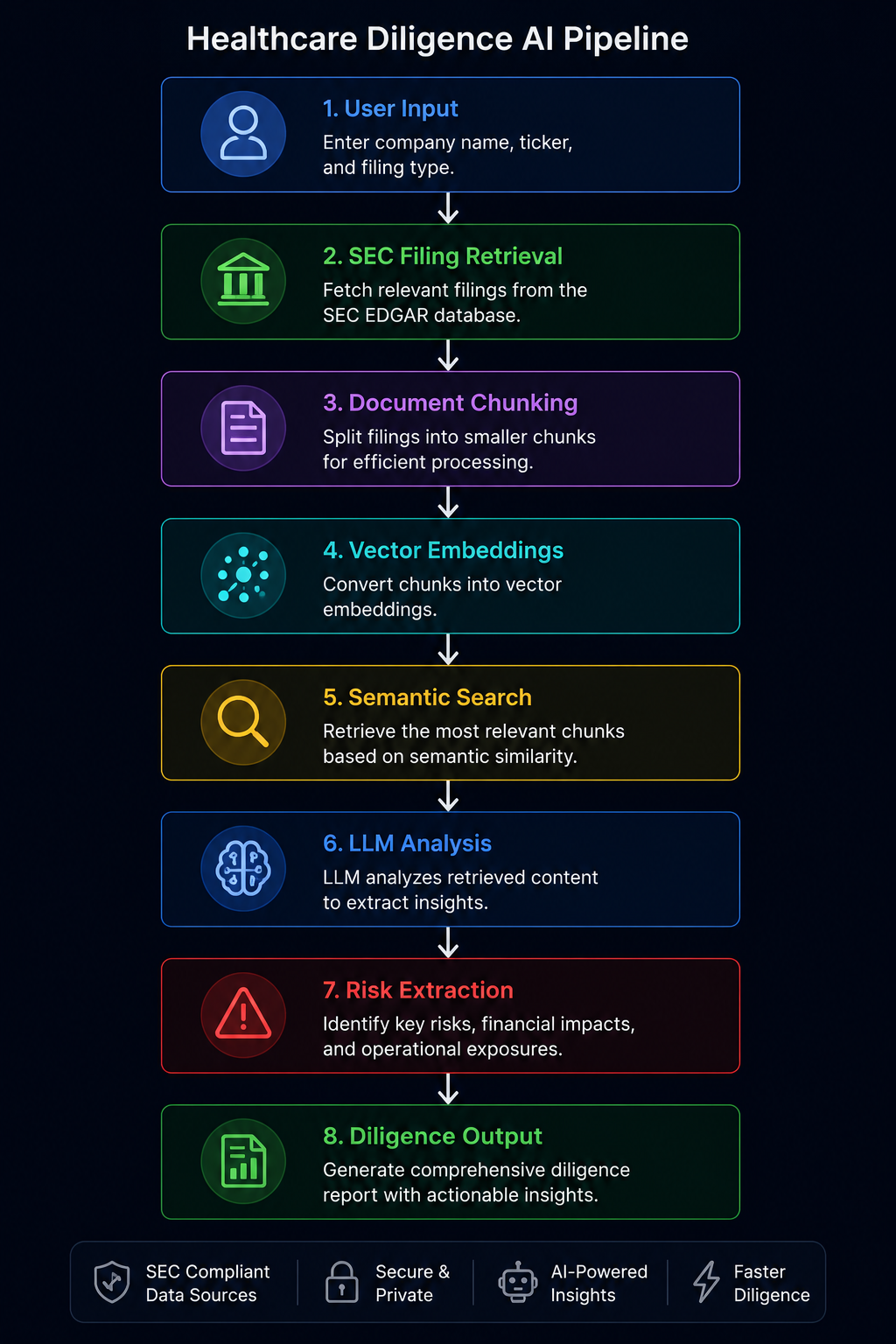
Semantic retrieval and AI analysis pipeline used to identify operational and reimbursement-related healthcare risks.
-
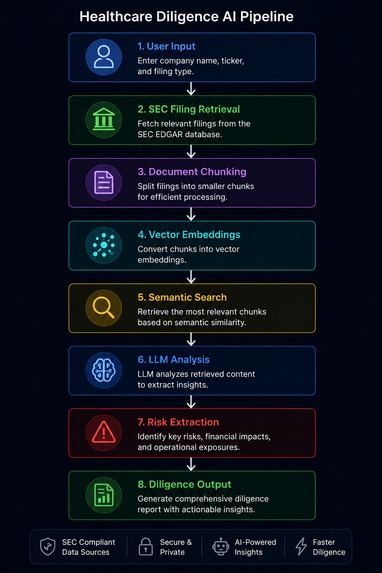
Enterprise-style AI orchestration workflow powering SEC filing retrieval, semantic search, and structured diligence generation.
Inspiration
MedIntel AI was inspired by how time-consuming and fragmented healthcare diligence workflows can be. Analysts and operators often spend hours reviewing SEC filings, identifying reimbursement risks, organizing operational insights, and synthesizing large amounts of unstructured information into something actionable.
I wanted to explore how AI could streamline that process while still keeping humans in control of decision-making. Since healthcare is such a regulation-heavy and operationally complex industry, it felt like the perfect environment to build a real-world AI workflow focused on automation, intelligence gathering, and structured analysis.
What it does
MedIntel AI is an AI-powered healthcare diligence and intelligence platform designed to automate SEC filing analysis, risk extraction, and operational research workflows.
The platform can:
- Retrieve healthcare SEC filings
- Analyze large regulatory disclosures
- Extract operational and reimbursement-related risks
- Generate structured diligence-style summaries
- Support contextual AI analysis through retrieval workflows
- Organize findings into more actionable intelligence outputs
The goal was to create something that feels more like an enterprise healthcare workflow tool than a simple chatbot.
How we built it
The project was built using:
- Python
- Streamlit
- Ollama and Llama 3.2
- OpenAI API
- SEC EDGAR retrieval
- Retrieval-Augmented Generation (RAG)
- Vector embeddings and semantic search
- Pandas and financial data tools
The workflow starts by retrieving publicly available SEC filings and healthcare disclosures. Documents are then chunked, embedded, and processed through a semantic retrieval pipeline capable of surfacing contextually relevant information during analysis.
The AI workflow then synthesizes operational insights, reimbursement risks, and financial disclosures into structured diligence outputs and reports.
The overall workflow can be summarized as:
User Input → SEC Filing Retrieval → Document Chunking → Vector Embeddings →
Semantic Search → AI Analysis → Risk Extraction → Structured Diligence Output

A major focus throughout development was making the workflow feel practical, scalable, and enterprise-oriented rather than simply generating isolated AI responses.
## Challenges I ran into
One of the biggest challenges was working with the complexity and inconsistency of healthcare filings. SEC disclosures are often extremely long, dense, and technical, which made retrieval quality and context management difficult.

Another challenge was balancing retrieval precision with model context limitations. A significant amount of iteration went into improving chunking strategies, semantic retrieval workflows, and prompt engineering to improve relevance while reducing hallucinations.

Deploying the application also introduced challenges because some model inference workflows relied on local Ollama execution environments during development.
## Accomplishments that I'm proud of
One of the accomplishments I’m most proud of was building a workflow capable of transforming large amounts of unstructured healthcare filing data into organized diligence-style intelligence outputs.

I’m also proud of combining retrieval systems, semantic search, and AI analysis into a cohesive workflow that feels useful for real-world operational and healthcare intelligence tasks.

Another major accomplishment was creating polished outputs, including AI-generated diligence reports, structured summaries, and deployment-ready demos.
## What I learned
This project reinforced how important retrieval quality, workflow design, and structured outputs are in enterprise AI systems.

I also learned that building useful AI workflows depends heavily on:

retrieval accuracy,
context management,
orchestration logic,
and usability,

not just raw model capability.

One major takeaway from the project was:

Relevant Context+Semantic Retrieval→Higher Quality AI Analysis

The project also highlighted how AI-powered automation can help streamline complex healthcare research and diligence workflows into more scalable intelligence systems.
## What's next for MedIntel AI
Future versions of MedIntel AI will focus on:

Multi-agent orchestration workflows
Human-in-the-loop review systems
Automated diligence memo generation
Comparative healthcare benchmarking
Risk scoring systems
Multi-document analysis
Expanded healthcare reimbursement intelligence

The long-term goal is to continue developing MedIntel AI into a scalable healthcare intelligence platform capable of supporting more advanced operational and regulatory analysis workflows.

Log in or sign up for Devpost to join the conversation.