-
-
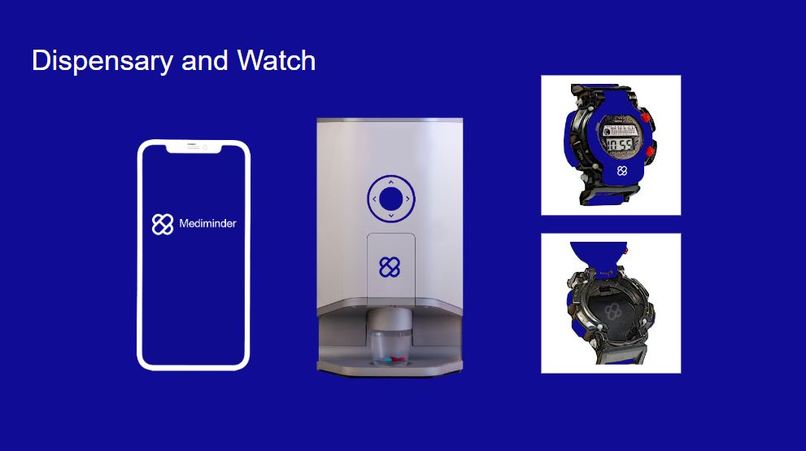
Dispensary and Watch
-
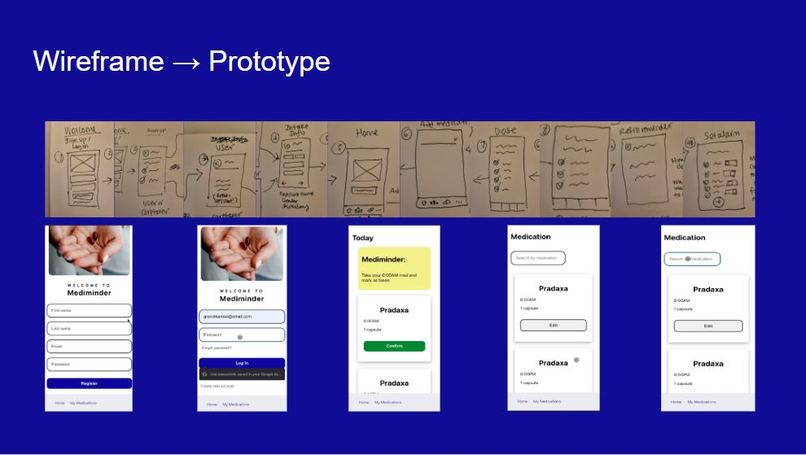
Wireframe and Prototype
-

Mediminder


Inspiration
One of our core team members has a grandparent that is currently challenged by their medication regimen, “Grandpa will either completely miss the time and realize hours later or he will take it too early and then wonder if he took his meds.”
Our team knew we could build something never done or built before during the PowerToFly Hackathon to solve this real problem. According to the World Health Organization, in the United States alone, around 125,000 preventable deaths occur each year due to medical nonadherence, i.e. failure to take medication exactly as prescribed (Source: https://bit.ly/WHO1250000).
What It Does
Our solution, Mediminder, solves the challenge through a three-component approach: 1. An app, 2. A pill dispenser, and 3. A watch. The Mediminder App connects to the dispenser and watch, enabling users to program how and when medication is dispensed, set reminders, monitor pill supply, and more. Whether at home or on the go, you and your family will never miss another medication.
How We Built It
We began with research to see how real users are currently navigating their medication routines so we could push our creativity and innovation. First, we synthesized our findings, including reminiscing about childhood memories and toys, which sprouted the watch component.
We started organizing our documentation and collaboration on Google Drive, then used Miro for our expected availability and Sprint Backlog. We continued to communicate via Discord and screen share via Loom.
Mediminder was designed on Figma and UIzard and developed using VSCode and GitHub, available here: https://bit.ly/GitHubMediminder121822.
Challenges We Ran Into
We had three main challenges. First, even though Grandma Rose was our persona name, she represents countless folks who are affected by medication regimen frustrations—making this very personal and urgent. Second, two of three of our team members, Amy and Sef, were participating in their first hackathon, so Sam introduced Sprint Backlog and Journey User Mapping for app development. Third, we were challenged by the time limit and working across three different time zones. Even with these three challenges, we were able to achieve what we wanted on behalf of our users.
Accomplishments That We're Proud Of
Simply put, we’re proud to offer a solution that’s never been done before to help save real lives and solve a real world problem. In less than 24 hours, we were able to ideate, research, and begin building our product despite time zone differences and technical challenges.
What We Learned
Our team consisted of one front end developer, Amy, one User Experience Designer, Sef, and one Inclusion Coach, Sam. It was an invaluable learning opportunity to be able to create a product using different lenses, perspectives, and skill sets. We also learned to collaborate asynchronously, take collective ownership of the project, as well as solve problems on the spot.
Amy was able to teach the team about converting designer ambitions into usable code through React components and CSS modules. Sef taught the team about uncovering user pain points through research and interviews. Sam was able to introduce the team to the Product Backlog, the Journey User Mapping and Web Content Accessibility Guidelines core criteria for better inclusion practices.
What's Next for Mediminder
We will be testing out with a wide pool of users to ensure we have both utilitarian and universal design that honors access and equity. We want to have Mediminder approved as a US Food and Drug Administration medical device so folks in the US can have Medicare/Medicaid and insurance coverage. This will help ensure that Mediminder remains as a top recommendation in doctor’s offices and health clinics.
Built With
- discord
- figma
- github
- google-drive
- loom
- miro
- pen-and-paper
- photoshop
- uizard
- vscode

Log in or sign up for Devpost to join the conversation.