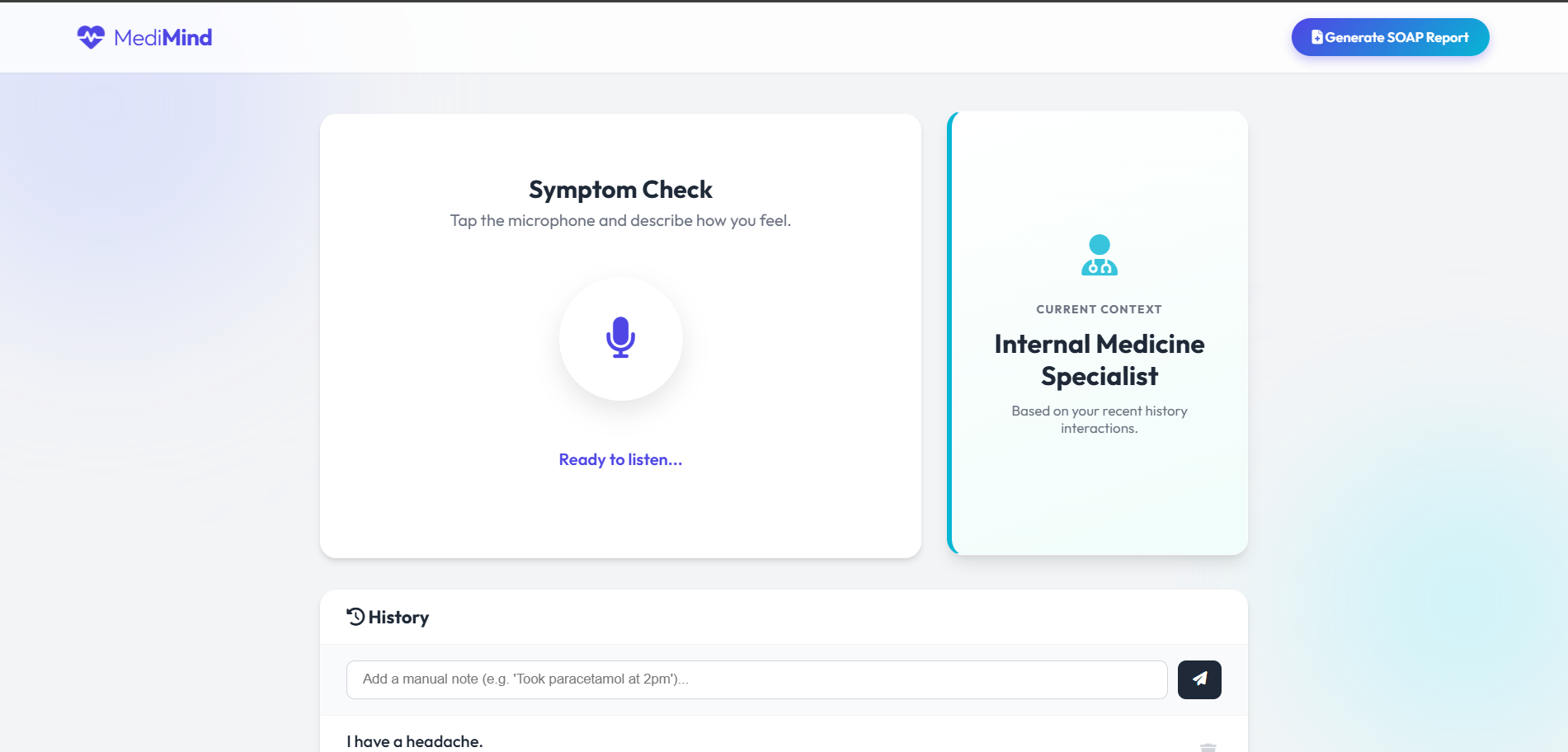
🩺 MediMind — Context-Aware Clinical Triage Assistant
AI that thinks in timelines, not snapshots.
🧠 About the Project
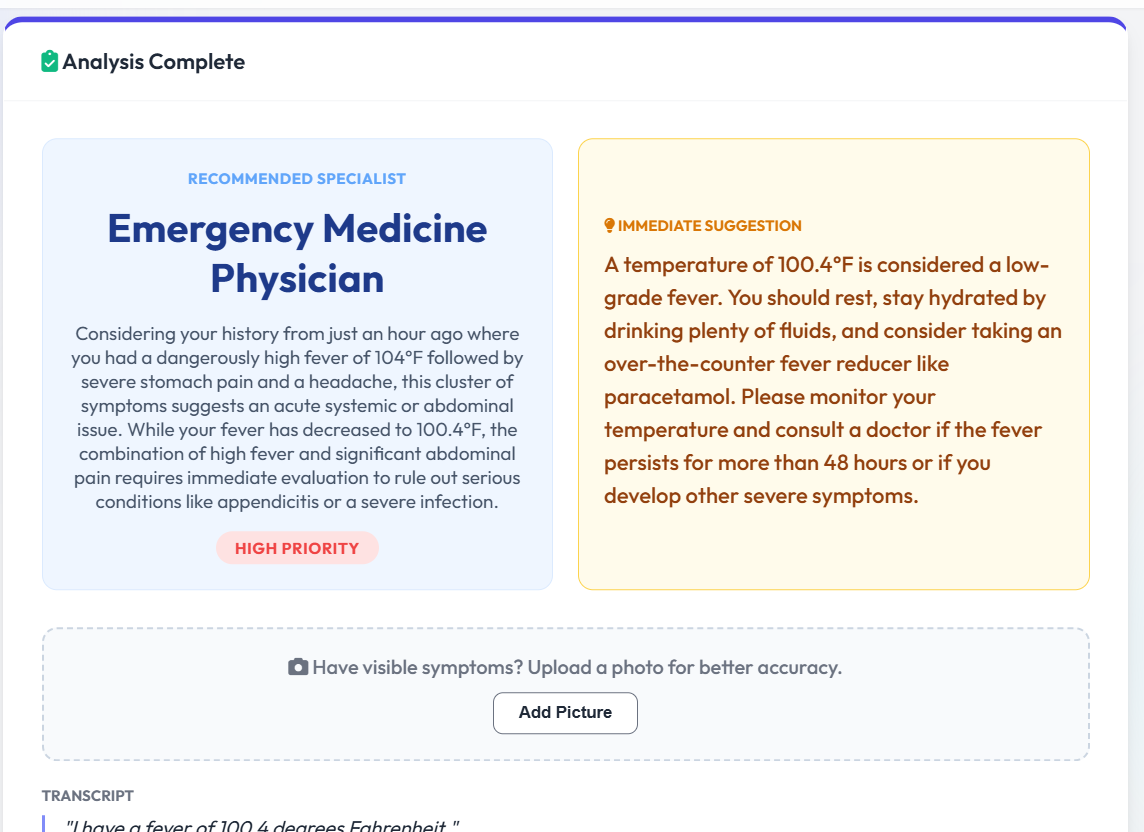
MediMind was inspired by a critical gap in existing digital health tools: most symptom checkers treat each patient input as an isolated event. In real clinical settings, diagnosis depends heavily on temporal context — how symptoms evolve over time. A fever today and abdominal pain tomorrow are not independent signals; they form a pattern.
In India, where the doctor-to-patient ratio sits at approximately $1:1500$, the window between symptom onset and professional consultation is where outcomes are often decided. MediMind is designed to operate in that gap — not as a replacement for doctors, but as an intelligent first layer that augments clinical workflows.
A second motivation was emergency response latency. In life-threatening conditions such as cardiac events or strokes, even a few seconds spent waiting on model inference can be dangerous. This led to the design of a non-LLM emergency override — a rule-based detection layer that triggers an SOS flow instantly, completely independent of AI response time.
🏗️ How the Project Was Built
MediMind is implemented as a lightweight, modular full-stack system:
| Layer | Role |
|---|---|
| Flask Backend | Symptom ingestion, event storage, AI inference, report generation |
| Persistent Event Log | Short-term clinical memory — stores and chains interactions over time |
| LLM Layer | Structured medical extraction, triage reasoning, SOAP report generation |
| Frontend | Voice input, image upload, real-time UI state, locked emergency mode |
The system follows an event-driven architecture: every interaction is stored, contextualized, and re-used in future reasoning steps rather than discarded. This is what separates MediMind from a standard chatbot.
User Input (voice/text/image)
        │
        ▼
Emergency Override Check (rule-based, instant)
        │
        ├──► 🚨 SOS Flow (if critical phrase detected)
        │
        ▼
Event Log + Timeline Builder
        │
        ▼
LLM Inference (contextualized prompt)
        │
        ▼
SOAP Report Generation + Triage Output
Stack: Python · Flask · LLM Prompt Engineering · Multimodal Input · Event-Driven Architecture · Real-time Frontend
✨ Key Features
- 🕐 Temporal Clinical Memory — symptoms are tracked across sessions; patterns surface automatically
- 🚨 Non-LLM Emergency Override — rule-based SOS trigger with $t_{\text{response}} \approx 0$, no model inference required
- 📋 SOAP Report Generation — structured Subjective / Objective / Assessment / Plan output ready for clinical handoff
- 🎙️ Multimodal Input — voice, text, and image upload with graceful fallback across model capability tiers
- 🔒 Locked Emergency UI — frontend enters a restricted state during emergencies, preventing accidental dismissal
📚 What I Learned
- Designing context-aware AI systems instead of stateless chat interfaces
- Prompt engineering for structured, low-hallucination clinical outputs with consistent SOAP section separation
- Handling model capability limitations (text-only vs. multimodal) with graceful fallback logic
- Secure deployment practices including environment-based secret management
- Translating loosely defined user input into clinically meaningful documentation
$$\text{Strong Architecture} \gg \text{Better Model}$$
This project reinforced a core principle: system design consistently outperformed simply swapping in a more capable model.
⚠️ Challenges Faced
1. Consistent SOAP Report Quality Early versions produced vague, poorly separated clinical sections. Solving this required rethinking both input representation (timeline normalization) and prompting strategy to enforce strict medical documentation standards.
2. API Instability & Provider Switching Rapidly evolving AI APIs and quota exhaustion forced mid-build provider switches, pushing the design toward provider-agnostic inference handling so the system stayed functional regardless of which backend was available.
3. Emergency Detection Architecture The SOS layer required complete separation from the LLM pipeline. Rule-based logic must guarantee near-instant response — model latency is never acceptable in a cardiac event scenario.
🎯 Outcome
MediMind demonstrates how AI can move beyond chat-style interactions into decision-support systems that respect time, context, and safety.
It serves as a proof-of-concept for:
- Intelligent triage — prioritizing critical cases before a doctor is involved
- Clinical handoff automation — SOAP reports reduce documentation burden on practitioners
- Emergency-aware AI interaction — hard separation between AI reasoning and life-critical response
Built to augment clinical workflows, not replace the professionals behind them.
🛠️ Tech Stack
| Category | Tools |
|---|---|
| Backend | Python, Flask |
| AI/ML | LLM APIs, Prompt Engineering, Multimodal Inference |
| Frontend | HTML/CSS/JS, Voice API, Real-time UI |
| Architecture | Event-driven, Provider-agnostic inference |
| Deployment | Environment-based secret management, GCP |
🔗 Links
- GitHub: github.com/Swastik-Prakash1


Log in or sign up for Devpost to join the conversation.