🧠 About the Project
MediMind was inspired by a simple but critical gap in existing digital health tools: most symptom checkers treat each patient input as an isolated event. In real clinical settings, however, diagnosis depends heavily on temporal context—how symptoms evolve over time. A fever today and abdominal pain tomorrow are not independent signals; they form a pattern.
Another motivation was emergency response latency. In life-threatening conditions such as cardiac events or strokes, even a few seconds spent interacting with an AI chatbot can be dangerous. This led to the idea of a non-LLM emergency override system that can immediately detect critical phrases and trigger an SOS flow without waiting for model inference.
🏗️ How the Project Was Built
MediMind is implemented as a lightweight full-stack system:
A Flask backend handles symptom ingestion, event storage, AI inference, and report generation.
A persistent local event log acts as short-term clinical memory, allowing the system to reason over symptom timelines instead of single inputs.
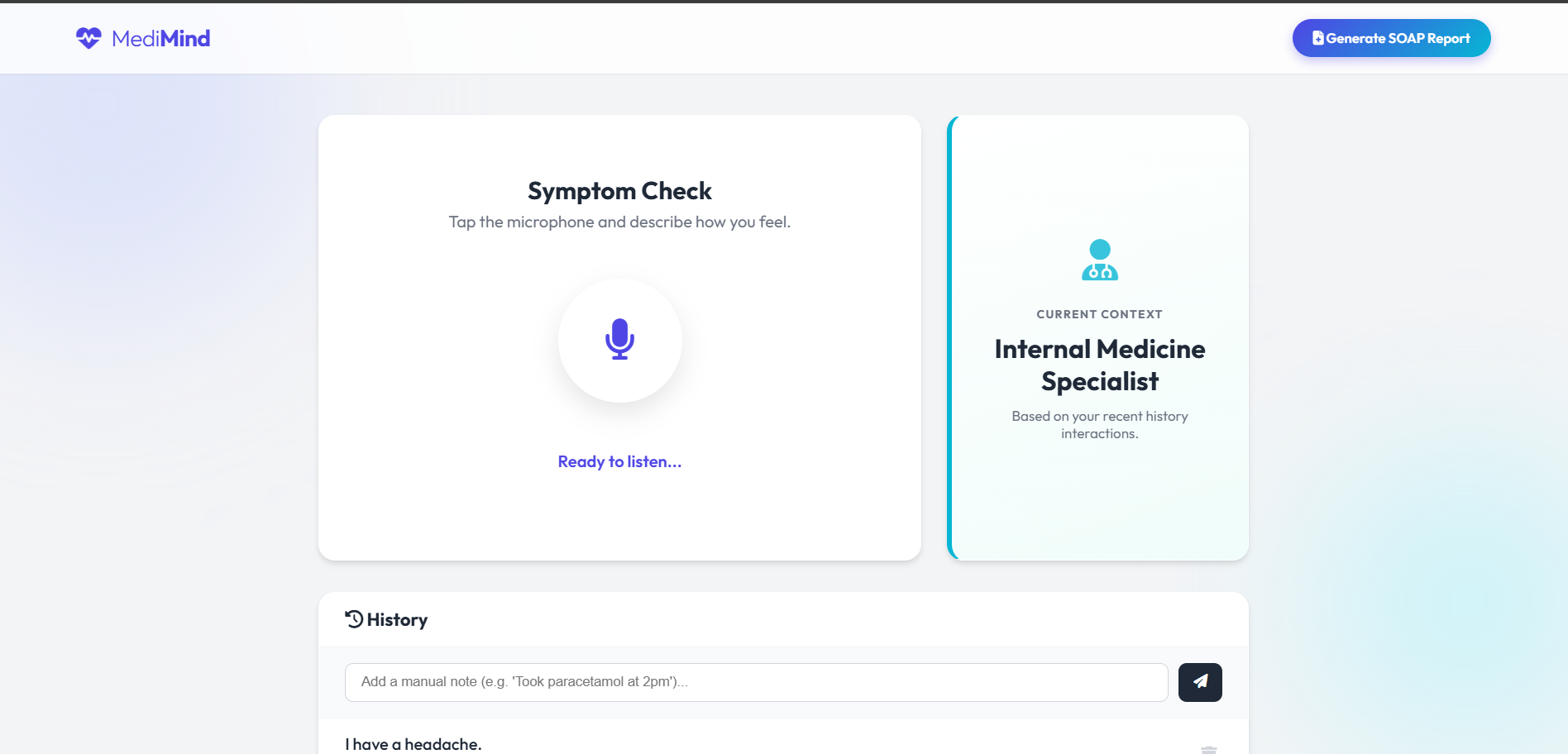
A large language model (LLM) is used for structured medical extraction, triage reasoning, and generation of professional SOAP (Subjective, Objective, Assessment, Plan) reports.
The frontend supports voice input, image upload, and real-time UI state changes, including a locked emergency mode.
The system follows an event-driven design: each interaction is stored, contextualized, and re-used in future reasoning steps rather than discarded.
📚 What I Learned
Through this project, I gained hands-on experience with:
Designing context-aware AI systems instead of stateless chat interfaces
Prompt engineering for structured, low-hallucination clinical outputs
Handling model capability limitations (e.g., text-only vs multimodal models) with graceful fallbacks
Secure deployment practices, including environment-based secret management
Translating loosely defined user input into clinically meaningful documentation
This project reinforced the importance of system design over model choice—strong architecture often matters more than the specific AI used.
⚠️ Challenges Faced
One major challenge was achieving consistent, high-quality SOAP reports. Early versions produced vague or poorly separated clinical sections. This required refining both the input representation (timeline normalization) and the prompting strategy to enforce medical documentation standards.
Another challenge was dealing with rapidly evolving AI APIs and quotas, which required switching providers and designing the system to remain functional even when certain capabilities (like vision) were unavailable.
Finally, building an emergency detection mechanism that was fast, reliable, and independent of LLM latency required careful separation between rule-based logic and AI-driven reasoning.
🎯 Outcome
MediMind demonstrates how AI can move beyond chat-style interactions into decision-support systems that respect time, context, and safety. While not a replacement for medical professionals, it serves as a proof-of-concept for intelligent triage, clinical handoff automation, and emergency-aware human-AI interaction.


Log in or sign up for Devpost to join the conversation.