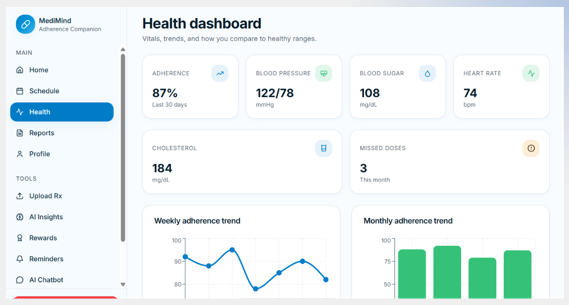
AI Powered Medication Adherence Platform Inspiration Many patients do not adhere to the recommended medication schedules. In most cases, the causes of non-adherence are related to human factors and behavior. This poses a challenge to healthcare providers as non-adherence is detrimental to patients’ health and expensive to the healthcare systems. Some existing solutions attempt to address this issue by offering reminder services for medication. However, little attention has been paid to addressing the complex adherence behaviors of patients. Our solution, MediMind, is built to solve this problem as it ensures that patients take medication as prescribed while engaging caregivers. What is it that you made MediMind is an intelligent medication adherence platform that supports patients in adhering to medication schedules while notifying doctors and caregivers in case of non-adherence. The application contains AI features that allow it to track medication data, predict, and remind patients about the doses they have missed. Additionally, the doctor dashboard helps caregivers monitor patients’ adherence and intervene in case of a detected irregularity. How did you make it We made MediMind using AI and data analysis techniques to support patients to take medication as prescribed. First, the system is able to store drug schedules and patient’s medication data. From this information, the application can learn patients’ adherence behavior and issue personalized reminders to patients in case of non-adherence. In parallel, MediMind can issue alerts to caregivers depending on the level of adherence. Additionally, the healthcare dashboards offer an insight into the adherence trends, which can help caregivers spot irregularities and intervene promptly. The application is designed to be scalable so that it can be connected to other health data sources such as wearables. What challenges did you face? We faced several challenges when designing this application. First, developing an intelligent medication reminder that learns patients’ behaviors while issuing appropriate reminders without spamming was a big challenge. Additionally, there was a great challenge in developing an application that could accurately predict adherence patterns using limited data while protecting the privacy of the information. Finally, we also had to ensure that the data is presented in a comprehensible manner that allows easy interpretation by patients and caregivers. What are you most proud of? We are proud of developing this interesting application that goes beyond just issuing reminders to patients about medication. Through this application, we were able to combine medication adherence data analytics, doctor dashboards, and AI powered-reminders into one platform that helps address patients’ non-adherence problem while supporting patients and caregivers. What did you learn? We learned how to design applications that can address a wide variety of problems in different fields using AI. Additionally, we also learned how to present data in an easily interpretable form. What’s next for your project? There are several exciting directions in which this project can be developed. In the future, we intend to connect MediMind to smart devices such as smartwatches and smart medication dispensers. In addition, we plan to connect the system to Electronic Health Record systems to offer more extensive support in patient management and medication administration. As a feature for the elderly, we also plan to add voice reminders to our application. Additionally, we intend to explore advanced features such as drug-drug interaction and population analytics to offer more extensive support in medication administration.
MediMind
Helping Every Dose Count with AI.
Updates

Leave feedback in the comments!
Log in or sign up for Devpost to join the conversation.