-
-
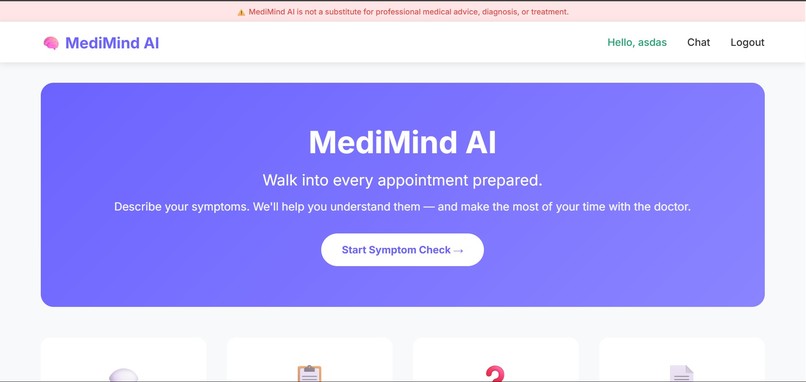
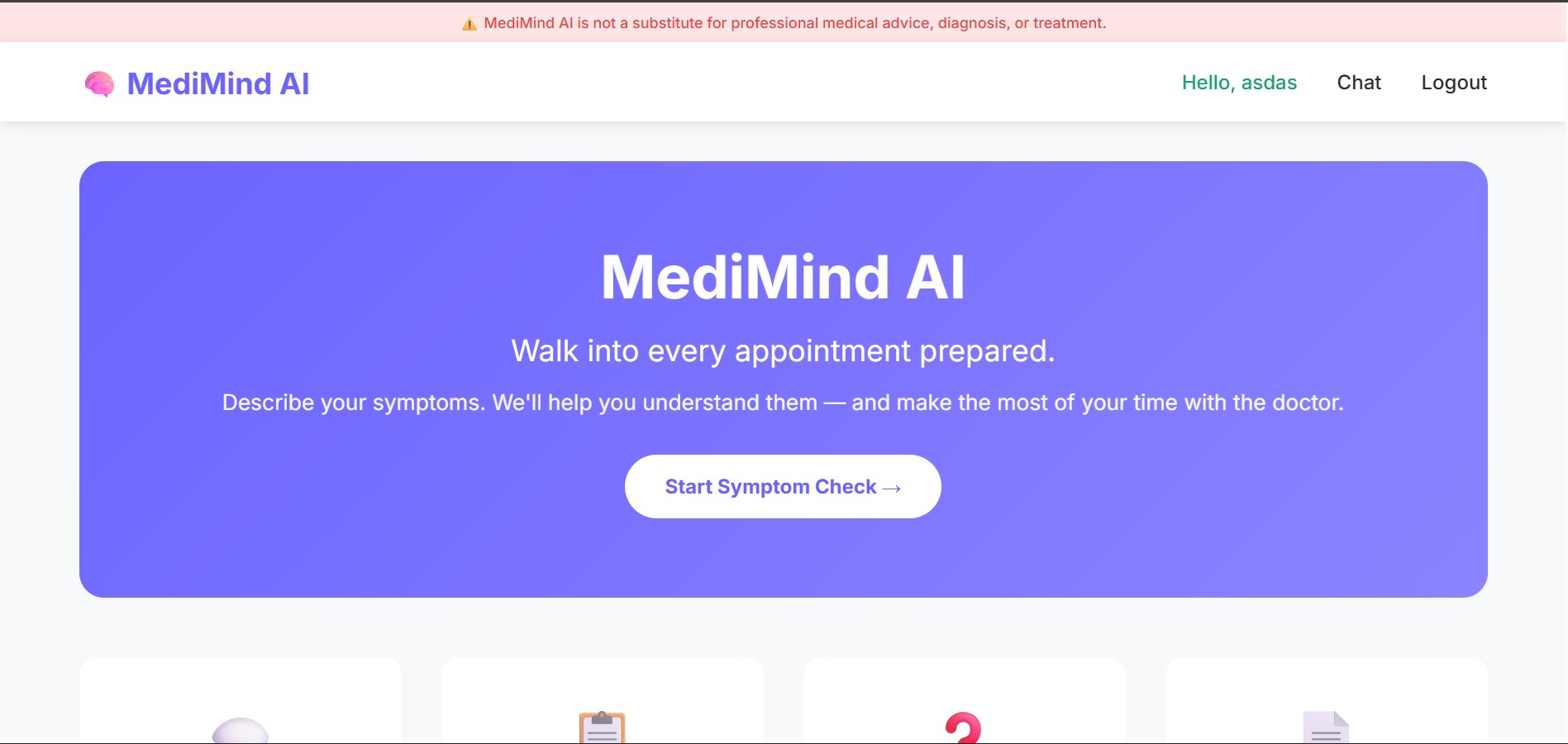
MY WEB MAIN PAGE
Inspiration
Most people have experienced that helpless feeling — you're sick, you Google your symptoms, and 10 minutes later you're convinced it's something serious. Or the opposite: you brush it off, delay seeing a doctor, and it gets worse. Then when you finally get an appointment, it's rushed, you forget what to say, and you leave more confused than when you walked in.This is not a rare experience. It is the everyday reality for billions of people, especially in regions like South Asia where doctor-to-patient ratios are critically low and appointments last less than 8 minutes on average.We were inspired by a simple but powerful question: what if AI could sit with you before your appointment, listen to everything you're feeling, and help you make the most of those 8 minutes? Not to replace the doctor — but to make you a better, more prepared, more confident participant in your own healthcare.
What it does
MediMind AI is a conversational AI-powered health companion that helps patients understand their symptoms and walk into any doctor's appointment fully prepared.A user starts by describing how they feel in plain, natural language — no medical jargon required. The AI then asks intelligent follow-up questions, the way a nurse would during triage. Based on the conversation, MediMind generates three things:A structured visit-prep summary that the patient can hand directly to their doctor. A plain-language list of possible conditions ranked by likelihood — with zero fearmongering. And a set of smart, relevant questions the patient should ask during their appointment.The result is a patient who arrives informed, calm, and ready — and a doctor who can spend less time on intake and more time on treatment.
How we built it
We built MediMind AI as a full-stack web application over 36 hours. The frontend is built with React and styled with Tailwind CSS, designed to feel clean, calm, and accessible — nothing that looks clinical or intimidating. The backend runs on Node.js with a FastAPI layer handling the AI logic. The core intelligence is powered by the Claude API, which drives the conversational symptom intake. We spent a significant portion of our time crafting and refining the prompts to ensure the AI asked follow-up questions naturally, responded with empathy, and never over-diagnosed or alarmed the user. Getting that tone right was the most important engineering decision we made. The visit-prep summary is auto-generated as a downloadable PDF using a templating pipeline, formatted so it can be handed directly to a doctor or uploaded to a patient portal. The entire application is deployed on Vercel.
Challenges we ran into
Prompt engineering was harder than we expected. Getting the AI to behave like a thoughtful, calm triage assistant — rather than a search engine listing diseases — required dozens of iterations. The difference between a response that reassures and one that terrifies is often just a few words. Scope creep almost killed us. We had ideas for appointment booking, medication tracking, lab report scanning, and multilingual support. We had to ruthlessly cut all of it to stay focused on the core experience. Saying no to features you love is genuinely difficult. Balancing helpfulness with responsibility was a constant tension. The AI needs to be useful enough that users trust it, but careful enough that it never oversteps into diagnosis territory. Every response had to walk that line. We solved this with a persistent, clearly visible disclaimer and by framing all outputs as "possibilities to discuss with your doctor" rather than conclusions. PDF generation formatting across different screen sizes and browsers took more time than anticipated — making something look good on a phone and printable on paper simultaneously is a real challenge.
Accomplishments that we're proud of
We are proud that MediMind genuinely feels human. Users in our internal testing consistently described the conversation as "like talking to someone who actually listens" — which is exactly what we were going for. We are proud of the restraint we showed. A focused, polished MVP that does one thing exceptionally well is harder to build than a feature-heavy prototype that does many things poorly. We are proud of the visit-prep PDF. It is the most tangible output of the project — a real artifact a patient can hold, hand to a doctor, or keep for their records. Several testers told us they wished they'd had something like this at their last appointment. And we are proud that we built something that could genuinely help people — not just in a hackathon context, but in the real world.
What we learned
We learned that the hardest problems in AI products are not technical — they are human. How does the AI make someone feel? Does it build trust or create anxiety? Is the language accessible to someone with no medical background? These questions drove more of our decisions than any technical constraint. We learned that prompt design is a form of product design. The words you choose in a system prompt shape the entire user experience in ways that are just as consequential as UI decisions. We learned that constraints are creative fuel. The 36-hour limit forced us to prioritize ruthlessly, and the product is better for it. Every feature we cut made the core experience sharper. We also learned to test with real people early. The feedback we got from friends and family in the first few hours changed the direction of the product in meaningful ways.
What's next for MediMind AI
The immediate next step is multilingual support — Urdu, Arabic, and Bengali — to reach the populations who need this most and who are currently underserved by English-only health tools. After that, we want to build a clinic integration layer, so a patient's MediMind summary can be sent directly to their doctor's inbox before the appointment even begins — turning preparation into a seamless part of the healthcare workflow. Longer term, we are exploring integration with wearable data, so the AI can factor in heart rate, sleep, and activity patterns alongside reported symptoms. We also see a strong opportunity in chronic disease management — helping patients with diabetes, hypertension, or asthma track their symptoms over time and spot patterns before they become emergencies. MediMind AI started as a hackathon project. It ends as a product we believe in — one built on the conviction that every patient, regardless of where they live or how much time their doctor has, deserves to feel heard, informed, and prepared.

Log in or sign up for Devpost to join the conversation.