-
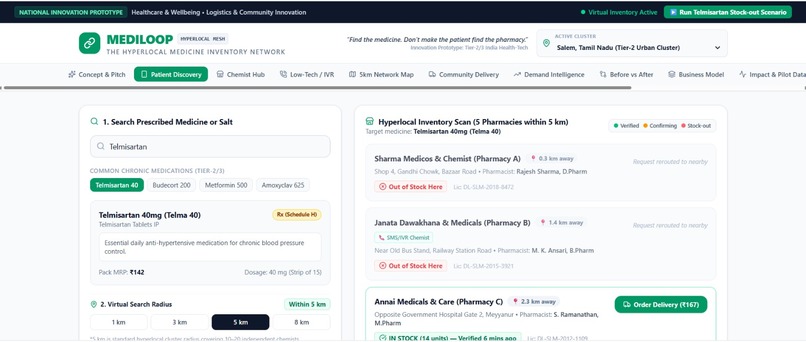
PATIENT DISCOVERY
-
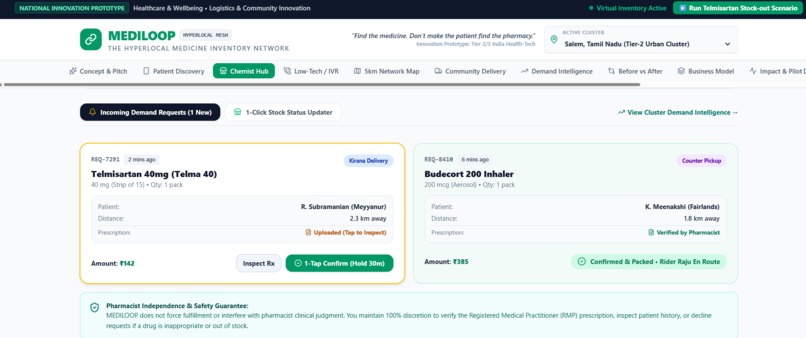
CHEMIST HUB
-
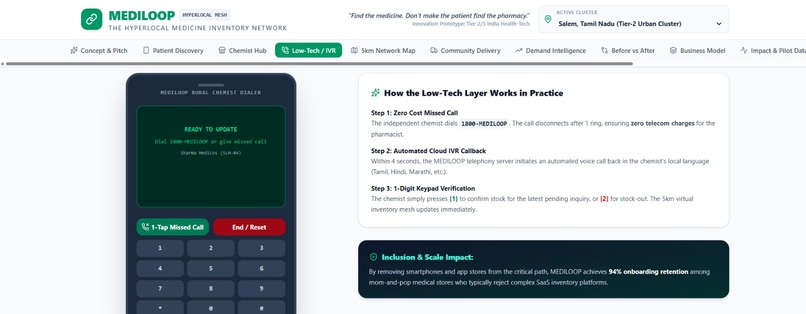
LOW-TECH
-
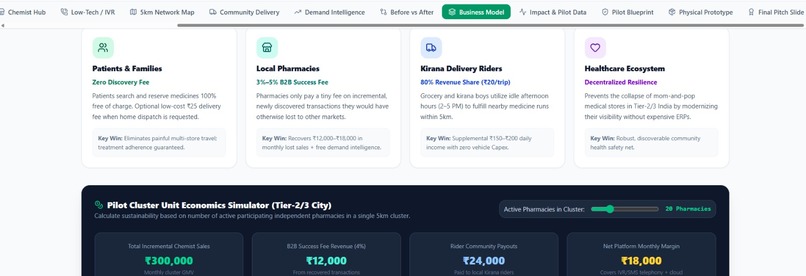
BUSINESS MODEL
Inspiration
MEDILOOP was inspired by a simple but frustrating situation: a person needs a medicine, but the nearest pharmacy doesn't have it.
In many tier-2 and tier-3 cities and rural/semi-urban communities, people may have to visit multiple pharmacies or travel several kilometres to find a prescribed medicine. Yet the medicine they need may already be available at another nearby pharmacy.
I realized that the problem isn't always affordability or delivery. Sometimes, the problem is that nobody knows where the medicine is.
Large online pharmacy platforms are not always designed around the realities of small independent pharmacies and low-digital-access communities. This led us to ask:
What if local pharmacies could share their inventory without needing expensive technology, and patients could search the entire local network instead of searching pharmacy by pharmacy?
That question became MEDILOOP.
What it does
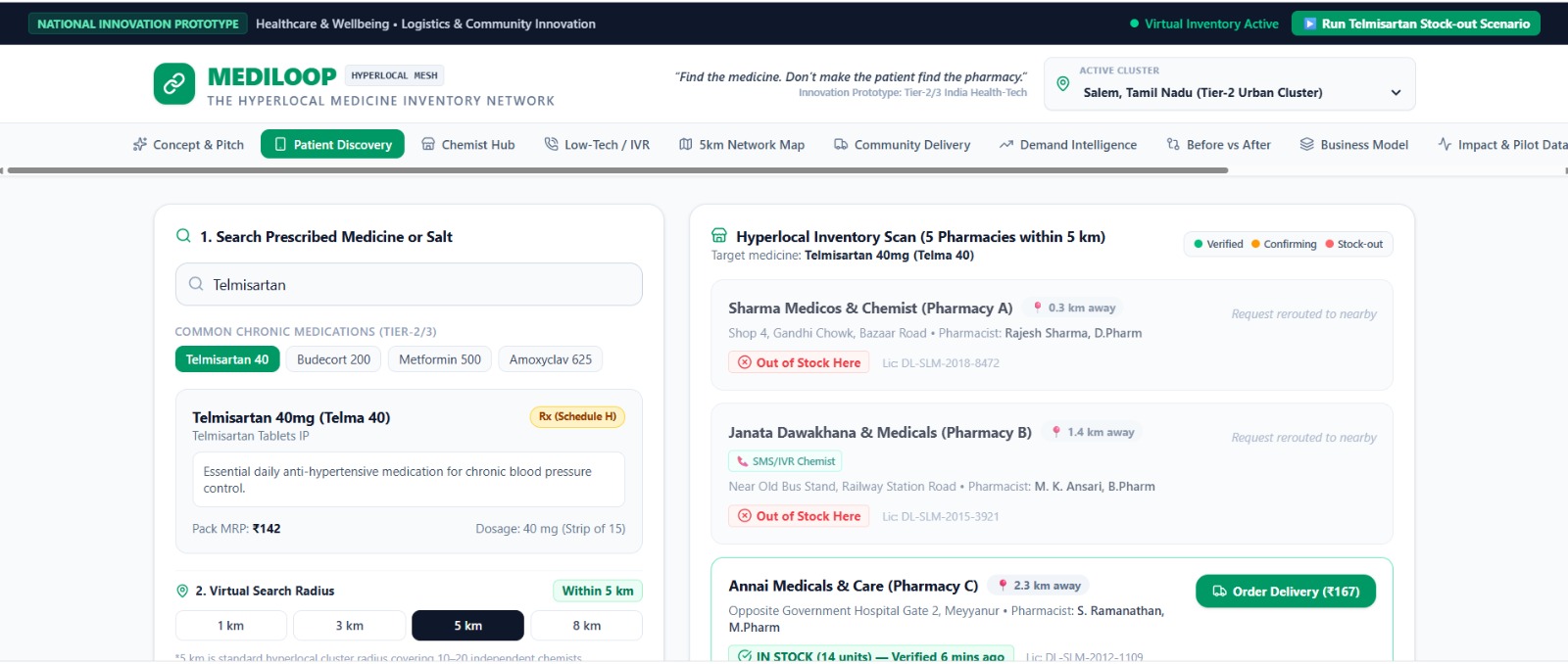
MEDILOOP is a hyperlocal medicine-availability network connecting independent pharmacies within a local radius.
Instead of making patients visit multiple pharmacies, MEDILOOP allows a medicine request to be checked across participating pharmacies.
The process is:
Patient needs medicine ↓ Nearest pharmacy doesn't have it ↓ MEDILOOP searches nearby participating pharmacies ↓ Medicine is located ↓ Pharmacy confirms availability ↓ Patient chooses pickup or local delivery
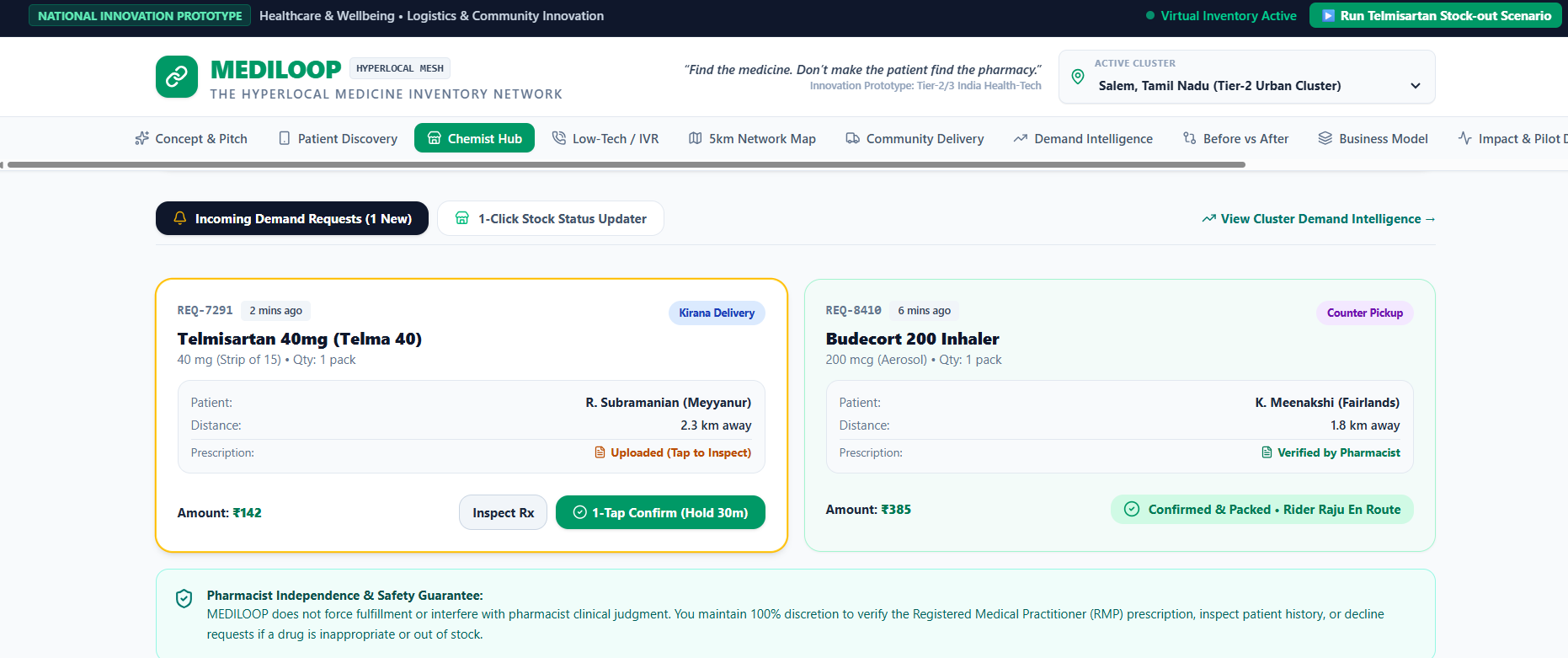
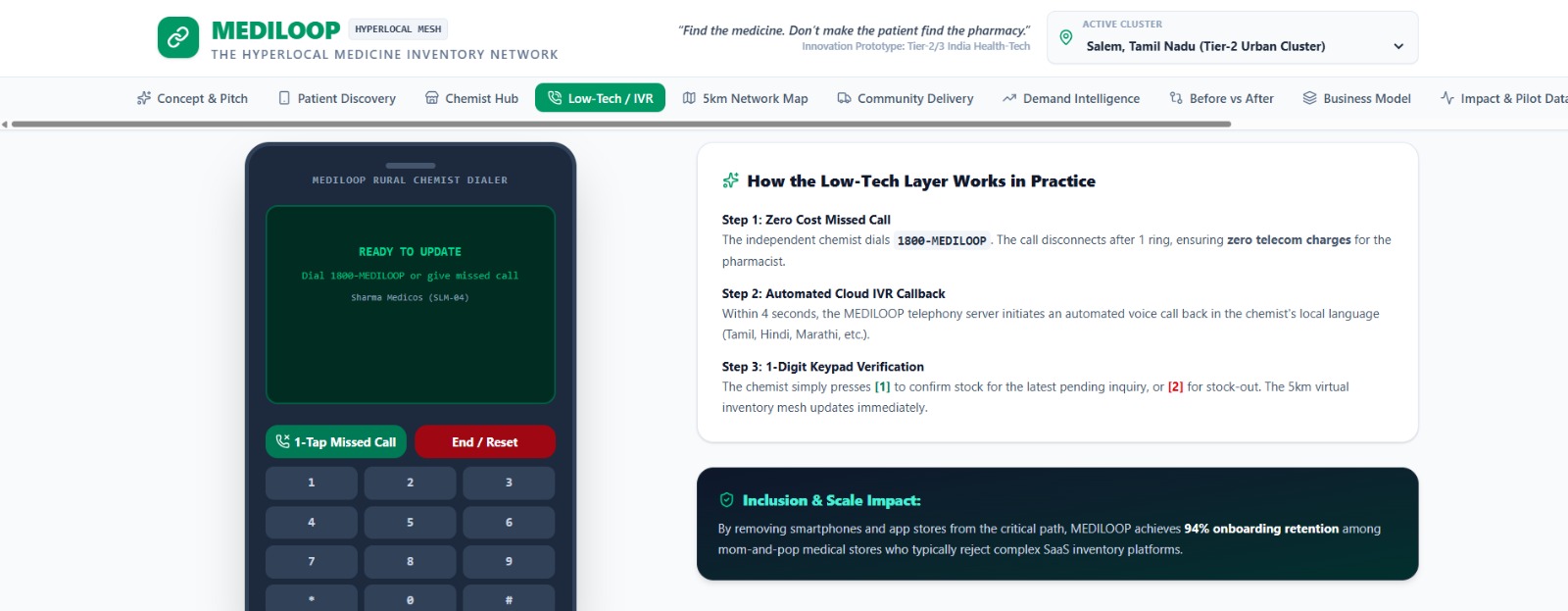
A key part of MEDILOOP is accessibility for small pharmacies. They can update or confirm inventory through SMS rather than requiring sophisticated software.
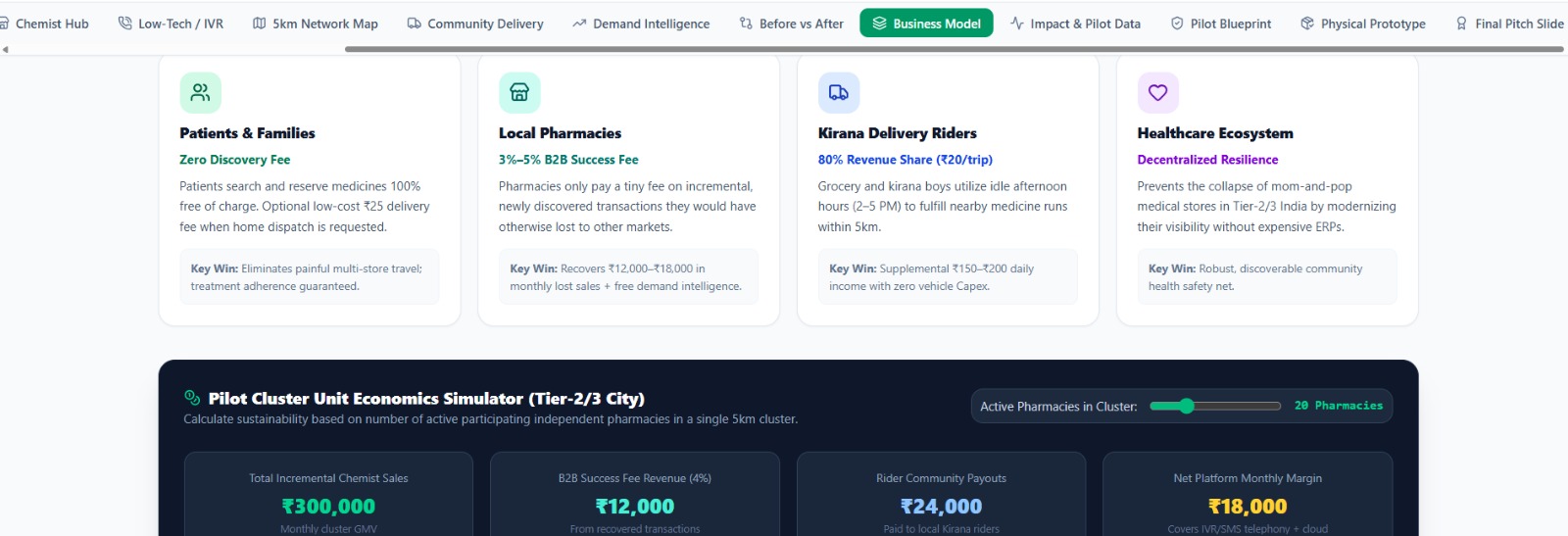
For delivery, MEDILOOP is designed to potentially use existing local delivery capacity, such as kirana delivery riders, instead of creating an entirely new fleet.
MEDILOOP also turns repeated medicine requests into useful local demand information, helping pharmacies identify medicines that are frequently requested but poorly stocked.
How we built it
I approached MEDILOOP as a system-design and innovation project, rather than simply designing another medicine-delivery app.
I first mapped the existing patient journey:
Patient → Pharmacy A → Unavailable → Pharmacy B → Unavailable → Pharmacy C → Medicine found
I identified the missing piece: local inventory visibility.
I then redesigned the journey:
Patient → MEDILOOP → Local inventory search → Pharmacy identified → Pickup/Delivery
I developed the concept around four interconnected components:
- Hyperlocal inventory network
Independent pharmacies within a defined radius share medicine availability with the network.
- Low-tech participation
Pharmacies can participate without requiring a sophisticated smartphone application through SMS, missed-call and IVR-based workflows.
- Flexible fulfillment
Once a medicine is located, the patient can choose pickup or, where appropriate, local delivery.
- Demand intelligence
Repeated requests reveal local medicine-demand patterns, helping pharmacies make better stocking decisions.
I also designed an inventory-confidence system so availability is not presented as permanently accurate. For example:
🟢 Recently verified 🟡 Requires confirmation ⚪ Stale/unconfirmed
Prescription medicines would require appropriate prescription verification by a participating pharmacist, while the initial pilot would focus on suitable non-cold-chain medicines.
Challenges we ran into
Inventory accuracy
The biggest challenge was realizing that pharmacy inventory can change quickly. If a pharmacy manually reports that five units are available, those units could be sold minutes later.
I addressed this by designing timestamped availability and requiring pharmacy confirmation before fulfillment.
Digital accessibility
A smartphone-only solution would defeat part of the purpose. Small pharmacies may not have the time or resources to maintain complex software.
This pushed us toward SMS.
Prescription safety
Medicines cannot be treated like ordinary e-commerce products. I therefore had to design the concept around licensed pharmacies, prescription verification where required, and pharmacist involvement.
Delivery economics
Creating a new delivery fleet could make the model expensive. I explored how existing local delivery workers could potentially fulfill medicine deliveries, increasing utilization of infrastructure that already exists.
Avoiding the "another pharmacy app" problem
One of our biggest conceptual challenges was differentiation.
I realized that delivery should not be the core innovation.
The real innovation is:
Making fragmented local pharmacy inventory discoverable.
Accomplishments that we're proud of
I am proud that MEDILOOP evolved from a simple medicine-delivery idea into a broader local healthcare-access system.
The concept brings together:
Independent pharmacies Patients Local delivery workers Inventory visibility Low-tech communication Local demand intelligence
I am particularly proud of the feedback loop:
Patient demand → Inventory search → Fulfillment → Unmet-demand data → Better stocking → Fewer future stock-outs
This means MEDILOOP doesn't only try to solve today's medicine search problem. Over time, it can help local pharmacies understand what their communities actually need.
I am also proud that the concept can be piloted without requiring every pharmacy to immediately adopt expensive technology.
What we learned
My biggest lesson was:
Innovation doesn't always mean inventing new technology.
Sometimes the better solution is to connect existing resources in a smarter way.
Local pharmacies already have medicines, pharmacists, physical locations and customers. Communities already have transportation and local delivery networks.
The missing element is often coordination and visibility.
I also learned that designing for underserved communities requires starting with their constraints rather than assuming everyone has a smartphone, reliable internet, digital payment access, or the ability to travel long distances.
Finally, I learned that a strong innovation needs to acknowledge its weaknesses. Instead of claiming that inventory is perfectly real-time, MEDILOOP explicitly addresses inventory freshness, pharmacy confirmation, prescription safety and delivery limitations.
What's next for MEDILOOP
The next step is real-world validation.
I would begin with a small pilot involving approximately 10–20 independent pharmacies in one tier-2/3 or semi-urban cluster.
The pilot would focus on:
Interviewing pharmacists and patients to validate the problem. Identifying commonly requested medicines. Testing low-tech inventory updates. Measuring how quickly medicines can be located. Testing pickup versus local delivery. Measuring inventory accuracy. Tracking repeated unmet-demand patterns. Gathering feedback from pharmacies, patients and delivery workers.
Our key success metrics would include:
Medicine search success rate Average time to locate a medicine Average distance travelled Number of fulfilled requests Pharmacy participation Inventory accuracy Repeated stock-out frequency Pharmacy revenue recovered
If the pilot demonstrates meaningful improvement, MEDILOOP could expand from a small local network into a city-wide network, and eventually connect networks across multiple tier-2 and tier-3 communities.
Our long-term vision is simple:
A patient's access to a needed medicine should not depend on how many pharmacies they can physically visit.
MEDILOOP aims to turn fragmented local pharmacy inventory into one discoverable, accessible community network.
Built With
- ai
- buildwithai
- googleaistudio

Log in or sign up for Devpost to join the conversation.