-
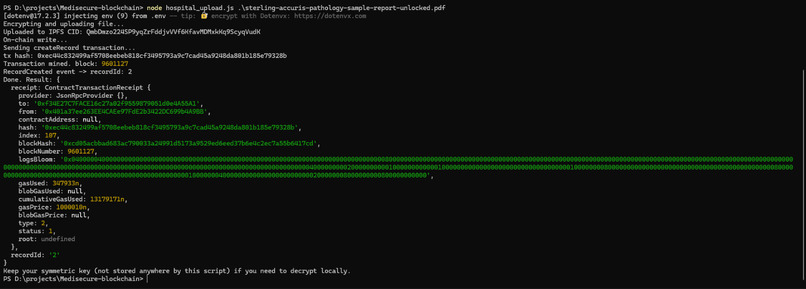
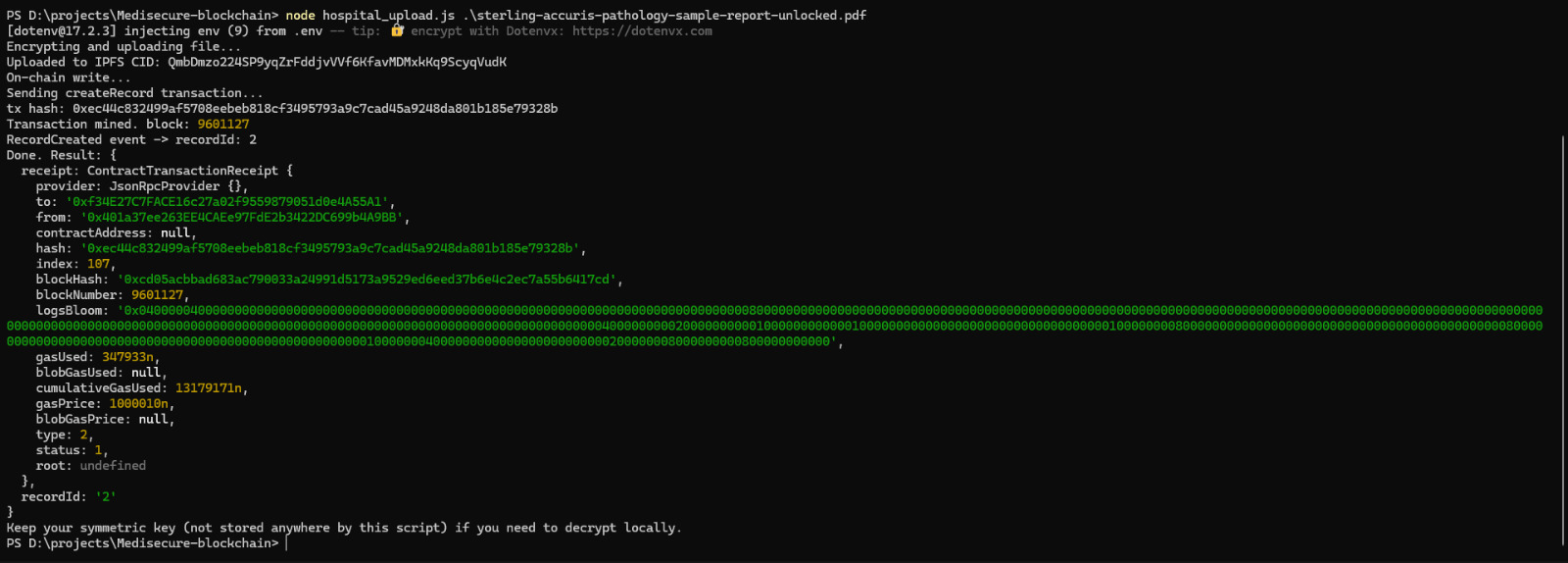
Encrypted medical report uploaded to IPFS, CID stored on Ethereum. Transaction mined successfully with recordId = 2. Secure, private upload
-

shows the patient securely Record 2 fetched and decrypted via AES-256 from IPFS. File saved as decrypted_record_2.pdf — secure retrieval.
-
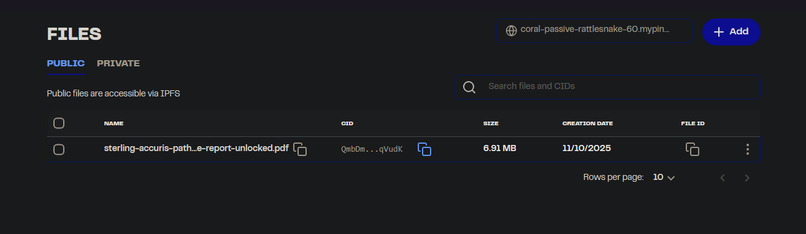
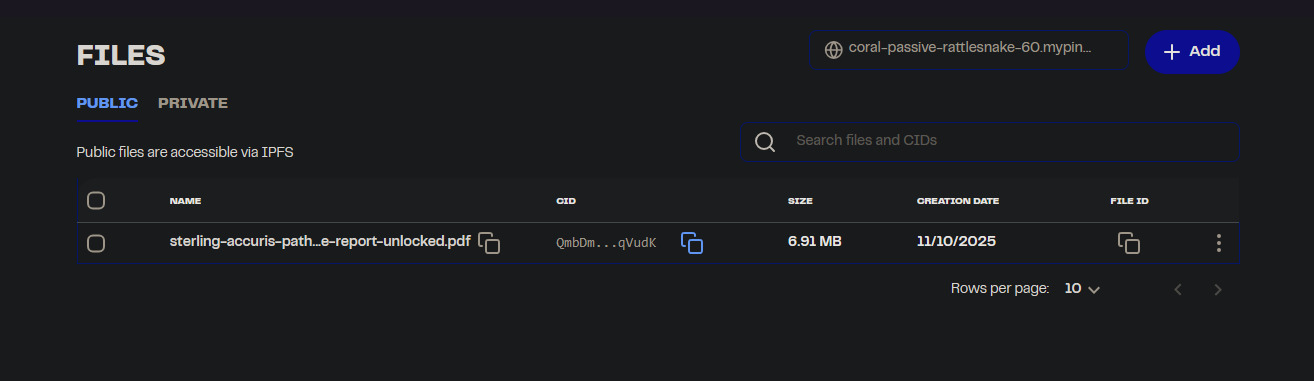
Encrypted medical record stored in Pinata (IPFS). Even though the file appears publicly accessible on IPFS, its contents remain protected.

🚀 MediSecure – Hackathon Storyboard
Blockchain-Enabled Medical Record Privacy
🎯 1. Title & Hook
Tagline:
“Give patients full control of their medical data — eliminate centralized data-leak risks.”
Visual Idea:
A patient connected securely to multiple hospitals via blockchain and encrypted IPFS storage.
💡 2. Problem & Opportunity
The Problem:
- Centralized hospital databases are vulnerable to data breaches.
- Patients lack ownership and visibility over their medical data.
- Hospitals cannot securely share records without risking privacy.
The Opportunity:
- Digitized healthcare demands secure and decentralized sharing systems.
- Blockchain + encryption can give patients true data sovereignty.
🛠️ 3. Solution Overview – MediSecure
MediSecure enables hospitals to upload encrypted medical records to IPFS, storing only the reference (CID) and metadata on Ethereum blockchain.
Only patients can decrypt their data.
Key Value Propositions:
- ✅ Full patient control
- ✅ No centralized database
- ✅ End-to-end AES + ECIES encryption
- ✅ Cross-hospital compatibility
Flow Visual Idea:
Patient → Hospital → Encryption → IPFS → Smart Contract → Patient Decrypts
✨ 4. Key Features
| Feature | Description |
|---|---|
| Decentralized Storage | Medical files encrypted and stored on IPFS |
| Smart Contract Access Control | Blockchain ensures only patient-linked access |
| Zero-Trust Security | Data decryptable only by the patient’s private key |
| Multi-Hospital Collaboration | Enables secure uploads from multiple sources |
| Privacy-by-Design | No plain health data stored on-chain |
⚙️ 5. Architecture & Data Flow
Step-by-Step:
- Hospital encrypts report with AES + patient’s public key.
- Uploads encrypted file to IPFS → gets CID.
- Smart contract stores CID + encrypted key.
- Patient retrieves CID and decrypts file locally.
System Components:
- Frontend: Hospital upload dashboard
- Blockchain: Smart contract for record registry
- Storage: IPFS / Pinata
- Encryption Layer: AES-256 + ECIES
- Wallet: MetaMask / Ethereum EOA
🧰 6. Technology Stack
| Layer | Tools / Frameworks |
|---|---|
| Blockchain | Ethereum (Sepolia Testnet) |
| Smart Contracts | Solidity |
| Storage | IPFS + Pinata |
| Encryption | AES-256 + ECIES |
| Wallet Integration | MetaMask |
| Backend | Node.js + ethers.js |
| Frontend (optional) | React.js / Web3.js |
🔒 7. Security & Trustworthiness
- Hospitals cannot read uploaded files.
- IPFS gateways see only encrypted blobs.
- Blockchain never stores personal data.
- Even if CID leaks → data remains safe without patient’s private key.
Guarantee: Privacy is mathematically enforced, not policy-based.
🎬 8. Demo Scenario / Use-Case
Scenario:
A patient visits two hospitals. Each hospital uploads a report encrypted for that patient.
Later, the patient logs in and decrypts both records into a unified view.
Command-Line Demo:
# Hospital uploads
node hospital_upload.js <report.pdf>

# Patient downloads & decrypts
node patient_download.js <record_index>
Built With
- aes-256
- aes-256-encryption
- blockchain-explorer
- crypto-library
- css
- ecies
- ecies-encryption
- ethereum
- ethers.js
- express.js
- ganache
- git
- github
- hardhat
- html
- ipfs
- ipfs-api
- javascript
- json-rpc
- metamask
- node.js
- pinata
- react.js
- sepolia-testnet
- smart-contracts
- solidity
- web3.js

Log in or sign up for Devpost to join the conversation.